
My practical tips for traveling by train in China

How to travel around China by train?
Traveling by train in China is more efficient than flying, but requires specific preparation
Rules, tools, and habits that are very different from what we’re used to in Europe: omnipresent ID checks, centralized booking, mobile payments, and stations organized like airports.
Without preparation, these specifics can quickly complicate the experience.
This guide was designed to provide the essential reference points before and during your trip: booking tickets, understanding the classes, getting around stations, and using the right tools to travel easily around the country.
- Eight reasons to travel by train in China!
- Before you leave: put together your digital survival kit (essential)
- Planning your trip to China
- Buying train tickets: step-by-step guide
- On the day: the train journey
In March 2026, I traveled 11,000 km by train in China and put together this mini guide based on my experience.
This article is part of a complete series dedicated to trains in China, based on my on-the-ground research.
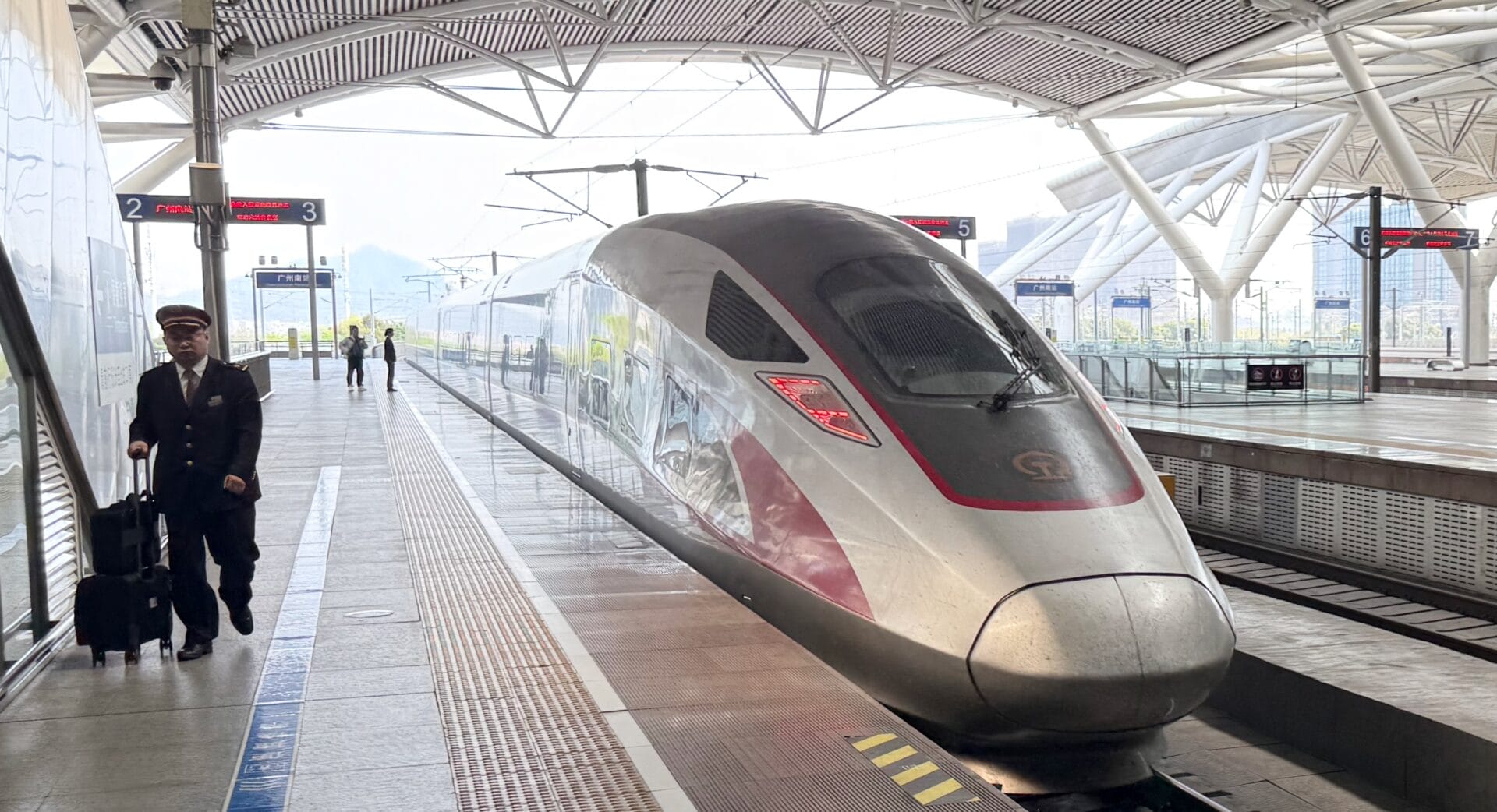
Eight reasons to travel by train in China!
- For 20 years, China has modernized its rail network, and today it’s excellent.
- The network is dense and makes it possible to get to many places.
- Trains are very fast, frequent, and punctual.
- Stations are more accessible than airports, because they’re often directly connected to the metro.
- Once you understand how it works, traveling by train is easy.
- Seeing the scenery from a train window is often more interesting than through an airplane porthole.
- With night trains, which are very common, you can save a night in a hotel.
- On domestic routes, train ticket prices are more attractive than flying.
Before you leave: put together your digital survival kit (essential)
China is a paradox: it’s both one of the most digitalized countries in the world, and also one where internet access is among the most closely monitored.
Before you go, you’ll need to spend a bit of time putting together your digital survival kit so you can travel and communicate easily.
Five must-download apps
- Alipay: essential for paying in China
- Railway 12306 : to plan your train trips, as I explain a bit further down.
- Amap: Amap is the app that will help you find your way around or get around on foot or by public transport. It works much better than Google Maps in China.
- Mojiweather: very useful for checking the weather in China.
- Google Translate : it will help you communicate, as very few Chinese people speak English.

Paying in China with Alipay
In China, you don’t use your credit card directly, and cash is disappearing. It’s best to get organized before you leave so you don’t end up stuck.
You pay with a payment app. I used Alipay, which I downloaded to my smartphone before leaving (available on the App Store and Google Play). I then set up my account very carefully:
- Sign-up: I used my French phone number by selecting “International Version”
- Identity verification (crucial): I went to Account > Settings > Account and Security > Identity Information.
- I then scanned my passport. A facial verification (selfie) was required. Without this step, my payments would have been blocked for security reasons.
- Add a card: Finally, I went to Bank Cards to add my Visa and American Express cards. (Tip: use two cards in case your bank blocks one due to anti-fraud filters. It happened to me.)
There are two ways to pay:
- Pay/Receive: in supermarkets or big chains, tap Pay/Receive. A QR code appears on your screen, and the merchant scans it with their handheld scanner.
- Scan: tap the Scan button in the app and point it at the QR code on the counter (or the taxi driver’s). Enter the amount, confirm, and you’re done.
Then Alipay will charge your saved credit card.

Only payments over 200 CNY (around €25) are subject to a 3% fee. To save money, make several small payments when possible—although for train tickets, you won’t have a choice.
Alipay lets you pay for everything in China, including trains, urban public transport, taxis, or Didi (the Chinese Uber).

WeChat is the competing app, but it’s less convenient and, personally, I’ve never used it.
Making sure you have internet access in China
The “Great Firewall” blocks access to Google, WhatsApp, and social networks. To stay connected, you have two options:
-
VPN: a budget-friendly solution, but unstable. Chinese authorities regularly block them, which can make the connection frustrating and slow.
-
A foreign eSIM (recommended): This is the most reliable solution. With an international eSIM (such as Orange, Airalo, or Holafly), your connection goes through your home carrier’s network (roaming). This automatically bypasses censorship with no setup: your apps work just like they do in France.
Practical tips:
-
Plan ahead: Buy and install your eSIM (or VPN) before you leave. Once you’re there, access to download platforms is very difficult.
-
Check your device: Your phone must be unlocked and compatible with eSIM technology.
-
Prioritize data: Avoid hotel Wi-Fi, which is still subject to censorship, and stick to your 4G/5G connection for total freedom.
Planning your trip to China
Traveling to China without a visa is possible!
Until 2023, traveling to China required a visa that was complicated to obtain.
Since December 1, 2023, and until the end of 2026, you can travel to China without a visa for up to 30 days, whatever the purpose of your trip. This applies to 45 countries, including EU member states.
The only requirement is to fill out the online arrival card very carefully before you leave: https://s.nia.gov.cn/ArrivalCardFillingPC/entry-registation-home
Choosing when to travel to China
My first tip is to avoid the Chinese school holiday periods, which trigger huge migration waves. At these times, trains are especially crowded:
- Chinese New Year (Spring Festival): the date varies with the lunar calendar, around January and February. It’s certainly the busiest period, with saturated transport, as families reunite.
- Golden Week in early October
July/August is also not recommended, because in the south and east the heat is stifling and very humid.
China is the size of a continent, so the climate varies greatly by region. In March, I had -10°C in Harbin and +25°C in Guangzhou.
Define your itinerary and what you want to visit
China is the size of a continent. Whether you’re going for a week or a month, you won’t be able to see everything. You’ll need to make choices.
I won’t pretend to decide for you, and I recommend spending time browsing online to read travel blogs or itineraries offered by tour operators to form your own opinion.
Just don’t be too ambitious! It’s better to visit fewer places and really enjoy them than to be constantly rushing to try to see everything.
How to find accommodation
Booking a hotel room on sites like Booking.com or Trip.com works like anywhere else in the world. In international hotels, you can pay directly with your credit card.
Since cities are huge, my advice is to choose accommodation in the most central area whenever possible.
In 2026, thanks to a very favorable exchange rate, the cost of living is inexpensive for Europeans.
On my trip, I stayed in very comfortable, recent 4-star hotels, often with a pool. I paid an average of €110 including breakfast.
Buying train tickets: step-by-step guide
Traveling by train in China is very different from how we do things in Europe. But if you follow my advice carefully, it should be easy.
Prerequisite: create an account on the Chinese railways website 12306.cn
The 12306.cn website is in Chinese, with a simplified English version. It provides information on timetables, and also lets you book and buy your ticket. But the essential step is to create an account by entering, very carefully, exactly the information shown on your passport.
You will then be asked to upload two photos:
- The page of your passport
- A photo of yourself holding your passport open.
Finally, after a delay of one or two days, your account will be validated with “verified” status, which will allow you to buy tickets. So do this well ahead of your trip to be sure you can buy your tickets when booking opens.
Then I recommend downloading the 12306 app (available on the App Store and Google Play) and signing in with your account.
How to check timetables and availability?
IMPORTANT : bookings are only possible 14 days before departure. Since timetables are fairly stable, you can still plan your trip in advance based on the services running in the coming days of the week.
Trains are classified by letter:
- High-speed trains are classified by maximum speed: G (300–350 km/h), D (200–250 km/h) and C (200 km/h for short intercity trips)
- Conventional trains are classified by journey time and number of stops: Z (few stops and the most comfortable—choose these first), T (intermediate) and K (the slowest).
In the 12306 app, the train type (letter) and journey time are clearly shown. Then, by tapping under each train, you’ll see availability by class as well as prices, which vary with demand.
I also recommend this site, which lets you see train routes on a map by train number or by the stations served: China train map
Which class should you choose?
There are many classes, but not all of them are available on every train:
- Standing ticket : avoid, as you have no guarantee of getting a seat
- Hard seat : found on conventional K or Z trains; it’s fairly uncomfortable, with narrow seats that don’t recline much.
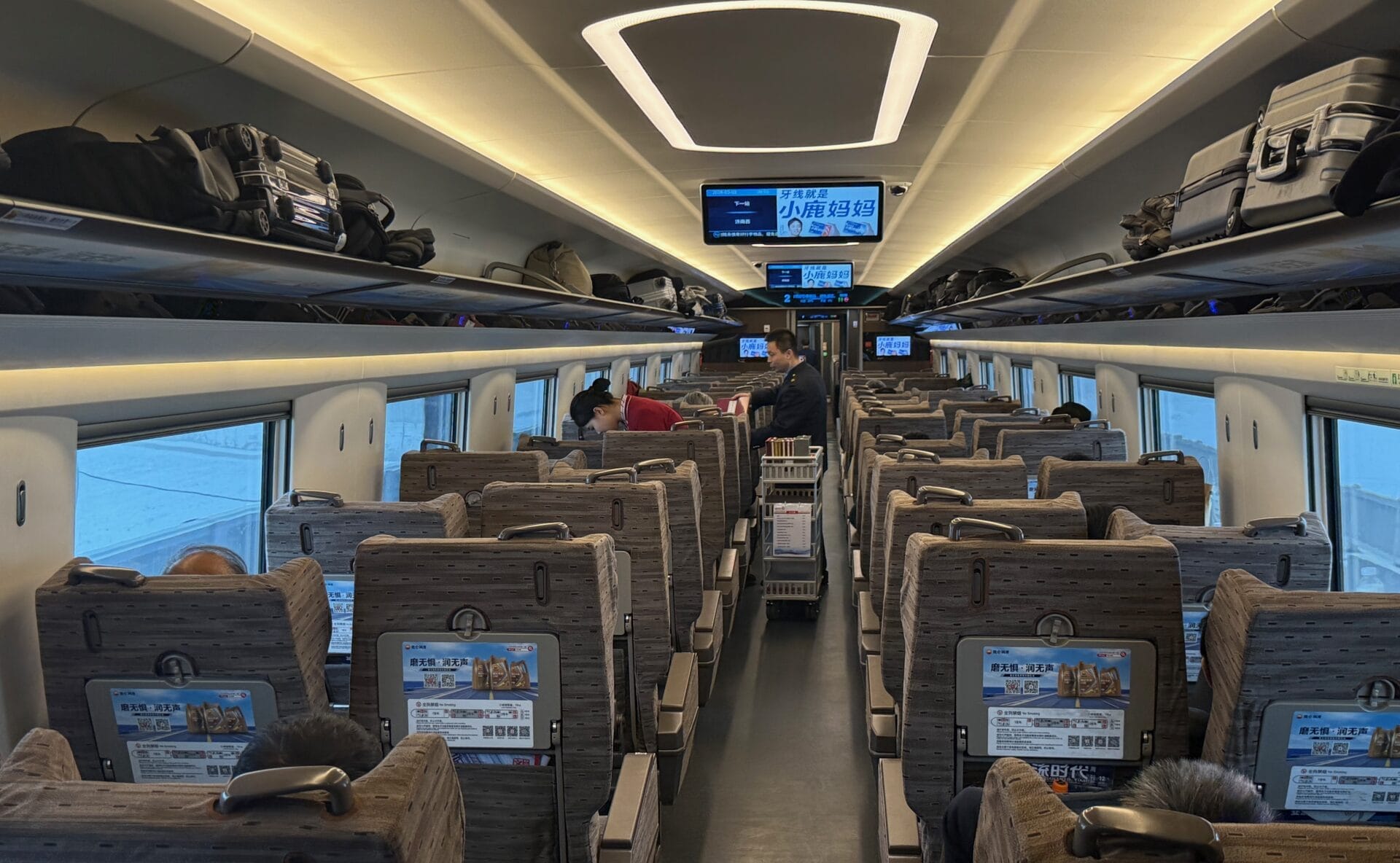
- Second class : the modern version of hard seat, found on high-speed D or G trains. In 3+2 rows, seats are narrow and recline a lot. Comfort is comparable to, or even better than, economy class on a plane.
- First class seat: on high-speed D or G trains, this class offers the best comfort-to-price ratio. Seats are arranged 2+2.
- VIP seat or Premium first class: available on only a few trains; it’s a slightly more comfortable First Class.
- Business class seat : available only on G high-speed trains. It’s much more expensive, but the travel experience is excellent.

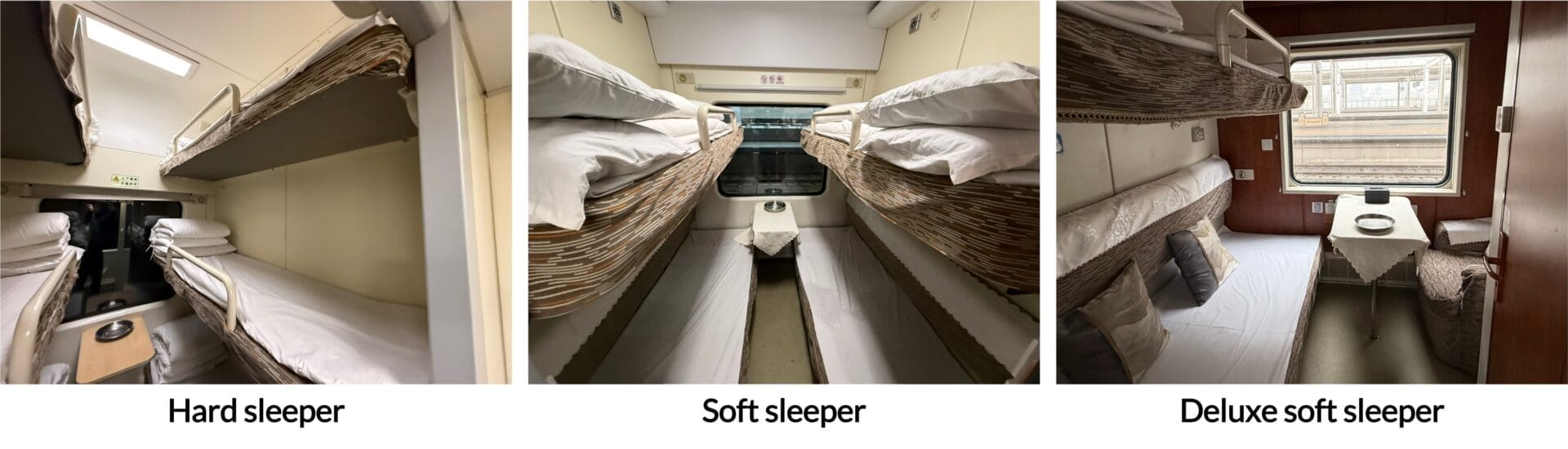
For night trains, you can choose between three types of berths:
- Hard sleeper or second class sleeper: open compartments (no door) with six berths. It’s quite cramped. Lower berths are slightly more expensive than middle or upper ones. Climbing up is a bit acrobatic—better if you’re flexible and young!
- Soft sleeper, first class sleeper, EMU sleeper: different names depending on the train type (conventional or high-speed), but the same offering: compartments with four berths closed by a door.
- Deluxe soft sleeper or Deluxe first class sleeper : compartments with two bunk berths and sometimes private toilets. They’re available on very few trains.
How to reserve your seat and buy your ticket?
To have a choice, buy your ticket as soon as booking opens 14 days before departure. During holiday periods (Chinese New Year, July/August, Mid-Autumn Festival), trains are very full, and it’s best to be flexible with your itinerary or times.
I recommend using the app to buy your tickets. It’s more reliable and simpler than the website. You can buy multiple tickets, as long as you’re just as careful to identify the other travelers with their passports as you were when creating your own account.

In the English version, the site’s features are limited. For example, you can choose your berth position (lower, middle, or upper), but not your seat position (aisle or window).
To pay for your ticket, I recommend using Alipay. I tried with my Visa card and it never worked!
IMPORTANT: Your booking appears in the app with your train number, car, and seat details, but your passport is your train ticket!
If you need to cancel your booking, you can do it very easily in the app. Fees apply (5% up to 48 hours before departure, 10% up to 24 hours before departure, and 20% after that).
Is it possible to privatize a sleeper compartment?
In principle, it’s not possible to privatize a compartment, because each berth is linked to a passport. One unofficial trick is to buy the unused berths using the exact passport details of people (friends or family) who aren’t traveling with you.
However, this solution isn’t foolproof. If the train is already quite full, the requested berths may be allocated across several compartments.
Alternative: use an online agency
Personally, I prefer not to use a middleman, because no one serves you better than yourself! That’s my choice.
But if you don’t feel very confident, if you want a solution with assistance or to be able to pay with an international credit card, I recommend one of these two online travel agencies known for their reliability:
They will charge a service fee of around 3%.
Warning : these agencies make it look like you can book your seat far in advance. In reality, it’s only an option, which will be confirmed only when bookings open, 14 days before departure.
On the day: the train journey
Check where your departure station is!
Many cities have several stations. Make sure you check your booking to see which station your train leaves from.
To help you, they’re often named using the four cardinal directions in Chinese:
- Bei = North
- Nan = South
- Xi = West
- Dong = East
At the station: your passport is your key
My most important tip is to always keep your passport within easy reach, because you’ll be asked for it often.
Be careful what you pack. Your bags will be screened like at airports: knives and lighters will be confiscated. Note that sprays (deodorants, hairspray) over 100 ml are also often confiscated.
The more you travel light with a small wheeled bag or backpack, the easier it will be—especially if you’re traveling during peak periods.
Plan to arrive at the station an hour before departure so you don’t stress if security lines are busy, and so you can get your bearings and make your way to your platform.
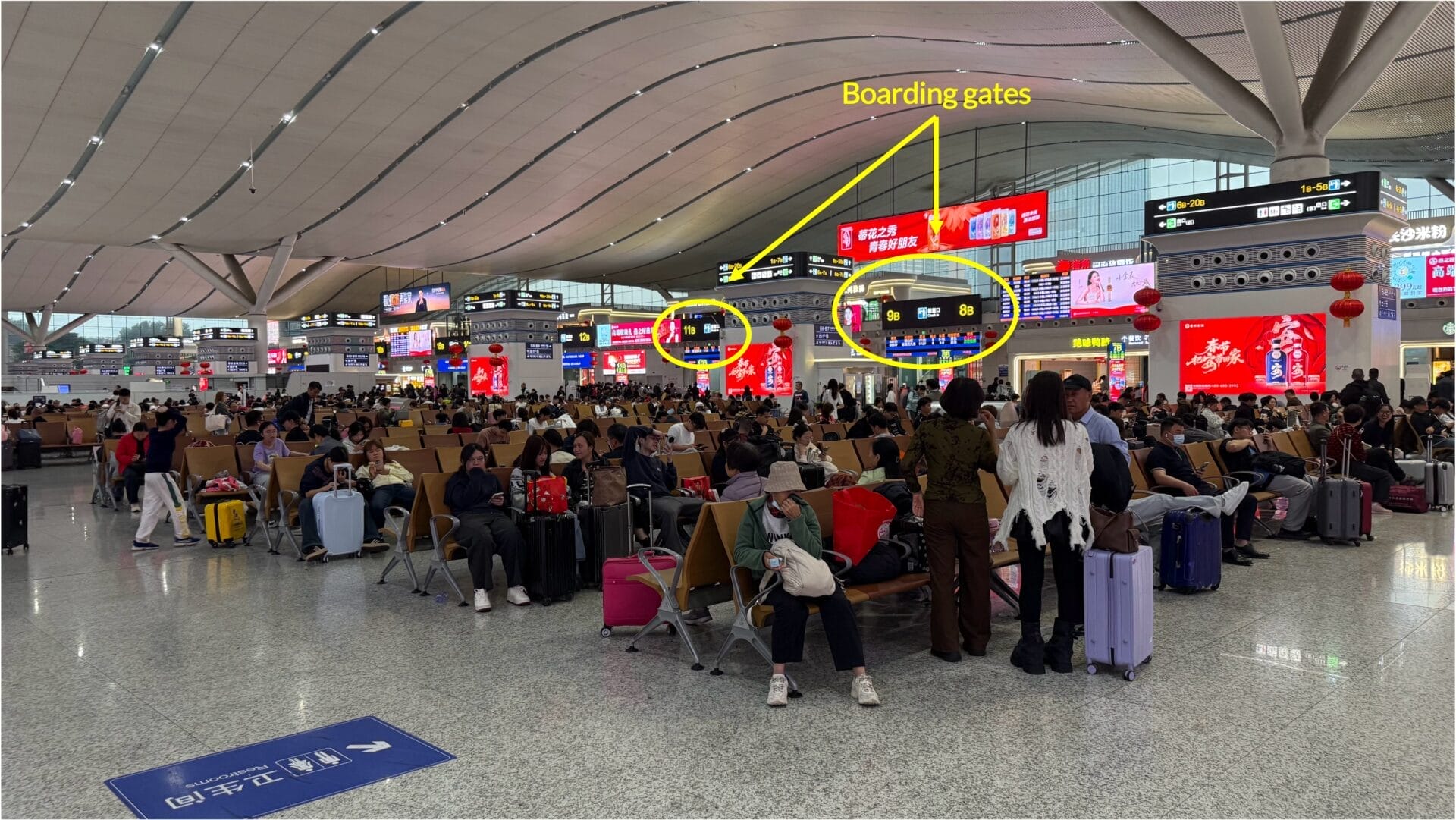
On board: what to expect?
If you want a preview of what train travel in China looks like, I invite you to read my two articles where I share my impressions:
- High-speed train travel in China: my take after 11,000 km
- Night trains in China: three generations between tradition and innovation
After reading my articles, you’ll know how to choose the travel class that suits you best, depending on your preferences and budget.
Since seats are assigned, you won’t have the stress of not knowing where to sit.
How to communicate with Chinese people?
In China, few people speak English, and French is even rarer. So it’s useful to plan a simple way to make yourself understood.
The Google Translate app quickly becomes essential. By downloading the necessary languages (French, English, and Simplified Chinese), you can use it even without an internet connection.
In everyday situations, you have several options:
- Write a short message and have it translated
- Talk with the other person using voice recordings
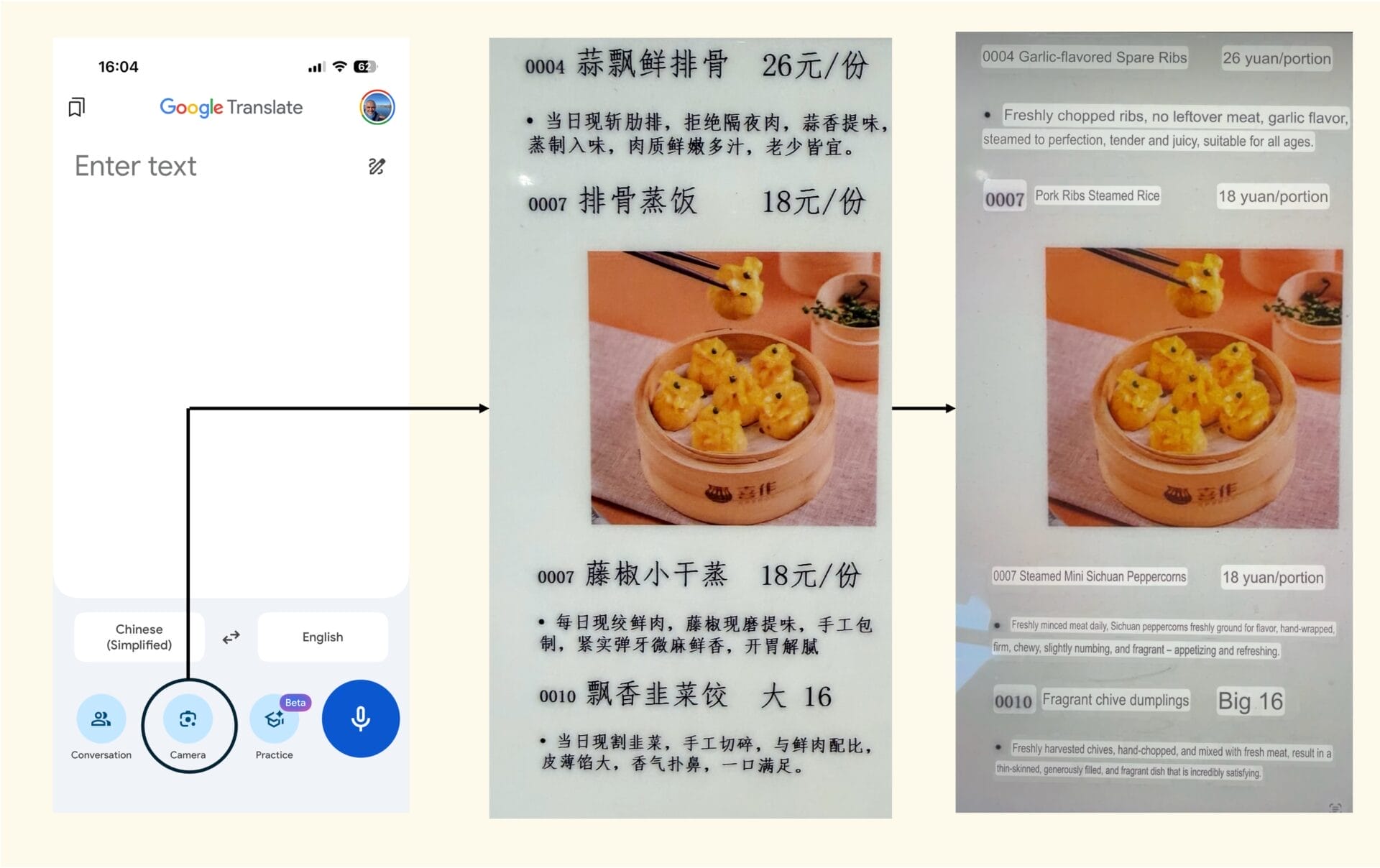
- Use the camera to instantly translate signs, posters, or menus
This last feature is particularly handy and effective, especially in restaurants or on public transport, as shown in the example below.
With good preparation, traveling in China and taking the train is easy!
Traveling by train in China takes a bit of getting used to, but the system quickly becomes smooth once you understand the rules.
Centralized booking, traveler identification, station organization, and mobile payments form a coherent whole, designed to handle massive flows efficiently.
Once you’ve got these basics down, the train becomes the simplest and most reliable way to get around the country, even over very long distances.
The goal of this guide is to help you approach your first journey with peace of mind, by avoiding the main difficulties encountered by Western travelers.
What if you still have questions?
I recommend joining a Facebook group and asking travelers who have just returned from China. It’s the best way to get the most up-to-date information.

0 Comments