
China: what high-speed trains are really like — my test
Everything you need to know about travelling on China’s high-speed trains
With its trains running at up to 350 km/h and spectacularly sized stations, China has profoundly transformed the rail travel experience.
But beyond the technical performance, what does the traveller actually experience on board?
Station logistics, comfort across the different classes, service quality, and how you perceive time and distance
In this article, I offer detailed first-hand feedback based on several high-speed journeys across the country, from the traveller’s point of view.
To make it easier to read, I’ve organised it by theme rather than chronologically:
- At the station: an almost airport-like setup, very different from Europe
- Travelling in Business class like on a long-haul flight
- The experience in second and first class: a bit like on board the French TGV
- My verdict on China’s high-speed trains
And as a bonus, a chapter on the diversity of China’s countryside you see when travelling by train.
Having worked on night trains and then in air transport for over 35 years, I bring a practical perspective on today’s passenger experience.
This article is part of a complete series dedicated to train travel in China.
At the station: an almost airport-like setup, very different from Europe
As everywhere, a train journey starts at the station. But taking the train in China is nothing like our European habits. Luckily I’d spent a lot of time researching online—otherwise, for my first trip departing from Shenzhen, I would have been completely lost.
On the other hand, the advantage of China’s big stations is that they’re all organised in the same way. That’s the result of centralised planning rolled out on a massive scale across the country. From my second trip onwards, I had my bearings and taking the train proved very simple and efficient.
My first train trip at Shenzhen North Station: everything is new!
Bei, Nan, Xi and Dong were the first Chinese words I learned! They mean, in order: North, South, West and East. In fact, many new stations are named according to their location within the urban area.
So Shenzhen Bei is in the north of the city, about ten kilometres from the centre.
I get there by metro, as I will at all the other stations, which are all remarkably well connected to the local network.
When I arrive, I first head to the forecourt to see the building from the outside. The least you can say is that the 400-metre-long façade of Shenzhen Bei, with its huge cantilevered roof, is impressive.
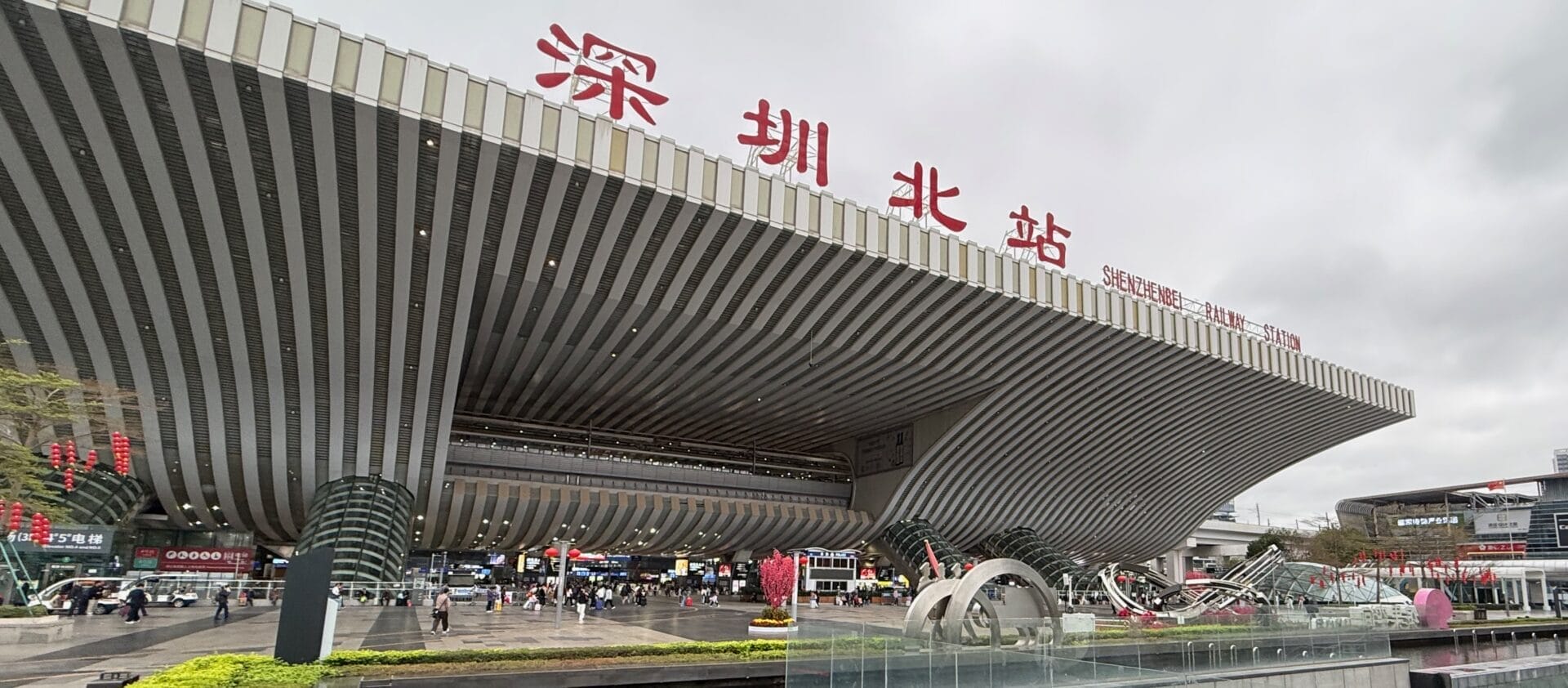
Access to the station is tightly controlled
Then, as I enter the station, I go through a first check where my passport is verified, which actually serves as my train ticket. All the information from my booking is linked to my passport details. It’s the same for Chinese travellers with their ID card. The system is fully tied to passengers’ identities, which can be problematic for freedom of movement.
Next, we go through a security screening with metal detectors and machines to scan our luggage. Apart from liquid restrictions, it’s as strict as at airports.
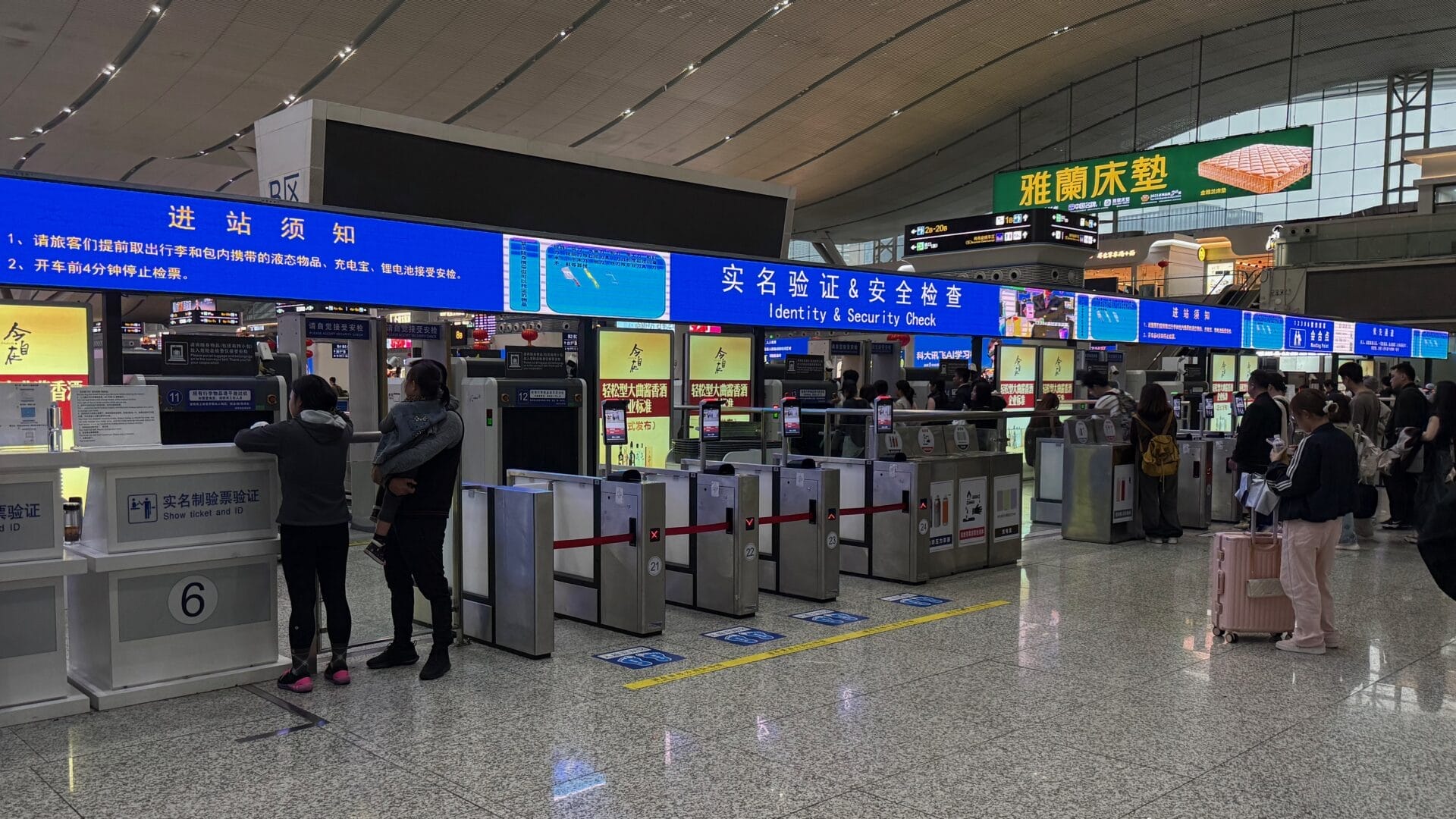 Security screening Shenzhen Bei
Given all these checks, the ticket counters are often located elsewhere in the station. I never needed to go there, because I always bought my tickets in advance on the Chinese railways mobile app, which is quite effective even if it’s still fairly basic.
A huge waiting hall designed for future growth
I emerge into the vast waiting hall which, on the day of my trip—a Saturday evening as people returned from Chinese New Year holidays—was quite busy. The organisation is very rational, and you find it in all the country’s new major stations.
On either side of the hall are the boarding gates to the platforms, which are located underneath it. At Shenzhen Bei there are ten, allowing 20 trains to be handled simultaneously. The fact that the platforms are hidden means you can’t see the trains, which takes away from the travel atmosphere.
At Shenzhen Bei, as in other stations, the hall is often majestic, with a very high, spectacular ceiling, but it also feels rather cold. Fast-food restaurants and shops are pushed up onto mezzanines overlooking the waiting and boarding area.
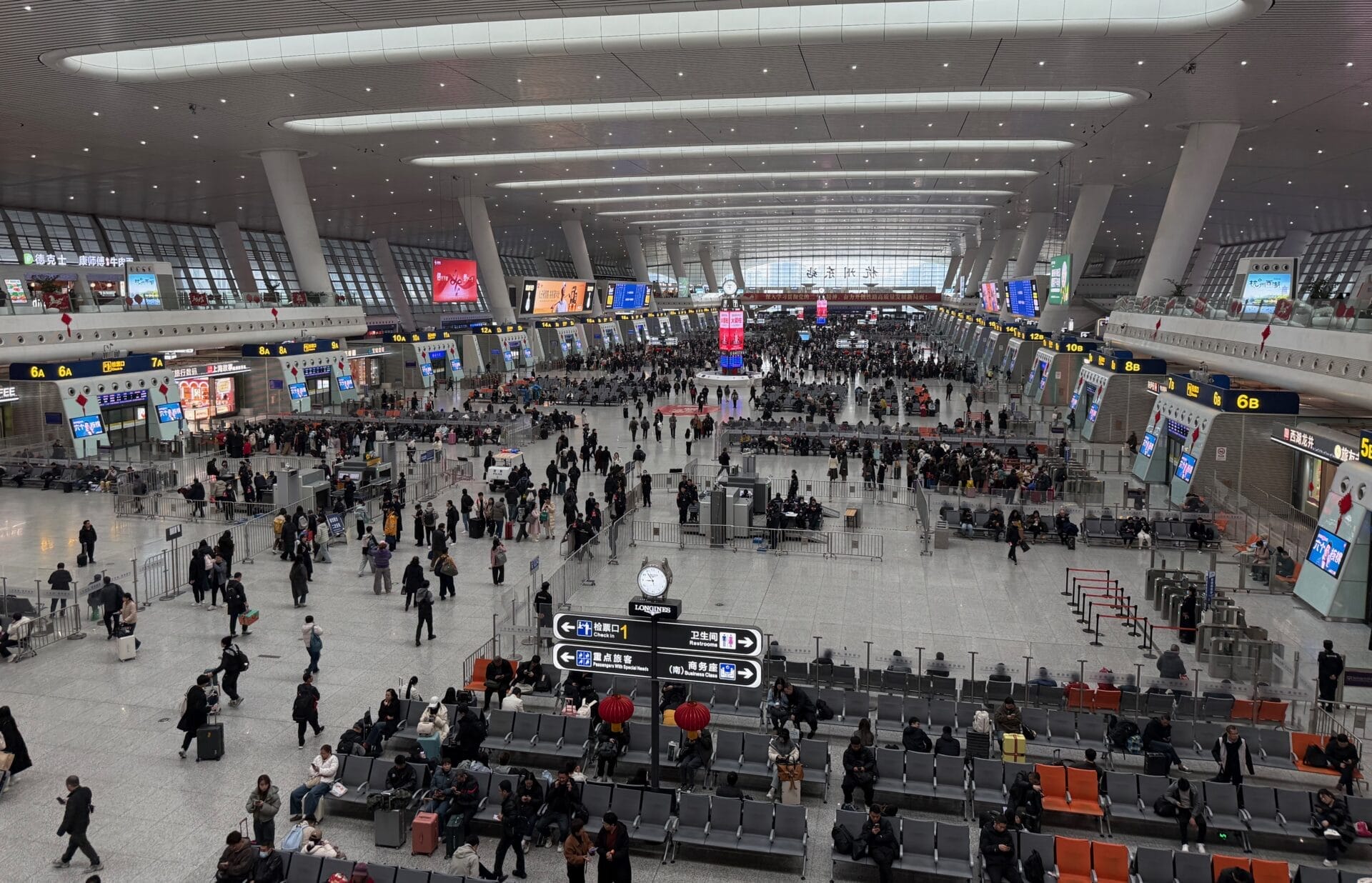 Hangzhou East Station
Enclosures are provided for PRM passengers and military personnel so they’re guaranteed a seat, whatever the crowd level.
 Shenzhen Bei enclosure reserved for military personnel
In some stations, like Chongqing Xi, gates are already in place for future platforms that haven’t been built yet. The Chinese authorities always think big!
Last-minute boarding, like flying
Huge display boards announce the platform and boarding time. In Shenzhen, they alternate between Chinese and English, but that’s not always the case. The best way for a Westerner to find their way is to know their train number. The platform is identified by a number, and boarding begins as soon as the status appears in green characters.
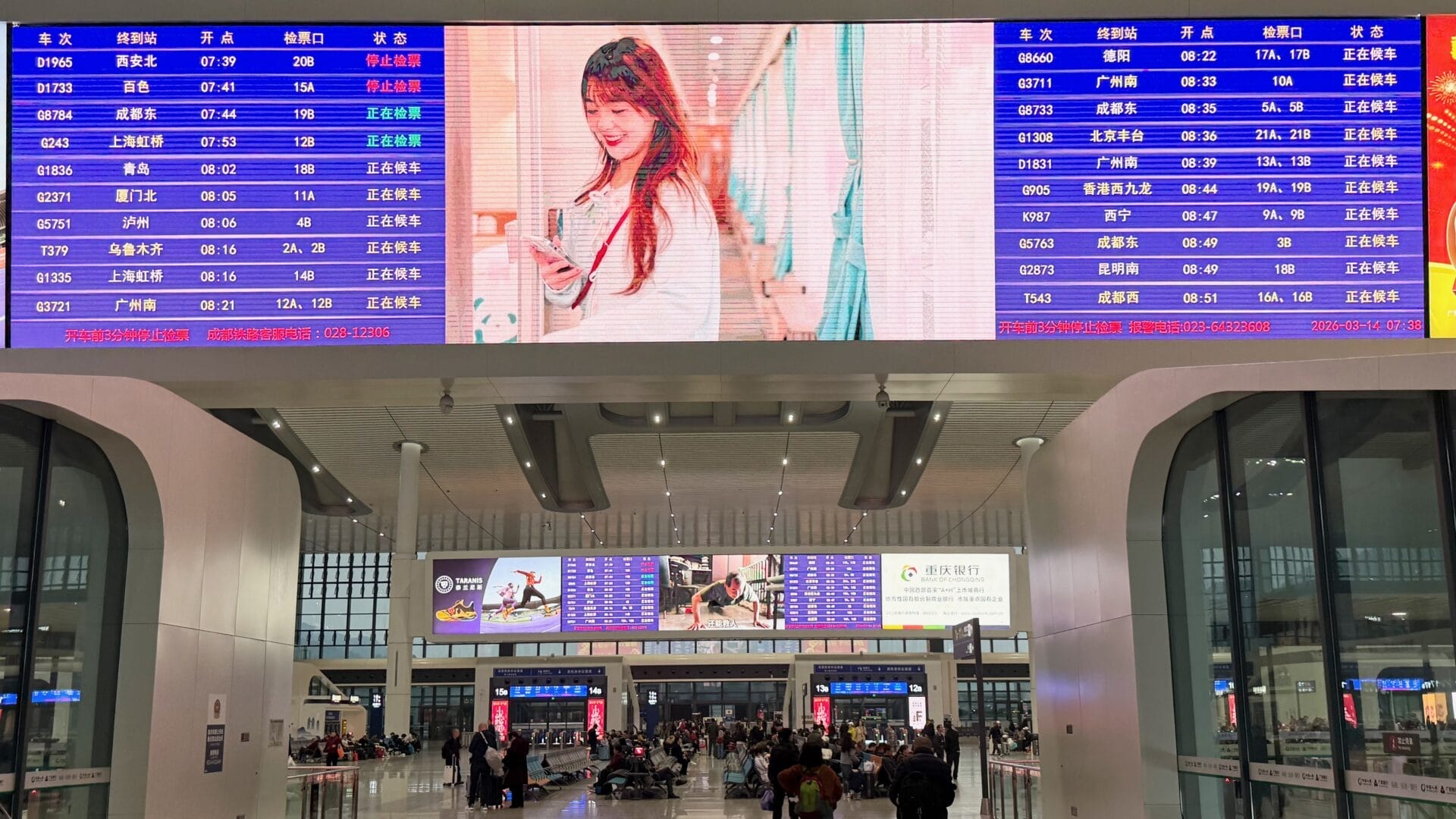 Departure board Chongqing Xi
Access to the trains is generally possible 15 minutes before departure. Chinese passengers go through automatic gates that scan their ID card. As a foreigner, my passport is checked manually by a staff member (fast check lane). Everything runs smoothly, even if travellers sometimes jostle a bit.

Down to the platform: finally discovering the trains!
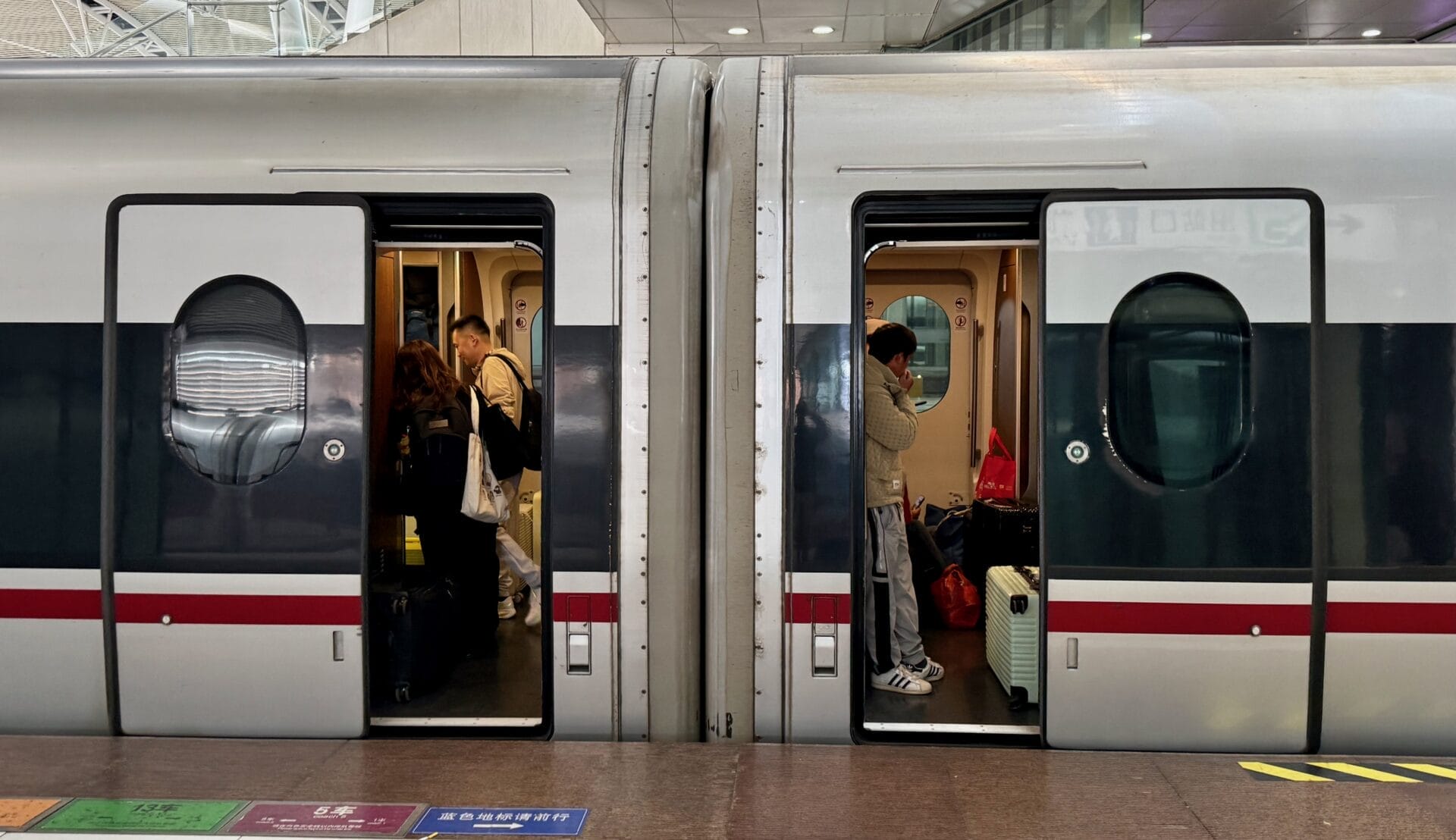
It’s only on the platform that you discover China’s high-speed trains. They stop only long enough to let passengers off and on.
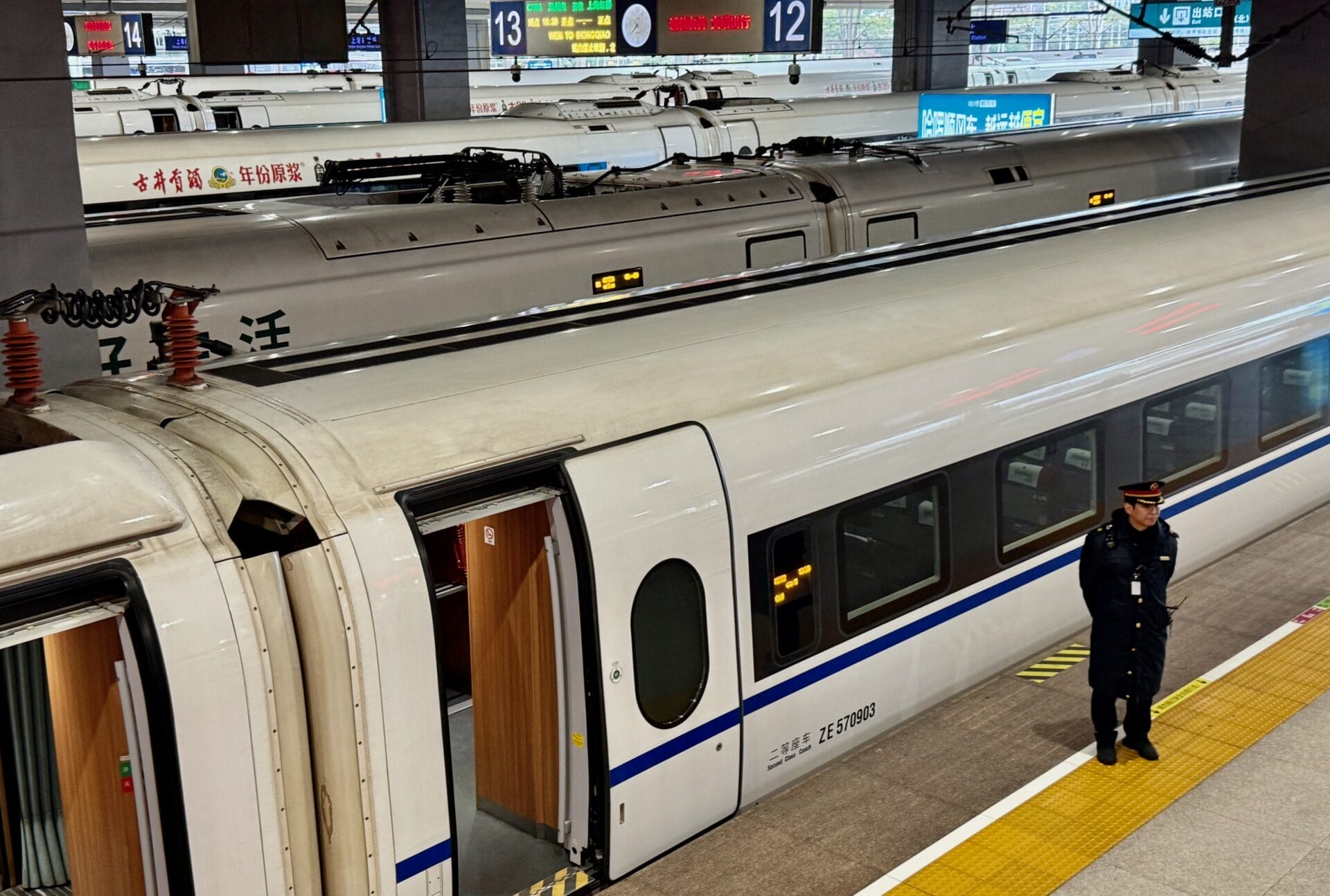 Shanghai Hongqiao Station
With their futuristic look, the trains are impressive.
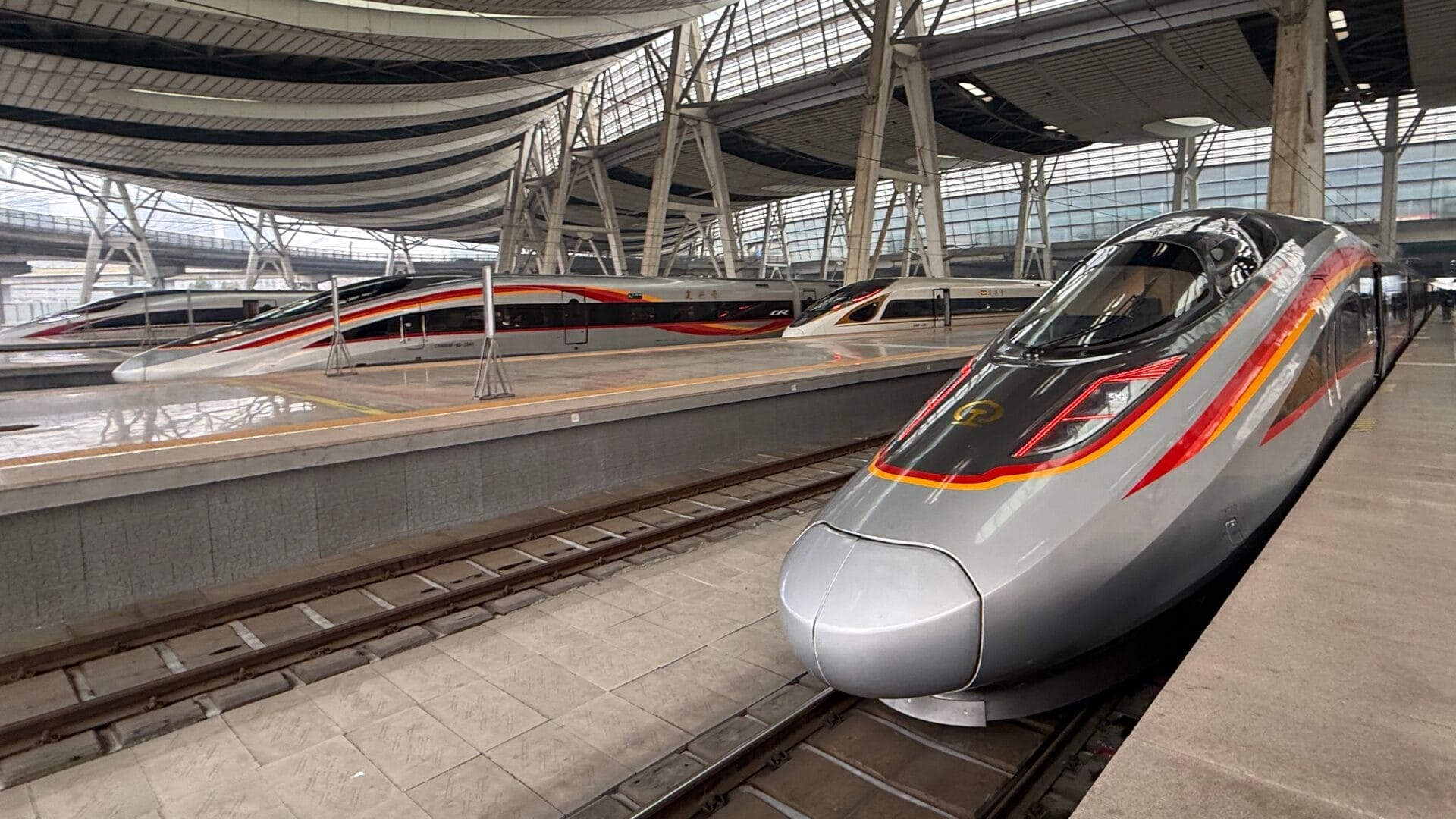 Beijing Nan Station
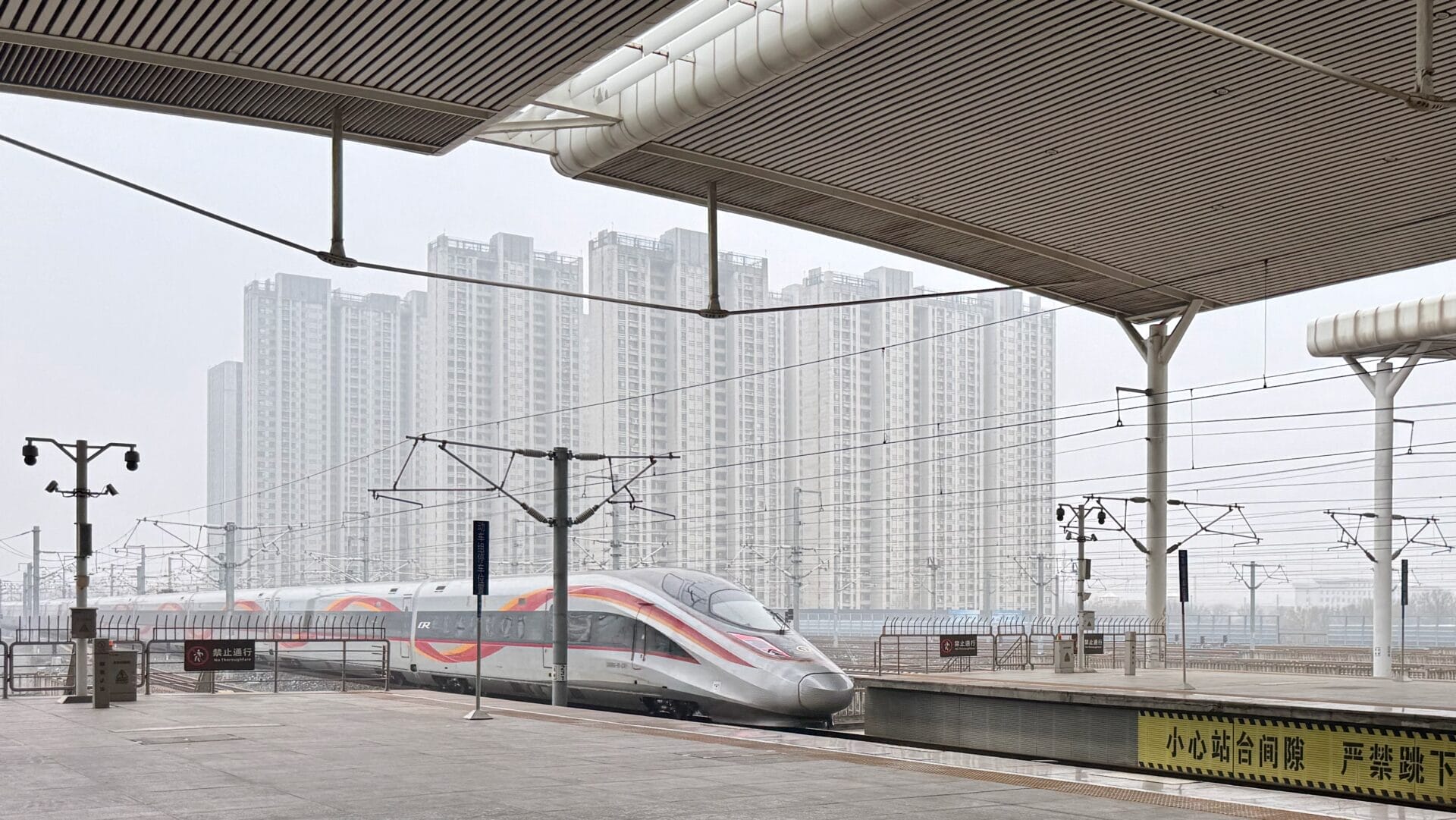 Shondong Station
Stations 2.0, but not much charm
On arrival, travellers follow a completely segregated route to exit the station without crossing paths with those departing. A flow is, however, provided for connecting passengers.
But it all lacks charm. Gone are the days when families and friends came to see loved ones off on the platform before watching the train pull away. In China, we’re firmly in the era of Travel 2.0.
On board China’s high-speed trains : a choice of three classes
There are three main travel classes on China’s daytime high-speed trains:
Business class: it only exists on the fastest G-type high-speed trains. It’s much more expensive, but the travel experience is excellent and unique in the world.
First class: it offers the best comfort-to-price ratio. Seats are arranged 2 by 2.
Second class: the modern version of the “hard seat” found on high-speed D or G trains, in 3+2 rows.
Travelling in Business class like on a long-haul flight
Travelling in Business class is a real innovation that’s worth trying despite the high price. The service already starts at the station.
At the station: a private lounge and VIP escort
The travel experience already starts at the station, in the private lounge. Facilities vary, though. Superb at Beijing Central Station, functional and stylish at Beijing South, cosy at Hangzhou East, disappointing at Chongqing West or Guangzhou South. As with European rail lounges, they’re more like comfortable waiting rooms. The buffet is limited to snacks, and drinks to soft drinks or tea/coffee.
The real perk of the lounge is the VIP escort! Just before departure, a hostess comes to pick you up and escort you to the train. She takes your wheeled suitcase, guides you through the station, and goes ahead of everyone. You feel important!
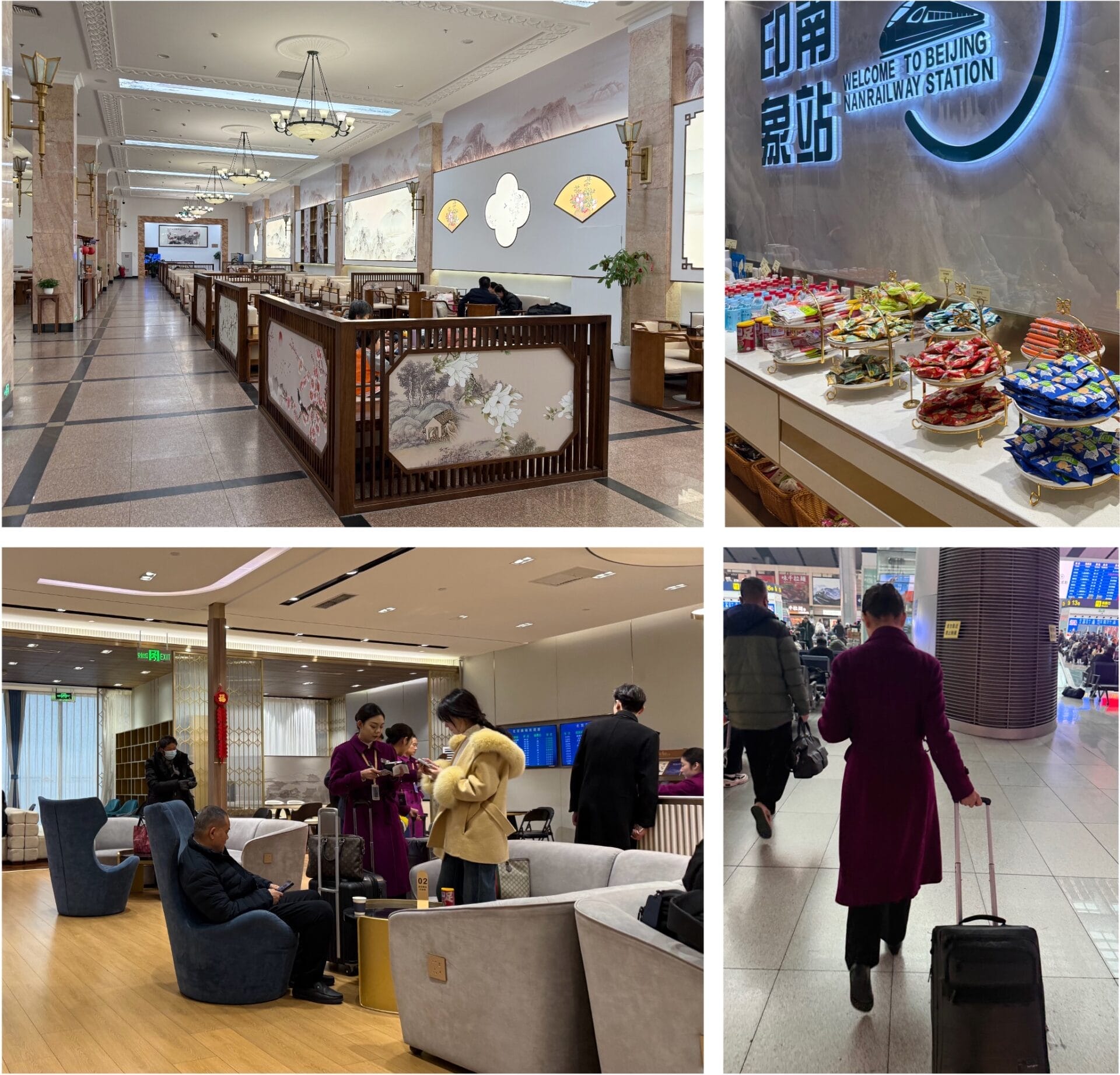 Top left: Beijing Central lounge — Bottom left: Beijing South lounge
Welcomed on board by a hostess
Business class is always located at the front and rear of the train. Depending on the train, it can accommodate 10 to 20 travellers. It’s therefore meant to be very exclusive.
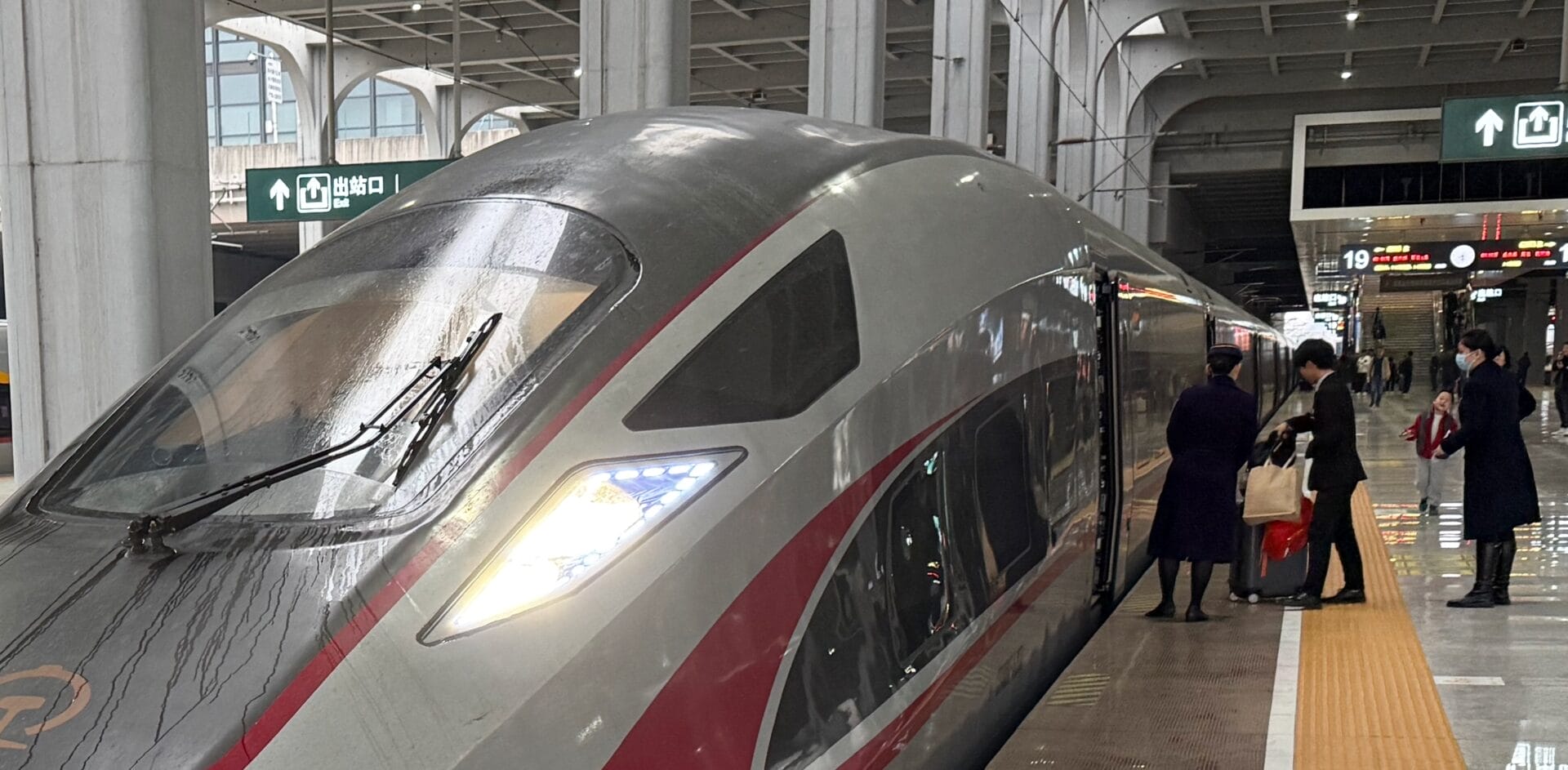
On board, you’re welcomed by another hostess (I’ve never seen a steward, though!) who takes you to your seat and makes sure your luggage is properly stowed. On all my trips, I never saw any of them speak English, but thanks to translation apps, we always managed to communicate.
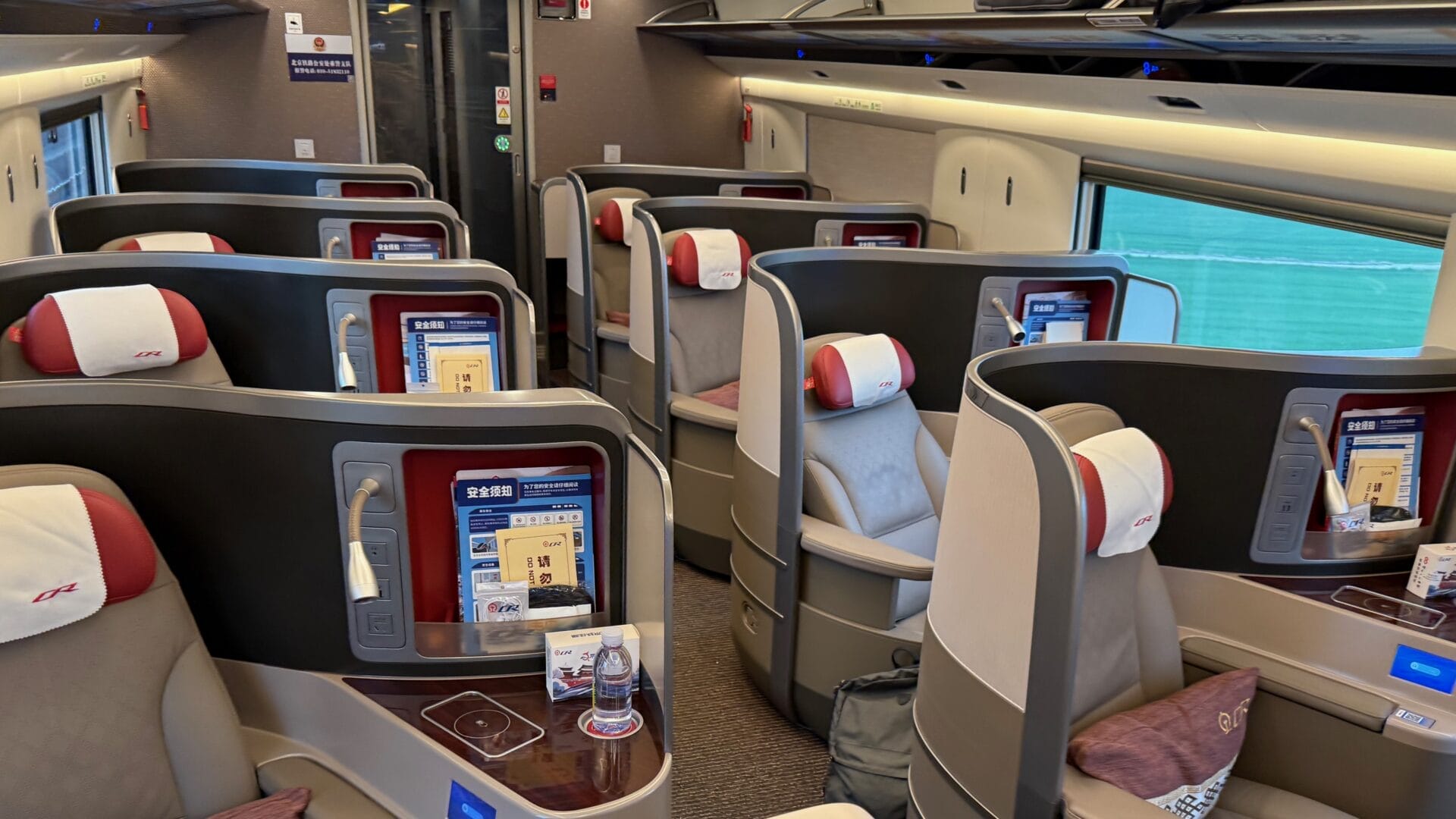
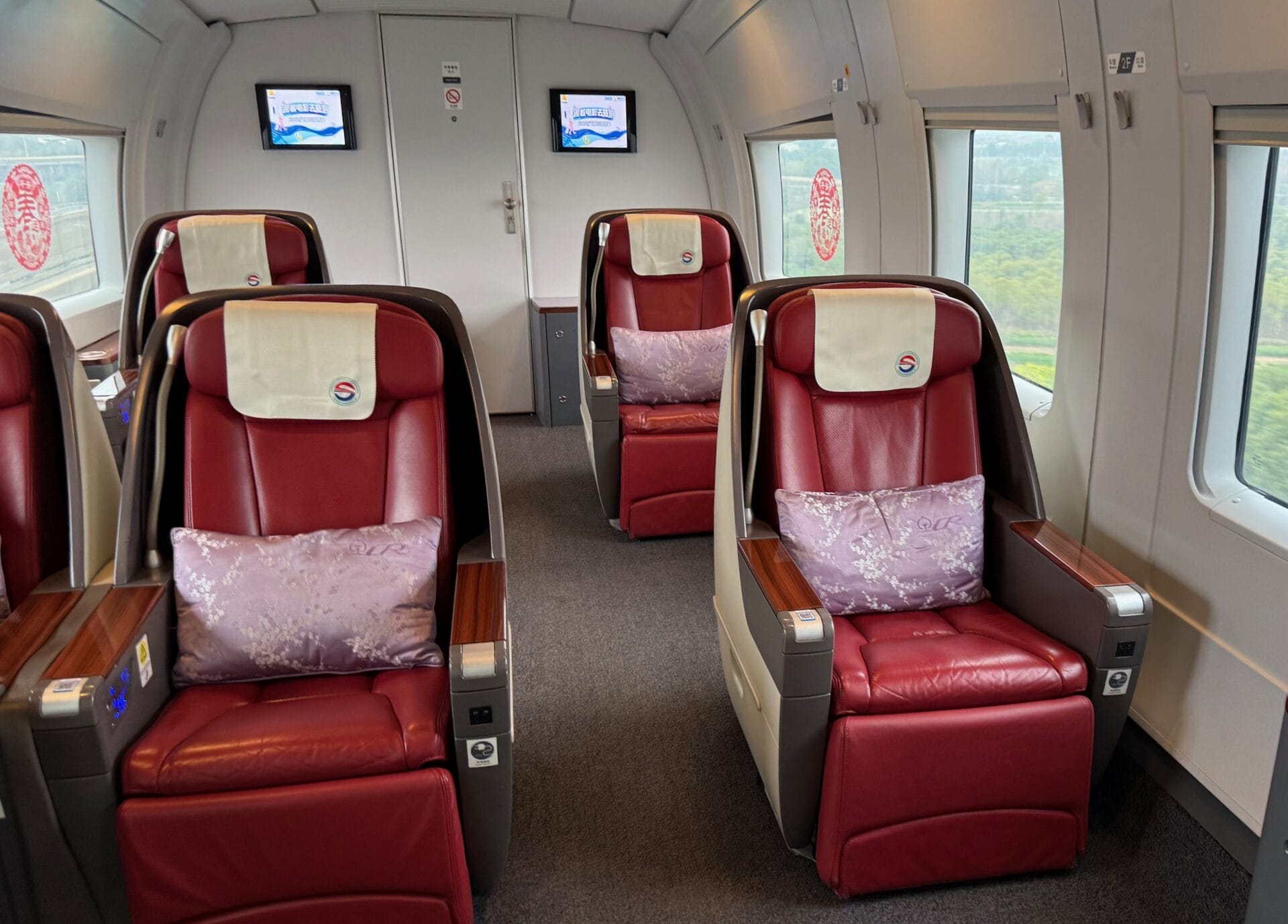
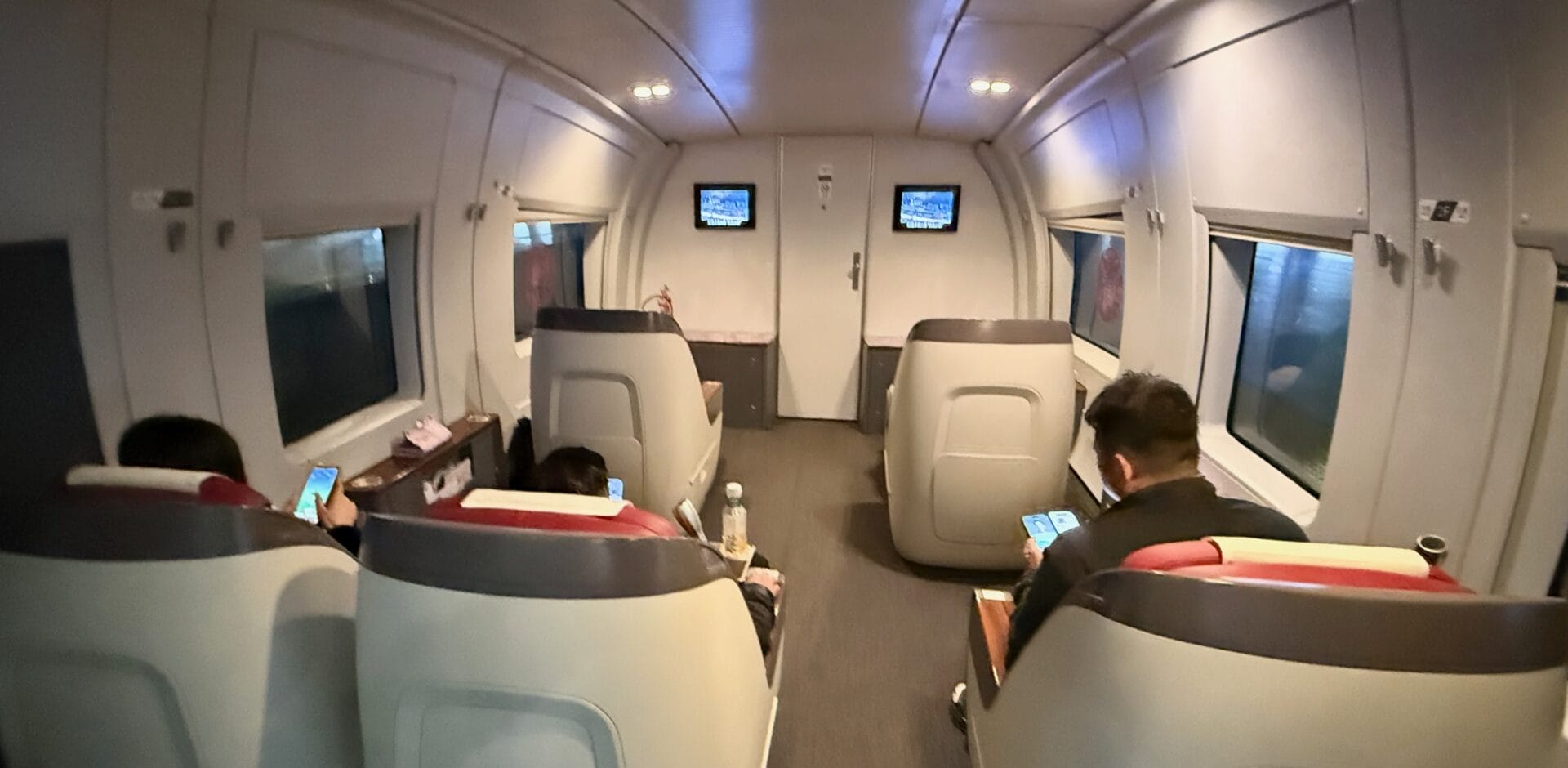
It seems the Chinese railways’ marketing department thinks a lot about the comfort of Business class seats. From the first CRH trains to the latest Fuxing version, the evolution is striking. Long-haul air travel is clearly the inspiration.
First generation: 2+1 seating rows
I took one of the oldest trains from Guangzhou to Shanghai: a CRH 380 based on Siemens technology but built in China. It stands out with its white livery highlighted by a blue stripe. Business class seats are in red leather and recline almost fully flat. The décor elements are reminiscent of classic trains, in a more retro style.
From Chongqing to Guangzhou, I took a CR400AF-A, the first generation of Fuxing trains, still not automated. The seating layout was still in 2+1 rows.
Second generation: herringbone seats
It was between Beijing and Hangzhou that I discovered this more recent version with a herringbone layout. It was my favourite for its comfort and also its elegance.
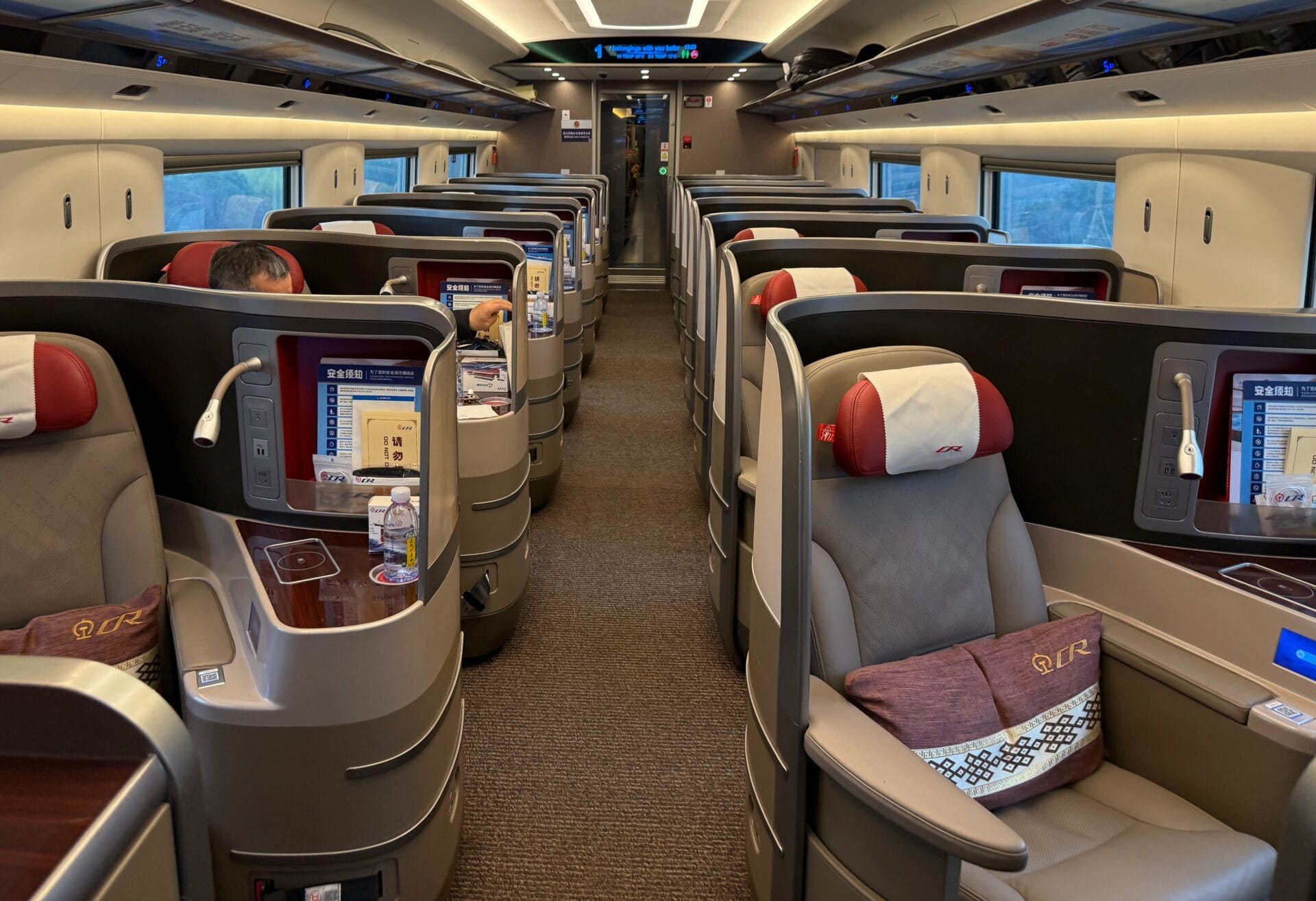
Travellers have several storage options, multiple ways to charge electronic devices (USB, power outlet, wireless charging), and a TV screen. The programme is limited, however, to informational videos about “Fuxing” trains.
The seat is very comfortable in its many positions.

Third generation: seats with a sliding door
They’re now very much modelled on the latest airline business classes, including a small door so you can retreat into your own bubble. I liked it less, though, because I felt a bit boxed in.
The seats are swivel. By default, staff position them in the direction of travel, but it’s also possible to set them up face to face for two people travelling together.
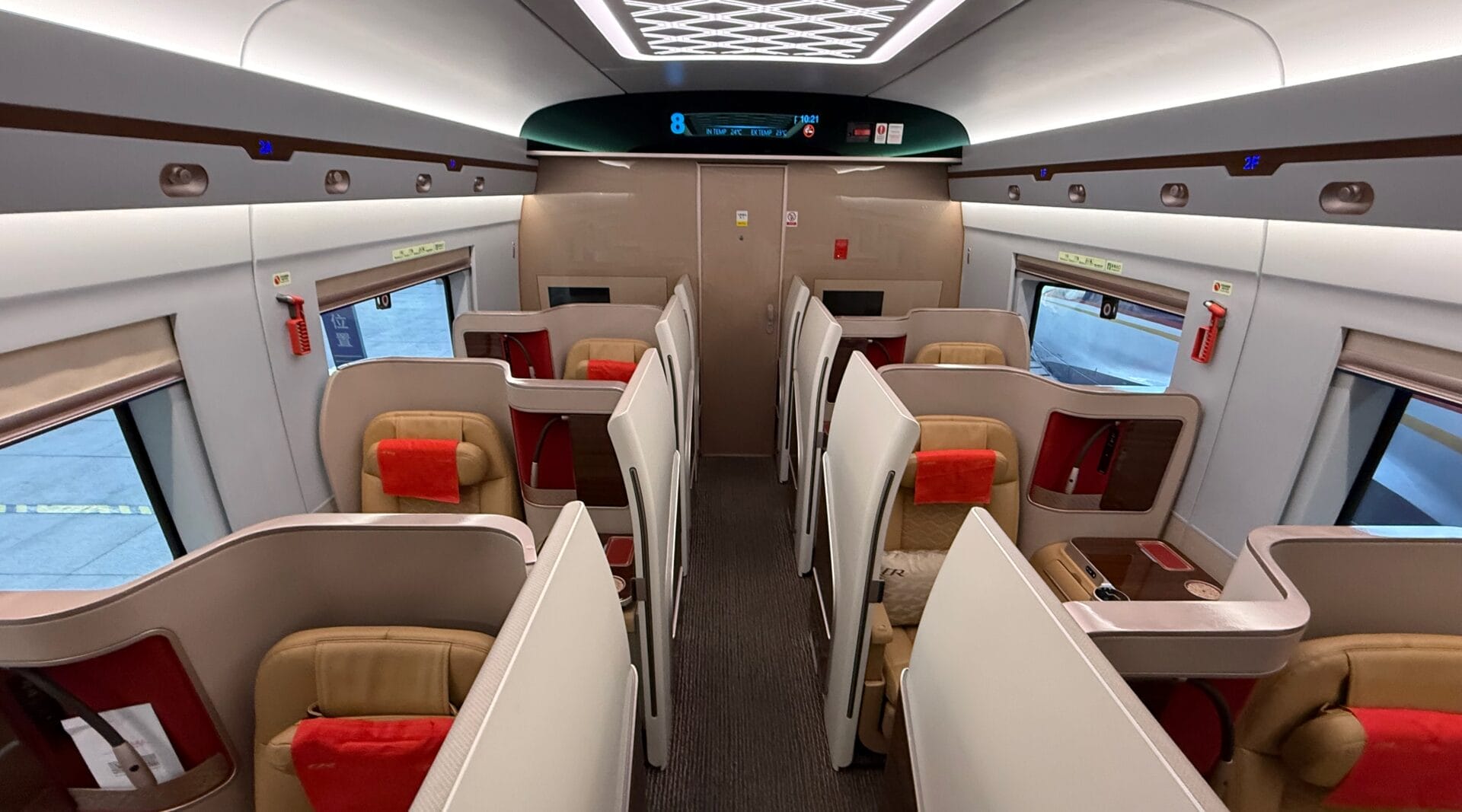

A journey where time flies
In these conditions, whatever the seat generation, the journey seems to go by too quickly, even on the longest distances where the trip can last six to twelve hours.
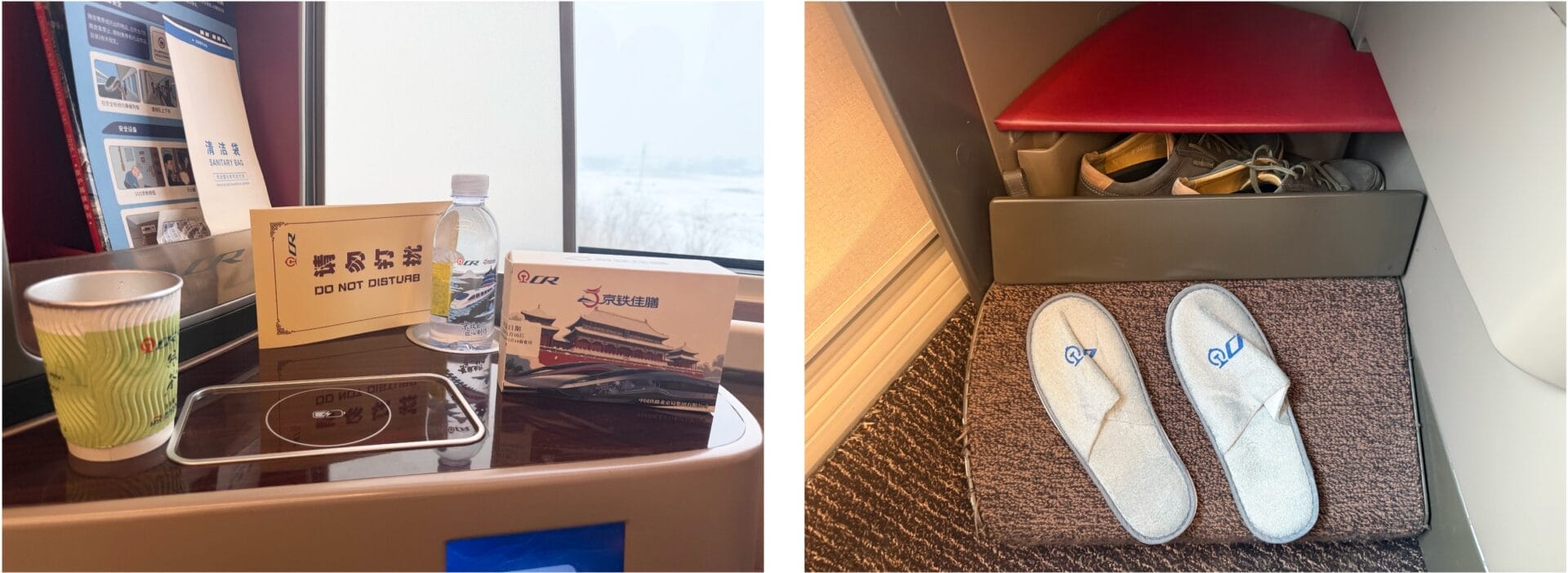
Just after departure, the hostess brings you a small kit with lots of snacks, some with unfamiliar flavours, like dried peas! Soft drinks and tea are served unlimited. The slippers are a very welcome comfort touch.
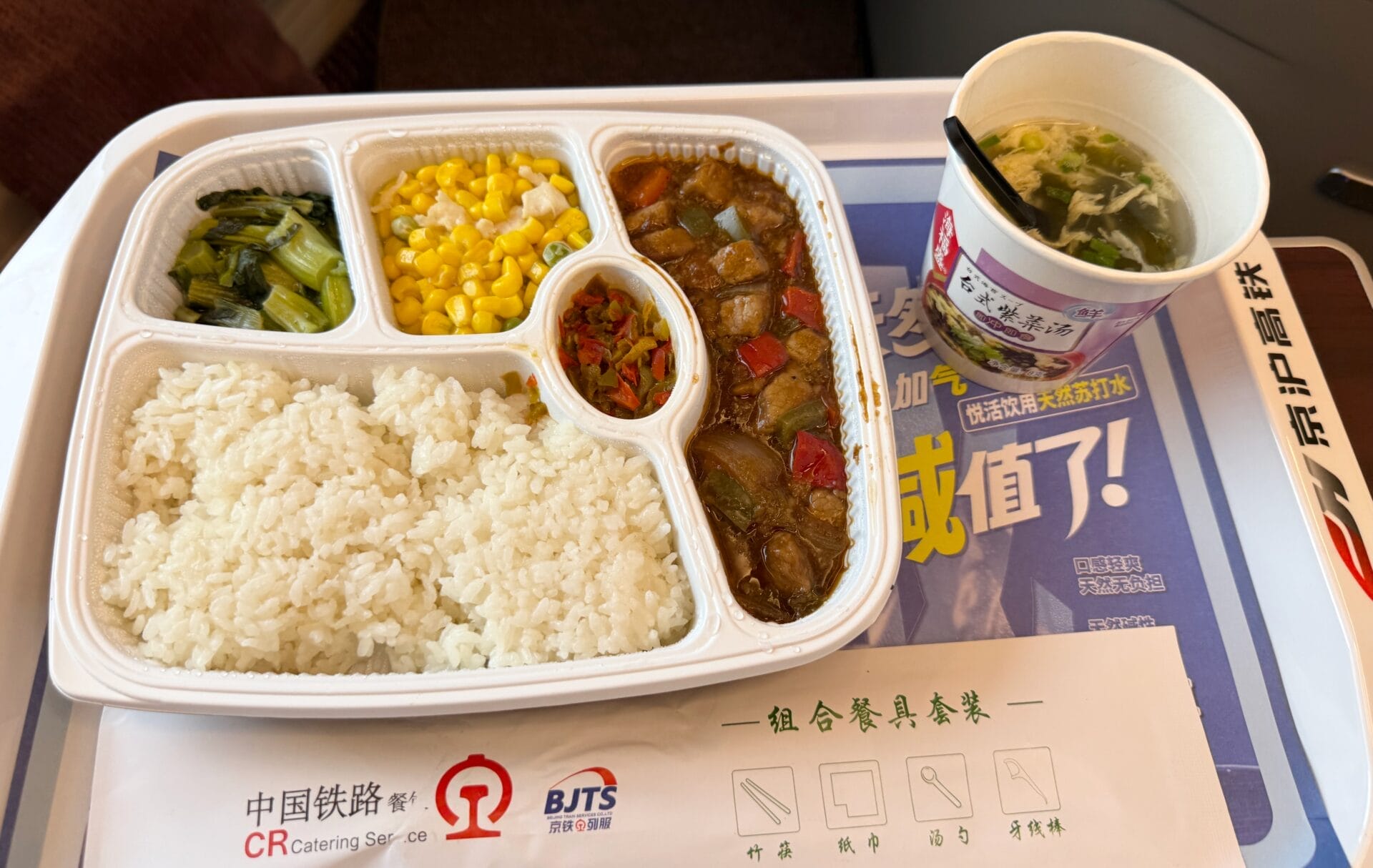
A hot meal is also offered at certain times. The service is a bit disappointing given the class, though: it’s a simple meal served on a plastic tray with compartments, more like what you’d expect in economy class on a plane.
The atmosphere on board is relaxing, only sometimes disturbed by passengers themselves, who don’t hesitate to make calls or watch a video on their smartphone from their seat. In that case, you just retreat behind your headphones with music from your own phone.
Access to the 4G or 5G network is generally excellent along the entire line. I never tested the Wi‑Fi, though.
The travel experience in first and second class is similar to the French TGV
The experience in second or first class on high-speed trains is fairly close to what we know in Europe. There are small differences, but mostly in the details—like the ones you find, for example, between the French TGV and the German ICE.
Travelling in first class
It’s the intermediate class and it’s comfortable. Seats are in pairs, four across. Legroom and recline are very good. A small footrest makes it even more comfortable. Also, it’s often less crowded than second class. Overall, it’s comparable to first class on European high-speed trains.
Whatever the travel class, the seats swivel and are positioned by staff in the direction of travel. But if you’re travelling as a group of four, nothing stops you from creating a “bay” so you can sit together.
In first class, expect to pay around 40% more than in second. The extra comfort really justifies it.
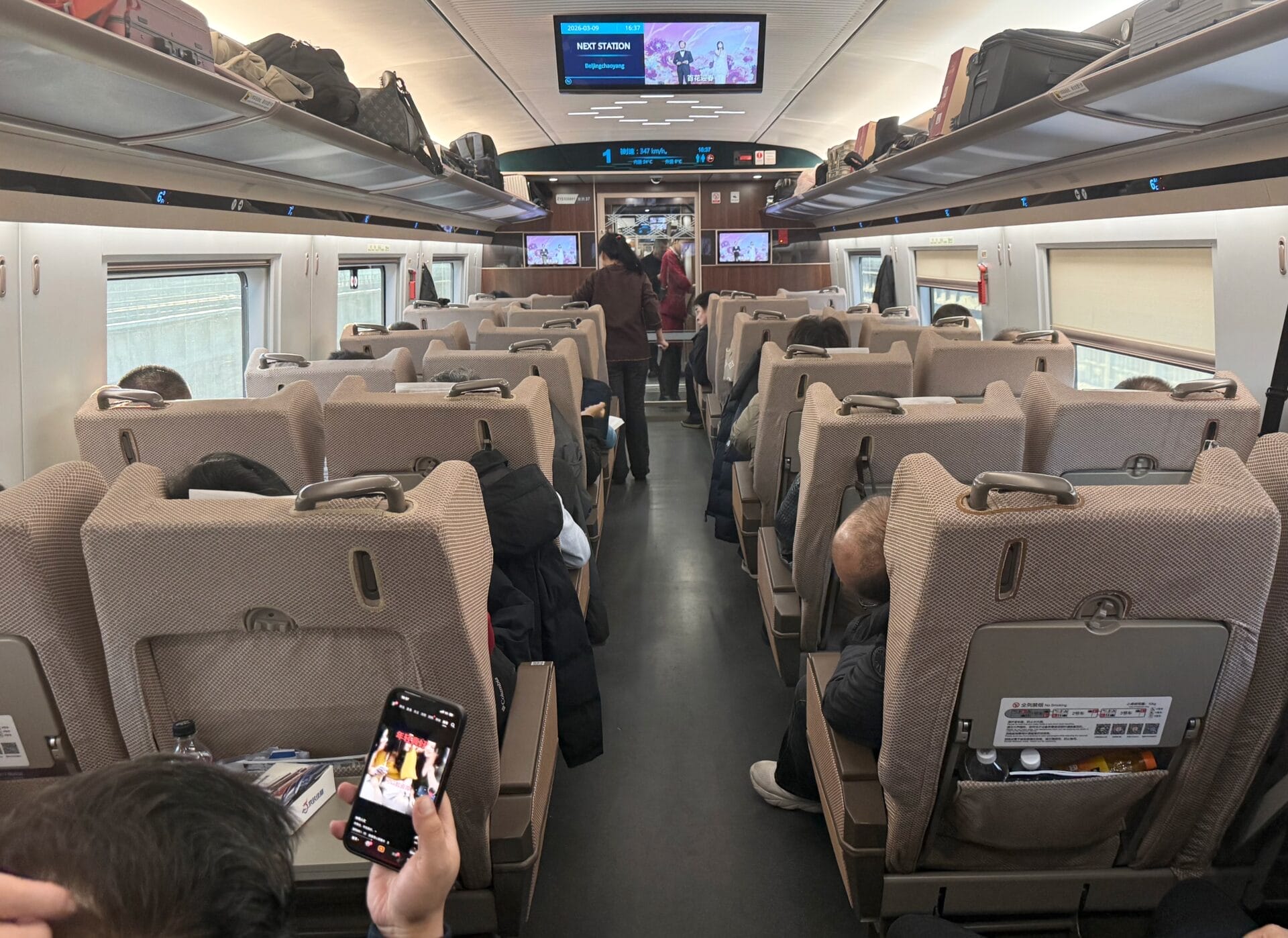
Travelling in second class: more comfortable than economy class on a plane
Second class is the new name for the “hard seat” on conventional trains. It accounts for more than 90% of the total offer.
Chinese high-speed trains are 3.36 m wide instead of 2.90 m for French TGVs or German ICEs. That makes it possible to fit five seats across instead of four in Europe. With seats only 45 cm wide and very narrow armrests, you feel a bit cramped.
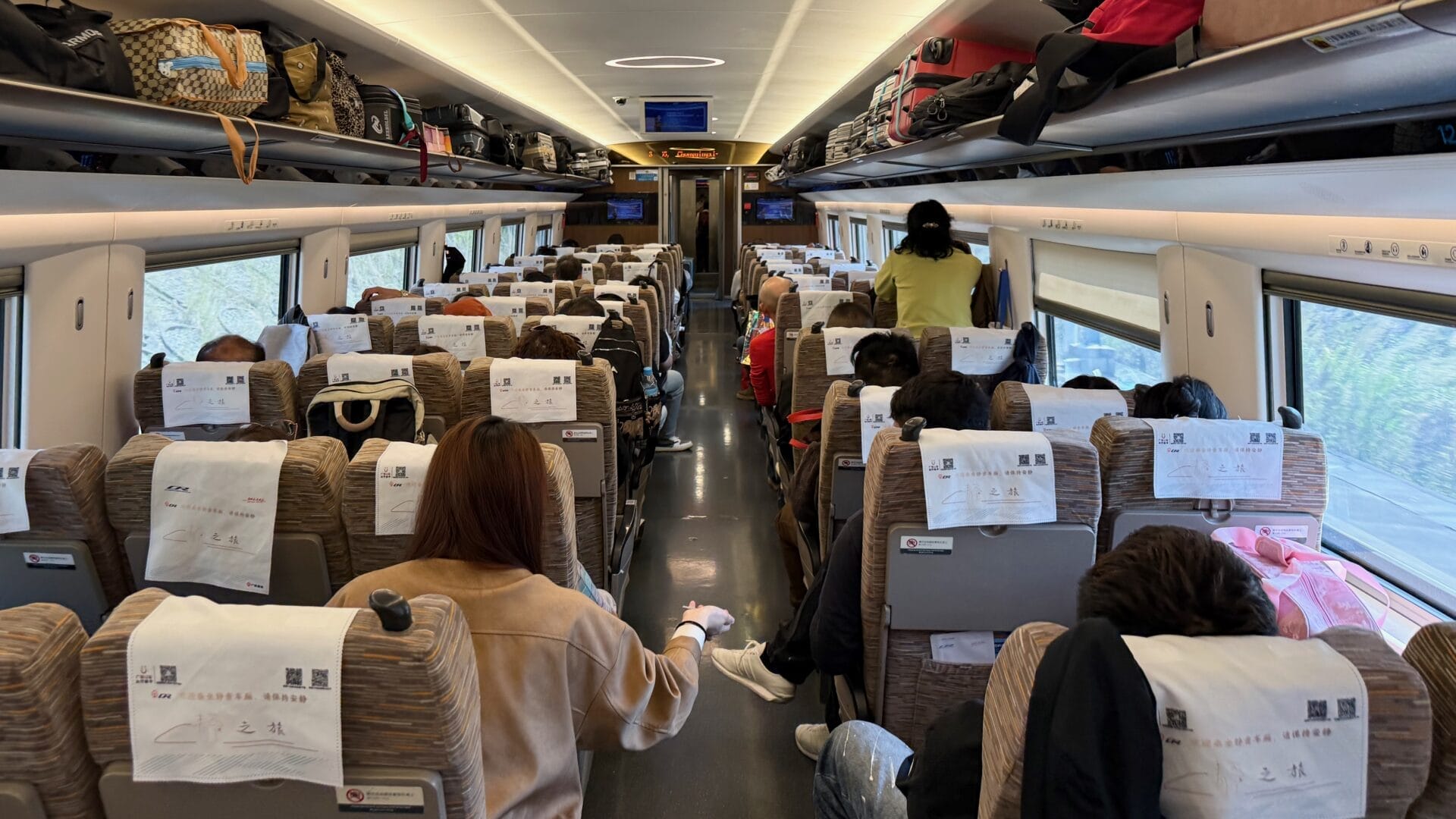
Fortunately, to compensate, legroom is quite generous, allowing a good recline. Overall, I find it more comfortable than economy class on a plane.
Today’s Chinese travellers are ultra-connected, and USB ports let them use their smartphones or tablets.

At peak times, space fills up quickly—for luggage and for people without reservations
The biggest downside of high-speed trains is the lack of luggage space, which can quickly clog the aisles—especially since Chinese travellers aren’t used to packing light.
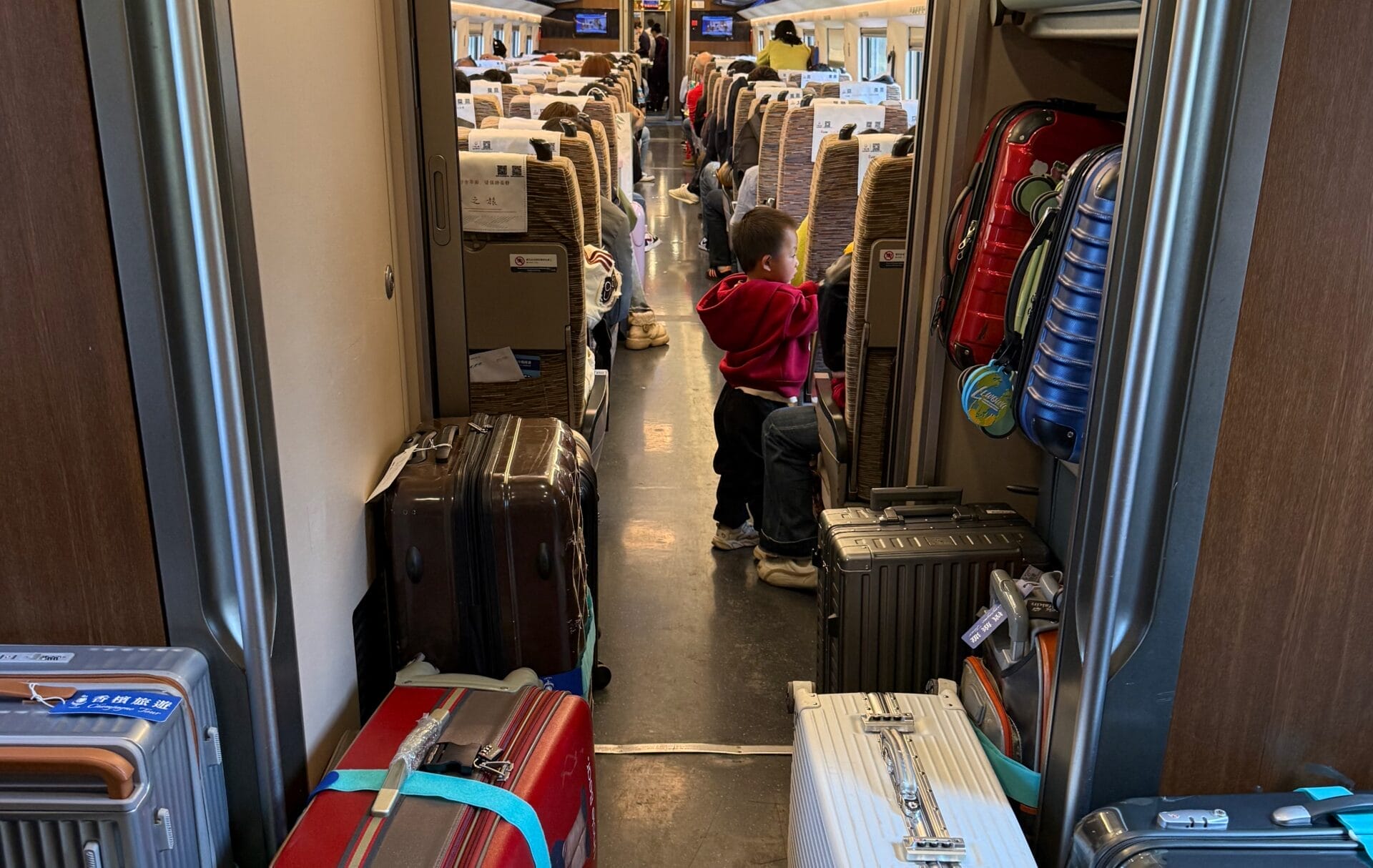
If the train is expected to be full, it’s still possible to buy so-called “standing” tickets. In that case, if no seat becomes available, you have to remain standing in the vestibules. These tickets are limited in number, however, to avoid overcrowding like you can experience on German ICEs at peak times.
The traditional dining car has given way to a simple bar that keeps getting smaller
In the middle of the train, there’s a bar. On older trains, there used to be an area where you could sit down to eat, but it’s gradually disappearing. Travellers only come to buy food and then go back to eat at their seat.
Even in China, the charm of the dining car you still find on classic trains is disappearing. There’s also trolley service, with a hostess regularly passing through with a cart.
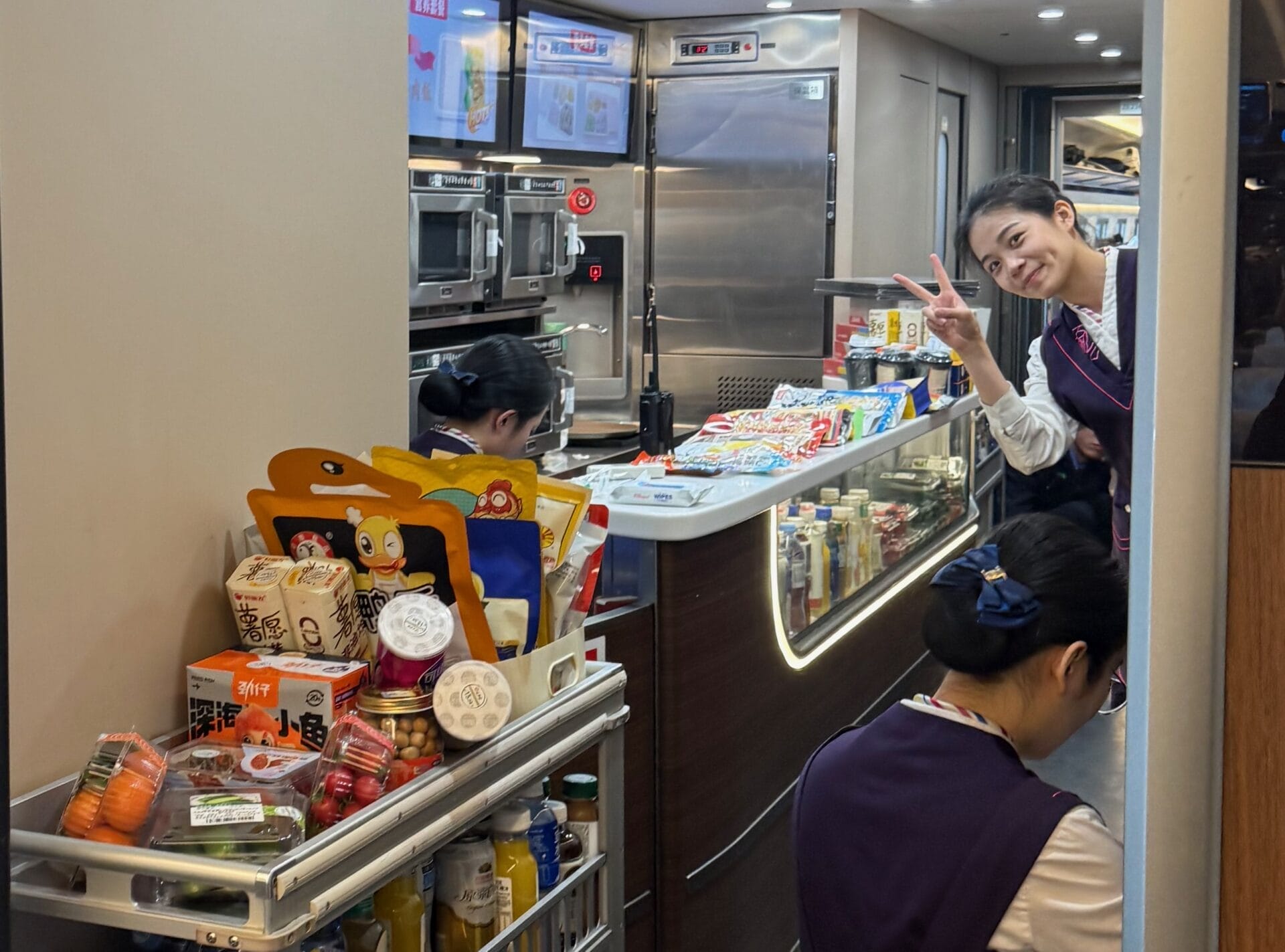
A train that’s always very clean and functional
A staff member is constantly walking through to ensure the train stays clean.
A small local curiosity: you can choose to use either Western-style toilets or squat toilets! There’s also a sink outside the cubicle and, right next to it, a hot-water dispenser. It’s a great idea for making tea or instant noodles, which the Chinese love.

Unlike conventional trains, smoking is strictly forbidden on high-speed trains.
My verdict on China’s high-speed trains
China’s high-speed train is comfortable, especially if you travel in Business or first class. It’s very punctual and, finally, it lets you see the diversity of China’s landscapes. It’s clearly the most suitable mode of transport for tourists who want to discover the country.
For Europeans, prices—especially given the long distances—are fairly cheap.
Once you understand how it works, the train is easy to use.
To help you, I’ve created a short guide that will make your travel experience much easier: My practical tips for taking the train in China.
To take this further, I recommend exploring two complementary angles that I cover in other articles:
- Night trains, which offer another view of rail travel in China
- The overall model, to understand what drives this large-scale success

Bonus: by train, I got a glimpse of the diversity of China’s countryside
Unlike flying, even at high speed, the train lets you see the landscapes you pass through. On my big rail journey, I was able to see China’s great diversity, both in terms of scenery and climate.
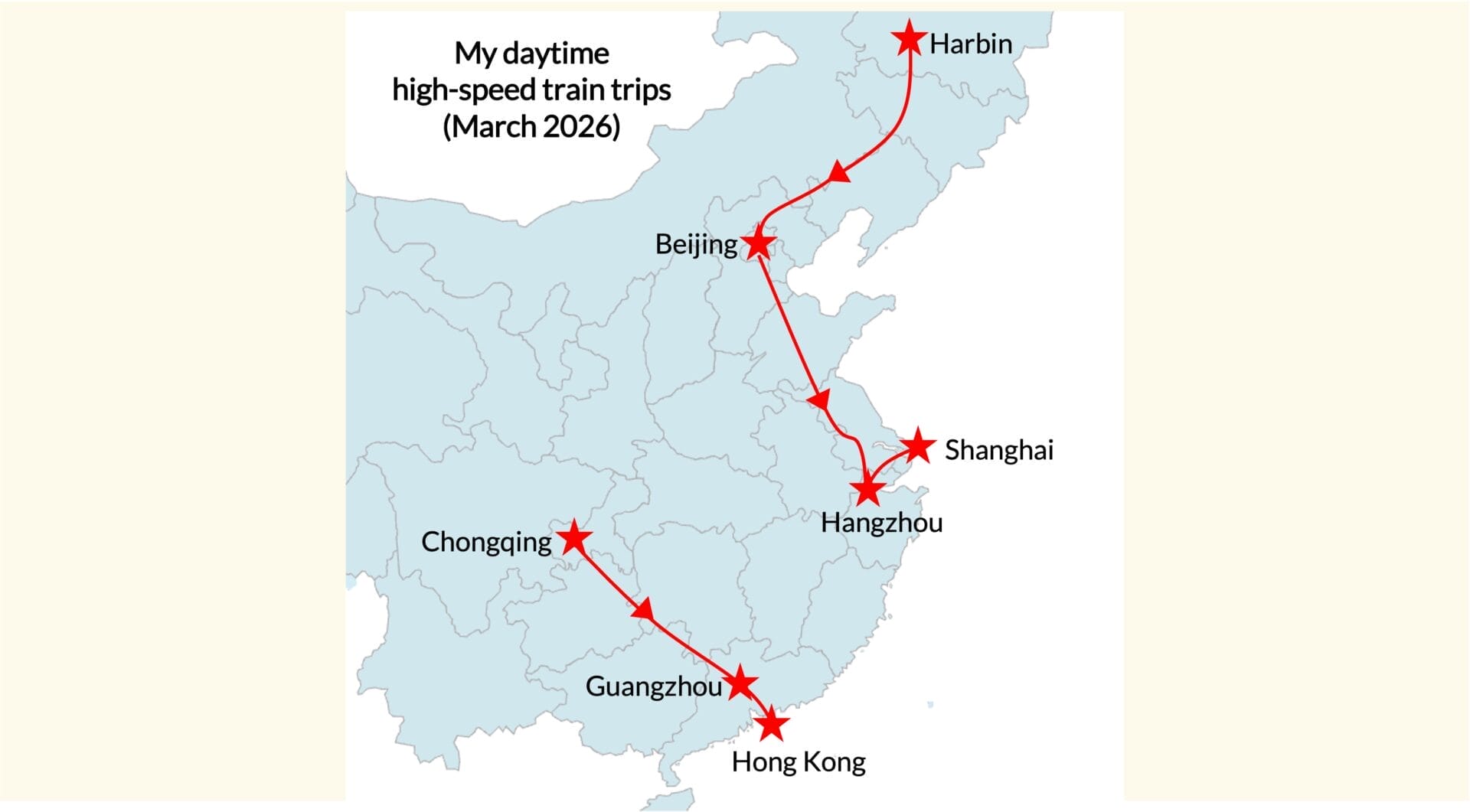
It has to be said that the country is as large as the European continent. So going from Harbin in the northeast to Chongqing is like travelling from Stockholm to Madrid.
Stretched out in a Business class seat, the travel hours fly by!
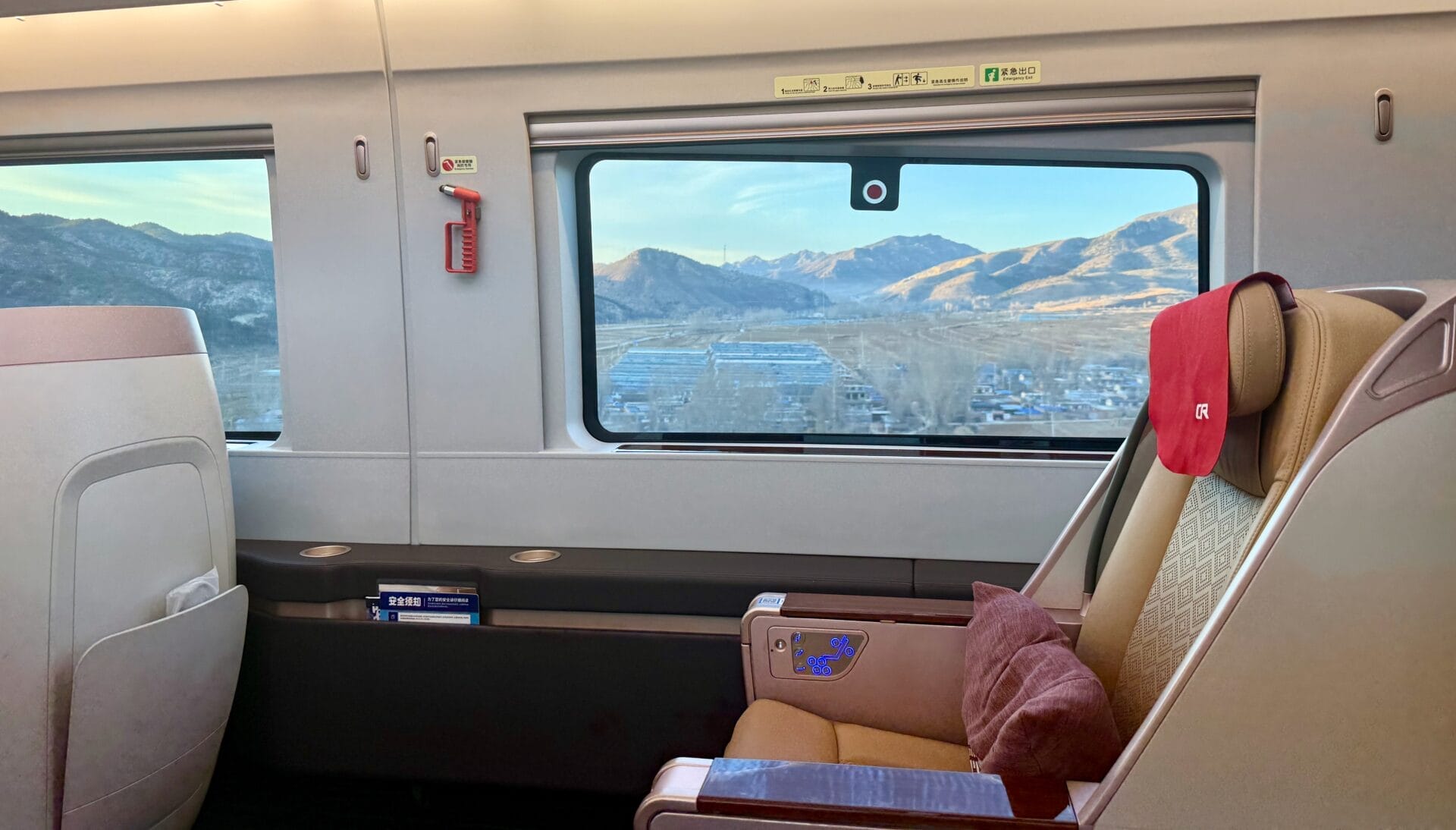
Beijing — Nanjing — Hangzhou 1,300 km in 4 h 30 : the flagship line of the high-speed network
My first daytime journey was from Beijing to Hangzhou via Nanjing. It’s the flagship line of the Chinese network, where trains run at 350 km/h to connect Beijing to Shanghai—1,300 km away—in 4 h 30.
It’s a huge, completely flat agricultural plain. Snowy when leaving Beijing, the further south we go, the more it gives way to green but very humid landscapes. It’s early March and winter is still very much here.
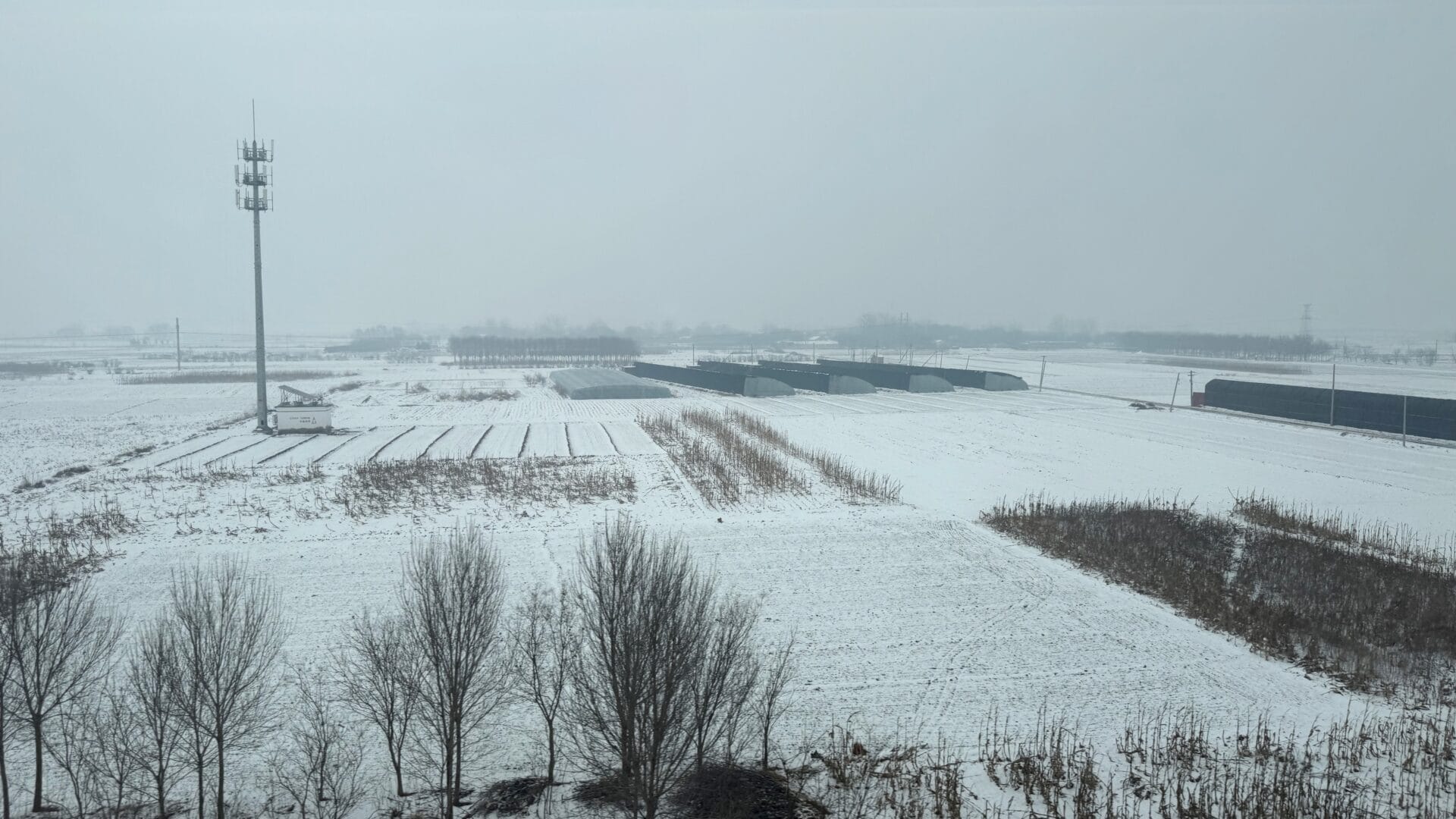
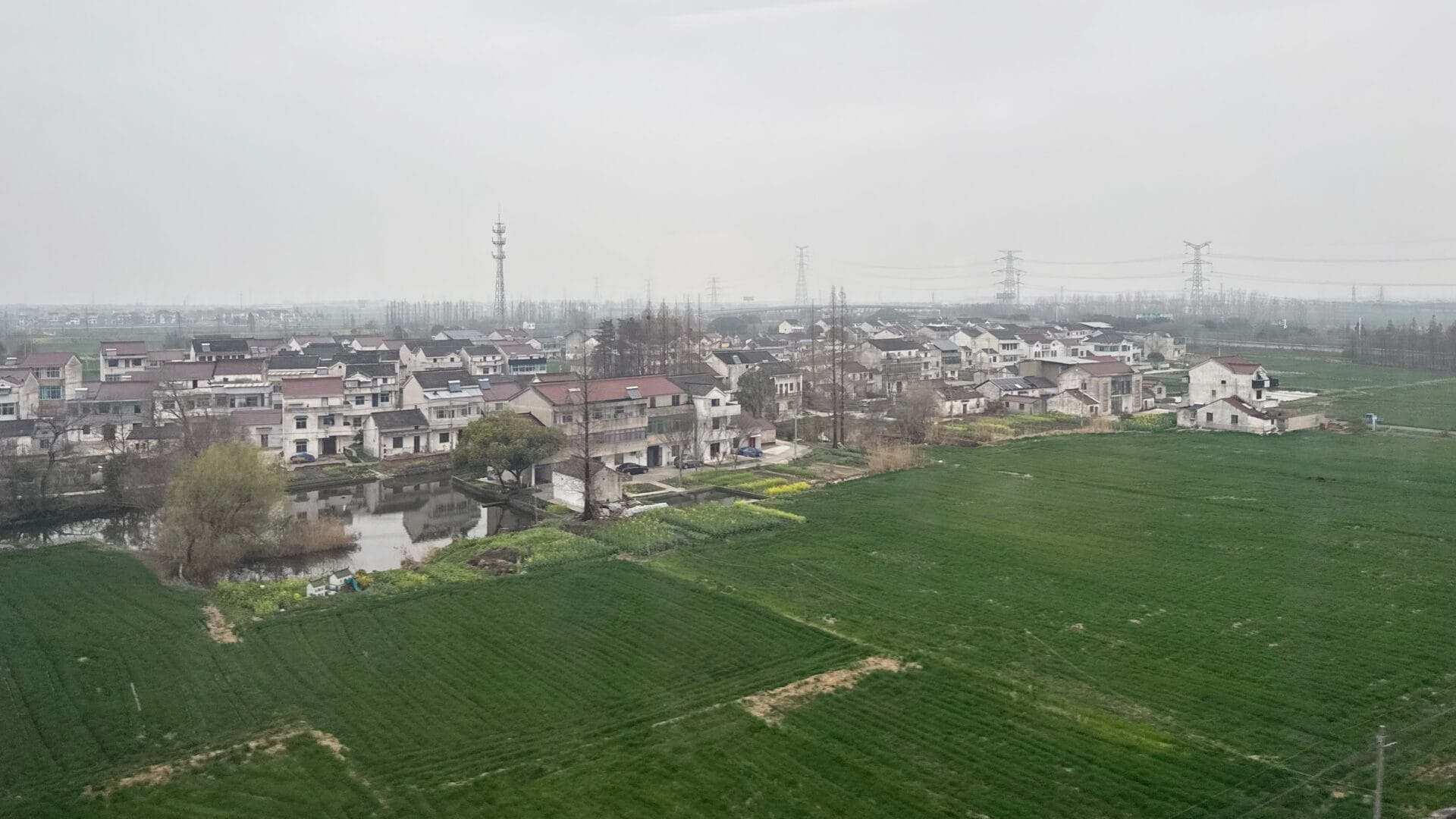
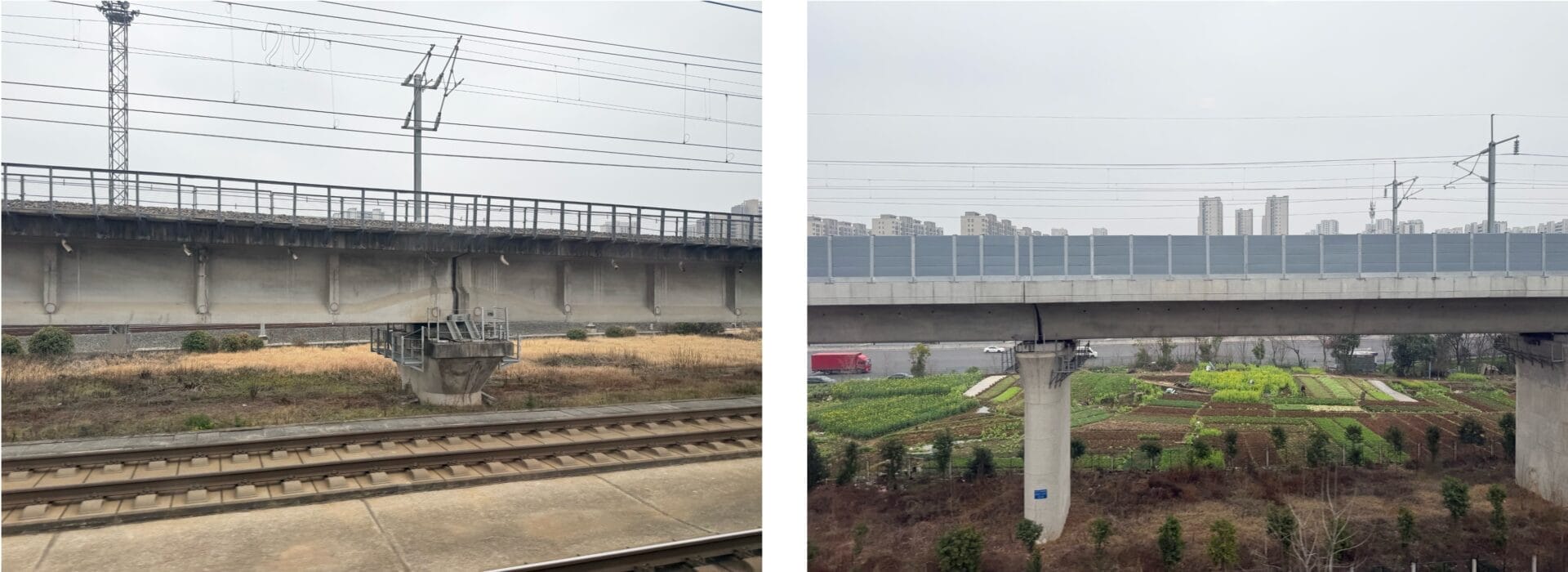
One distinctive feature: more than 80% of the journey is on viaducts or raised embankments.
This type of construction has many advantages. It allows you to pass over obstacles like roads and rivers, and avoids creating artificial borders between villages in a densely populated region. It also helps to cross flood-prone areas, which are common in this part of the country.
Because the beams are prefabricated, building the high-speed network is industrialised and fast. Finally, the line profile is effectively flatter, which is favourable for high speed.
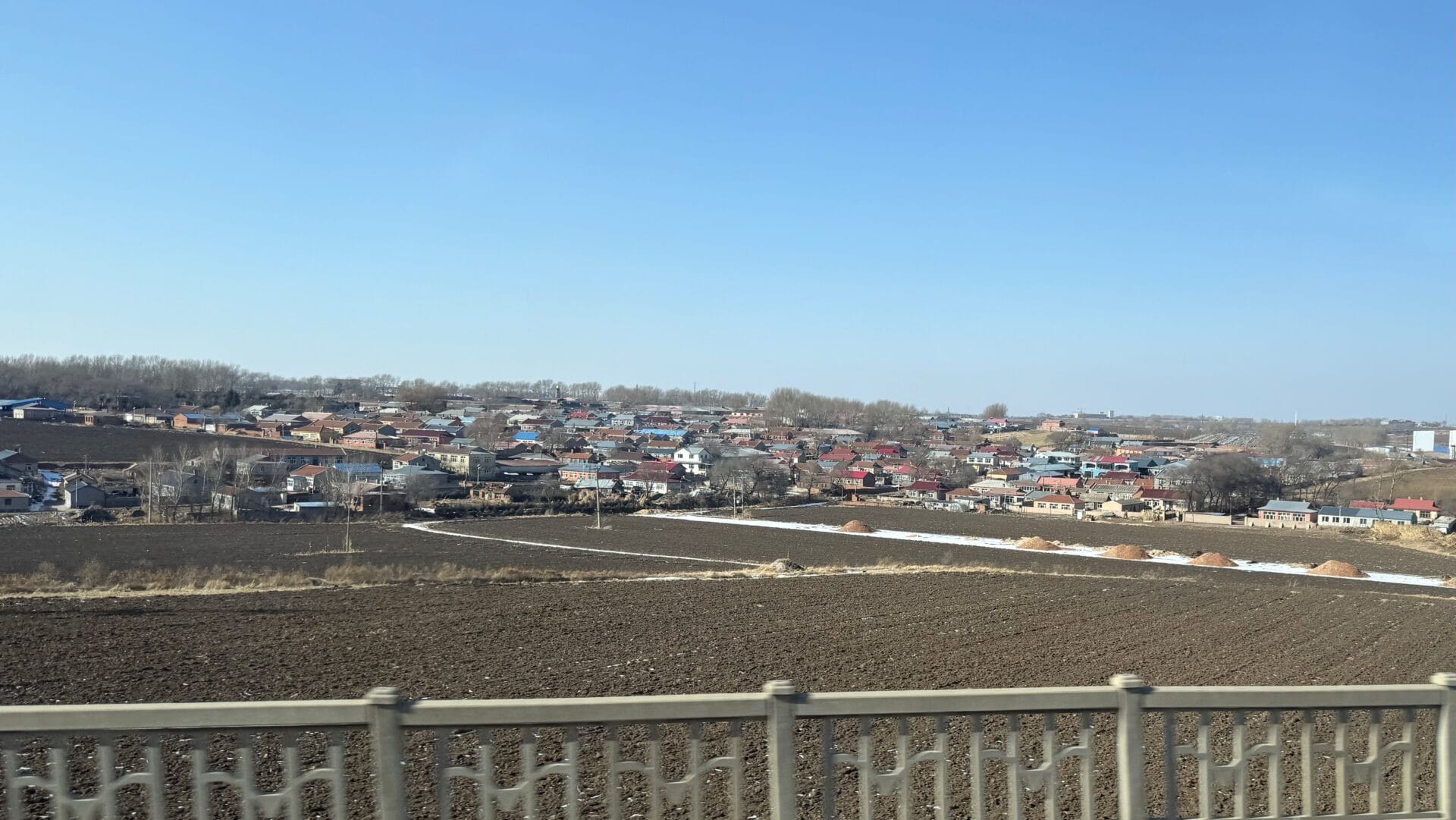
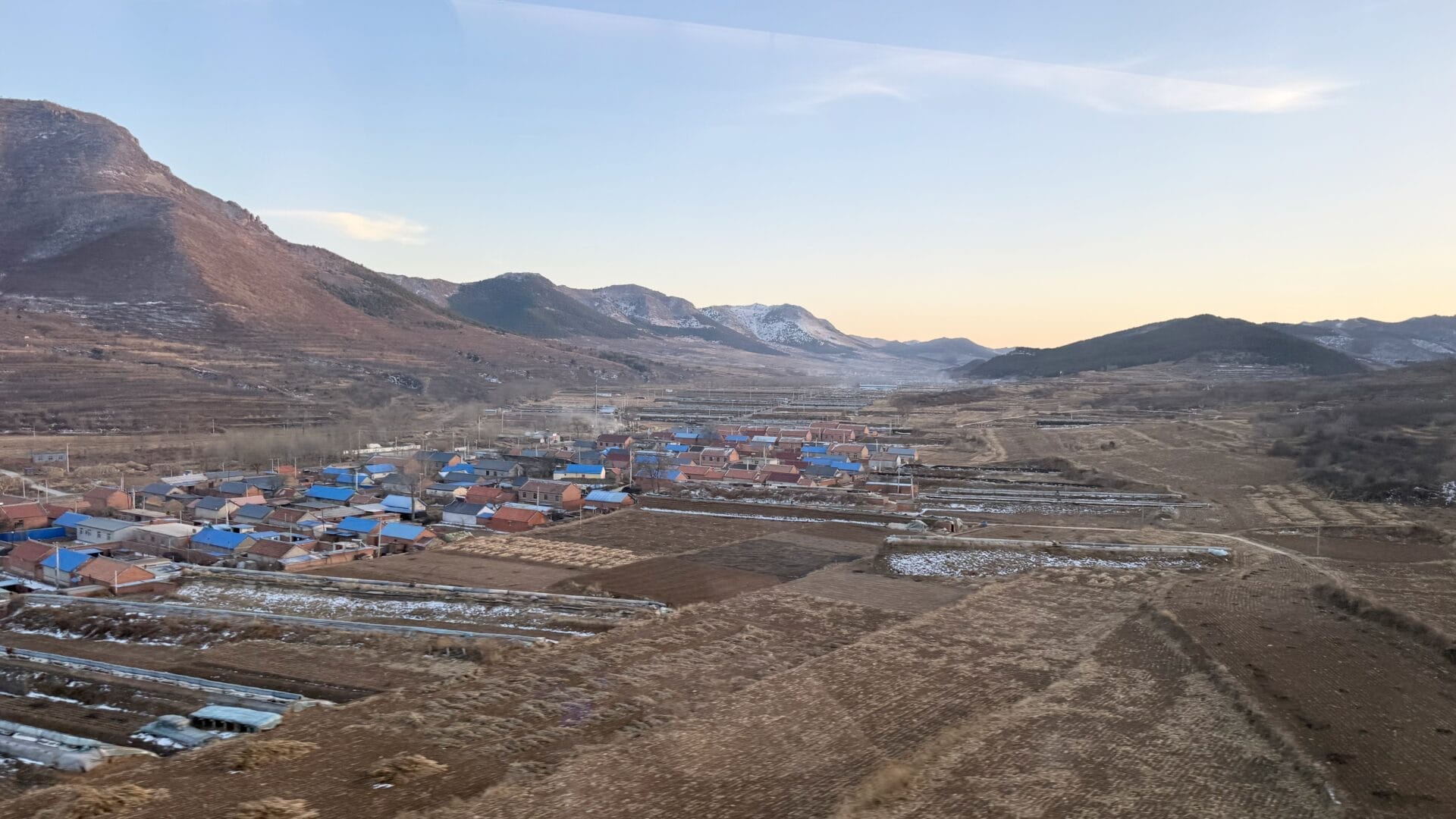
Harbin — Beijing 1,300 km in 4 h 40: Northeast China in its austere winter clothes
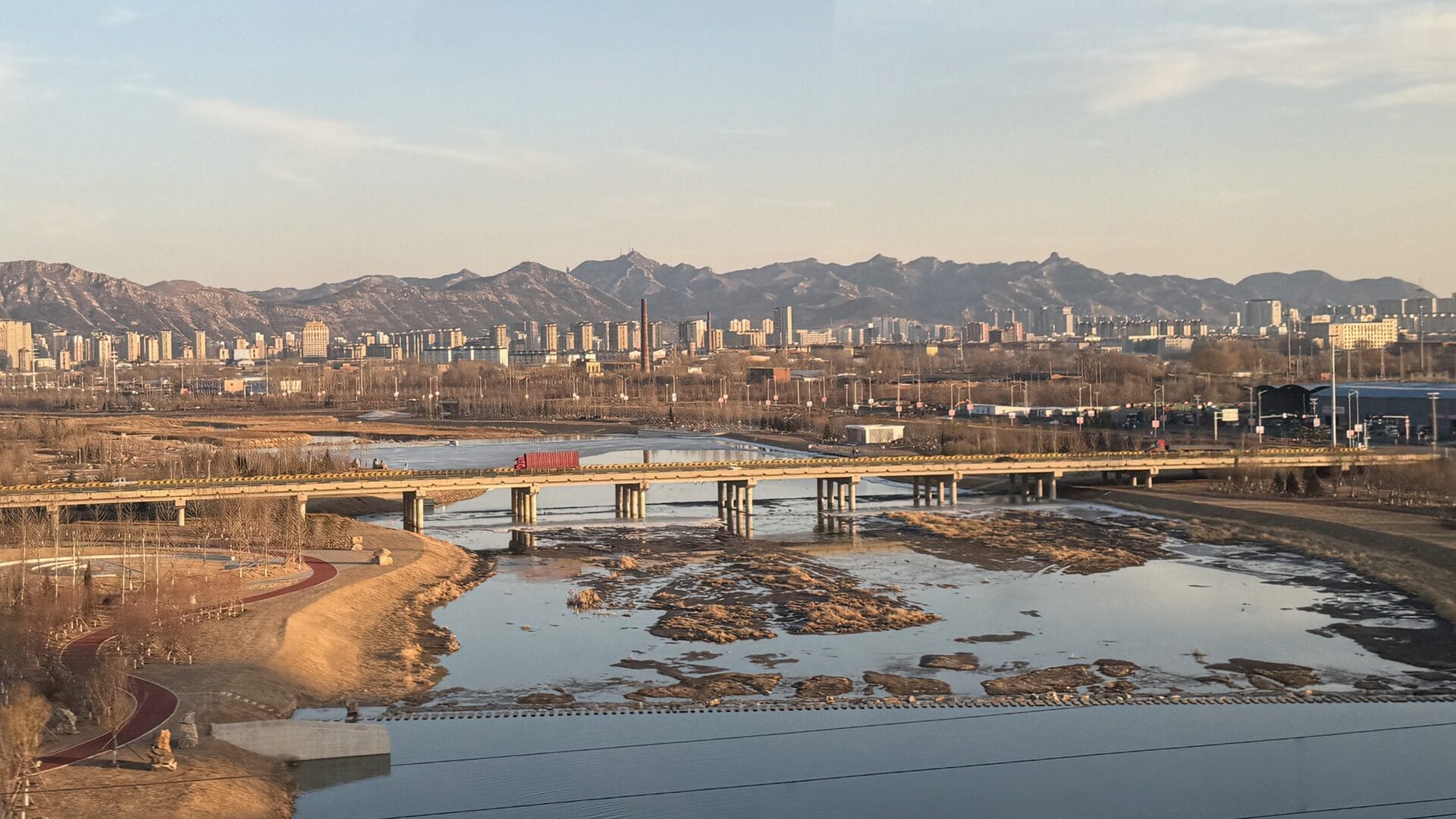
Different landscapes, different climate: here’s my journey from Harbin to Beijing, 1,300 km. I saw frozen, brown, lightly snow-covered landscapes, because the climate is relatively dry.
The terrain is flat except just before arriving in Beijing. I found this journey harsh, but more interesting than between Beijing and Nanjing.
Chongqing — Guangzhou 1,300 km in 6 h 10: more cheerful subtropical scenery
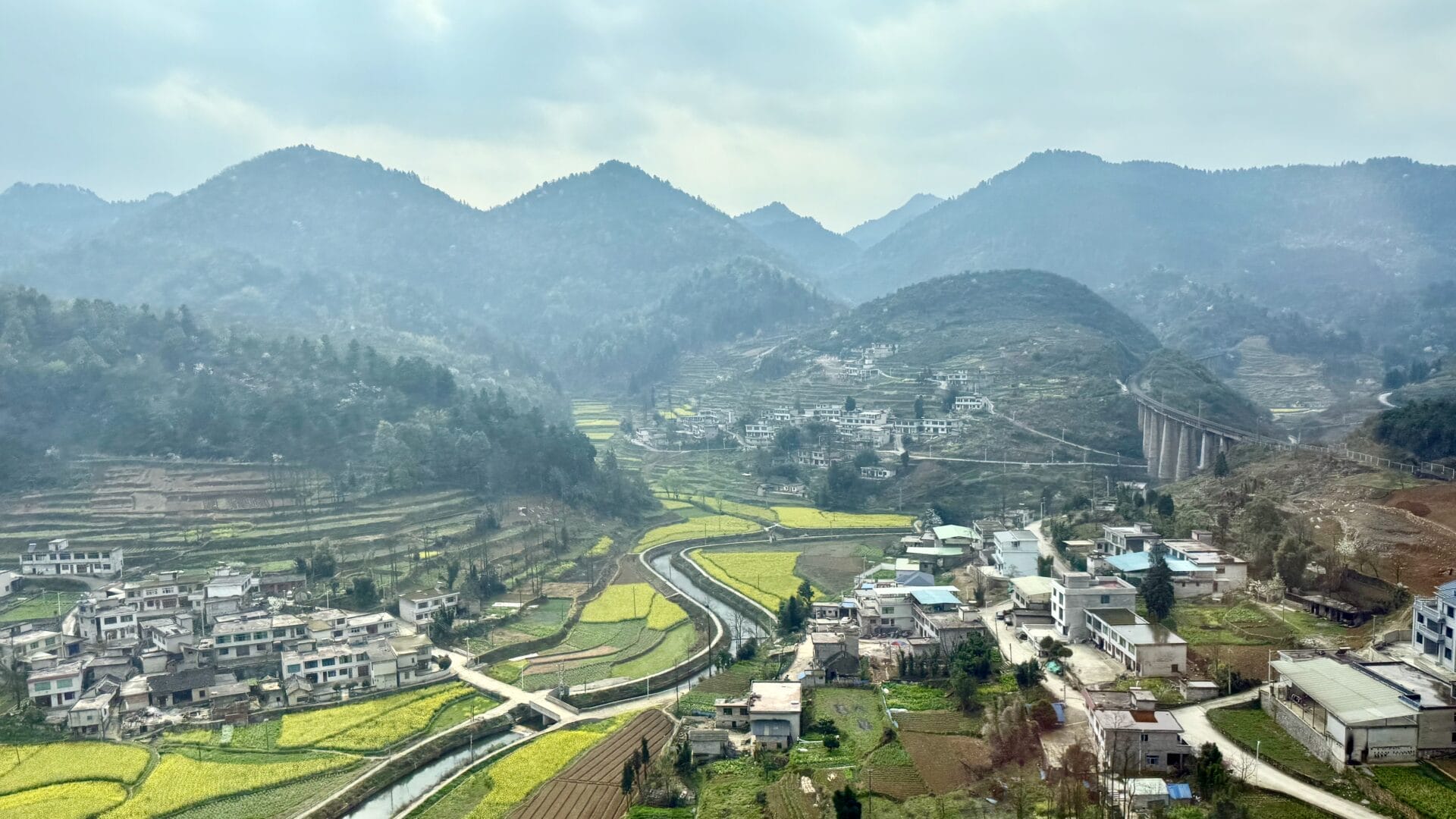
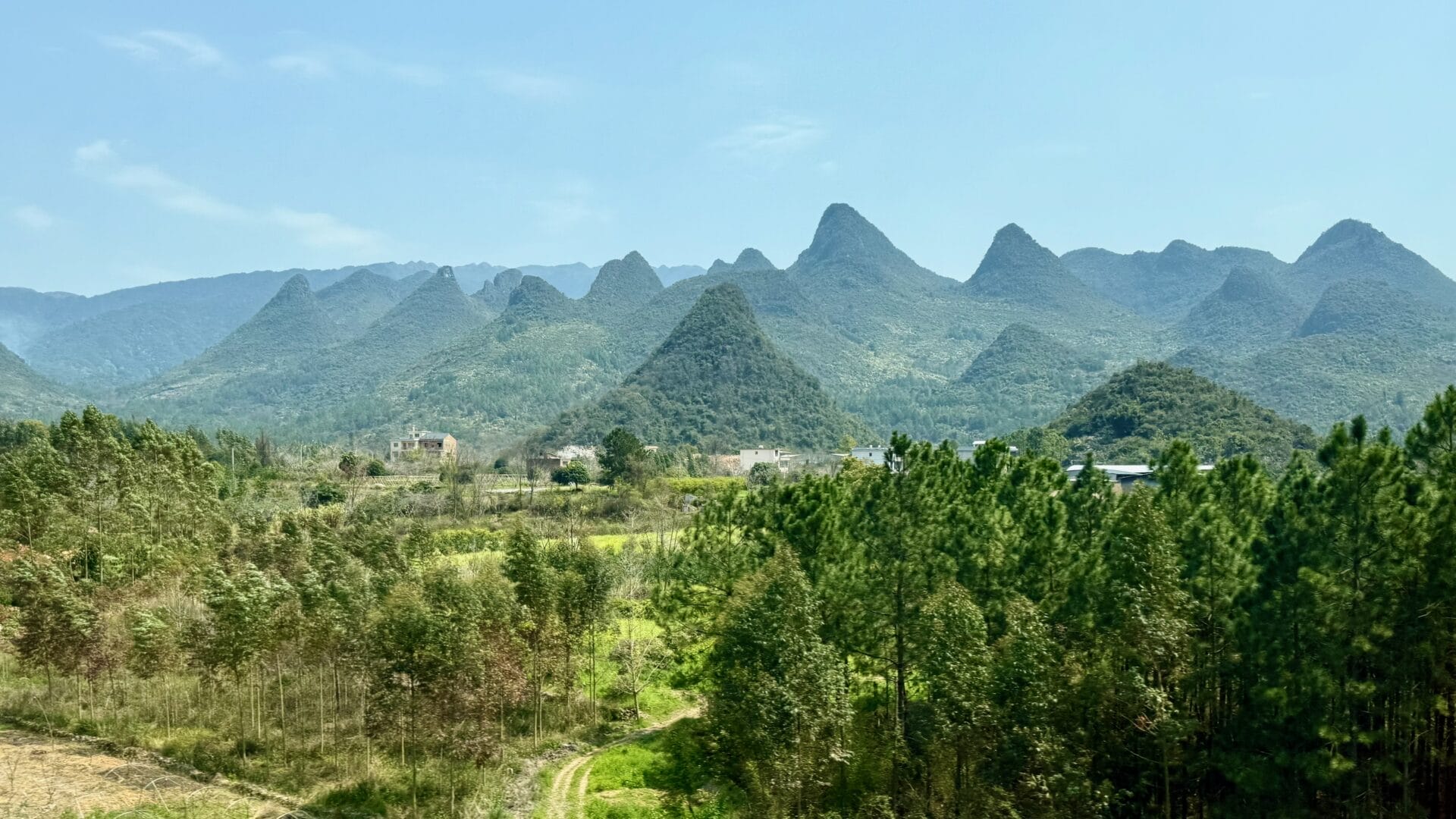
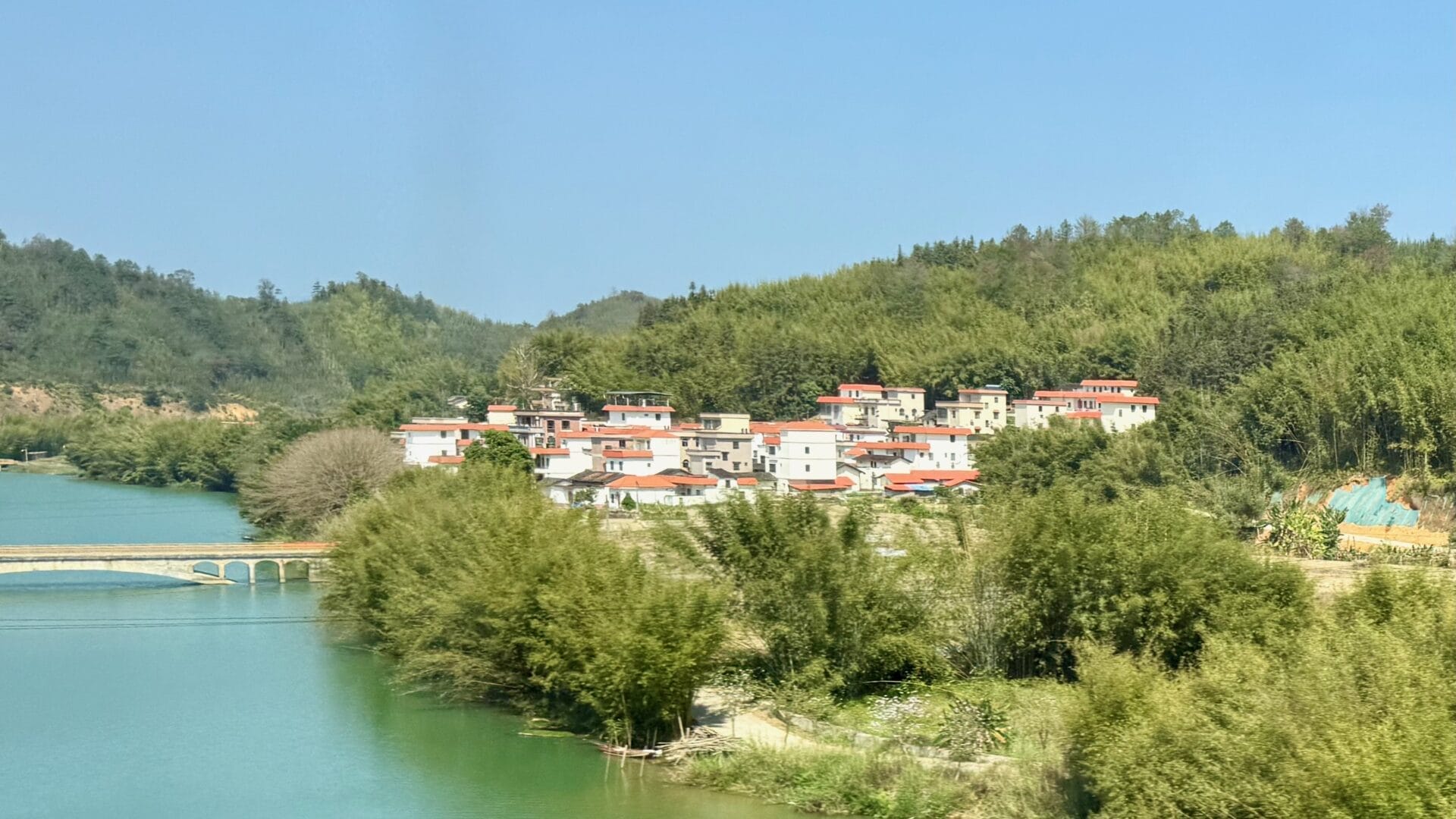
At the same time of year, my most beautiful journey was from Chongqing to Guangzhou. The route is a succession of bridges and tunnels through a mountainous, green region. The climate is subtropical and very humid. You discover lots of rivers, rice paddies and bodies of water.
The villages seem more cheerful and charming than in the east and north of the country. After crossing the misty mountains of Guizhou, you reach the famous karst limestone peaks around Guilin.
0 Comments