
From Paris to Portsmouth via Le Havre as a prelude to our transatlantic crossing
Crossing the Atlantic from Le Havre: a childhood dream
When I was a child, in the 1960s, I lived in Le Havre, home port of the legendary liner France.
A few years earlier, my mother, at 18, had embarked on an unforgettable crossing from Marseille to Tahiti. This adventure, which I discuss in another article titled "Voyage from Marseille to Tahiti in 1951: Logbook", had given her a taste for grand voyages. From the window of our apartment in Le Havre, she enviously watched the elegant silhouette of the France as it set off for Southampton, then New York.
For her, as for so many French people, the great crossing remained an inaccessible dream: a promise of glamour, cinema, and high-society encounters, but reserved for an elite. I grew up immersed in this imagery.
Sixty years later, I decided to cross the Atlantic myself. In June 2025, my spouse and I departed Le Havre aboard the Commodore Clipper, before boarding the Queen Mary 2 in Southampton. Destination: New York. A legendary crossing, a blend of nostalgia and fascination, where my childhood memories intertwined.
But, like many travelers from the golden age of transatlantic liners, we began our journey at Saint-Lazare station in Paris.
- Paris Saint-Lazare: a commuter train station with a prestigious past
- Le Havre: a city facing the Atlantic
- Aboard the Commodore Clipper, from Le Havre to Portsmouth
- Portsmouth: a city facing the sea
- What are our thoughts on our English Channel ferry crossing and visit to Portsmouth?
I conclude this article with practical tips to help you make the most of this journey as a prelude to our transatlantic crossing, which you can discover in this article: "Southampton – New York aboard the last transatlantic liner: the Queen Mary 2".
Paris Saint-Lazare: a commuter train station with a prestigious past
In the early afternoon, on a day in June 2025, we head to Saint-Lazare station to begin our grand journey from Paris to New York by land and sea. We will take the train to Le Havre, then an overnight ferry to join the Queen Mary 2, which departs from Southampton.

The Grand Hôtel Terminus at Saint-Lazare Station
Only the imposing hotel, with its typical Haussmannian architecture, built on the station's forecourt, still harks back to the era of transatlantic liners. It dates back to 1889 and was inaugurated for the famous Universal Exhibition. Its facilities, ultra-modern for the era, included electricity, telephones, and luxurious bathrooms, which were still rare. This was the Grand Hôtel Terminus, now known as the Hilton Paris Opéra.
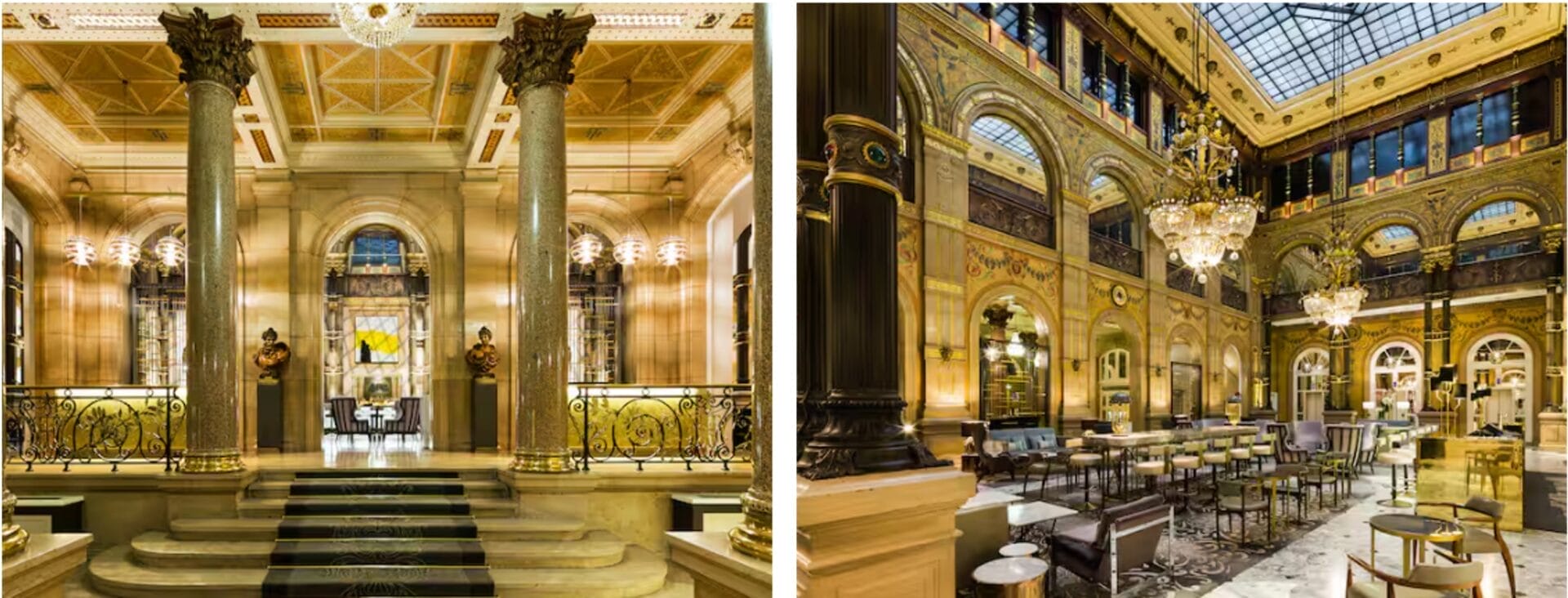 Source: Hilton
It was the departure point for affluent travelers to the New World. They accessed their trains via a walkway that led them directly to the station. Dedicated trains, with Pullman cars, took them either to the port of Cherbourg (the New York Express) or to Le Havre (the Transatlantic Express), to embark on prestigious liners like the Normandie.
From Paris to Le Havre by train: the landscapes of the Impressionist painters
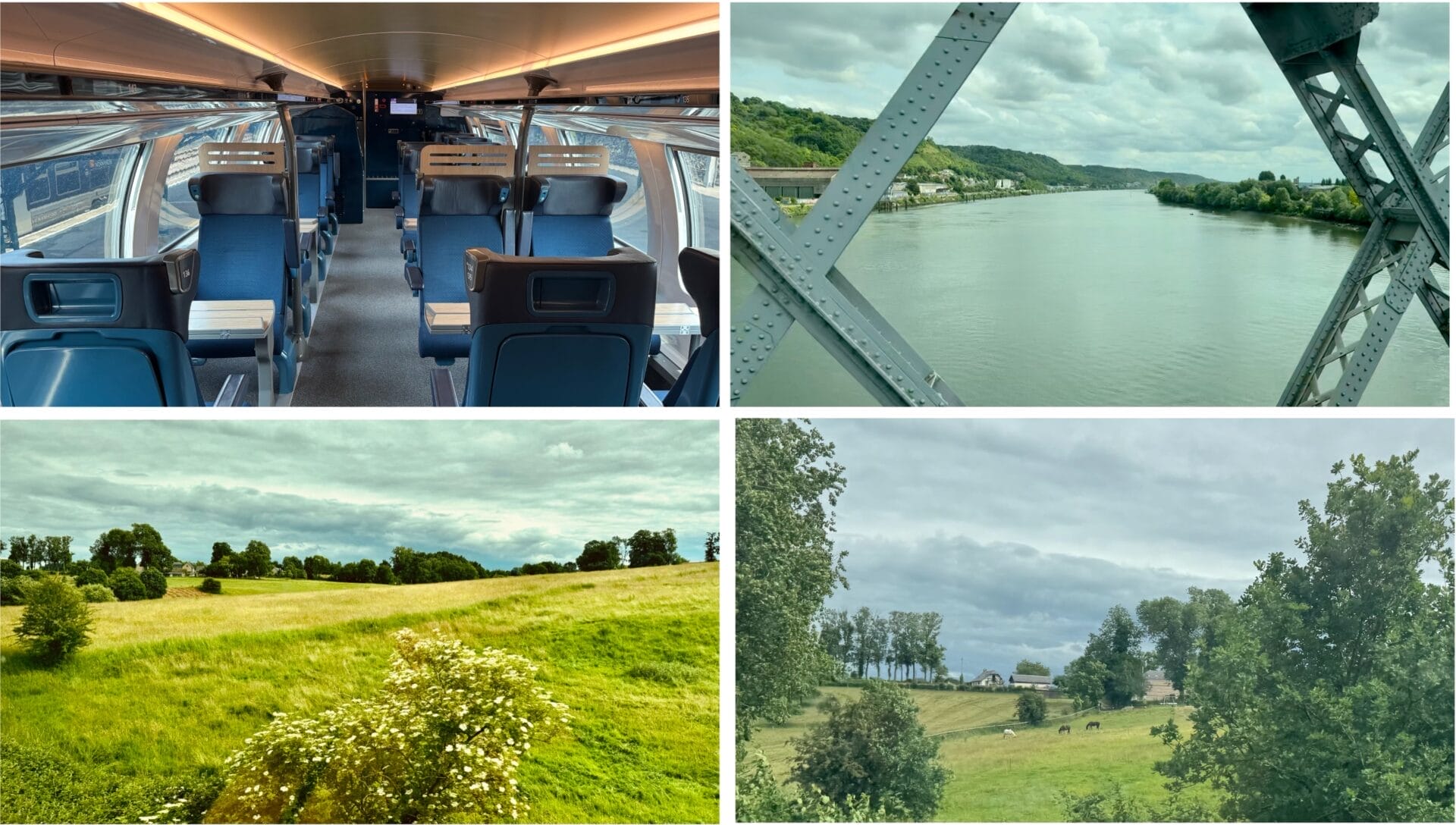
But today, we feel like intruders, mingling with the large crowd of travelers who, without enthusiasm, take the countless daily trains, mostly returning to the Parisian suburbs. We depart, comfortably seated in first class, aboard a Nomad train, to reach Le Havre in just over two hours, with images of the prestigious past in our minds.
Our train regularly runs along the Seine, making a brief stop in Rouen before our arrival in Le Havre. The Norman countryside unfolds before our eyes, between sun and clouds. It's not hard to understand why the unique light and the shimmering colors of spring could have charmed the Impressionist painters.
Le Havre: a city facing the Atlantic.
After leaving our luggage at a restaurant that offers a baggage storage service, we take a stroll through the city center's pedestrian area and along the waterfront. We had previously visited Le Havre, which I describe in more detail in another article titled "Honfleur, Le Havre: two ports, two destinies".
A city entirely destroyed during World War II
Le Havre is a city facing the sea, as evidenced by the imposing visual presence of its port. It's a city I find interesting, even though it was almost entirely destroyed by Allied bombings in 1944.
It was rebuilt by a French architect, Auguste Perret, almost entirely in concrete. While the people of Le Havre struggled to adapt to this new urban planning, they eventually embraced it over the years. Today, Le Havre is a UNESCO World Heritage site.
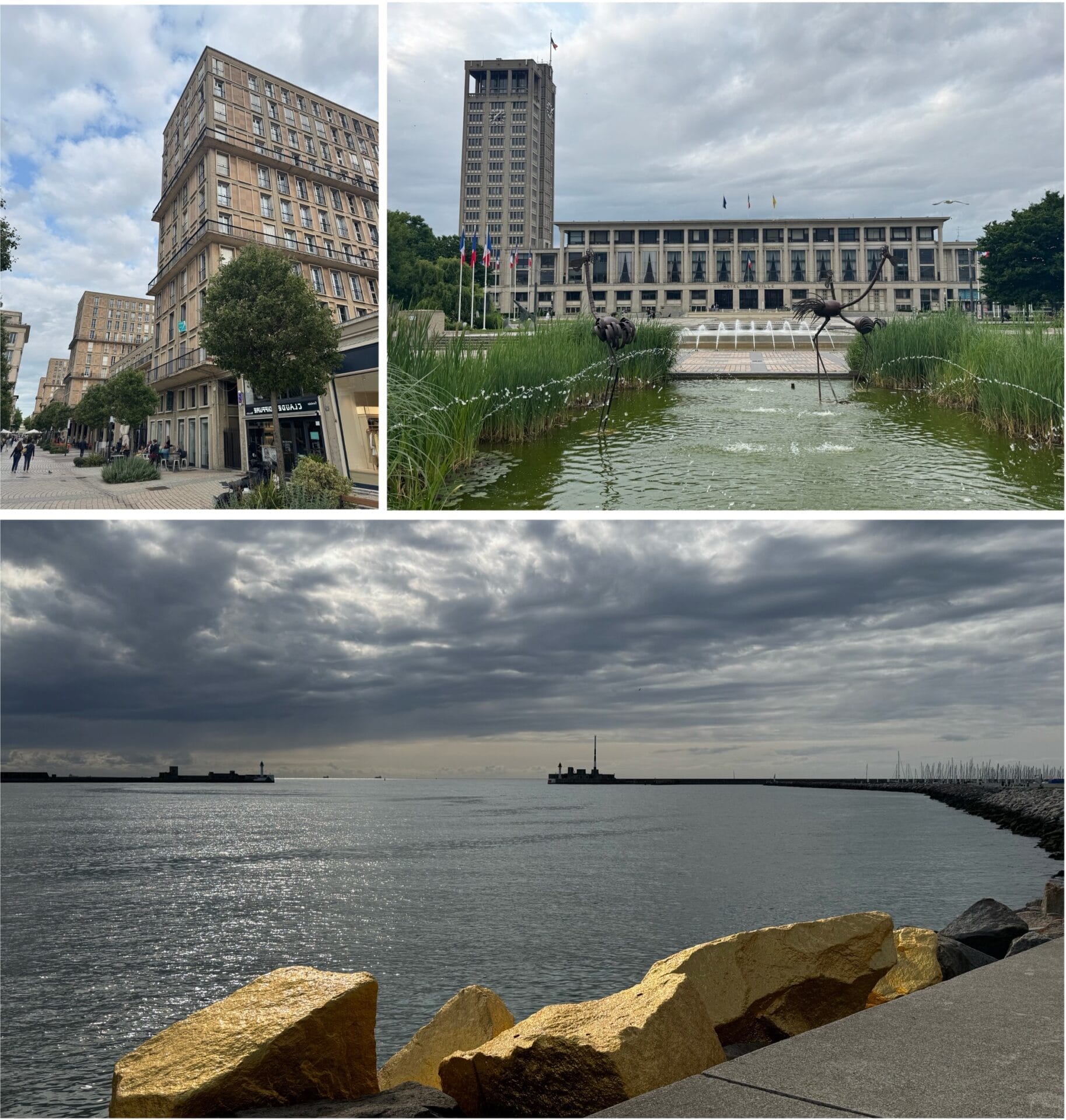
The surprising Saint-Joseph Church
We spare a thought for the travelers of the past, awaiting their liner after disembarking from their train. Some were migrants, and we imagined them wandering through the city for a few hours before embarking, sometimes forever, towards a new continent and a new life. The pre-war city, however, was very different from today's.
In late 19th and early 20th-century Europe, many migrants would stop to pray in a church, anxious about whether their future would be better than the life they left behind. We also visit a church to admire the surprising Saint-Joseph, with its 107 m-high bell tower, which gives the impression of being a lighthouse.

Aboard the Commodore Clipper, from Le Havre to Portsmouth.
Before heading to the ferry terminal, we go to see the France... or at least what's left of it: its bow! A tribute I found almost disrespectful, given how legendary the ship was.
Our first maritime leg begins with an overnight crossing between Le Havre and Portsmouth. Departure is scheduled for 9 PM and arrival the next day at 7 AM. We make the journey aboard the Commodore Clipper, a Brittany Ferries vessel. It's not very large, with a capacity of 300 cars and only 39 cabins.

A ferry designed for truckers
In the boarding lounge, only about ten foot passengers are waiting for a minibus to take us aboard. This makes us feel like VIPs. It's worth noting that the ferry is mainly used by truckers, who board directly with their trucks. They are the ones Brittany Ferries has decided to pamper.
As we departed, it was not without a particular emotion that I watched Le Havre recede, under a subtle sunset that managed to break through the clouds. I tried to spot the balcony from where my mother used to watch the France glide towards unknown horizons!
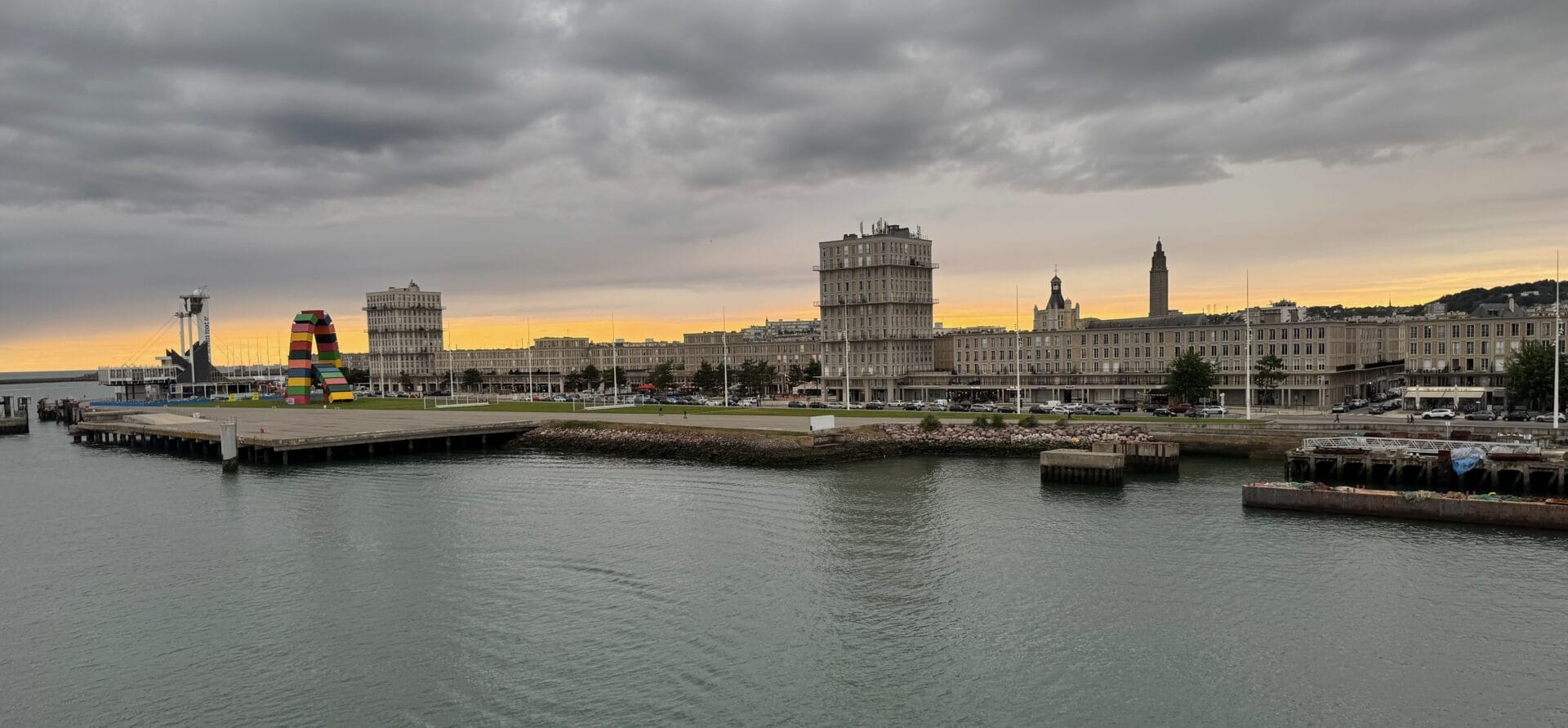
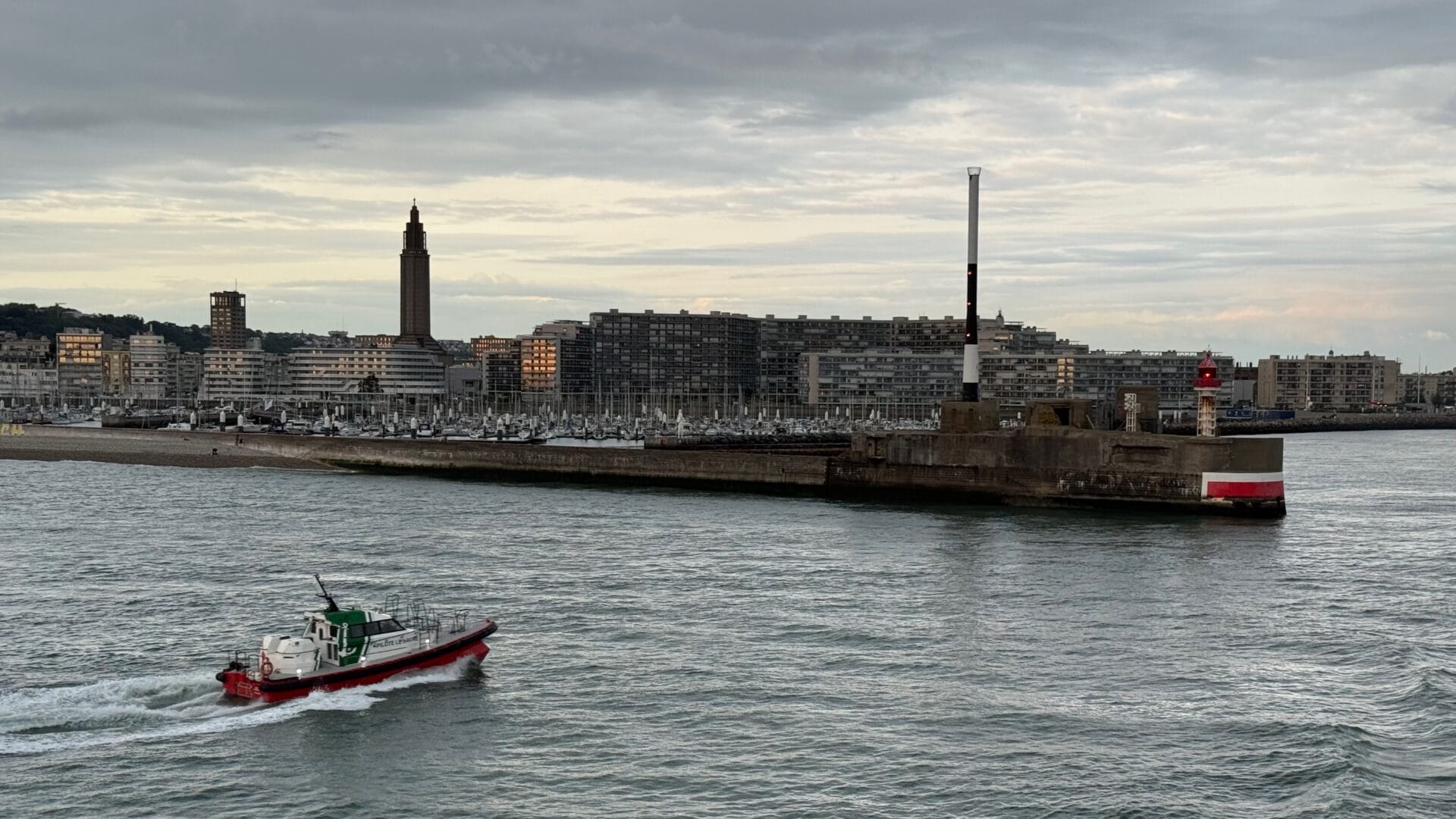
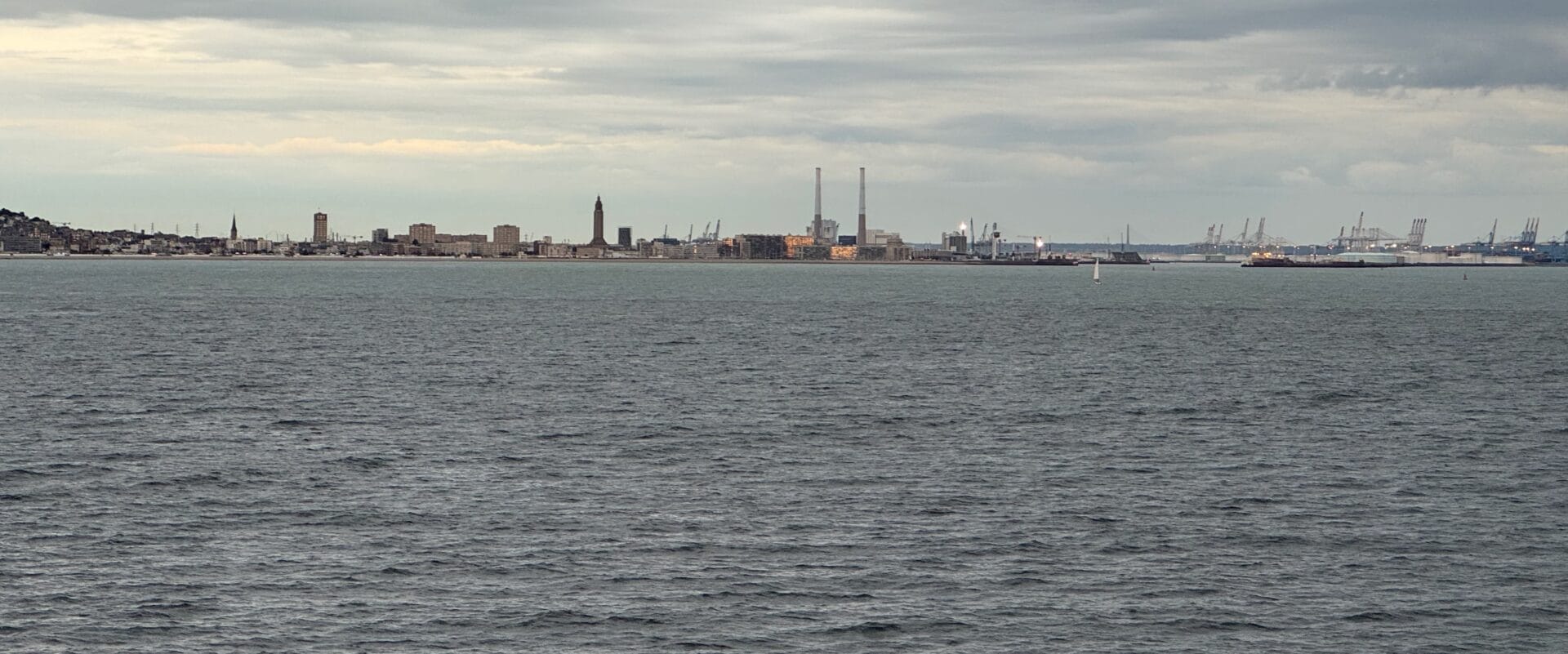
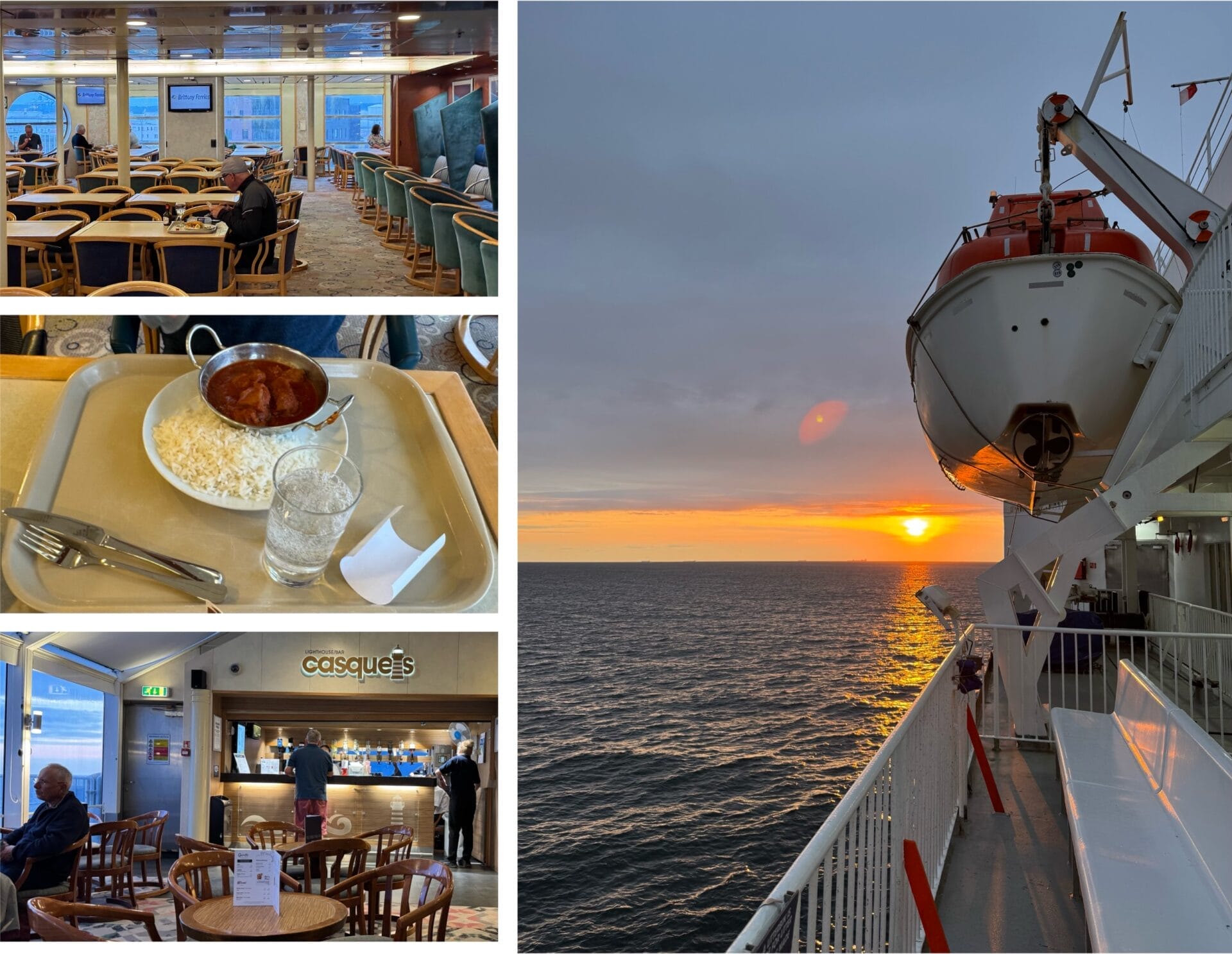
The Commodore Clipper is a ferry that was built in 1999. It belonged to the Condor company, which was acquired by Brittany Ferries. It only has 39 cabins and can carry a maximum of 120 cars.

We quickly explore the Commodore Clipper, whose layout is primarily functional. Despite the ferry's small size, we were pleasantly surprised to find a restaurant on board. Our meal was vaguely inspired by Indian cuisine, reinterpreted by a British chef. Suffice it to say it wasn't exceptional, but it filled us up.
We then spent our evening in the comfortable ship's bar, drinking a beer or a whisky, in the company of the truckers.
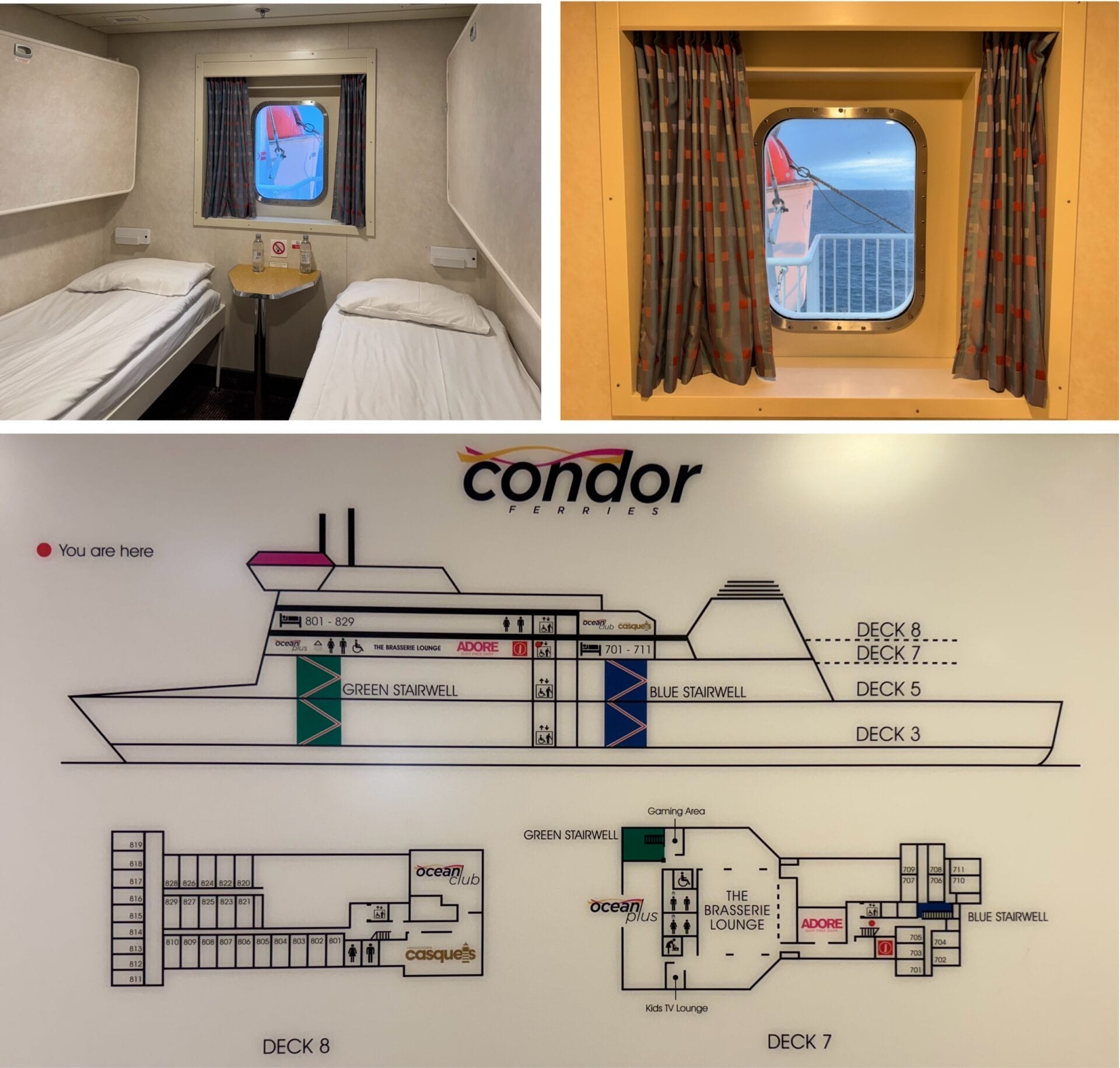
The cabin is small but functional, with its private shower room and toilet. A map of the Commodore Clipper clearly shows the small size of the ship.
Portsmouth: a city facing the sea
After a good night's sleep, we arrive in Portsmouth in the early morning, in the rain. Typically English weather, even though it's already early summer!
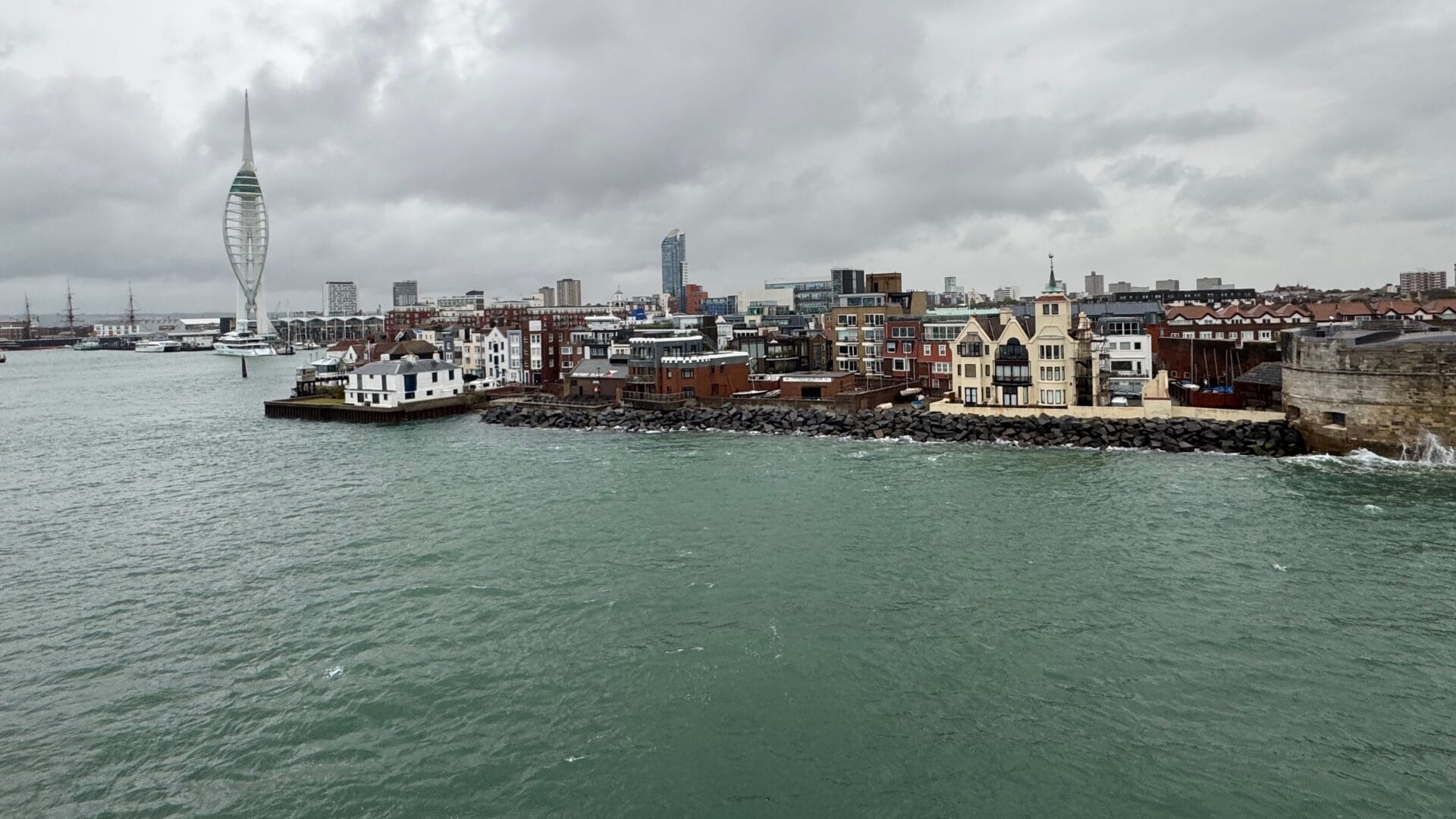
Before docking, we sail past the military naval base, with numerous vessels, including the aircraft carrier HMS Queen Elizabeth, which was undergoing extended maintenance at the time.

We could have had breakfast on board, but given the early arrival time, set at 7 AM, and to allow ourselves to sleep longer, we decided to have it later at our hotel.
Portsmouth and Southampton: Ports with exceptional geographical locations
Portsmouth and Southampton, located only about 30 kilometers apart, benefit from an exceptional location for hosting both military and commercial ports.
Indeed, Portsmouth's port is located in a very well-protected natural bay. Southampton's benefits from the broad estuary of the River Test.
Furthermore, both ports are protected from major storms thanks to the presence of the large Isle of Wight, which acts as a natural breakwater.

Both ports are located in the middle of the English Channel, at the place known as the 'double tides'. Indeed, when the tide is high in the east, at Dover, it is low at the western tip of Cornwall. Southampton and Portsmouth, located halfway, then benefit from two attenuated low tides at the time of reversals. This phenomenon facilitates access to the ports for ships with deep drafts.
Finally, Southampton and Portsmouth are located less than an hour from the capital, London, and its enormous economic appeal.
The two cities are among the most strategic locations of the United Kingdom's former maritime and colonial power.
Nostalgia at the Queens Hotel
After a quick disembarkation, we take a taxi to the Queens Hotel, located in the residential area of Southsea. We chose it for its historical character: it features Edwardian-style architecture, dating from the late 19th century.
We could thus imagine ourselves as wealthy bourgeois from the 1930s, having taken a ferry from the continent before embarking on a first-class transatlantic crossing. We have breakfast in the beautiful dining room of the Queens Hotel. In the company of elderly English men and women in old-fashioned attire, we find the illusion almost perfect!

Being in Portsmouth on June 5th is not just any date!
We arrived on June 5th, a date laden with heavy symbolism, as it was on that day in 1944 that the Allies began the D-Day landing operations on the beaches of Normandy, which would take place the following day.
We begin our visit to Portsmouth with the fascinating D-Day Museum ((D Day story museum). Rich and highly educational, it helps to understand better what the young soldiers must have felt during this extraordinary military operation.

In the same museum, we also admire the Overlord Tapestry, which tells the story of the D-Day landings in the form of an 83-meter-long embroidery, echoing the famous Bayeux Tapestry.

Portsmouth: a city damaged during World War II
Due to its naval base, Portsmouth was not spared from the bombings of World War II. As a result, its architecture lacks homogeneity and its old town is quite limited. Therefore, it's not a city one immediately falls in love with, especially not in the rain.
To best discover it, follow the 'Millennium Promenade', which connects Southsea, home to the D-Day Museum, to the Portsmouth Historic Dockyard.
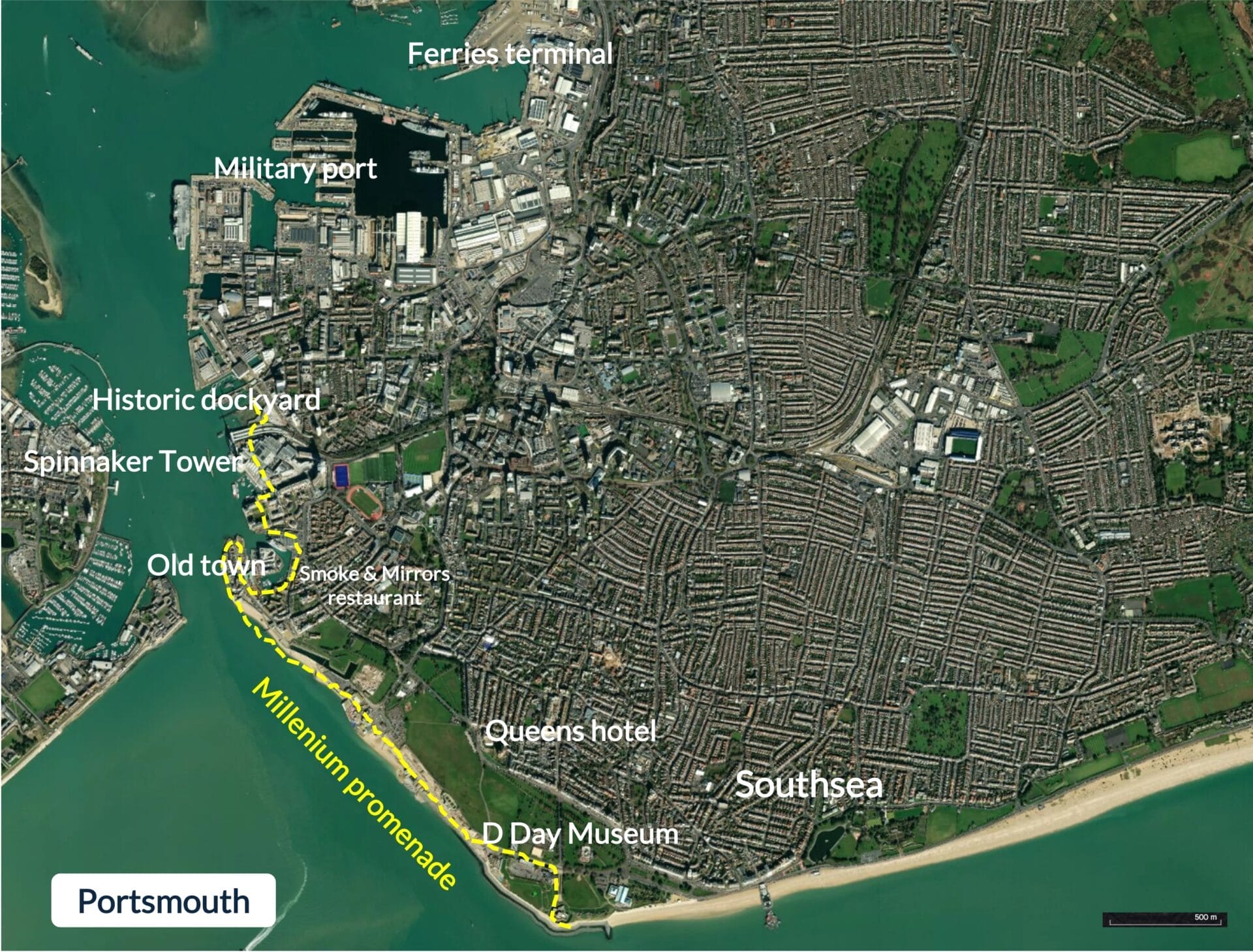
We start our walk at the D-Day Museum, right next to Southsea Castle, one of the many forts built since the 16th century to defend the port. Then an immense lawn opens up, Southsea Common, today used in summer for events like funfairs.
Throughout the walk, we are fascinated by the incessant ballet of ferries. The smaller ones head towards the Isle of Wight, a popular holiday destination for the English. The larger ones set course for France or Spain. On the beach, we can almost touch them.
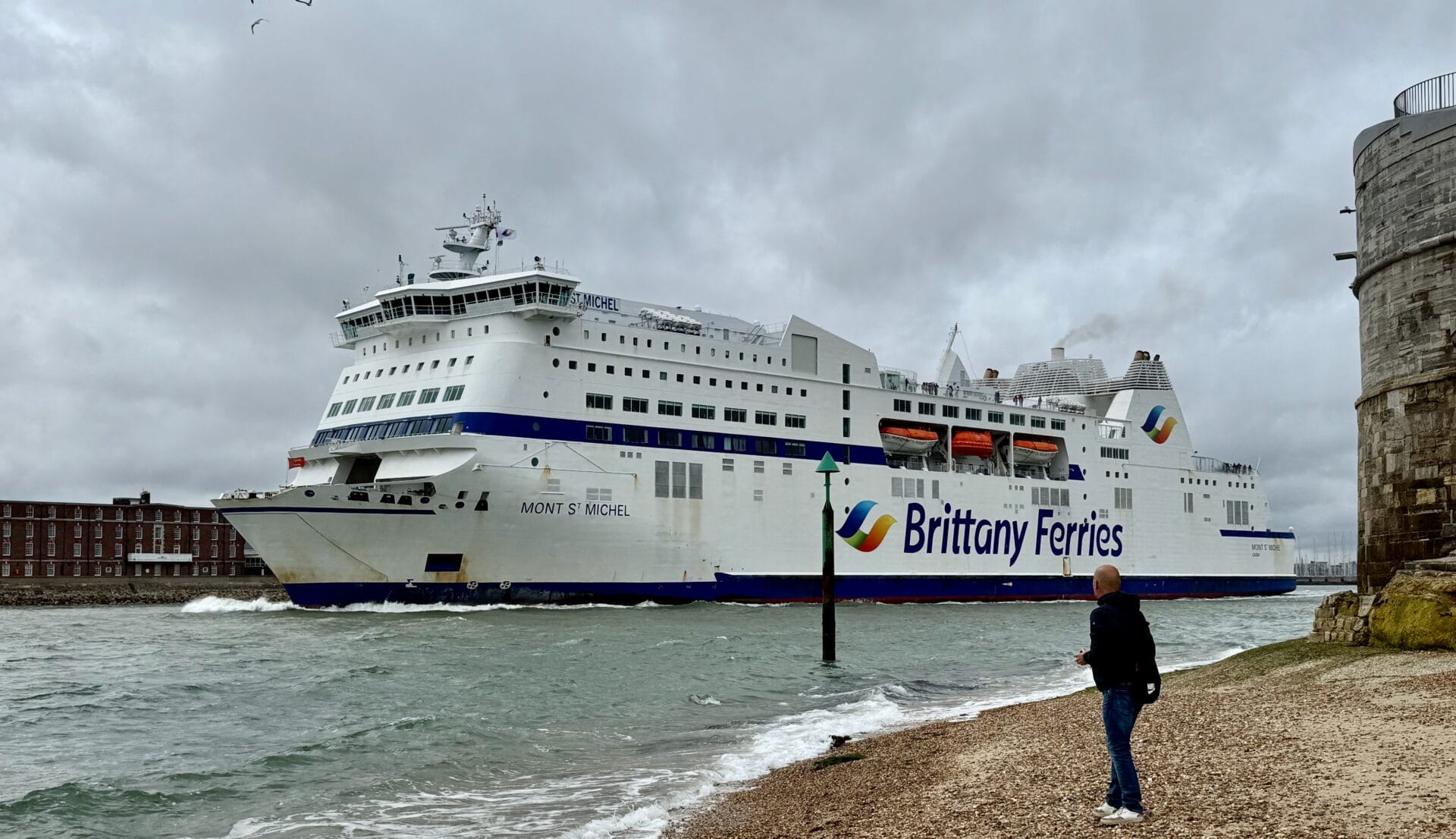
We then reach the Square Tower, built in 1494 as a defensive tower equipped with cannons to protect the city. It was part of a set of ramparts, of which only a few traces remain today.
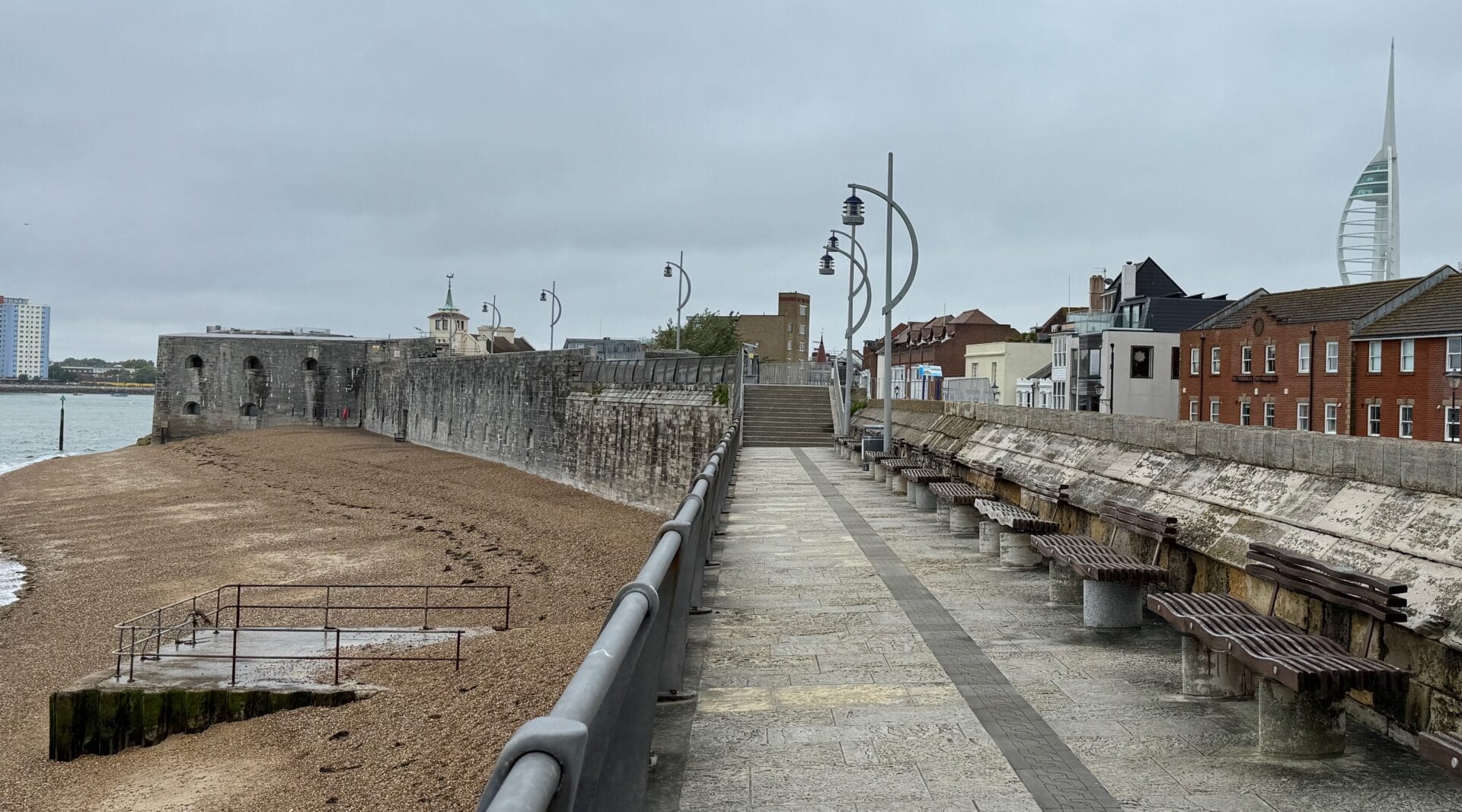
We finally arrive in the old town, Old Portsmouth, which consists of only two cobbled streets by the sea. One needs to make a real effort of imagination to visualize the city in Admiral Nelson's time!

The Spinnaker Tower: the city's proud landmark
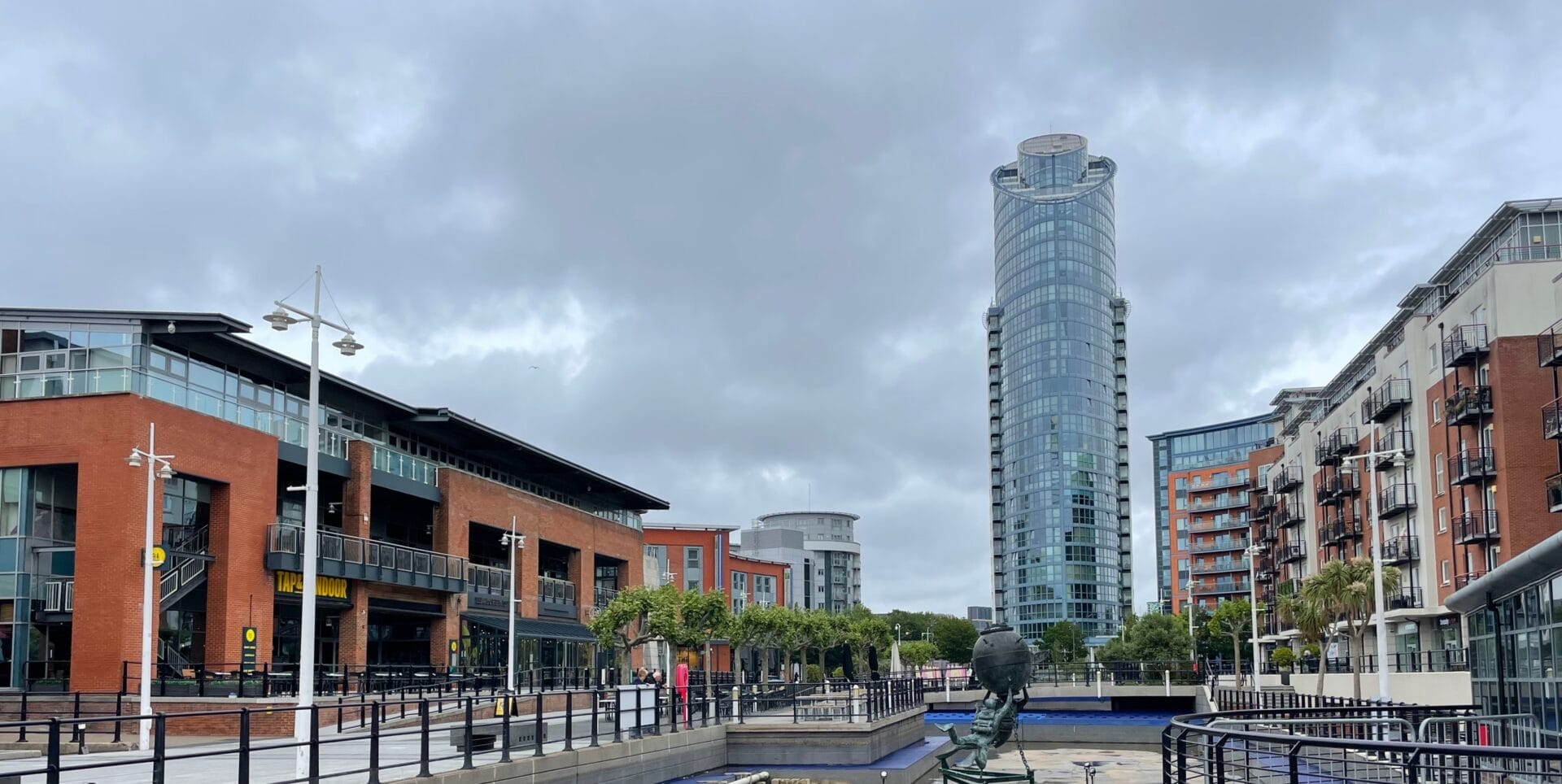
We then head towards the Spinnaker Tower, which overlooks the city from a height of 170 m. Its shape, evoking a ship’s sail, is elegant and, all things considered, reminiscent of the Burj Al Arab hotel in Dubai. As visibility wasn’t very good, we decided not to go up.

Right next door, we continue our stroll through the shopping center of Gunwharf Quays. A former military site where weapons and ammunition were manufactured and maintained, it now mainly houses outlet stores for major clothing brands, attracting customers from afar for their attractive prices. There are also many pubs and restaurants, and the overall redevelopment is quite successful.
Portsmouth Historic Dockyard: a tourist destination in itself
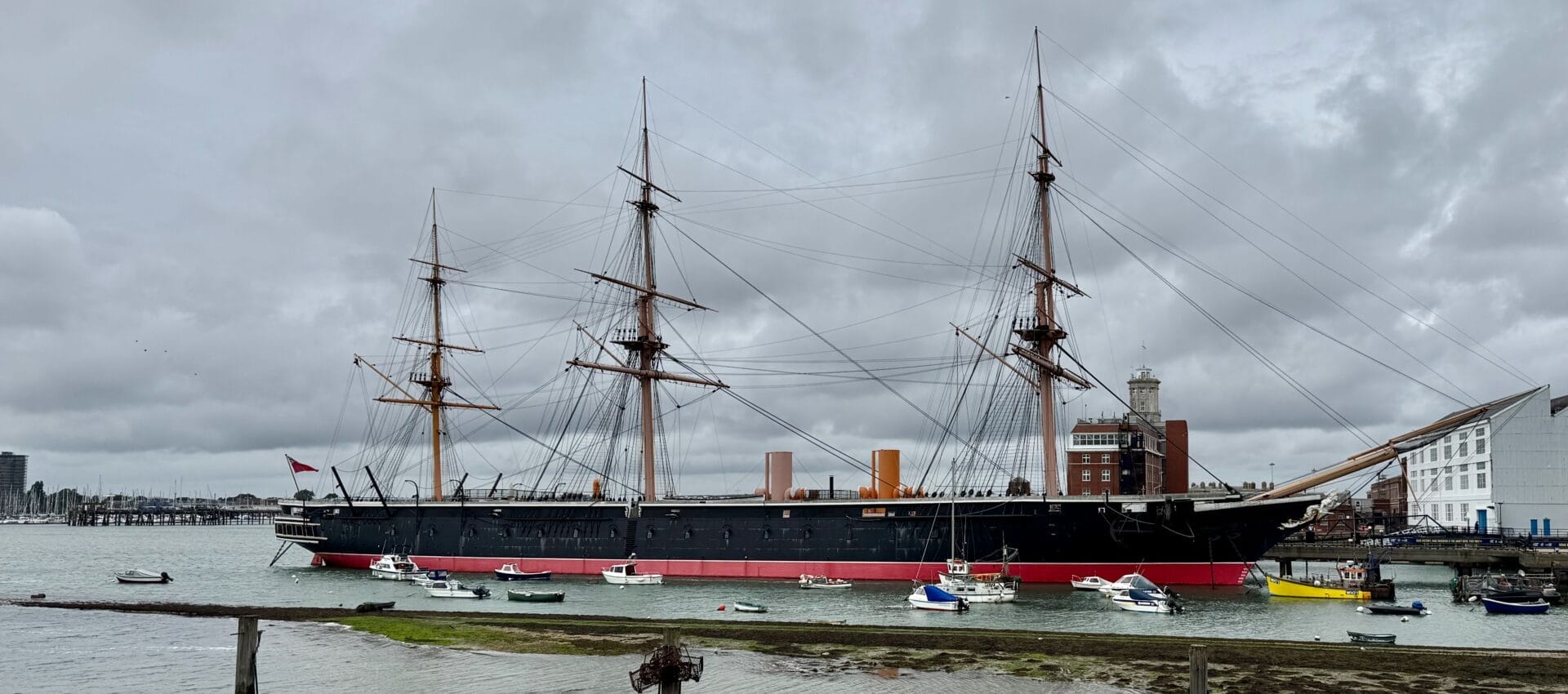
We end our walk at the gigantic Portsmouth Historic Dockyard, a vast complex of museums dedicated to British naval history, with several historic ships docked. It’s a unique place, dedicated to nearly five centuries of Royal Navy maritime adventures.
The museums offer a promising immersion, but it would have taken us several days to see everything. Moreover, the pricing proves prohibitive for a short visit. Indeed, the entrance ticket is 51 GBP. It's expensive, but in return, it's valid for a year.
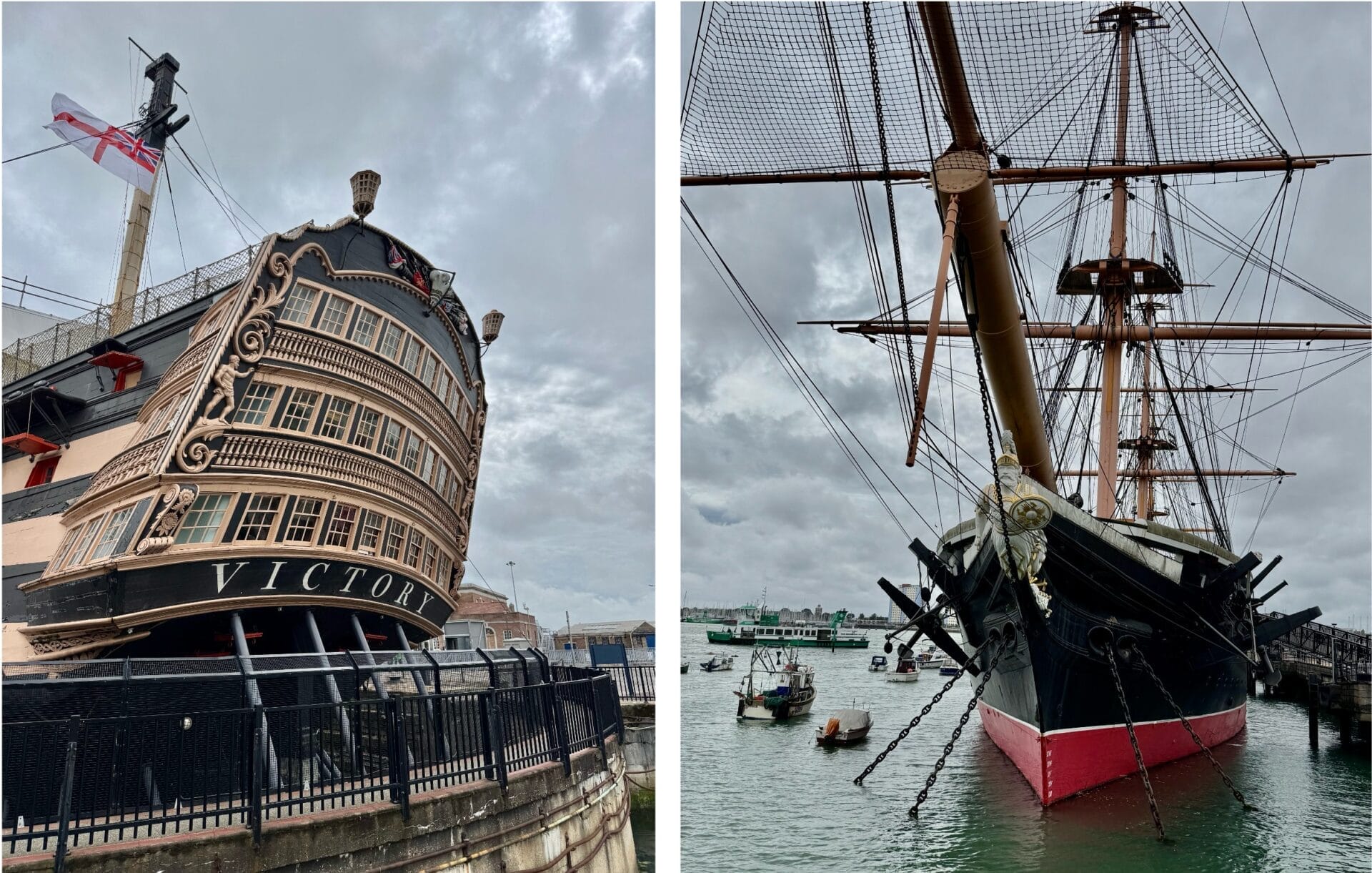
We therefore content ourselves with admiring, for free, from the quays, two iconic ships: the HMS Victory, Nelson's flagship, and the HMS Warrior, the first ironclad sailing and steam battleship.
Southsea Beach: Portsmouth's chic and residential district
In the evening, we dine at a pleasant restaurant in Southsea, “Smoke and Mirrors“, run by Chef Jordan Thompson. This independent restaurant is a welcome surprise in a country largely dominated by chains, where the cuisine is often unoriginal, if not bland.

The next day, we take one last stroll along Southsea beach, under a glorious sun that has finally returned.
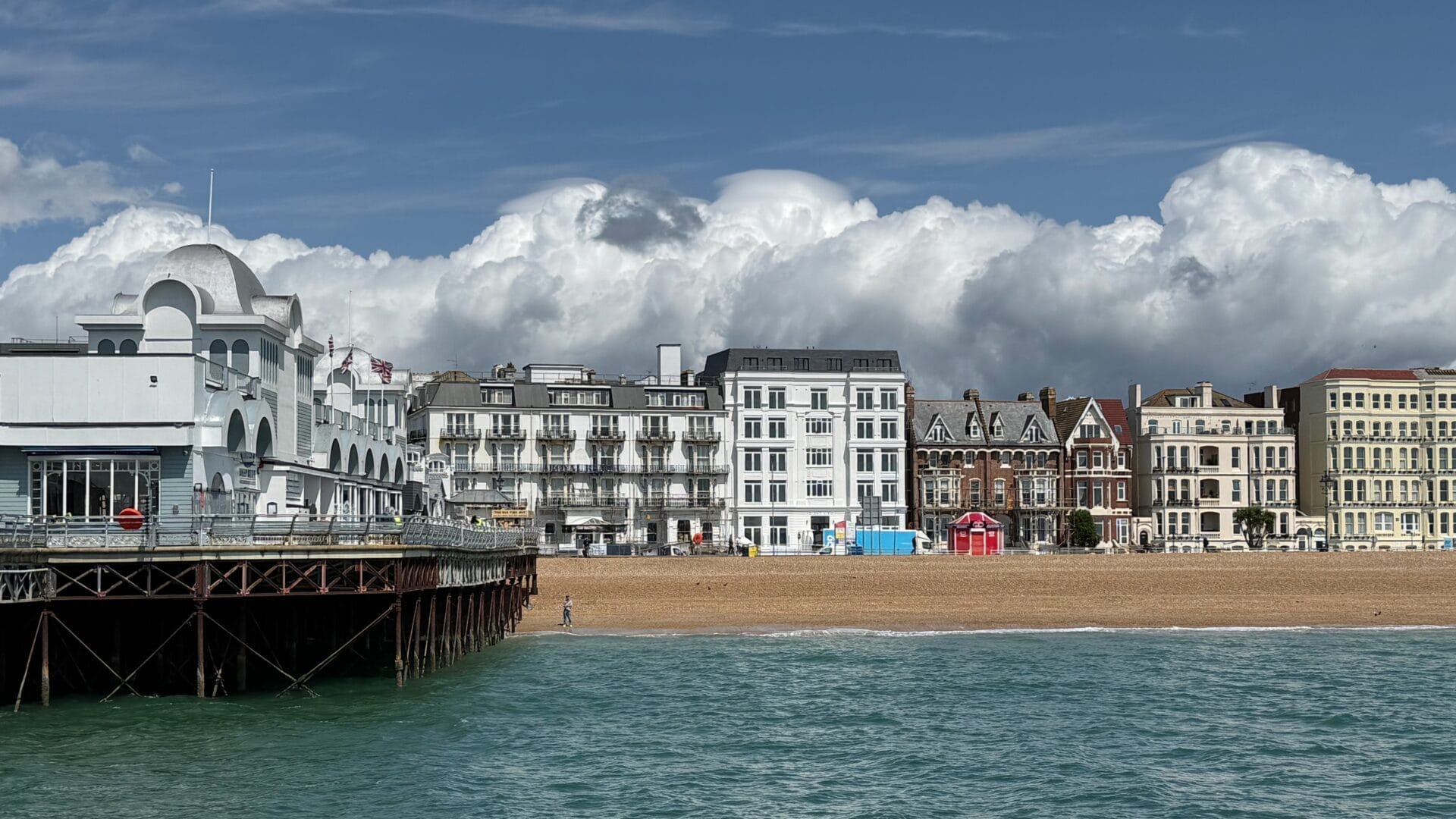
Beautiful Victorian-style villas line the seafront.
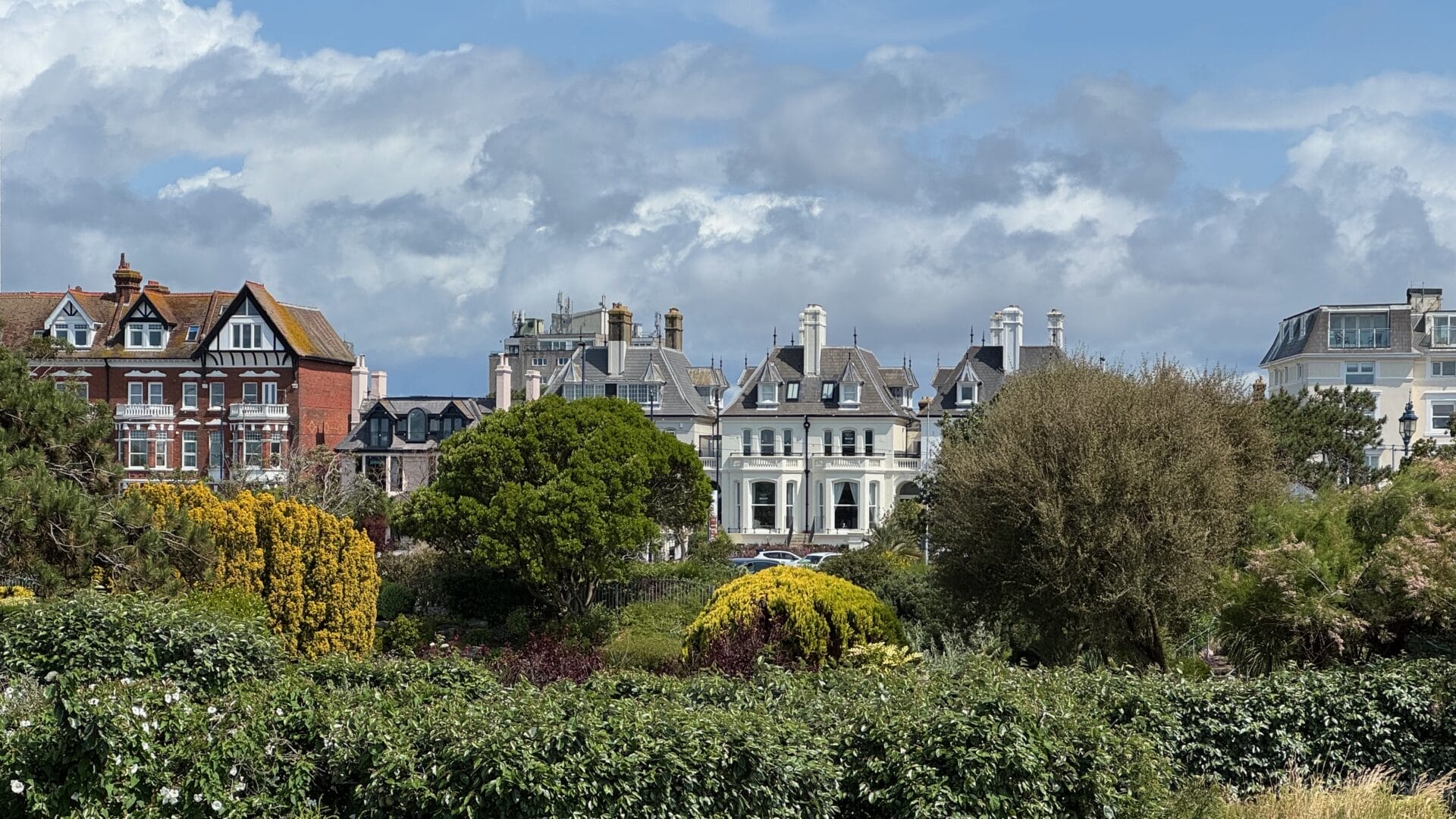
Continuing east, the beach becomes a little wilder, with a naturist area at its far end, which is somewhat unusual in Great Britain. But we didn't have time to go that far.
However, it's time to hop in a taxi to Southampton, the starting point of our transatlantic crossing. The rest of our travel story is told in my second article: "Southampton – New York aboard the Queen Mary 2". A legendary journey!
What are our thoughts on our English Channel ferry crossing and visit to Portsmouth?
Starting from Paris, if you wish to cross the Atlantic with the Queen Mary 2 from Southampton, I highly recommend going via Le Havre and Portsmouth. I find this much more interesting than traveling by plane or Eurostar to London before joining the Queen Mary 2 in Southampton by bus or train.
This itinerary allowed us, right from Paris, to immerse ourselves in the atmosphere of a rail-and-sea journey of yesteryear, fully embracing the retro and slow-travel spirit of our grand transatlantic crossing.
Unless you wish to explore its main tourist site, the Historic Dockyard, one day in Portsmouth seems sufficient to discover it.
Practical tips for your English Channel crossing and visit to Portsmouth
How to get from Paris to Le Havre by train?
The modern and comfortable Nomad trains belong to the Normandy region and are operated by SNCF.
There are many connections between Paris and Le Havre, but to get good prices, you need to book in advance.
Finding luggage storage in Le Havre (or elsewhere)
There are now apps that allow you to find luggage storage, most often offered by a restaurant, hotel, or shop.
How to get by ferry from Le Havre to Portsmouth?
Only one ferry company operates the Le Havre-Portsmouth route: Brittany Ferries
Given the small number of cabins, you need to book well in advance. The price varies by season. For a double cabin, it starts at 240 EUR without meals.
Getting to and from the ports of Le Havre and Portsmouth
The ferry is easily accessible on foot from Le Havre city center. Otherwise, a taxi won't cost you much given the short distance from the train station.
In Portsmouth, the ferry terminal is slightly out of the way, and a taxi is the best solution to get into town.
Where to stay in Portsmouth?
In theory, it's possible to arrive early in the morning by ferry and go straight to Southampton to board the Queen Mary 2. However, I recommend staying one night in Portsmouth as a precaution.
We chose the Queens Hotel for its Victorian charm and its location in the residential area of Southsea.
Check the weather forecast!
Few websites provide weather forecasts for oceans and seas. Windy is the most comprehensive in this area.
In Great Britain, the governmental weather website is the most reliable
Have a good trip!
Bon voyage!
0 Comments