
Journey from Marseille to Tahiti in 1951: logbook
In 1951, at the age of 18, my mother, Colette, traveled from Marseille to Tahiti aboard the Changchow, a ship of the Messageries Maritimes company. She recounted her journey in a logbook.
Colette's Logbook
In 1951, Colette, my mother, left for a year in Tahiti as an au pair to accompany friends.
She left Marseille by boat and recounted her crossing using a very detailed logbook, with photos and documents she gathered during the voyage.
Going to Tahiti in 2023 remains an exceptional journey that few people undertake. So, you can imagine that this was even more true in 1951!
I felt a particular emotion reading her logbook because it now holds historical value. In this blog post, I have therefore tried to recreate the spirit of this crossing on the Changchow as she experienced it at the time!
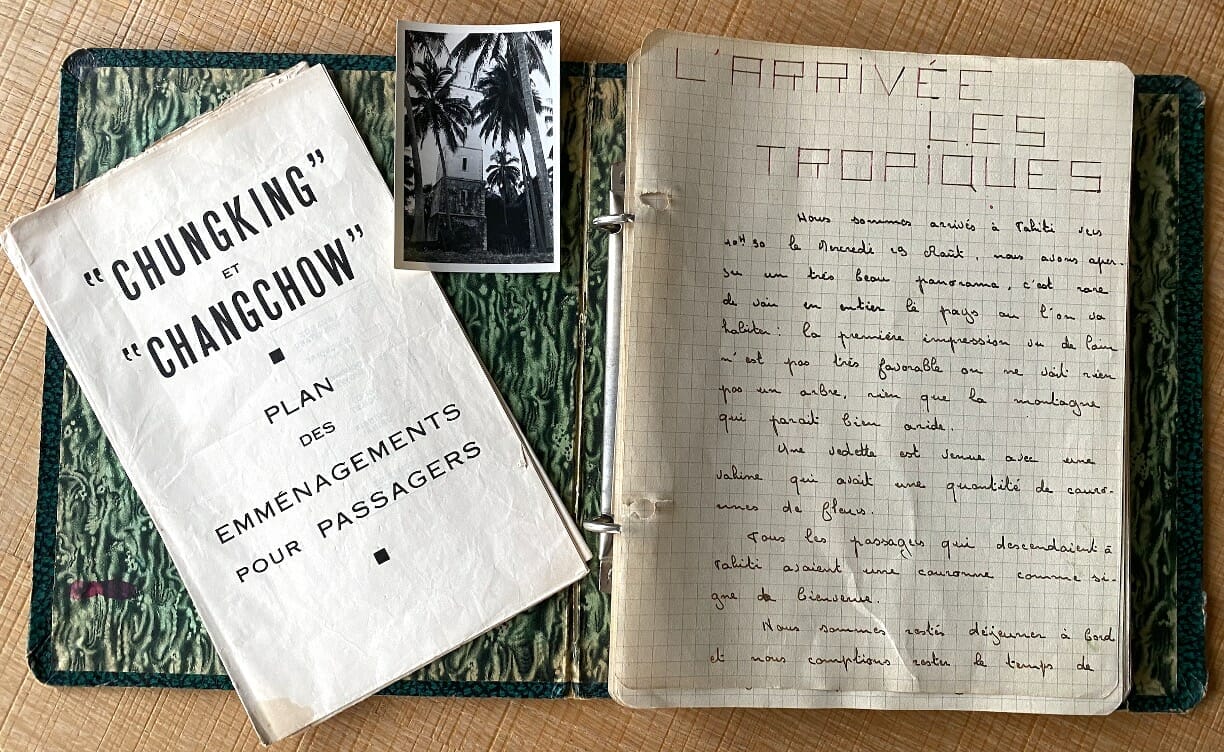
This extraordinary journey fueled my sister's and my own childhood imagination when our mother told us about it. It partly explains why we so much wanted to explore our planet, as I recount in “my story.”
Colette is now over 90 years old. She was just 18 when she went to Tahiti.

A travel opportunity to Tahiti for my future mother
In 1951, Colette had just turned 18 and her friend Kiki suggested she go with her to Tahiti as an au pair, because her husband, Gérard Pellé, had just been appointed to represent Messageries Maritimes
Colette still lived with her parents in the Paris region, so even though the adventure scared her a little, she didn't hesitate long to accept her friend's offer.
The Messageries Maritimes company is one of the most prestigious French shipping companies as announced in the description found in an internal review of the shipowner in 1951. (source: Frenchlines.com)

Convincing Colette's parents (my grandparents!)
The hardest part was convincing Colette's parents to see their daughter go to the other side of the world.
We need to put ourselves back in the context of the time. World War II had only ended six years prior. Europe had begun a major reconstruction, but the scars of the conflict were still very much present. Everyday life was very complicated for everyone.
My grandparents knew that the only way to communicate with their daughter would be rare letters that would take many weeks to arrive. No phones, let alone the internet! They were worried about their daughter going so far away. Moreover, at that time, the age of majority was only 21, women had only had the right to vote for seven years, and an 18-year-old girl was barely considered more than a child!
But Kiki was persuasive, and the travel plan could go ahead. Colette would be an au pair for a year to help Kiki with her children Brigitte, two years old, and Catherine, three months old.
In 1951: no airport in Tahiti! They went by boat for a month-long voyage.
The boat was the only way to get to Tahiti in 1951.
Going by plane was simply impossible, as there was no airport! Papeete's airport would be inaugurated only in 1960 with the arrival of a TAI DC-7. So, it would take Kiki, Gérard, and Colette a month of travel to reach their destination!
From Paris, they would first have to reach Marseille by train to board their ship. Then, the ship would call at Algiers before crossing the Atlantic to the West Indies. Stops were planned in Guadeloupe, Martinique, and the Dutch Antilles. Then, it would be the crossing of the Panama Canal before a long voyage in the Pacific Ocean. Having left Paris on July 26, they would not reach Papeete in Tahiti until August 29!
As the ship offered a mixed service, even if they were promised that the boat was comfortable, they knew that cargo would take priority over passengers. This meant that stops were scheduled for loading and unloading goods, not for their entertainment. They would have to adapt!

An ordinary departure from Gare de Lyon in Paris for an extraordinary journey !
Friday, July 27, 1951 — The evening of the grand departure for this exceptional journey arrived! My grandparents took Colette, Kiki, and Gérard to Gare de Lyon in Paris. The goodbyes were emotional, but also strange, because no one realized that our travelers were heading to the other side of the world! Accompanying loved ones to the station was quite commonplace in the 50s.
In 1951, means of transport were still makeshift with equipment that had survived the war. This was true for trains, as well as boats and planes.
Laroche-Migennes and its steam locomotives
From Paris to Marseille, the line was only electrified as far as Laroche-Migennes. It's a station located in the middle of Burgundy that everyone has forgotten today, but which was well-known at the time as an essential railway depot that employed nearly 1,500 railway workers. From Laroche-Migennes to Marseille, traction was then provided by steam!
It therefore took our friends almost 10 hours to reach the Phocaean city. In the middle of summer, in old, non-air-conditioned carriages, the journey was grueling. They traveled in a second-class seated carriage because no berths were available.
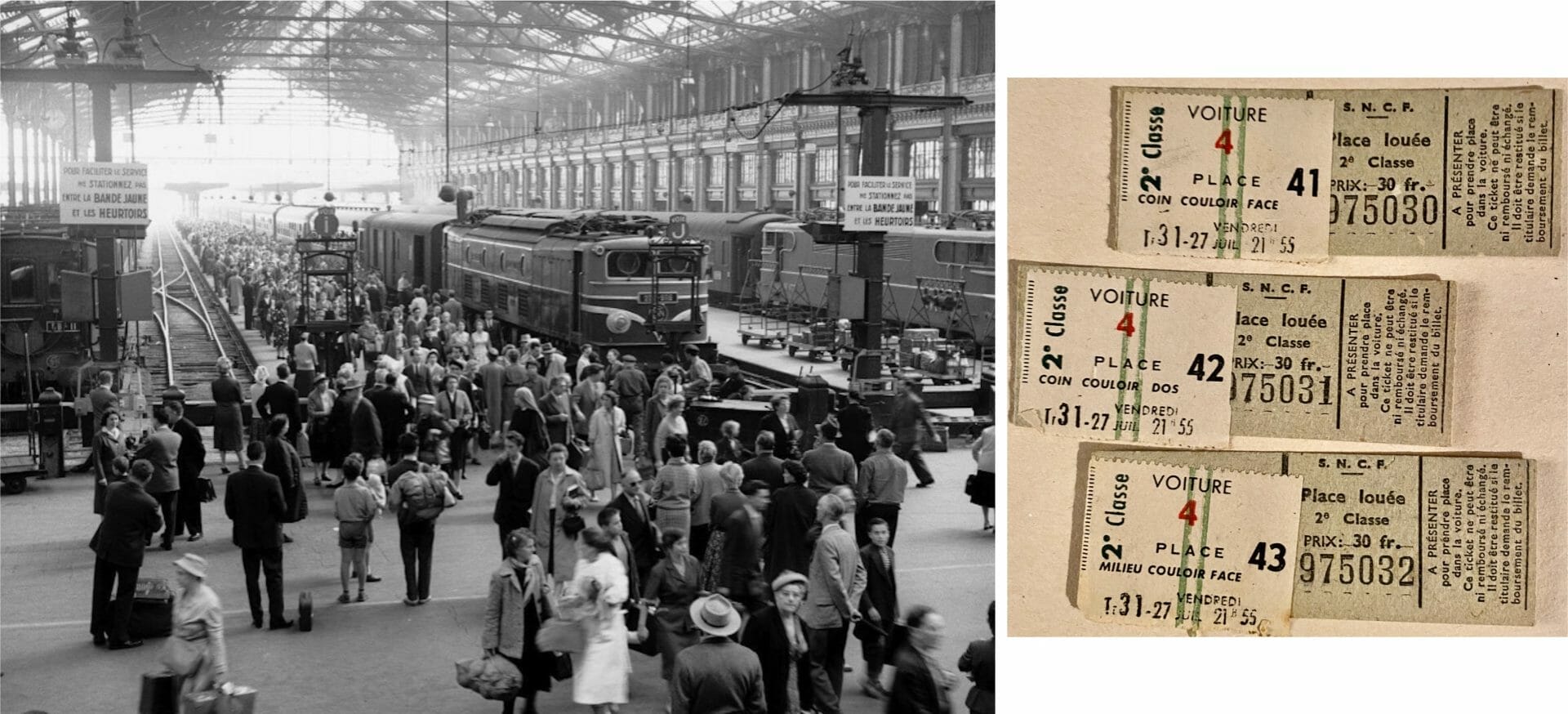

The photos are from the SNCF archives.
Marseille: already a hint of exoticism
Early in the morning, Kiki, Gérard, and Colette arrived at Marseille Saint-Charles station very tired after a grueling night journey.
But in the fervor of their youth and the excitement of the trip, they still went to explore Marseille before joining their ship, which was scheduled to depart in the late afternoon.
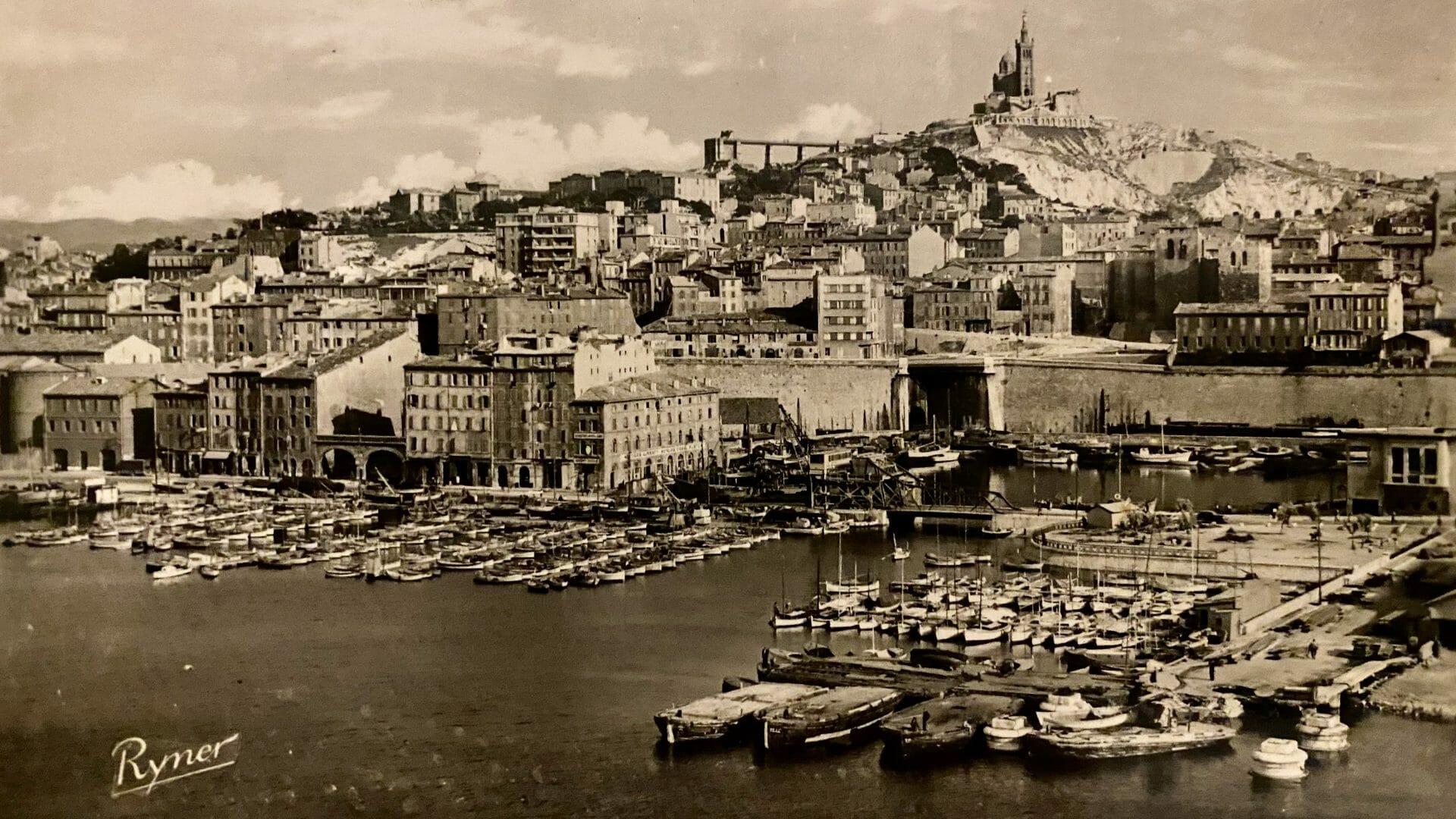
They were immediately captivated by its magnificent setting, thanks to the wide opening of its bay towards the sea and the Frioul islands.
The city was very lively with an incredible number of nationalities. In France in the early 50s, this cosmopolitan aspect was still rare.
Colette, Kiki, and Gérard had lunch on a terrace in the Old Port. Before them, it was an incessant parade of street vendors and entertainers from all Mediterranean countries. They found it much more colorful than Paris.
Then, a must-do, they went up to Notre-Dame de la Garde to have their crossing blessed. From there, they had an extraordinary view of the entire port, which stretches for many kilometers north of the city.
In the distance, they spotted the Changchow, at the dock, waiting for them for their month-long journey that would take them to Tahiti.
Boarding and discovery of the Changchow
Colette, Kiki, and Gérard then took a taxi to go to the port and board. The departure formalities were completed without difficulty, and they soon found themselves aboard the Changchow.
The Changchow was an English ship that was intended to serve China, but with the communist revolution, it could no longer do so. Therefore, it was chartered by the Messageries Maritimes company to sail between France and the Pacific while awaiting the delivery of new ships, as the vast majority of its fleet had been destroyed during the war.
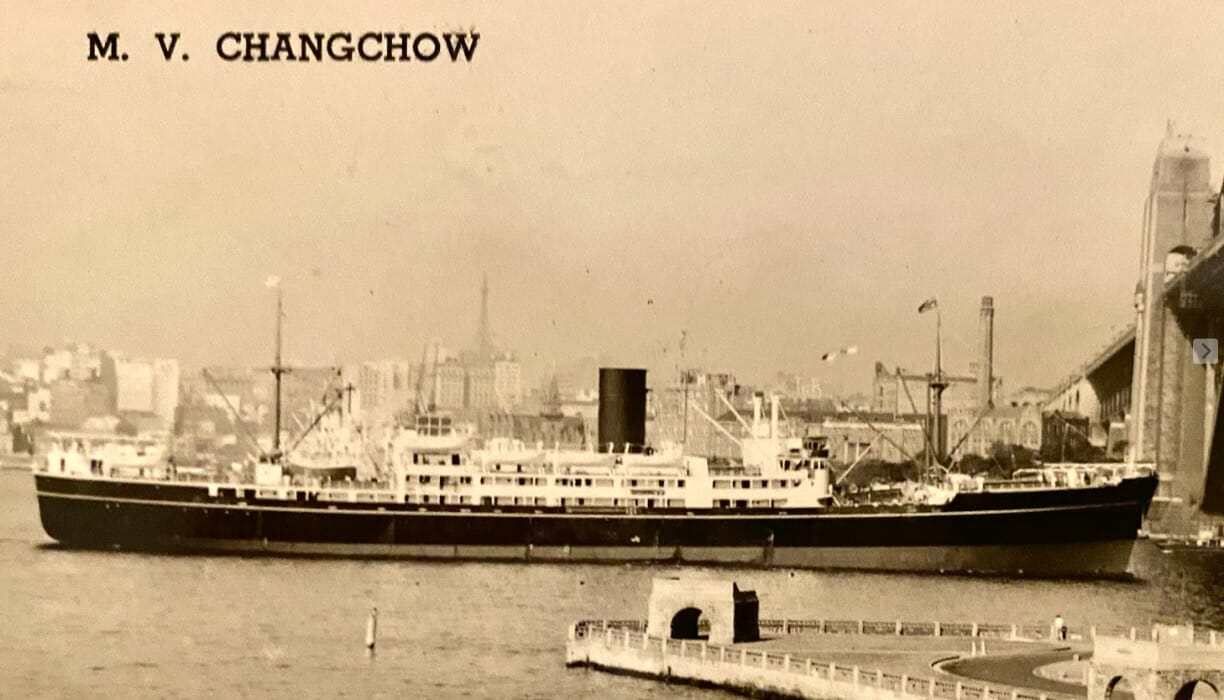
The Changchow was a brand new mixed cargo and passenger ship, rather small at 140 m long and with a sleek appearance thanks to a low waterline. It had only four decks.
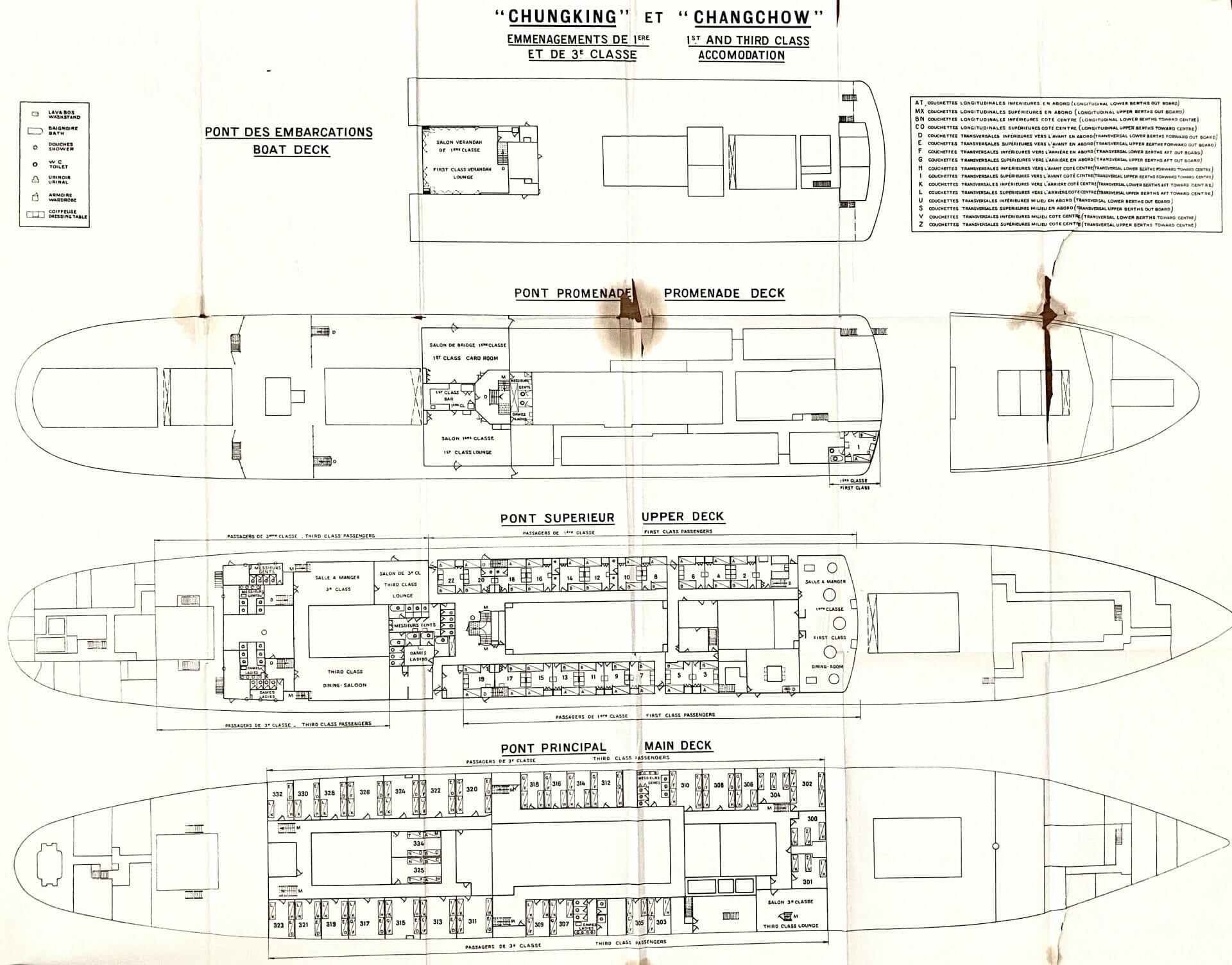
The ship offered only two types of cabins:
- First Class reserved for 48 privileged individuals.
- Third Class which accommodated 200 passengers, mostly migrants hoping to start a new life elsewhere.
Curiously for us today, there was no Second Class on the Changchow, because post-war, intermediate classes still traveled very little.
The Changchow's crew was cosmopolitan. The officers were English, the sailors Chinese, and the commercial staff French.
As Gérard was an executive at Messageries Maritimes, our friends were lucky enough to travel in First Class.
Colette had to share her cabin with a single woman in her sixties with somewhat strange behavior. A chatterbox who wouldn't let her fellow travelers get a word in and would spread every bit of gossip during the month-long journey to Tahiti. She used a pendulum to check if the pitcher of water brought by the steward was truly potable! A true character out of a novel. Colette quickly nicknamed her “the medium”!
The Changchow leaves Marseille for Algiers, the first stop on its long journey to the Pacific
It was Saturday, July 28, 1951, at 4:45 PM. A first siren sounded to inform all those accompanying passengers that they had to disembark. It was the grand departure for Colette towards a new life!
She pensively examined the voyage itinerary, which seemed endless. And yet, even stopping in Papeete, the Changchow's journey would be far from over until its final destination: Sydney. The ship would not return to Marseille until late November, after almost four months of sailing!
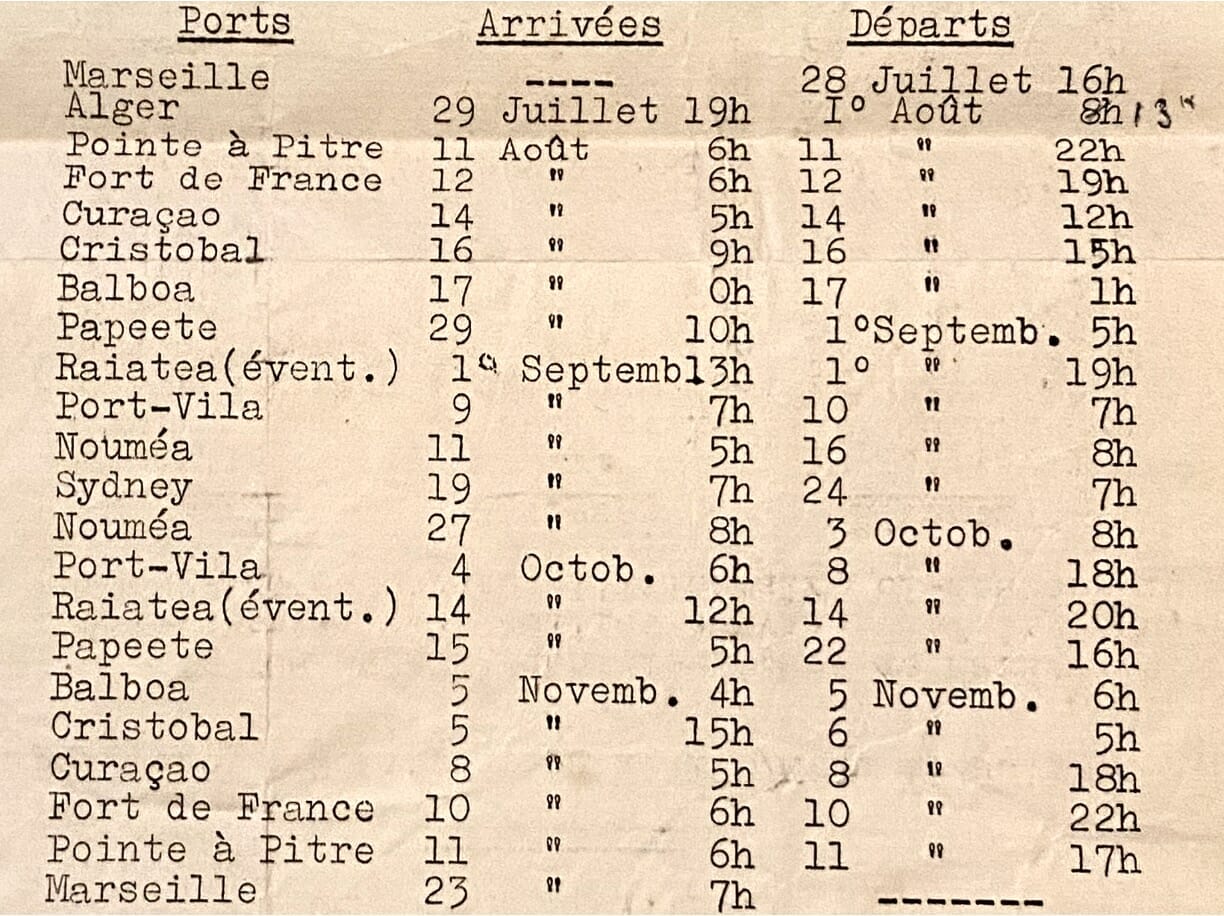
The Changchow majestically left the magnificent harbor of Marseille.
As tradition dictates, a rumor circulated on board that a stowaway was present! This unconfirmed information was quickly forgotten.
Unfortunately, Colette would soon realize that the ship rolled a lot, causing seasickness in many passengers, including her. The reason was that its holds were heavily loaded with cargo, while the upper decks reserved for passengers were too light. The Changchow was fast, but not very comfortable.
The loudspeakers asked passengers to set their watches back half an hour to adjust to the time of the first stop: Algiers.
Discovery of the Changchow's First Class cabin: comfort without luxury
Once the ship was at sea, Colette reviewed the new environment of her cabin, and it was a pleasant surprise, as the ship was almost new.
Beautiful cherry wood covered the walls of the corridors and cabins. Plastic had not yet invaded the atmosphere of ships. Two single beds were separated by a dressing table that also served as a chest of drawers. On one of the walls, a window, or rather a porthole, protected by a mosquito net and shutters, opened onto the deck.
A great novelty: air conditioning
As throughout the ship, cold air vents located above the berths ventilated the cabins. Air conditioning was still quite unusual and created surprise among the passengers.
Next to the beds, there was a rattan armchair and stool upholstered in green and white canvas. A soft green carpet covered the linoleum floor. The overall effect was rather elegant.
Opposite the beds were a washbasin and a pitcher of drinking water that the assigned steward would refill daily. Even in First Class, showers or bathtubs and toilets were outside for common use.
A large wardrobe completed the furnishings. Inside, Colette noticed the life jackets, which did not reassure her, as it reminded her that a ship could sink.

The interior photos of the ship are those of the MS Taiyuan, which was built at the same time and by the same builder. They give a good idea of what the Changchow was like (source: ssmaritime.com)
First stop in Algiers the White
The Changchow reached its first stop, Algiers, after a night and a short day of sailing. Algeria was a flourishing French colony, and independence was not yet being discussed.
The ship would remain at the dock for nearly three days to load its cargo of wine, paper, vegetables, fruits, and meat bound for Tahiti, New Caledonia, and Australia.
Upon disembarking, our three friends received a welcome telegram from Colette's father, sent from Paris. This would be the only contact with her family throughout the entire journey.

Algiers the White spreads around a harbor. But behind the facade of beautiful Haussmannian-style streets and well-maintained arcades with branches of Parisian stores, Colette discovered poorer and dirtier neighborhoods that were hidden. It was the hidden side of colonization, which was rarely discussed in mainland France.
A friend of Gérard's, a general in the French army, drove Colette, Kiki, and Gérard to the hill overlooking Algiers, from where the view of the harbor was magnificent. The outing ended at the military club, a beautiful Moorish-style building with inner gardens in courtyards that resembled cloisters.
On the second day, Colette, Kiki, and Gérard visited the Casbah with its many shops where goods spilled out both indoors and onto the streets. Colette felt overwhelmed by the colorful, bustling crowd. Paris seemed a long way off…
The photos below were taken by Gérard.
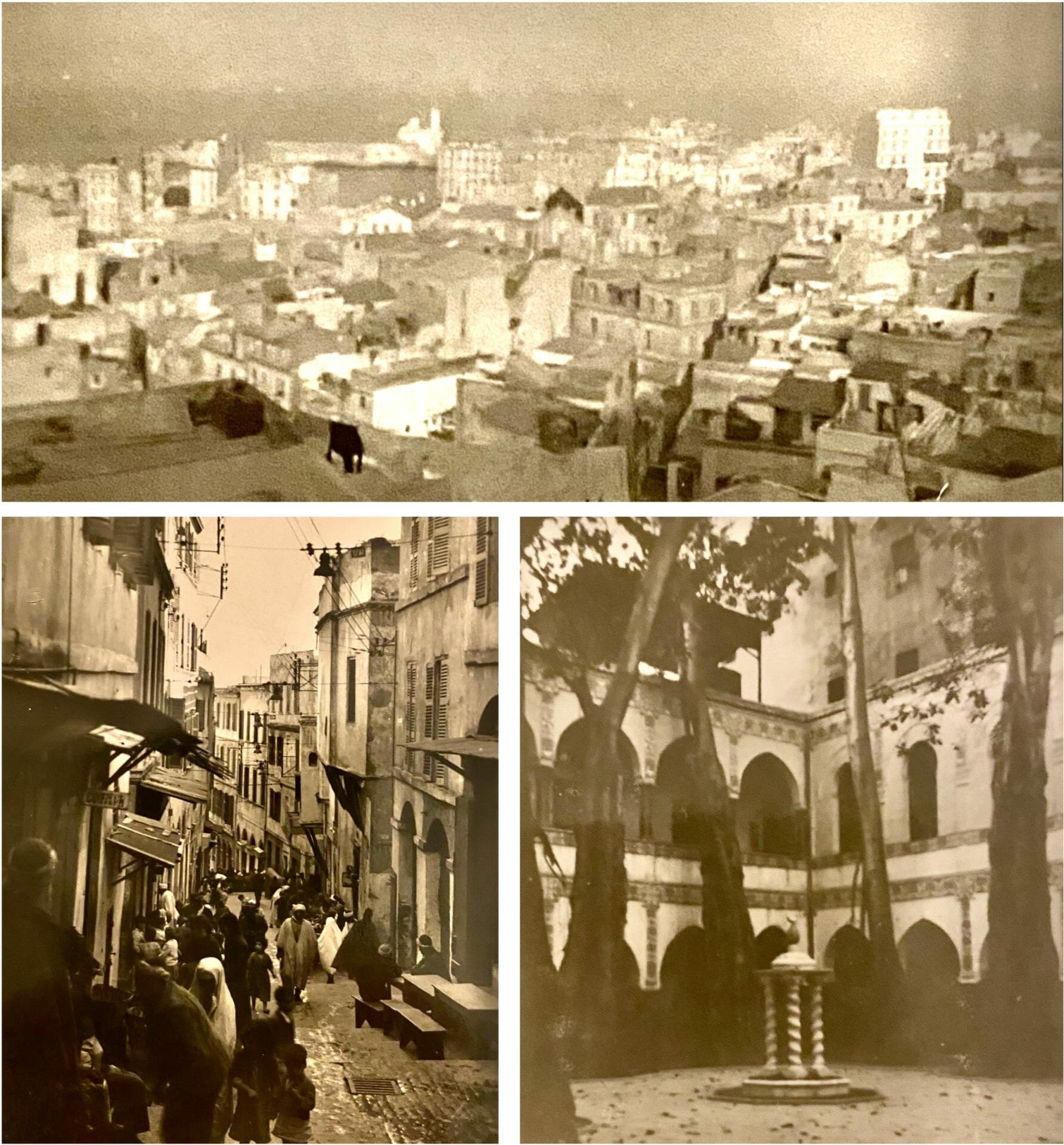
The discovery of Algiers concluded with Notre-Dame d'Afrique Cathedral, a somewhat unique Romano-Byzantine style, which offers a magnificent sea view from its forecourt.
But the third day quickly arrived, and it was already time to re-embark for the Atlantic crossing.
Until departure, street vendors tried to sell carpets, jewelry, scarves, and other trinkets to passengers. Even after they had to leave the ship, they threw their goods, tied to ropes, onto the deck. Their customers returned the money in the same way! The spectacle amused Colette.
The Rock of Gibraltar before the ten-day Atlantic crossing
Colette, Kiki, and Gérard met for their second dinner in the First Class dining room. In a beautiful, spacious, and bright room, guests are gathered around seven round tables (rectangular on the MS Taiyuan). The forward view from the ship is spectacular.
Wooden circles surround the tables so they can be raised when the sea is rough, preventing dishes from sliding onto the floor. In case of a severe storm, there are even plans to chain the chairs down!

Most of the provisions were loaded in Marseille and stored in a huge cold storage locker. Resupply at port will only be supplementary, such as for fish, which cannot be preserved for the duration of the crossing.
The kitchen's very modern equipment surprised Colette, because in 1951, private households did not yet have refrigerators, blenders, electric hot plates, or coffee grinders.
The meals were excellent and plentiful. As Colette mischievously wrote, "Faces will round out as the journey progresses!" The wartime restrictions, which ended only six years prior, already seem a distant memory.
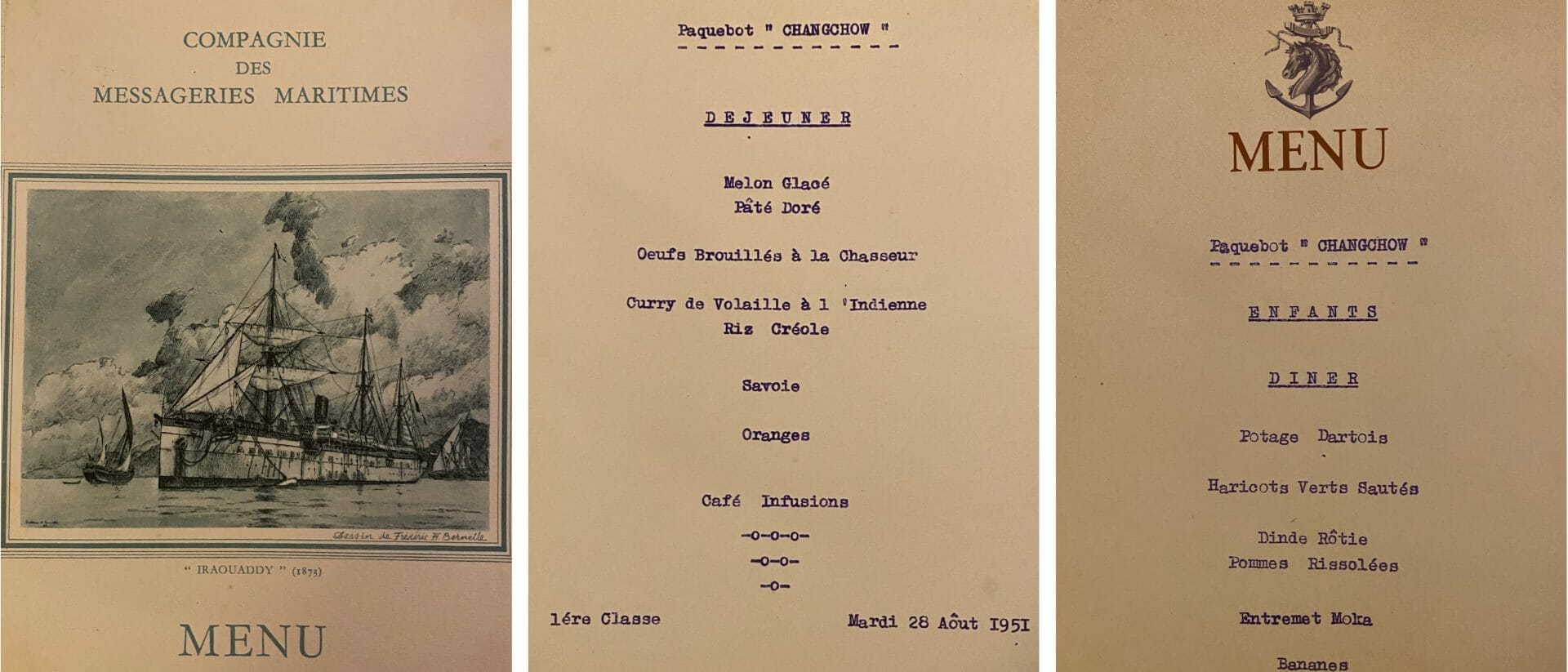
The Changchow passed near Gibraltar with its famous rock, which overlooks the strait like a huge, dark sentinel keeping fierce watch.
Then it's the long Atlantic crossing to Pointe-à-Pitre. These will be ten days at sea that all feel similar. With the summer heat, a certain languor will settle among the passengers.
Only meals punctuated the journey. They were served daily at fixed times: from 7 AM to 9 AM for breakfast, at noon for lunch, and at 7 PM for dinner. Tea was also offered at 4 PM.
Children did not eat with adults and were invited to dedicated sittings for them at 11 AM and 6 PM. I can imagine the surprise of today's parents if such an arrangement were suggested to them!
Every two or three days, the clocks were advanced to a new time zone. The adjustment was very gradual, and the feeling of "jet lag" was still unknown!
Few distractions on board
Boredom was certainly the most common form of entertainment among passengers!
The Changchow is a mixed-use vessel, and entertainment is not the crew's primary concern. The staff responsible for passenger comfort is under the authority of a purser who is not very accommodating. He will be nicknamed "Sourpuss " by Colette!
Indeed, he only organized two dance evenings during the entire journey, much to Colette's dismay and everyone's great disappointment; he didn't even mark the crossing of the equator with a special event.
Each day Colette received a small card indicating the Changchow's position and its cruising speed. Thus, on August 2nd, the ship traveled at 15.02 knots, or approximately 28 km/hour.
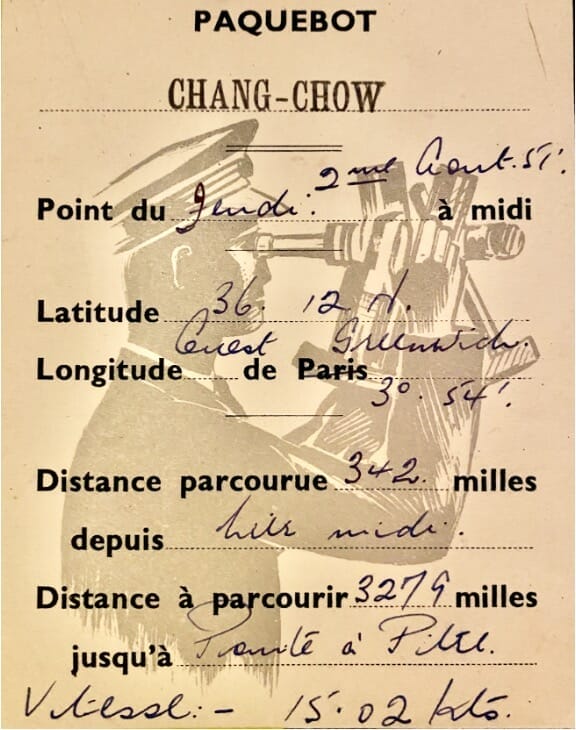
The outer deck is not very spacious, and Colette quickly walks around it. Deck chairs are placed everywhere for resting and dreaming while watching the sea, provided the children don't disturb them. Indeed, the latter have no space of their own and no suitable games. As Colette wrote in her logbook, "they bore the adults, and the adults hinder their frolics."
It is possible to play shuffleboard, which involves either throwing small discs into numbered squares or pushing them with a type of rake.
Of course, at that time, there was no cinema or television on the ship. Passengers would do well to have brought a good supply of books with them, even if the onboard library is well-stocked.
The First Class lounge and game room: " adult only "
The lounge is cozy in a very British style with its leather and rattan armchairs. Drinks can be ordered from the bartender, who records the consumption on a small slip that the customer will settle at the end of the trip.

Two nice desks allow passengers to write their correspondence.
The game room consists of four bridge tables where enthusiasts will gather for endless card games.
Access to both is strictly forbidden for children!
Traveling Third Class aboard the Changchow: cramped conditions!
From Third Class, Colette only catched a glimpse of the outer deck where travelers have their deck chairs piled up against each other with no space to stretch their legs.
The worlds of First and Third Class do not mix. Each class has its own dining room, lounge, and outer deck, which it does not share with the other class.
Traveling Third Class on the Changchow is very spartan. Passengers are grouped in cabins of six or eight passengers with bunk beds.
Meals are plentiful but far less elaborate than in First Class.
Sanitary facilities are shared, but proportionally fewer than in First Class.
A journey with such cramped conditions was certainly not easy.
My mother's logbook does not mention any Leonardo di Caprio who might have secretly joined her!
After the Atlantic, arrival in the Antilles, in Guadeloupe
After ten days of sailing, the Changchow arrived at the port of Pointe-à-Pitre in Guadeloupe only an hour and a half late.
The ship weaved its way to the port between the imposing Soufrière volcano located in Basse-Terre and the city of Pointe-à-Pitre. Colette discovered coconut trees for the first time in her life.
Fishing boats came to meet the Changchow. After ten days at sea, she recounted that it feels good to see new faces!
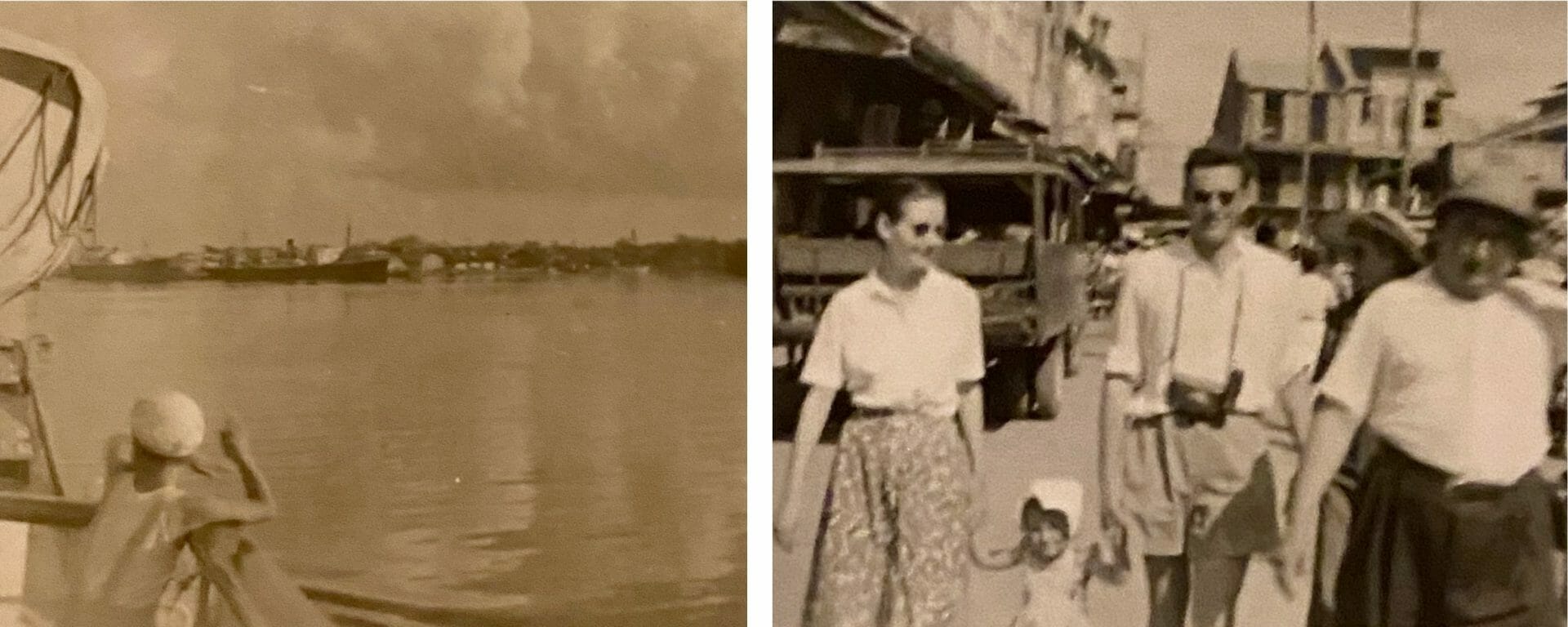
Colette's first impression of Pointe-à-Pitre is a small town with single-story wooden houses that appear poorly maintained and ready to collapse, and unfortunately, dirt is very common, with streets strewn with litter.
Once off the ship, passengers headed to Pointe-à-Pitre's shimmering and typical market. It's a discovery of numerous tropical fruits like bananas and pineapples, still rare in mainland France. The women were beautifully dressed in long skirts with magnificent lace petticoats underneath and bright colors and madras headwraps.
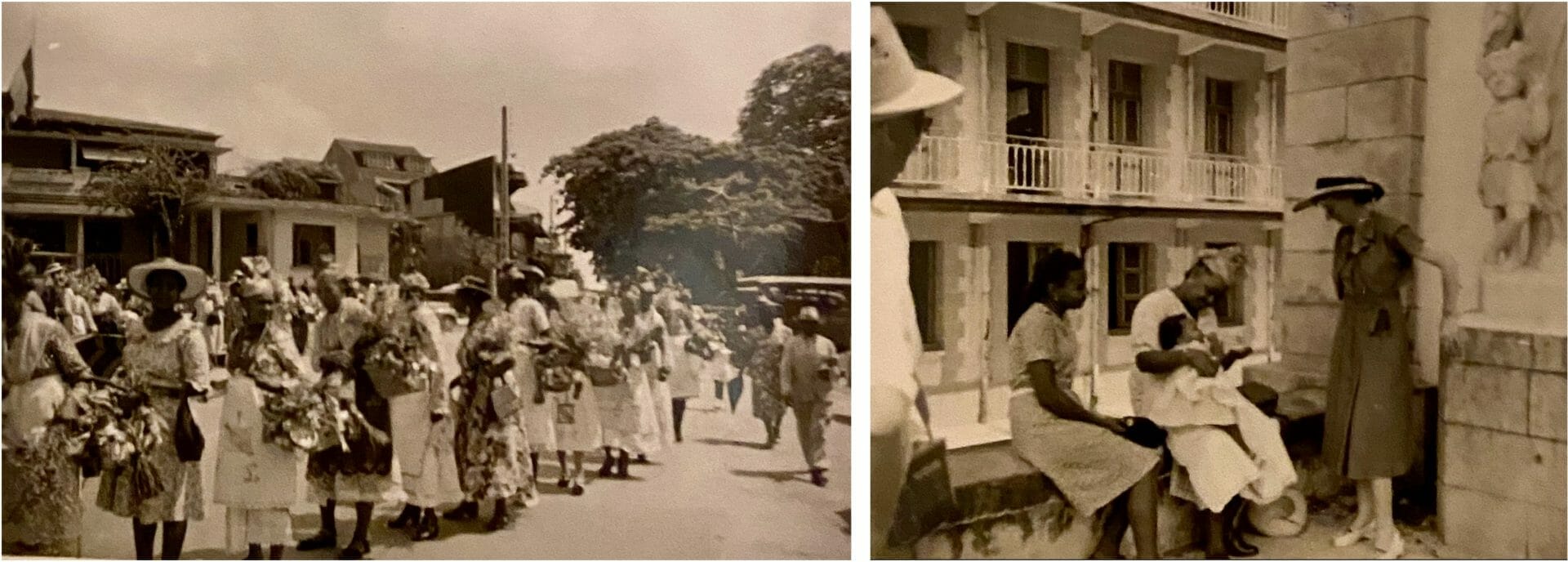
Colette stumbled upon a procession of women with baskets full of fruit, from which doll-sized kitchen utensils are hanging! The procession headed towards Saint-Pierre and Saint-Paul Church to celebrate the Festival of the Cookwomen. A festival that still exists today!
When Colette's trip almost ended abruptly !
During the stopover, Colette wished to reconnect with a former schoolmate who had gone to live in Guadeloupe with her family.
Without a mobile phone, it wasn't easy for them to meet up! By chance, a local employee of Messageries Maritimes knew her friend's father who, having been informed, came to pick her up by car to take her home to the pretty town of Le Gosier, located about ten kilometers from the port.
En route, Colette discovered sugarcane for the first time, which reminded her of large reeds. As communication methods were still underdeveloped in the early 1950s, everything seemed more extraordinary and new.
The tropics are a world Colette could only have imagined through books and a few poor black-and-white representations. Her sense of exoticism is much more vivid than what we experience today with the saturation of images.
The Changchow left Pointe-à-Pitre without Colette!
After a few hours with her friend, her friend's father took her back to the port, and to her horror, she saw the Changchow already sailing away towards the sea!
At the same moment, on the ship, Kiki and Gérard were frantic with worry, because Colette, at 18, was still a minor, and the next ship to Tahiti wasn't scheduled for another two months! They tried to get the captain to delay departure, but he wouldn't listen, and they were panicked at the thought of having to send a telegram to Colette's parents to inform them of the situation.
Fortunately, everything worked out with a shuttle, allowing Colette to rejoin the ship and climb aboard the Changchow in a dramatic fashion! It's like something out of a Tintin comic book!
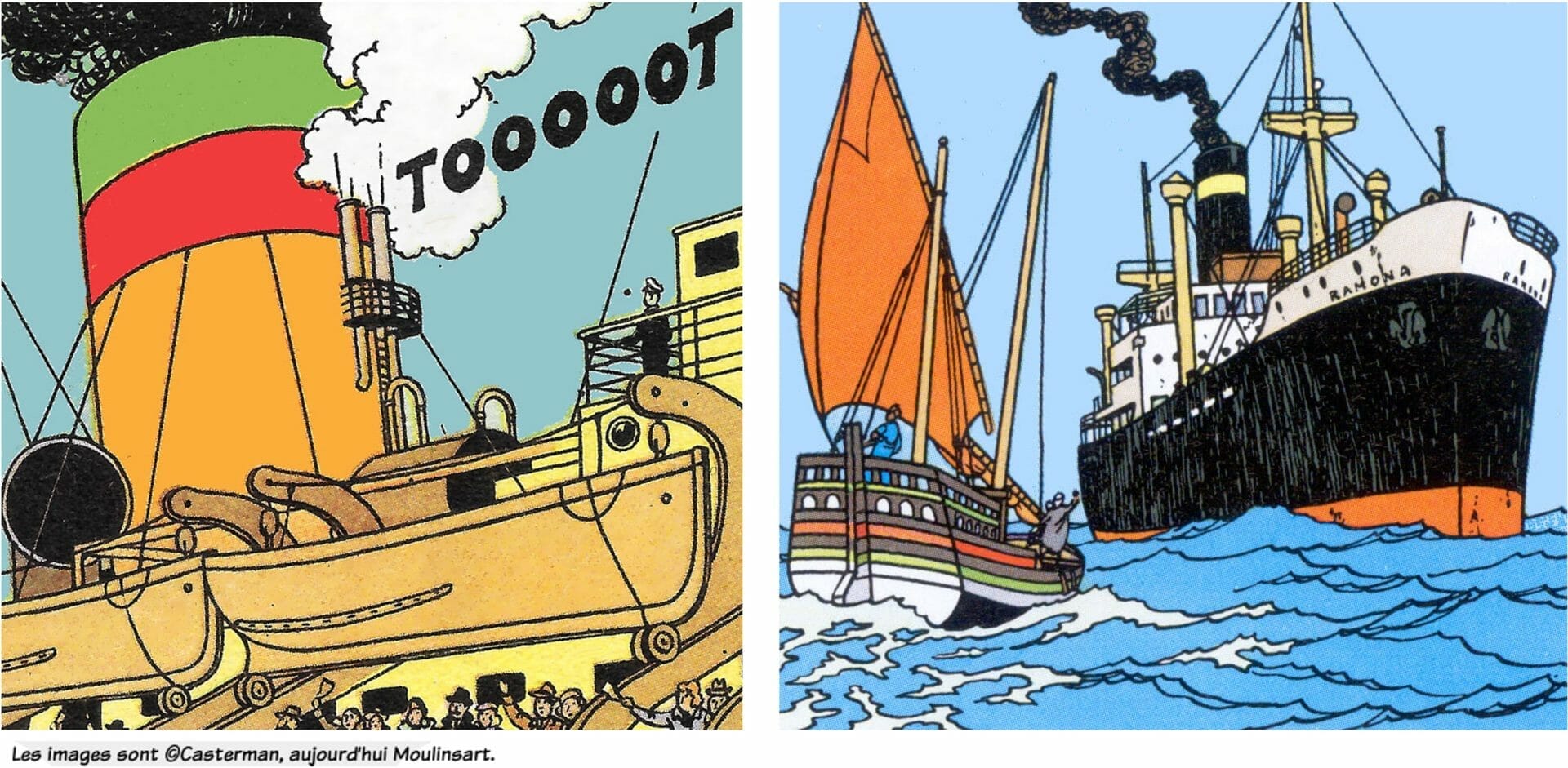
Once on board and after everyone's emotions had calmed, it became clear that the mishap occurred due to a misunderstanding between the captain and Colette's friend's father regarding the Changchow's departure time! Indeed, the captain had decided to move the departure time forward to 5:30 PM, but Colette's friend's father had understood 7:30 PM.
Second stop in the West Indies, in Martinique at Fort-de-France
The boat trip between the two French Antillean cities takes only 11 hours, as the distance to cover is only about two hundred kilometers. The Changchow arrived in Fort-de-France during the night.
It is upon waking that our friends discovered Fort-de-France, which appears larger and prettier than Pointe-à-Pitre, being nestled in greenery.
In the morning, since it was Sunday and religious obligations were still well-respected, Colette, Kiki, and Gérard attended High Mass at Saint-Louis Cathedral. Stepping out onto the forecourt, they admired the view towards the port, which buildings hide today.
Afterwards, the small group of friends took a taxi to Lido Beach, today called Anse Collat, to have lunch at a restaurant overlooking it. The road through the vegetation and the glimpses of the sea are splendid.
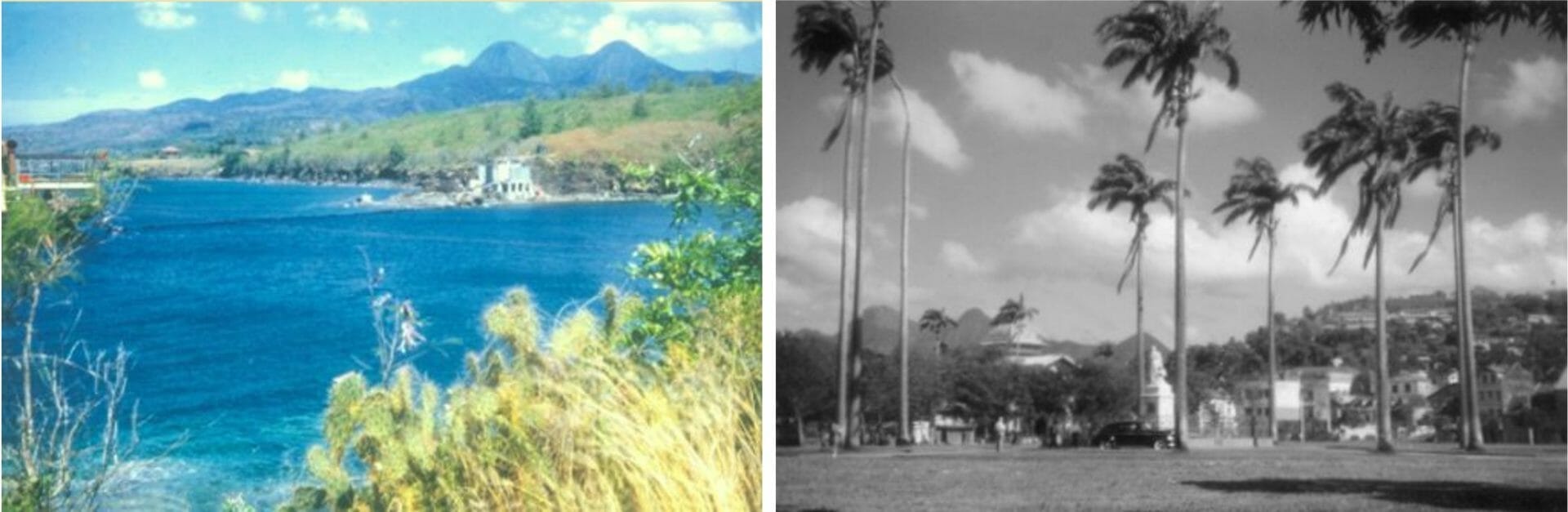
The photos come from the Potomitan.info website, with a page dedicated to Martinique in the 1950s.

Gérard captured Colette, Brigitte, and Kiki, from left to right, in this shot!
On their return, they witnessed the departure of an ocean liner belonging to the Compagnie Générale Transatlantique, a competitor of Messageries Maritimes, bound for mainland France. Indeed, ships were still the primary mode of transport, and air services were nascent. Fort-de-France Airport had only been inaugurated a year earlier, in 1950.
Last stop in the Caribbean at Curaçao
The Changchow then continued its journey through the Caribbean Sea, whose blue color contrasts with the gray of the Atlantic. It started to get really hot on board.
The stopover in Curaçao, in the Dutch Antilles, was solely for refueling with fuel oil. The island is only 60 km from Venezuela and its rich oil reserves.
The port, Caracas Bay, is located 15 km from the capital, Willemstad. The island's landscape is arid, with its cacti, and bears no resemblance to the opulent vegetation of the French Antilles.
Willemstad is a very pretty city where it's pleasant to stroll. Dutch influence is very visible with 17th-century houses.
Tourists still rare in the Dutch Antilles
At that time, tourists were still few, and the capital felt very authentic. The proof is that Colette recounts having a terrible time finding simple postcards to send to her family! But she succeeded, and in her logbook, I found a postcard sent to her elder brother, Yves.
The postmark indicates that it will only take three days to arrive thanks to the airplane! Airmail was still more developed than passenger transport.

The highlight of the stroll was the floating bridge that Colette was lucky enough to see open to let a large ship pass. Not far away, she visited the floating market, where she found many trinkets from Venezuela. Finally, the walk ended at Fort Amsterdam, which consists of old fortified buildings that protected the harbor entrance. The place is very pretty.
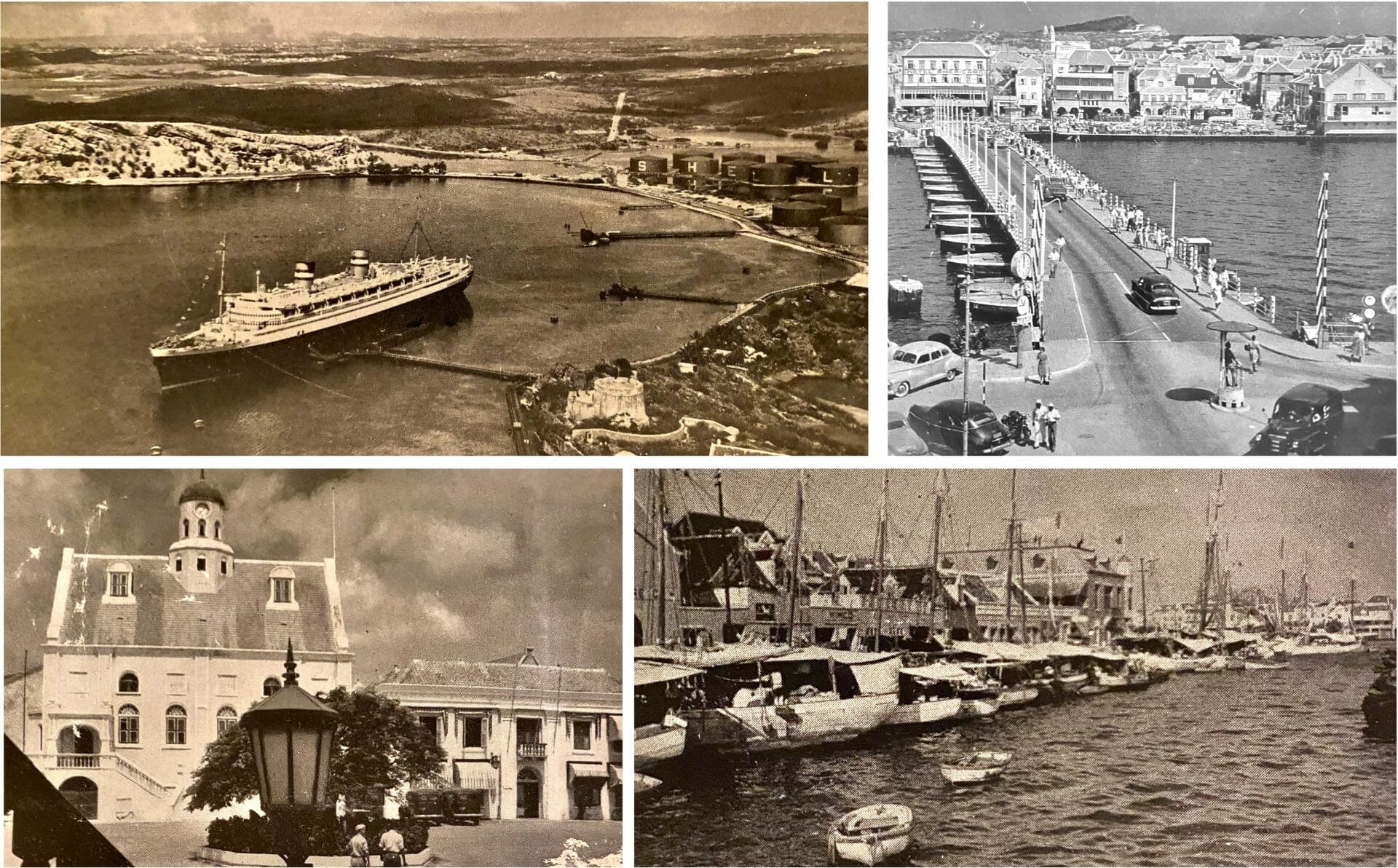
The photos are collages from local magazines and brochures in Colette's logbook.
The Panama Canal: the climax of the journey !
Leaving the Caribbean Sea, passengers were excited because the moment everyone had been waiting for was arriving: the passage through the famous Panama Canal!
A stopover was planned in Cristobal, the port of Colón city, on Panama's Caribbean coast, in case of congestion to use the famous Panama Canal. But since the way was clear, the Changchow could proceed immediately to the Gatún Locks. So much the better!

At 12:40 PM, the ship reached the first of the three locks. Six enormous motorized engines assisted the Changchow by pulling and guiding it into position. Then, It took nine minutes to fill the lock before opening it to move to the next one. The operation was repeated three times. Colette was quite impressed by this display of technology.
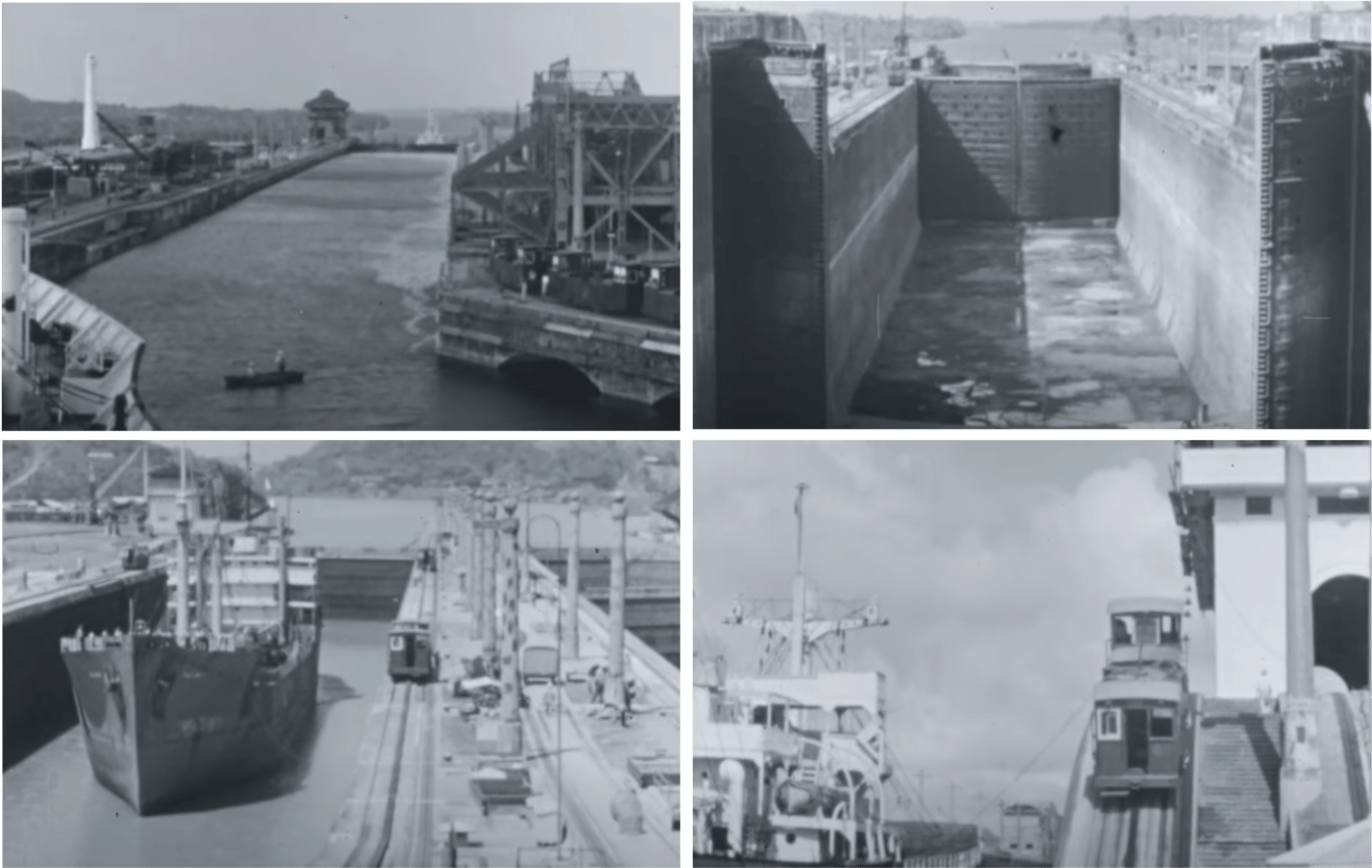
Then the Changchow continued its journey through Lake Gatun, which is 26 m above sea level and covers an area of 425 km2, making it one of the largest artificial lakes in the world.
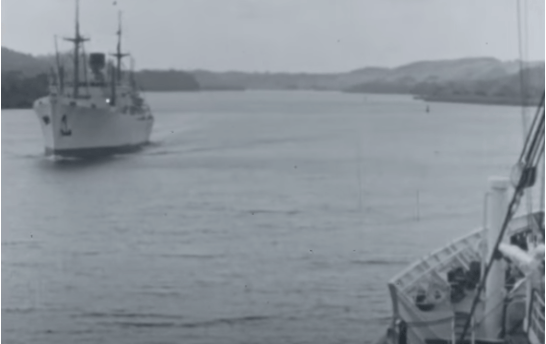
The landscape is stunning with many islands covered in tropical forest. With binoculars, Colette even spotted monkeys jumping from tree to tree. Numerous birds made the crossing joyful with their songs.
Our friends were dreading the Panamanian heat, but it's the rainy season, and frequent showers made the atmosphere quite breathable.
The ship then navigated through the narrow Gaillard Cut, which is constantly traversed by a dredger to remove the accumulating silt. Finally, at 5:30 PM, the Changchow reached the first of three locks that will allow it to descend to sea level and reach the Pacific.
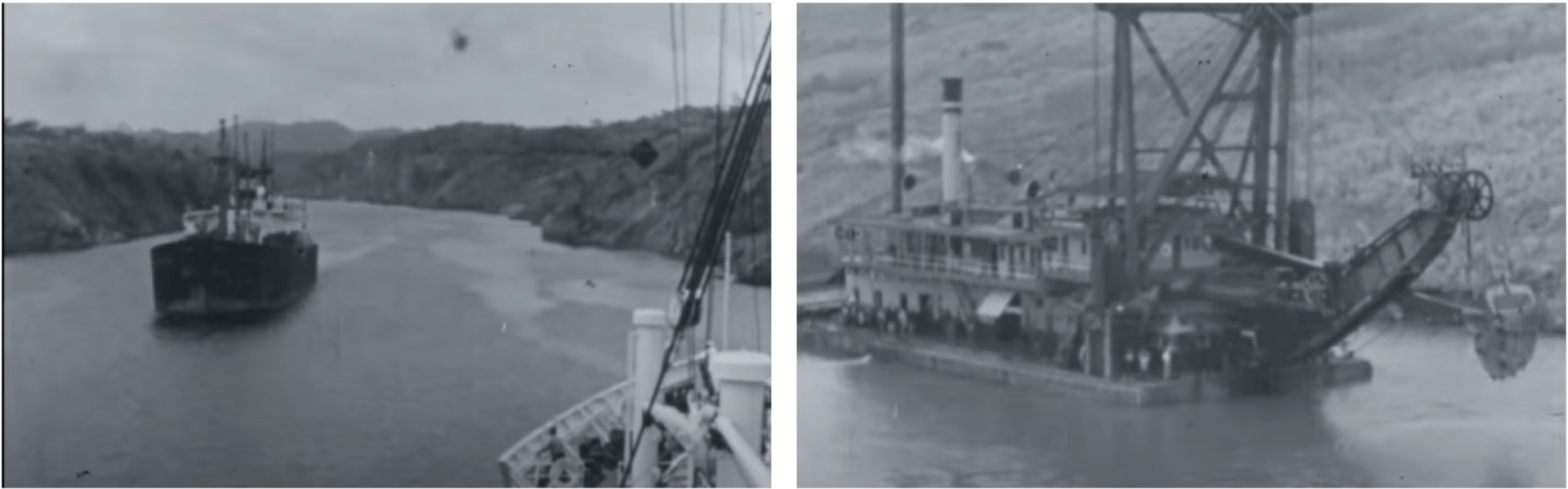
Online, I found a great video on Periscopefilm.com "This World Of Ours" made by Dudley Pictures in the 50s about Panama. The canal crossing starts at 4'29.
The photos above are taken from the film and give a good idea of what Colette saw aboard the Changchow.
Panama City: A Slightly Frustrating Stopover Before the Pacific
The Changchow docked at Balboa, Panama City's port, at 7 PM. It took six hours to cross the canal and its six locks.
All passengers wanted to go ashore to stretch their legs and visit the city, but the Purser announced that only passengers with a valid passport and vaccination certificate could disembark.
German Travelers Still Barred from Panama
Furthermore, German nationals were required to remain on board, even though the country no longer posed a threat to world peace. Panama, officially independent, was still under American influence. As the canal zone was considered strategic, the movement of people was highly controlled.
Since the ship was departing early the next morning, Colette, Kiki, and Gérard only had the evening to explore the city. They settled for a stroll through the shopping streets and then watched a show in a cafe. They felt frustrated not to be able to visit the old town, which was reportedly very beautiful.
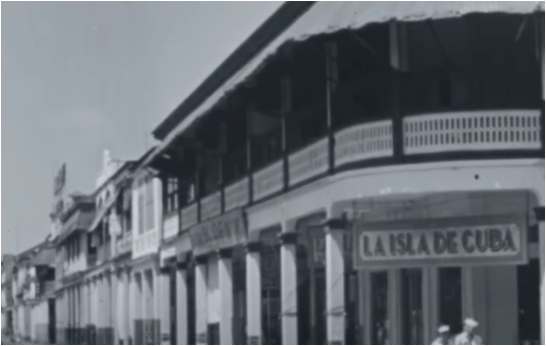
As throughout the entire journey, stopovers were for cargo, not passengers. Messageries Maritimes did not organize any excursions, and tourism was still a very abstract concept!
The Not-So-Calm Pacific and a Missed Equator Crossing
Last leg of the voyage: the Pacific crossing to Tahiti, with 13 days at sea. After 21 days of travel already, weariness began to set in for Colette and the other passengers.
Especially since the first few days in the Pacific, the weather deteriorated sharply with a lot of rain. Passengers pulled out their woolens, as it had never been so cold the entire trip, even though they were almost at the equator!!!
It's a storm!
On Saturday, August 18, it was a full-blown storm. In the dining room, the rails around the tables were raised to prevent all the dishes from falling to the floor. Bottles wouldn't stand upright, and even a child fell from their high chair, fortunately without getting too hurt.
Once the bad weather zone was crossed, it was the purser, "Vinegar-Puss," who refused to hold a celebration for crossing the equator, much to the passengers' dismay. He used the excuse that there were too many foreign refugees in Third Class and that it could only degenerate.
The sea became calm, and the days at sea all blended together with water, just water, as far as the eye could see… The only distraction was to watch the hundreds of flying fish and schools of tuna swimming around the ship.
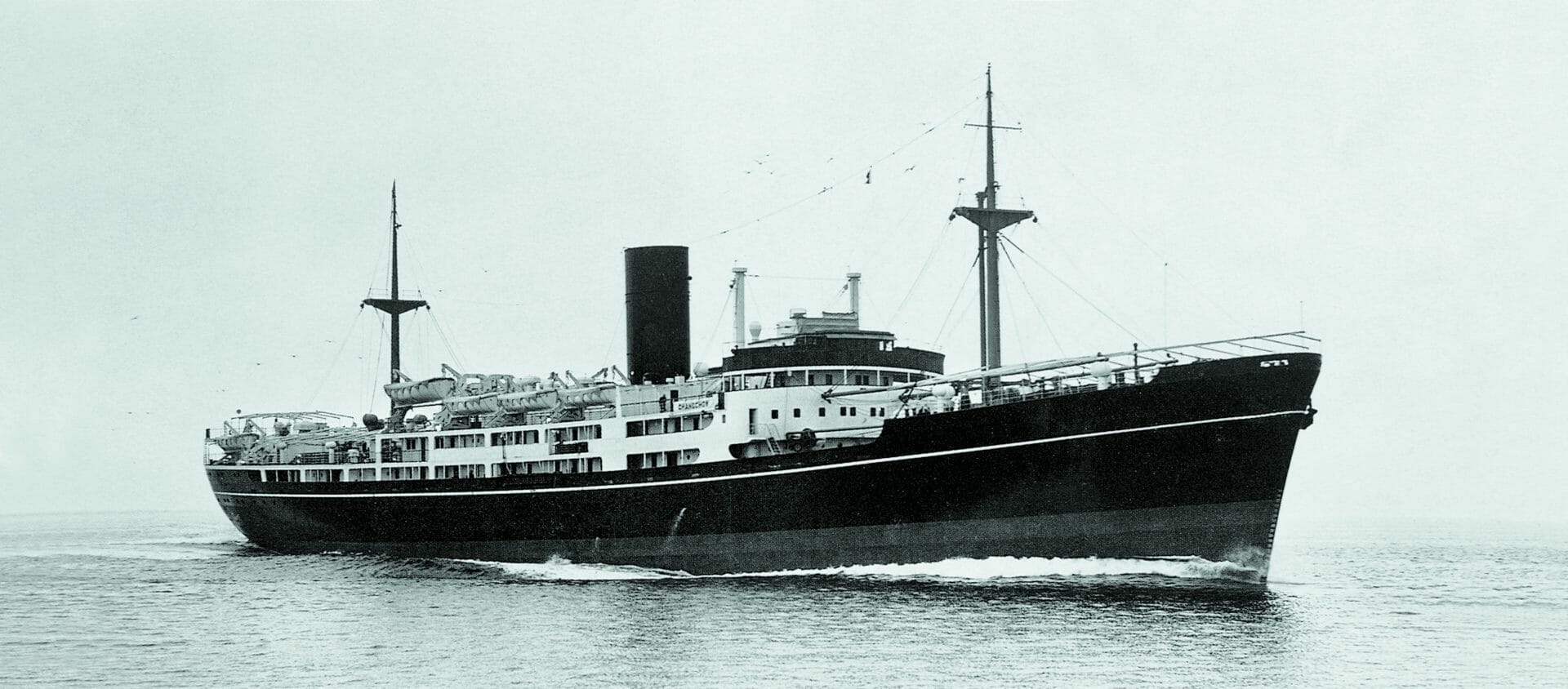
The photo is from the archives of RobJ
On Monday, August 20, an unexpected event, however, broke the monotony of the journey. A seagull landed on the deck with a fish in its beak. The woman sharing Colette's cabin, the famous "medium," came to tend to it with her pendulum. She stayed by the bird's side for many hours, and Colette worried she might decide to bring the seagull into their cabin! Fortunately, that was not the case.
This Pacific crossing was truly long, and Colette grew increasingly bored. Her logbook became more laconic.
Colette indulged in reading during these endless days, and she took the opportunity to read the extraordinary biography of Philibert Commerson that "Vinegar-Puss" had found for her in the ship's library.
In the Footsteps of Philibert Commerson, Colette's Ancestor
Before their departure, Colette's father told her that one of her ancestors, Philibert Commerson, a famous and talented 18th-century French botanist, had already been to Tahiti!
Philibert was destined for a quieter life when he married Antoinette Beau, but his wife died giving birth to their son Anne-François. Overwhelmed with grief, he entrusted his son to his brother-in-law, a priest, and embarked in 1766 on a voyage of exploration around the world with Louis-Antoine de Bougainville.
He brought with him his valet, who was actually his new companion, Jeanne Baret, disguised as a man! Indeed, at that time, women were forbidden on such expeditions, and it was the only way they found to go together.
Their journey led them to Tahiti where the deception was discovered! During his brief stay on the island, Philibert Commerson was captivated by the Tahitians and their very free and joyful way of life.
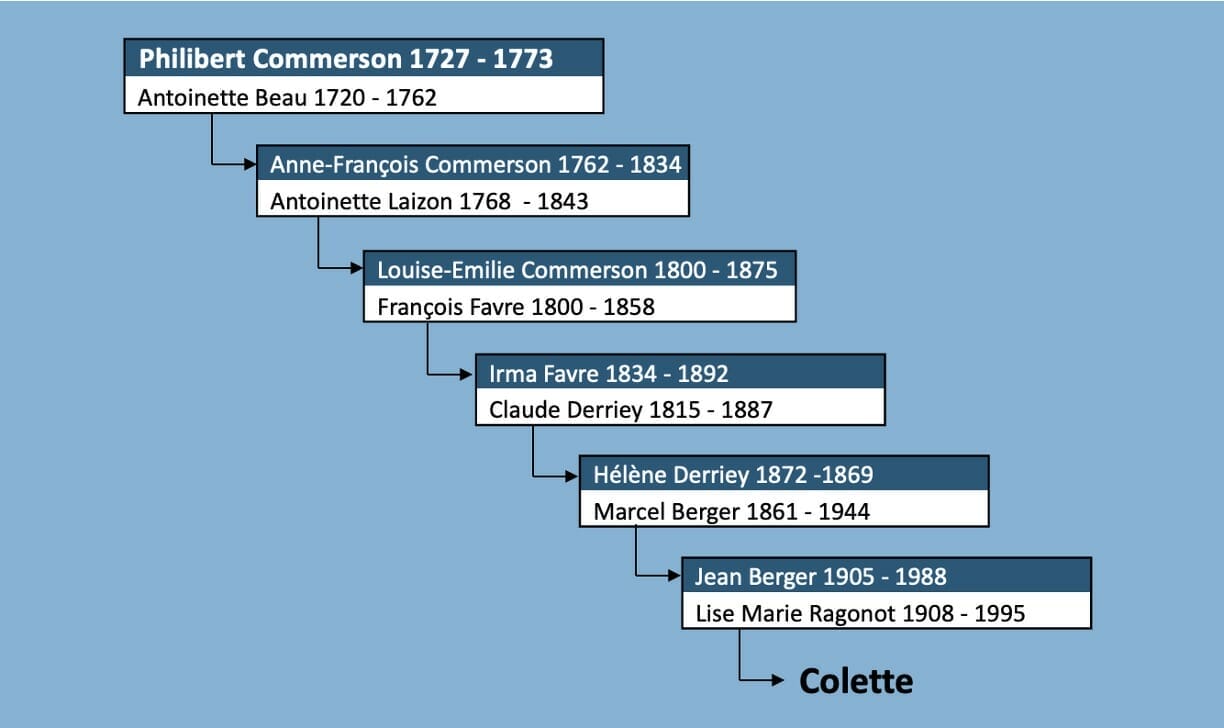
The story was romantic and beautiful enough for Colette to dream of this distant ancestor, as she lay on her deck chair on the Changchow!
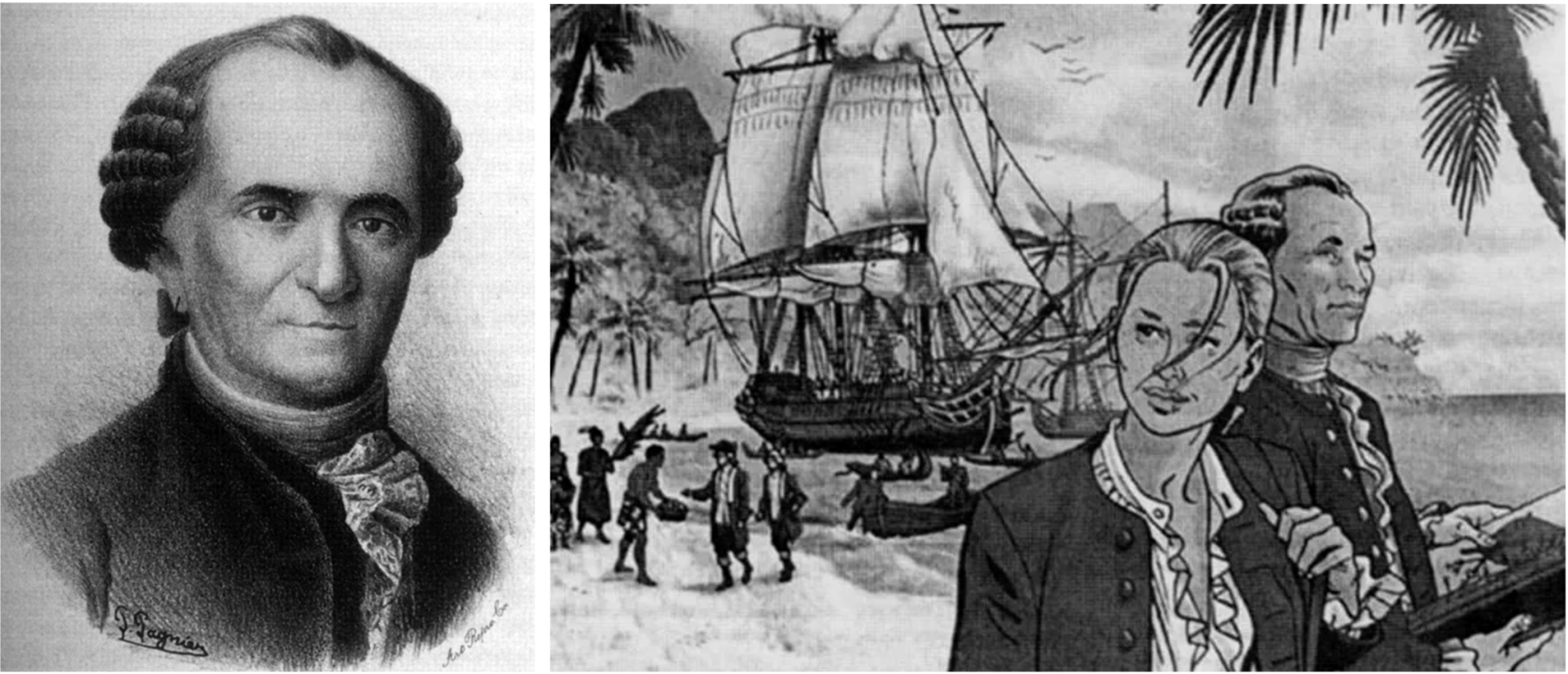
The illustration on the right, of Philibert and Jeanne, was created by Marc Bourgne and Cyril Leriche.
Finally, Tahiti and its Legendary Welcome
Finally, Tahiti! After a month of sailing, Colette, Kiki, and Gérard had reached their destination, or almost!
A launch approached the ship with vahines on board, the name given to Tahitian women, who brought many flower leis to distribute to passengers disembarking in Papeete as a sign of welcome. The unique scent of the Tiare flower immediately gave the impression of arriving in Paradise!
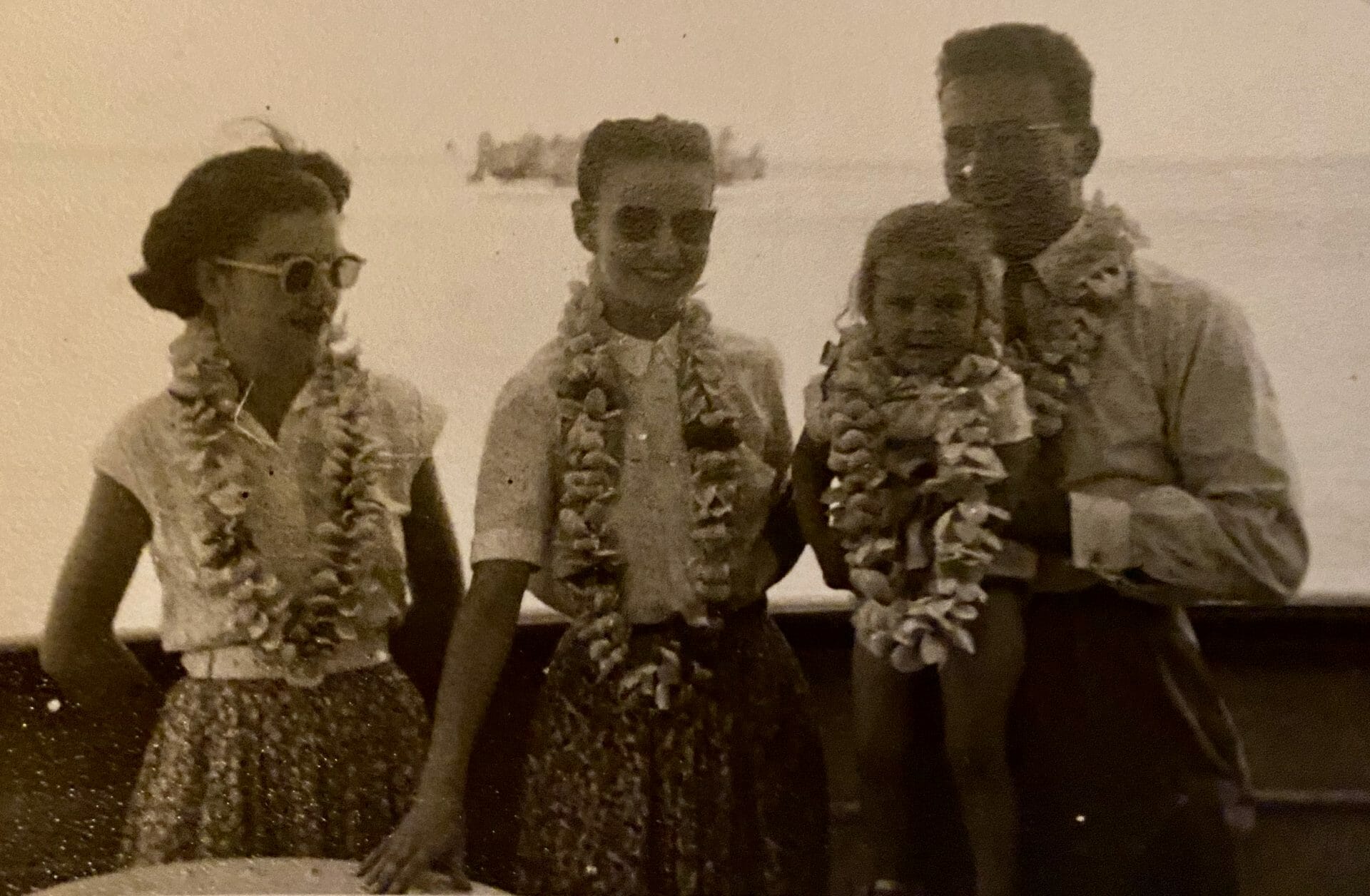
Our friends were looking forward to being back on solid ground, but the Messageries Maritimes representative delivered bad news: no accommodation was available in Papeete!
Indeed, in 1951, there were very few hotels in Tahiti, as only a few tourists ventured to Polynesia, which was only accessible after a long boat journey. Colette, Kiki, and Gérard therefore had to, much to their regret, remain aboard the Changchow for two additional nights during the stopover.
With a bungalow finally available at the Hotel des Tropiques, our friends could leave the Changchow to begin their new life in Tahiti. Colette immediately fell under the spell of the island with its lush vegetation and the beauty of its lagoon. Post-war France, in full reconstruction, seemed very far away.
For the Changchow, Papeete was just a stopover, and it departed for Sydney, its final destination, with stopovers in Port Vila and Nouméa. This would require three additional weeks of travel!
The concept of "slow travel," which we seek to revive nowadays, was a true reality back then. That was only seventy years ago!
Colette would stay a year in Tahiti and would make the return journey to Marseille in 1952.


Sailing with Messageries Maritimes Through the Eyes of a Contemporary Academician
While searching online archives to illustrate Colette's journey, I came across this account by Georges Lecomte, a member of the French Academy, recounting his voyage on a Messageries Maritimes ship. Source: Shipowner's internal review in 1951.
I found it interesting to share, as a bonus, an excerpt from his account that offers a romantic vision of maritime navigation in the 1950s with a somewhat antiquated style!
George Lecomte already seems to be an influencer as he concludes with a subtle reference to Messageries Maritimes, leading one to suspect he must have negotiated the price of his trip in exchange for this glowing article! Millennials didn't invent everything 🙂
The Carefree Beautiful Travel
by Georges Lecomte, Permanent Secretary of the French Academy
Marseilles… The passengers are ready. A faint stirring begins to appear on the grand stairway, and soon the wide deck is alive with the majesty of elegance.
Hardly settled on the sparkling floats, we already feel relieved of our worries. Carried far from the noise of crowds and the agitation of cities, we hear nothing but the gentle murmur of soft waves and the voice of a growing breeze. This vast expanse, these deep horizons—how could they fail to inspire relaxation, rest, serenity in the souls that contemplate them? The spirit rises, ready for thoughts of distance, clarity; it is at once enlivened and appeased.
Leaning against the railing or settled into a soft armchair in one of the lounges, one watches the day fade and night rise. It is a spacious night, unlike that of earthly places; freer, radiant, filled with poetry and wandering souls, with inspired breath. A fantastic bridge gives the feeling of infinity, with its endless skies, a spectacle unparalleled by any landscape.
On these great liners everything contributes to freedom, the preferences of each. According to one’s mood, one may isolate oneself to dream or to enjoy the pleasures of society. For there are always passengers with whom one finds sympathy of ideas, a community of intellectual and artistic tastes. And often, some historian, archaeologist, Hellenist, Egyptologist, astronomer adds insightful explanations to all that is spoken of, in this Mediterranean basin, this sea of humanism that bathes precious lands, enriched by memories of antiquity.
Comfort, all possible amenities ensure material well-being, well-being that security and even the nature of the landscapes or the airplanes, however ingeniously arranged, do not guarantee to the same extent. One lives here in a floating palace which, in addition to so many pleasures, has provided that the stays in hotels, the tiresome search for lodging and a table that often spoil travel, are avoided. At stopovers, one ignores the need to unpack and repack a suitcase in a foreign room. After the outward journey, after the return excursion, one finds again the familiar cabin. From the moment of departure until that of return, one has taken on the habits of nothing to arrange, one has a “home.”
Bad weather or heat, turbulent seas, grain squalls—what does it matter? One takes refuge, sheltered by the ship’s solidity, in one of the halls, lounges well furnished, which offer countless ways to distract oneself; games or books from the onboard library are plentiful for everyone.
The mild sea of Provence welcomes the returning valiant ship which, soon, will set off again for distant lands. It will sail one day, perhaps, through the Suez Canal, the Red Sea to the marvelous Indies; the Indian Ocean, with its scents, its spices and teas; Ceylon, Colombo… Then, in the far reaches of the Pacific, Indo-China, Japan, the mysterious and formidable Far East will see the white pavilion with four purple triangles flying—the colors and emblem of the Compagnie des Messageries Maritimes.

0 Comments