
How to reach Sicily by train from Paris: the story of an extraordinary journey

I decide to go to Sicily by train and not by plane
There is still a train in Europe that leaves the tracks… to board a boat. This amazing scene takes place every day between Calabria and Sicily, where the cars of the Milan – Palermo night train cross the Strait of Messina aboard a ferry before resuming their journey.
When I decided to discover Sicily, the simplest solution would have been to book a flight between Paris and Palermo. Fast, inexpensive, practical… on the surface, because it's often uncomfortable with poorly adapted schedules. I wondered if the journey itself couldn't also become part of the holiday.
So I chose another way: reaching Milan by high-speed train, then boarding the InterCity Notte, Italy's longest night train. Thirty-four hours of travel, 2,300 kilometers covered, and a unique rail experience in Europe.
I'm taking you with me on this journey like no other. At the end of this article, I'll tell you frankly if this alternative to flying is really worth the detour. As usual, you'll also find all my practical tips for organizing your own trip.

I'm taking you along with me in this story to give you my verdict at the end! And, as usual, you'll find my practical tips at the end of this article.
First step: reaching Milan in Executive class with Trenitalia
I head to Gare de Lyon early in the morning. In Paris, it's my favorite, or at least the one that inspires the most emotion in me. First, there are childhood memories, when I took the train to go to Burgundy or Grenoble to see my grandparents.
Then, there's my student life, during which I worked in the sleeper cars. As I recount in the article "I worked on night trains in France in the 80s," many of my journeys began at Gare de Lyon.
Gare de Lyon stands out from afar with its magnificent 64m high clock tower. It's 6:55 AM, so I have time to wander through the different halls before my train departs. I don't miss admiring the superb fresco painted by Jean-Baptiste Olive, which represents some of the destinations served by the station and stretches for nearly a hundred meters. These were the first illustrations of the emerging tourism at the time the current building was created, which dates back to 1900. If you look closely, you'll notice more recent paintings that were added in 1980!


Is Executive class worth the price ?
I decided to treat myself to Trenitalia's Executive class. Granted, it's expensive — €305 — but I thought it was worth trying for a journey of over six and a half hours.
Executive class occupies one end of the train. Upon boarding, what strikes you is the space: the 60 standard class seats are replaced by only 10 wide armchairs and a meeting room that can accommodate six people.
Each armchair swivels, allowing you to travel face-to-face or to isolate yourself. A hostess explains how it works. Its design feels a bit bling-bling, and I get the impression it was mainly designed for beautiful Instagram photos.
Unfortunately, behind this flattering appearance, the comfort is disappointing, especially in the relaxed position. The seat reclines very little, lumbar support is insufficient, the leg rest is ineffective, and it's difficult to find a truly comfortable position.


Trenitalia should have taken inspiration from the magnificent product that Chinese railways have developed, with business class seats of the same type as those on long-haul airlines.
I had the opportunity to test them and I present them in the article: "China: what the high-speed trains are really worth, my test."
The real plus of Executive class is the catering. The hostess gives me a menu with a very wide choice and explains that I can have whatever I want, at any time. It's included in the ticket! Given the early hour, I start with a solid breakfast accompanied by an excellent cappuccino.

I take a walk to discover the other ways to travel with Trenitalia. Standard class corresponds to SNCF's TGV second class with four seats across and very similar comfort.
Business Class is the equivalent of First Class. It's the one I would recommend because it offers the best value for money. Executive Class provides excellent service, but the seat design is too mediocre for me to recommend it.


From Burgundian plains to Alpine mountains
We start by taking the oldest high-speed line in Europe, between Paris and Lyon, which will celebrate its 45th anniversary in 2026!
It's July, and the weather is fine. The Burgundian countryside seems to come from another time, with its pretty villages clustered around a church. Only the cows no longer lift their heads as the trains pass: we are going much too fast!

Lyon Part-Dieu station. Businessmen and women, unfaithful to SNCF, get off, a bit rushed to reach their meetings. On board, it's a more leisure-oriented clientele that remains, still sleepy from the early Trenitalia schedule.
We set off again, at low speed, towards the Maurienne valley. In some places, we are even on a single track. Fortunately, the Alpine landscape is increasingly majestic, with the mountains rising before our eyes.


Just before arriving at the border town of Modane, we pass under the cliff that spectacularly collapsed on August 27, 2023, blocking the track for nearly two years. In Modane, the stop time allows smokers to have a cigarette on the platform. Personally, I take the opportunity to breathe in the fresh mountain air!

We then cross the venerable Fréjus tunnel to emerge on the other side, in Italy. 13.6 km long, it was inaugurated in 1871. An absolutely remarkable technical feat considering the means of the time. In 2033, a 57-kilometer-long tunnel will be built, reducing the train travel time between Lyon and Turin from 3 hours 30 minutes to just 1 hour 50 minutes!
Our Frecciarossa, the "red arrow" in English, slowly descends from the Alps towards Turin. The railway line, on the mountainside, offers spectacular views of the valley.

It's lunchtime and I enjoy an antipasti of cold meats and cheese, followed by pasta perfectly cooked al dente.
After Turin, we speed again across the Po plain, as flat as Dutch polders. It's a good time for a short nap, even if the poor seat design forces you to contort a bit, as the traveler opposite me shows.

Between two trains: six hours in Milan for an original discovery
We arrive at Milano Centrale station at 2:07 PM, perfectly on time. It's one of the most spectacular in Europe, with its monumental architecture commissioned by Mussolini.


After putting my luggage in the locker located within the station, I have six hours ahead of me to enjoy the city. This is one of the pleasures of the train: with stations located in the city center, it's possible to turn a connection into a real moment of discovery.
The secret is to plan so it's not too short. Moreover, this avoids the stress of a late train that would compromise the connection.
Milan is a city I already know, and I don't need to see the must-sees, like the Duomo. I prefer to visit other less-known places, starting with the Shoah Memorial.
A place of memory hidden under Milan station
A Shoah Memorial is located within the Centrale station and it is very little known.
There was a basement platform, unknown to the public, which was originally reserved for loading postal trains. But between 1943 and 1945, it was used to group and deport Italian Jews in total discretion. This dark page of Italian fascism has today become a place of remembrance and reflection.

It was important for me to go there because the train is often a symbol of escape, but, depending on what men decide to do with it, it can also be associated with much more tragic realities. The composer Steve Reich expressed this best in his work "Different Trains." I invite you to discover it on your usual music platform.
After this emotional interlude, I hop on a bike to go for a ride in the city.
Milan has a self-service bike system at very reasonable rates, which allows for quick travel.
Modern Milan: skyscrapers and hanging gardens
I head towards the new districts built around the Biblioteca degli Alberi Milano. It's a pretty park surrounded by futuristic buildings and the whole thing is quite successful. The most amazing are the two Bosco Verticale towers, residential buildings that give the impression of being vertical gardens. More than 700 trees and several thousand shrubs grow on their terraces.


Castello Sforzesco and the bobo district of Brera
I continue my bike ride towards Castello Sforzesco. It's an impressive Renaissance fortress that was the residence of the Dukes of Milan. Today it houses several museums. I'm content to admire the buildings from the outside as well as the huge adjacent park.
I finish my ride in the Brera district. It's one of the most pleasant in Milan , with its cobbled streets and colorful facades in yellow and ocher tones. It once housed artists and intellectuals, but it's becoming gentrified with its many trendy shops and restaurants.


A refreshing break before the night train
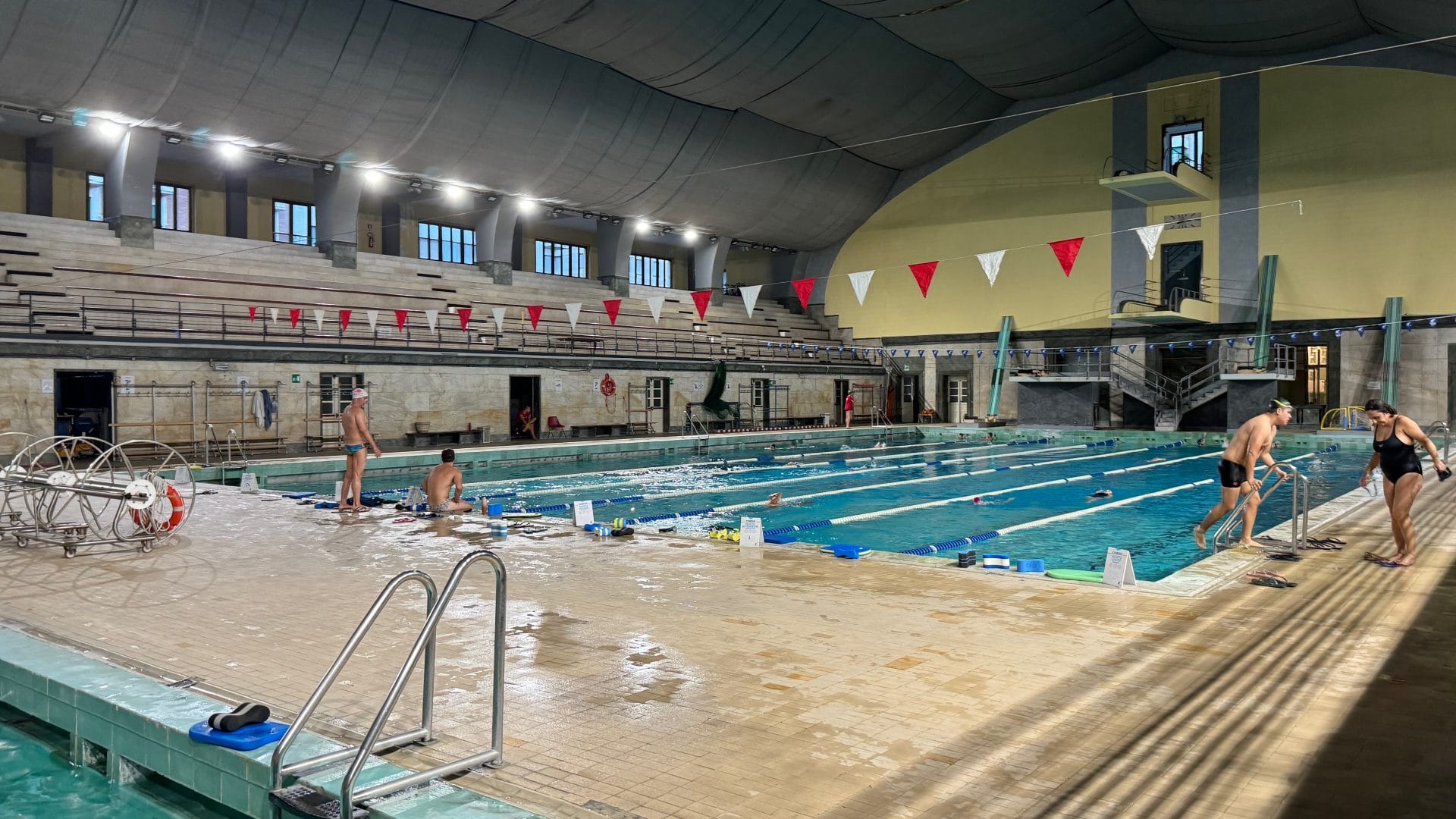
Just before returning to the station, I head to the Cozzi pool. It was inaugurated in 1934 and is one of the oldest in Milan. After a long day of train travel and walking in the city, it does me a world of good to do a few laps. And since Italian night trains don't have showers, I'll already be clean and fresh for the second part of my journey.
Aboard the InterCity Notte to Sicily: the longest night train in Italy
The InterCity Notte Milan — Palermo — Syracuse train is exceptional for two reasons: first, its duration exceeds twenty hours, and second, it is the only train that, in our time, makes a ferry crossing.
It's a subsidized public service. The positive side is that the prices are very reasonable, compared to those charged by ÖBB with the Nightjet or by the Caledonian Sleeper. On the other hand, the services offered are more rudimentary, especially in terms of catering, which is almost non-existent.
But in the Centrale station, on the Piazza IV Novembre side, you'll find the "Mercato Centrale." It's a huge space where I find a wide choice of food to eat on-site or take away. I'm spoiled for choice to put together an excellent dinner to enjoy later on board.
 The InterCity Notte to Sicily is composed of "Comfort" cars, with four-berth compartments, and "Deluxe" cars, with one- to three-bed compartments.
There are no cars with seating.

Sleeping aboard the Milan — Palermo night train in a private " DeLuxe " compartment
I continue my journey comfortably with a private sleeper compartment. Unlike other railway companies, it is not possible to book only a bed and share your cabin with other travelers.
My cabin is spacious and adaptable with a night version and a day version with a sofa. I have a small sink, but the toilets are shared and located at the end of the corridor.
New sleeper cars are planned soon. It's about time, because you can feel that the current equipment is a bit at the end of its life, especially the sanitary facilities. Fortunately, the air conditioning works well, as it's July!


A conductor — the outdated term steward being formerly used in sleeper cars — welcomes me on the platform. I have a small surge of nostalgia for this job that I did in the 80s during my studies.
Our train leaves on time, at 8:10 PM. We speed through the Po plain, in the middle of rich agricultural land, towards Bologna.

I count 33 stops before our final destination, Palermo! I'll realize that one of this train's interests is to offer quality service to many intermediate towns. Very few travelers complete the entire journey. Many get on or off in intermediate towns, using this train as a long-distance regional link rather than a tourist train.
However, no stops are planned between Florence, which we leave at 12:12 AM, and Salerno, which we serve at 6:13 AM. The tranquility of everyone's sleep is thus preserved.

The day has been long and rich since my departure from Paris. So, around 10:30 PM, I slip under the duvet for a good night's sleep. The mattress is very firm, but that's perhaps what Italians want, because throughout my trip in Italy, this will be a constant in all my accommodations.
A wake-up call facing the Tyrrhenian Sea
It's around 7 AM when I wake up. We've just left Agropoli and, all morning, we'll be hugging the Tyrrhenian coast until Villa San Giovanni.
I slept very well, as the train's swaying was steady and rocked me. I had still put in earplugs to avoid being woken up by untimely noises, often inevitable on night trains.
The steward brings me my breakfast. It's included in the ticket price , but it's quite frugal, as is often the case in Italy, where little importance is attached to this meal. Fortunately, I supplement it with some pastries I bought the day before at the Mercato. On the other hand, the cappuccino is excellent!

Most of the time, our railway line runs very close to the sea, and the landscapes we cross are picturesque. I don't notice the time passing. It's just a shame that the windows are dirty, which is often the case on European trains, making taking photos difficult.
In some stations, I take the opportunity to get off on the platform for some fresh air. Dog owners and smokers do the same, but for other reasons!
At Lamezia Terme Centrale, the crew that accompanied us from Milan is replaced by a new one. The travel time is too long to keep the same staff until the final destination.


The magical moment: a train that boards a boat
We arrive at 10:40 AM at Villa San Giovanni, where we'll board a ferry. It's the long-awaited moment of the trip: a train on a boat!
Formerly, similar services existed between France and Great Britain or between Germany, Denmark, and Sweden. Today, the one crossing the Strait of Messina is the only one to have survived. You have to enjoy it quickly, because there is a suspension bridge project that could see the light of day in the early 2030s.


Source: espazium.ch
The crossing itself only lasts 15 minutes, but Trenitalia has planned two hours between our arrival at Villa San Giovanni and our departure from Messina. It must be said that, even if it's well-practiced, the operation is complex.
We first wait for our ferry, which arrives with the Palermo — Rome day InterCity on board.

Then our train is split into several sections of four cars maximum to be able to board the ferry.
Once on board, we are allowed to leave the train and go up to the ship's passenger decks.

It's lunchtime and that's good, because there's a cafeteria on board. The choice isn't very vast, but arancini, those breaded and fried rice balls, a Sicilian specialty, satisfy me.

I then go up on deck to watch the crossing. The distance covered is only eight kilometers, but the simple fact of boarding a boat gives an impression of a long-haul journey. Around us unfolds a major ballet of ferries that also transport road traffic between the island and the mainland.

The Strait of Messina has fascinated since Antiquity. It was feared because of its very violent currents, but also because it is located in a highly seismic zone. In fact, in 1908, an earthquake completely leveled the city of Messina.
Today, the crossing is very calm and here is the port of Messina with, at its entrance, the Madonnina del Porto, a statue of the Virgin that stands atop a column to symbolically welcome and bless the arriving boats.

In a perfectly orchestrated maneuver, our train is taken off the ferry then reconstituted into two sets, one bound for Syracuse and the other for Palermo. Today, all maneuvers went well and we even have over an hour's wait before our scheduled departure at 1:10 PM.
I take the opportunity to go stretch my legs and take a detour to Messina Cathedral, the city's main monument. Its bell tower houses the largest and most complex mechanical astronomical clock in the world. Every day at noon, its automatons come to life for about twelve minutes to offer a show that attracts many visitors.

Otherwise, the city itself presents quite austere architecture since its reconstruction following the 1908 earthquake.
Between sea, vineyards, and hilltop villages
Just before departure, I take the opportunity to buy a sandwich at the station buffet. Even if there's no dining car on board the train, it's still possible to stock up along the way!
At 1:10 PM, we set off for the last part of our journey. While the train was full when leaving Milan, it is now sparsely filled, as many travelers got off at intermediate stops.

We hug the Sicilian coast with, in the distance, the Aeolian Islands standing out on the horizon. We pass along beaches and, on the inland side, vineyards and agricultural land, with occasionally villages perched on hills.
I notice a detail: the rails are painted white! This is the way the Italians found to limit the expansion of the rails caused by the summer heat.


Cefalú, the beautiful surprise of the trip
When organizing my trip, I had planned to do the Milan — Palermo journey in one go. But, during the morning, I took the time to read the Guide du Routard in a bit more detail, my faithful companion since the 80s. I discovered that one of the prettiest towns in Sicily is on the railway line, just an hour from Palermo.
Looking at the various hotel booking apps, I'm lucky enough to get a room at Casa del Geko, an adorable little family guesthouse located in the old town of Cefalú.
I get off my train at 3:57 PM, right on time.

I reach my guesthouse in less than ten minutes on foot through charming cobbled alleys lined with small houses with pretty balconies. At this hour, they are deserted, as the siesta isn't quite over yet.
After such a long journey, my first desire is to take a dip in the sea. A beach is located just below the old town, but to my surprise, it's deserted. Yet, we are in the middle of July. A Sicilian grandmother, sitting on her doorstep, explains that due to a sewage pipe burst, the beach has been temporarily banned and that I have to go a bit further to be able to swim. The positive aspect is that I can take beautiful photos with no one in them.


The beach where you can swim is 500 meters further and it is of course crowded, but I spend a good time observing the expressive Italian vacationers chatting, moving, playing: a real commedia dell’arte!

In the evening, I visit the old town. I'm far from the only one to have had the same idea and, at the time of the passeggiata, there's a crowd on Corso Ruggero. But the atmosphere is family-oriented and relaxed. I love these houses overlooking the sea.
Fortunately, early the next morning, I can better enjoy the old town which has a lot of charm.


Finally, before taking my train back to Palermo, I visit Cefalú Cathedral. Founded in 1131 by the Norman King Roger II of Sicily, it blends Norman, Byzantine, and Arab influences. At the foot of the Rocca, the imposing rock that dominates it, it stands majestically with its two towers.
There are several tour options. I choose the most complete, the red route, which includes climbing the towers and onto the roofs, as well as the adjacent cloister. It's a feast for the eyes, especially since there are few of us visiting it.
The interior also houses a remarkable Byzantine mosaic of Christ Pantocrator, considered one of the most beautiful in Sicily.


Finally, Palermo Centrale !
In the early afternoon, I head to the station for my last rail segment, which only lasts an hour. It's a relatively empty regional train.

Palermo Centrale: here I am at the end of my rail journey! I am 2,300 km from Paris and I was able to appreciate every kilometer between the two cities. My vacation started not when getting off a plane on the overheated tarmac of Palermo, but right from the departure from Gare de Lyon. I saw the landscapes, architecture, vegetation, and even the climate change progressively throughout my journey, and that is priceless. This is what we call travel with a capital T.
The station, like the city, is almost deserted at the time of my arrival and it's 34°C. It's siesta time. So, I take a taxi to go directly to my hostel and lie down in the cool of my room, like all Palermitans.

My Sicilian stay, about a week, will take me first to the island of Ustica, then towards Trapani, before ending with a few days in Palermo. This will be the subject, later, of another story on my blog.
Is this train journey to Sicily worth it ?
Without the slightest hesitation, yes.
Granted, it took me 34 hours to reach Sicily — or rather 58 hours in my case with my improvised stopover in Cefalù. The plane would have transported me much faster and, probably, for less money. But it would have deprived me of the essential: the pleasure of the journey.
For two days, I saw the landscapes evolve progressively, from the Burgundian hills to the Alps, from the Po plain to the shores of the Tyrrhenian Sea, before reaching Sicily. This slow progression, where the landscapes, architecture, and even the climate change little by little, provides sensations that a flight of a few hours cannot offer.
The most striking moment will obviously remain the crossing of the Strait of Messina. Seeing your train board a ferry is an experience that has become almost unique in Europe. On its own, it justifies the trip.
If this trip turned out to be so pleasant, it's also because I had prepared it thinking as much about the journey as the destination. Choosing a long enough connection in Milan to discover the city, buying a good meal before boarding the night train, enjoying a shower at the municipal pool, or spontaneously extending the trip with a stop in Cefalù: all small choices that transformed a simple move into a real experience.
My only small downside concerns the Executive class between Paris and Milan. I appreciated its exclusive atmosphere as well as the quality of the catering, but the chair lacks comfort. Given its high price, I prefer Business class, whose value for money seems much better to me.
This trip won't suit everyone. Those who simply wish to reach Sicily as quickly as possible will naturally choose the plane. On the other hand, if, like me, you consider that the holidays start as soon as you leave home, this crossing of Italy will leave you with memories long before you arrive at your destination.


Practical tips for your France-Sicily train journey
Where to book your train journey
Trenitalia is the go-to website for checking schedules, booking your journey and purchasing your tickets.
Between Paris and Milan, you can choose to travel with SNCF. This can be worthwhile if you have an Avantage card.
Just be careful to allow several hours for your connection in Milan.
Finally, compare the cost of buying individual train tickets with using an Interrail Pass. It can quickly become a worthwhile option, especially if you're traveling for more than two days.
Tourist offices
Italy being a very touristy country, the tourist offices are comprehensive.
In Milan
In Sicily
Accommodation
Sicily being very touristy, it's very easy to find accommodation with a wide and diverse range of hotels or homestays.
In Cefalú I stayed at Casa del Geko
And in Palermo at Room 19, a small guesthouse very well located in the old centre of Palermo
The weather!
During my trip in July I was lucky as it wasn't too hot! I would however recommend doing it in June or September instead. Plus Sicily will be less crowded.
How much does it cost? (in 2026)
As usual, the earlier you book, the better your chances of getting good rates!
Paris – Milan (one way)
- In Standard class (second class): €55 to €145
- In Business class (first class): €80 to €195
- In Executive class: €305
Milan – Palermo (one way)
In sleeper cars, it's not possible to share your cabin with travellers you don't know. Cabins are private and reserved for people travelling together.
- In Single sleeper car: €157 to €240 for one person
- In Double sleeper car: €266 to €353 for two people
- In Triple sleeper car: €312 to €372 for three people
In couchette cars, compartments can be shared with up to four travellers. There are also compartments reserved for women.
- In couchette car: €60 to €117

Buon viaggio!
Have a good trip!
0 Comments