
Night Trains in China: My Experience
I tested night trains in China
China, like Russia, has a long tradition of trains covering immense distances. Even today, a train connects Moscow to Beijing in six days via Mongolia.
While night trains have largely declined in Europe, China has followed the opposite trajectory: it has continued to operate and innovate them.
High-Speed Night Trains: A Chinese Exclusive
Today, China is the only country in the world operating high-speed night trains.
I tested two very different concepts:
- A high-speed train with capsule sleepers between Shenzhen and Beijing: a particularly innovative concept
- A high-speed train with compartments between Beijing and Chongqing
Classic trains over very long distances
Despite the expansion of the high-speed network, these classic trains remain widely used, suited to long-distance journeys in a continent-sized country.
I thus traveled a 24-hour journey between Shanghai and Harbin, in an atmosphere with Soviet-Maoist overtones, tinged with a certain nostalgia.
Lessons for Europe
These experiences offer interesting insights for the future of night trains in Europe.
This article is part of a field investigation dedicated to trains in China.
My experience of over 35 years in transportation allows me to offer an analysis based on concrete comparisons.
Shenzhen — Beijing: I slept in a futuristic capsule at 250 km/h aboard the CRH2E
My first night train experience in China is the one I'm most looking forward to, as it's by far the most innovative in terms of customer experience.
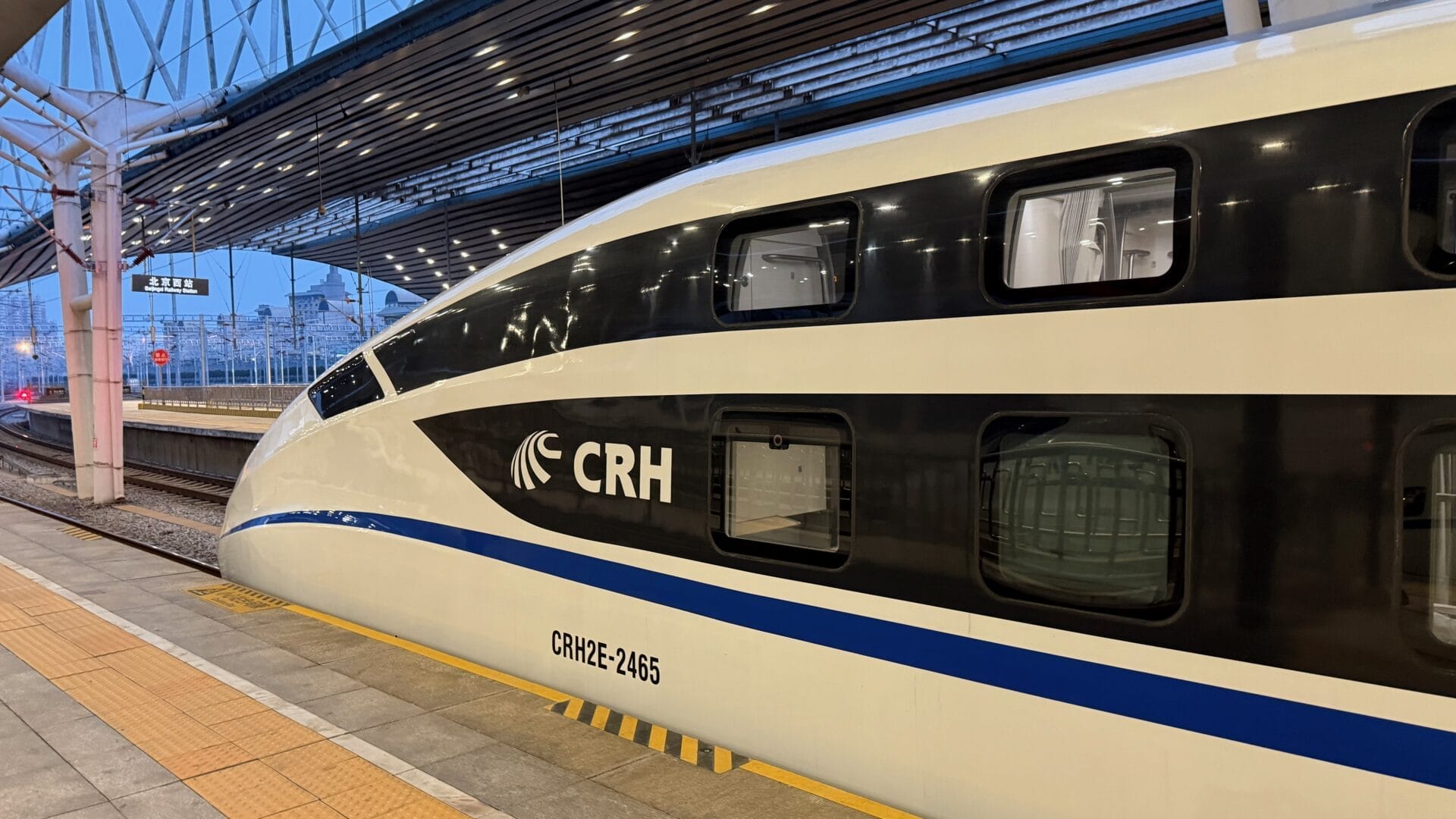
It's a journey I made from Shenzhen to Beijing aboard a CRH2E: twelve hours to cover 2,200 km with an innovative concept: capsule sleepers.
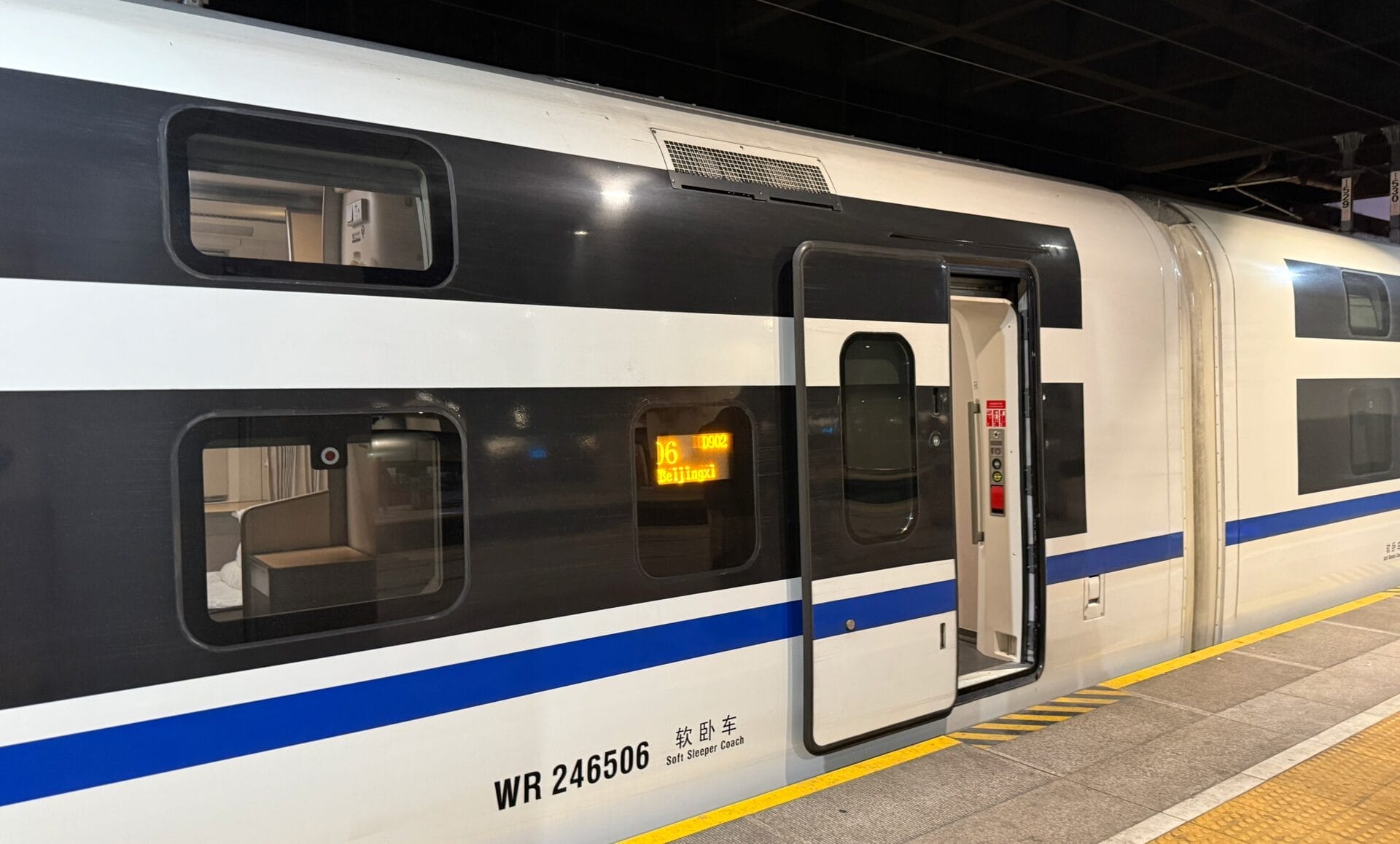
Train D902 with a CRH2E
Departure Shenzhen Bei: 6:24 PM
Arrival Beijing Xi: 6:32 AM D+1
Shenzhen Bei Station: A departure at the heart of China's "Silicon Valley"
Forty years ago, Shenzhen was still a small provincial town, a fishing port at the gates of the powerful city of Hong Kong. Today, it's a megacity of 17 million inhabitants and one of the world's leading high-tech hubs. It is, in a way, China's Silicon Valley.
It's therefore not surprising that the most innovative night train was assigned to serve this city.
I head to Shenzhen Bei station, from where most high-speed trains depart.
On the day of my journey, the crowds are heavy: it's a Saturday evening, at the end of Chinese New Year holidays. It's a period of very high mobility, when trains and planes are packed. The clientele is mainly families, with many children and elderly people accompanied by their relatives.
Discovering the CRH2E
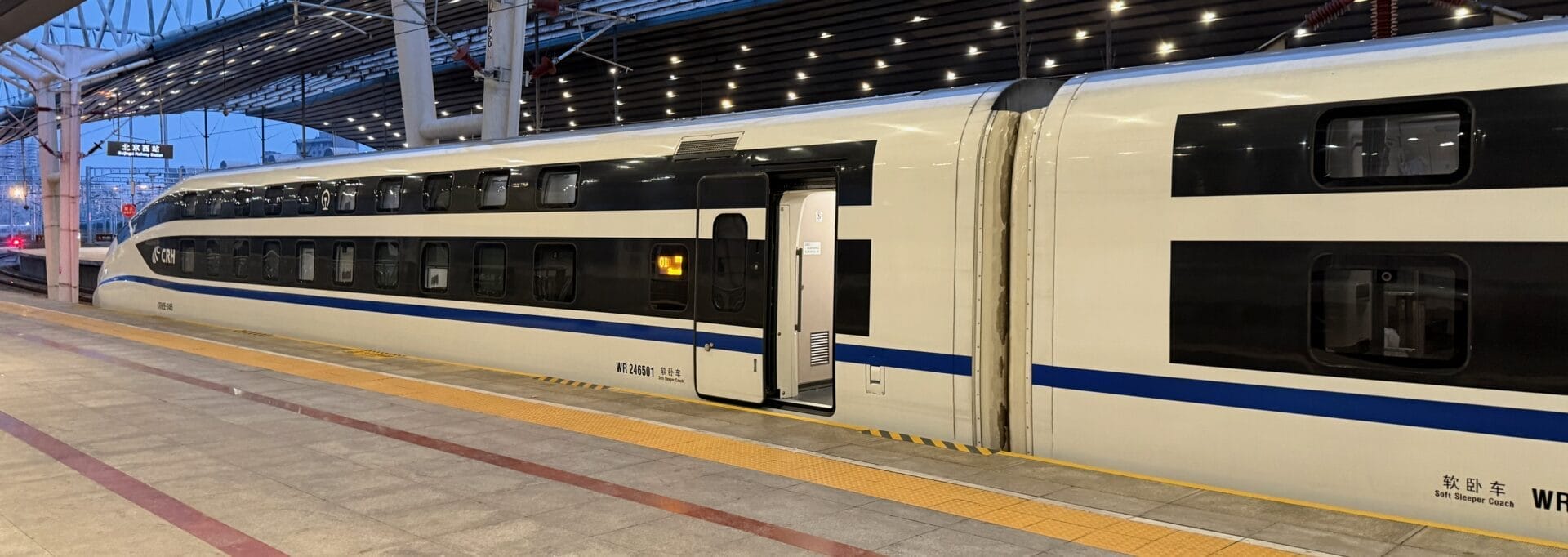
The CRH2E entered service in 2017. It was built in China under Japanese license, based on the Shinkansen model. Only three trains of this type exist, operated exclusively on the Shenzhen — Beijing line.
The exterior features a beautiful white and black livery, with rows of windows corresponding to the two sleeping levels.
The CRH2E Concept: The Art of Optimizing Individual Space
Unlike other trains, only one travel class is offered.
It's a train entirely composed of sleepers, arranged longitudinally rather than in compartments as is usually the case.
The sleepers are arranged on either side of a central aisle.
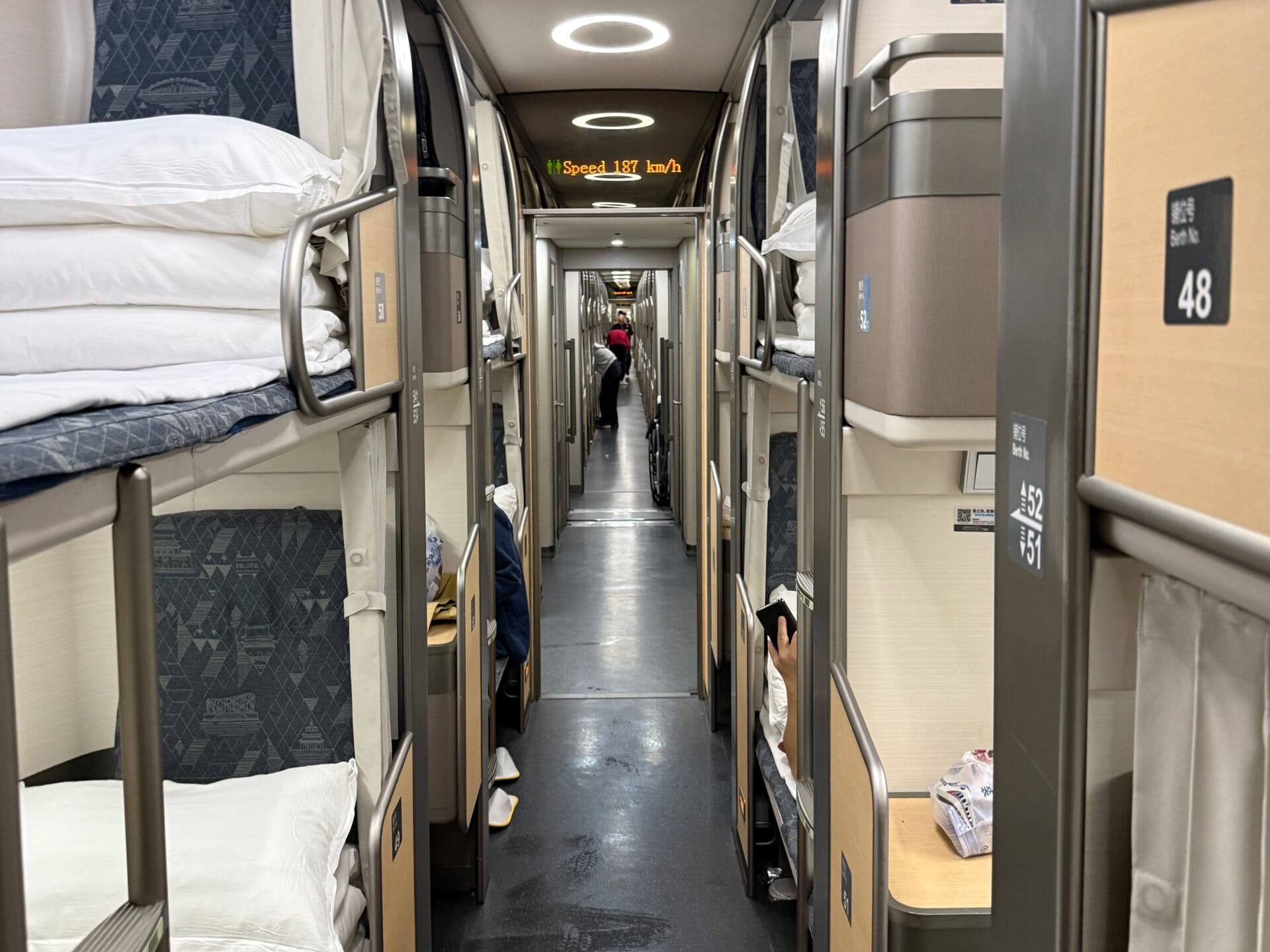
This choice allows for individual capsules while maintaining high occupancy density.
Each car offers 60 sleepers, equivalent to a classic hard sleeper car (ten compartments of six sleepers).
With its 16 cars, the CRH2E can accommodate 860 passengers on board, equivalent to two Airbus A380s!
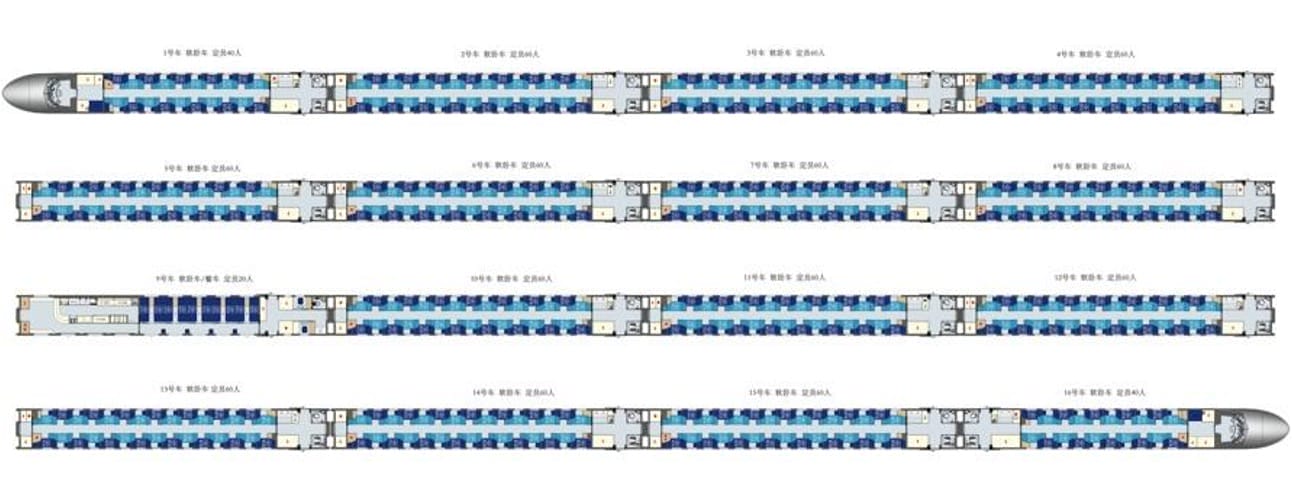 Source: 12306.cn
All cars are similar except for the one located in the center of the train, which houses a tiny bar area and staff compartments. Since they're all interconnected without separation, the whole gives an impression of almost uninterrupted length.
Anatomy of a Capsule
The sleepers are generally identical with two main variations:
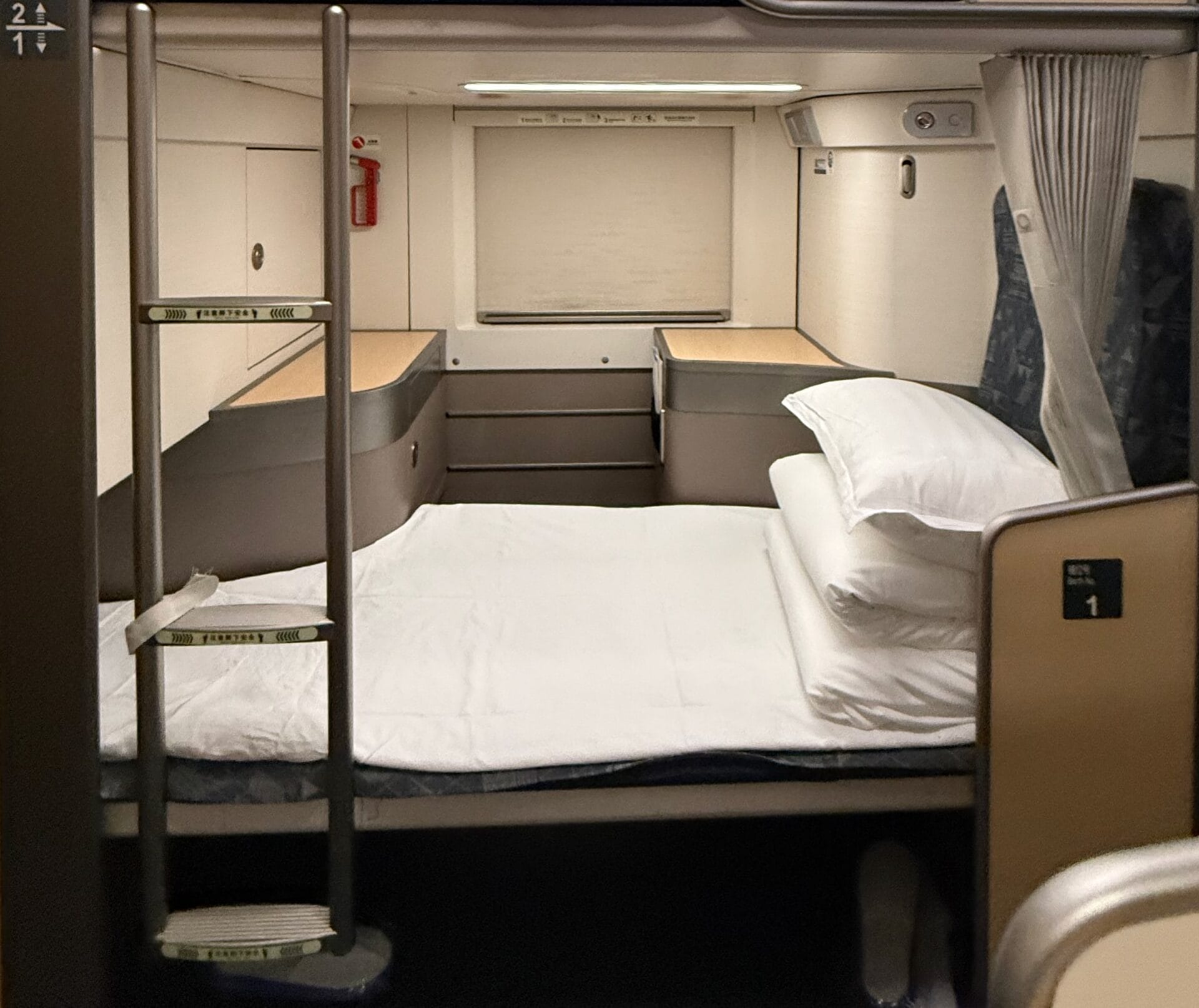
- They're arranged on two levels. The lower ones, more accessible, are slightly more expensive. The ladder for accessing the upper sleepers is well designed.
- The sleepers are arranged in a staggered pattern, alternately window-side or aisle-side. This configuration allows for more space at the upper body level.

Personally, I preferred an aisle-side sleeper, which offers more generous interior space.
Unfortunately, it's not possible to choose your location when booking: seats are assigned randomly.
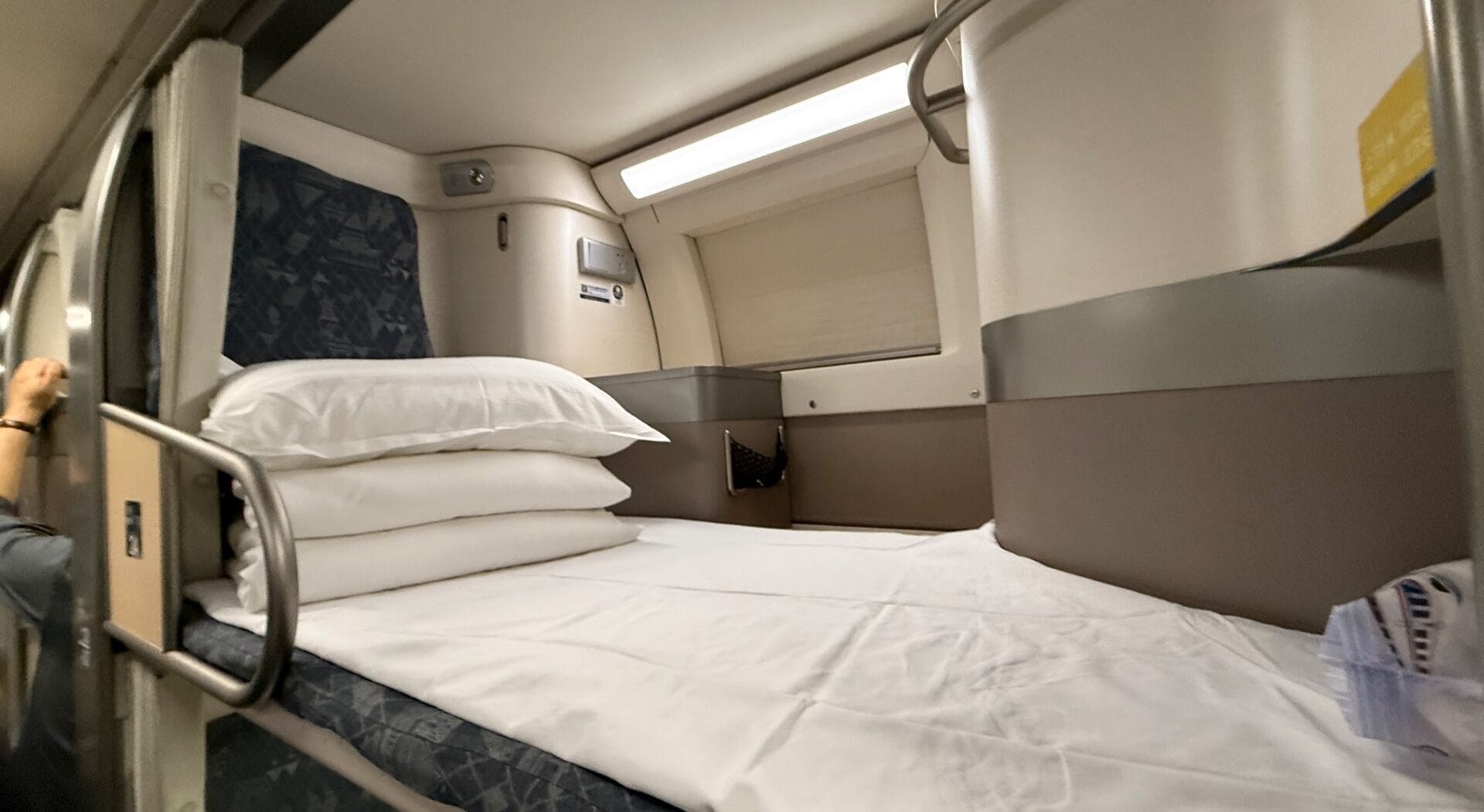
I settle into my sleeper and immediately feel comfortable:
- It's surprisingly spacious. Luggage can be stored under the bed or in a space near the window.
- The sleeper is fixed and cannot be converted into a seat, but it's possible to sit cross-legged leaning against a padded backrest integrated into the headboard. With the pillow, it remains comfortable, although it may be less suitable for elderly or less mobile people.
- I also have a small table to place my belongings and a socket to charge my smartphone. Since it's still early, I take the opportunity to watch a movie I had downloaded beforehand.
- Gradually, everyone draws their curtain to find themselves in a more intimate space, away from prying eyes.
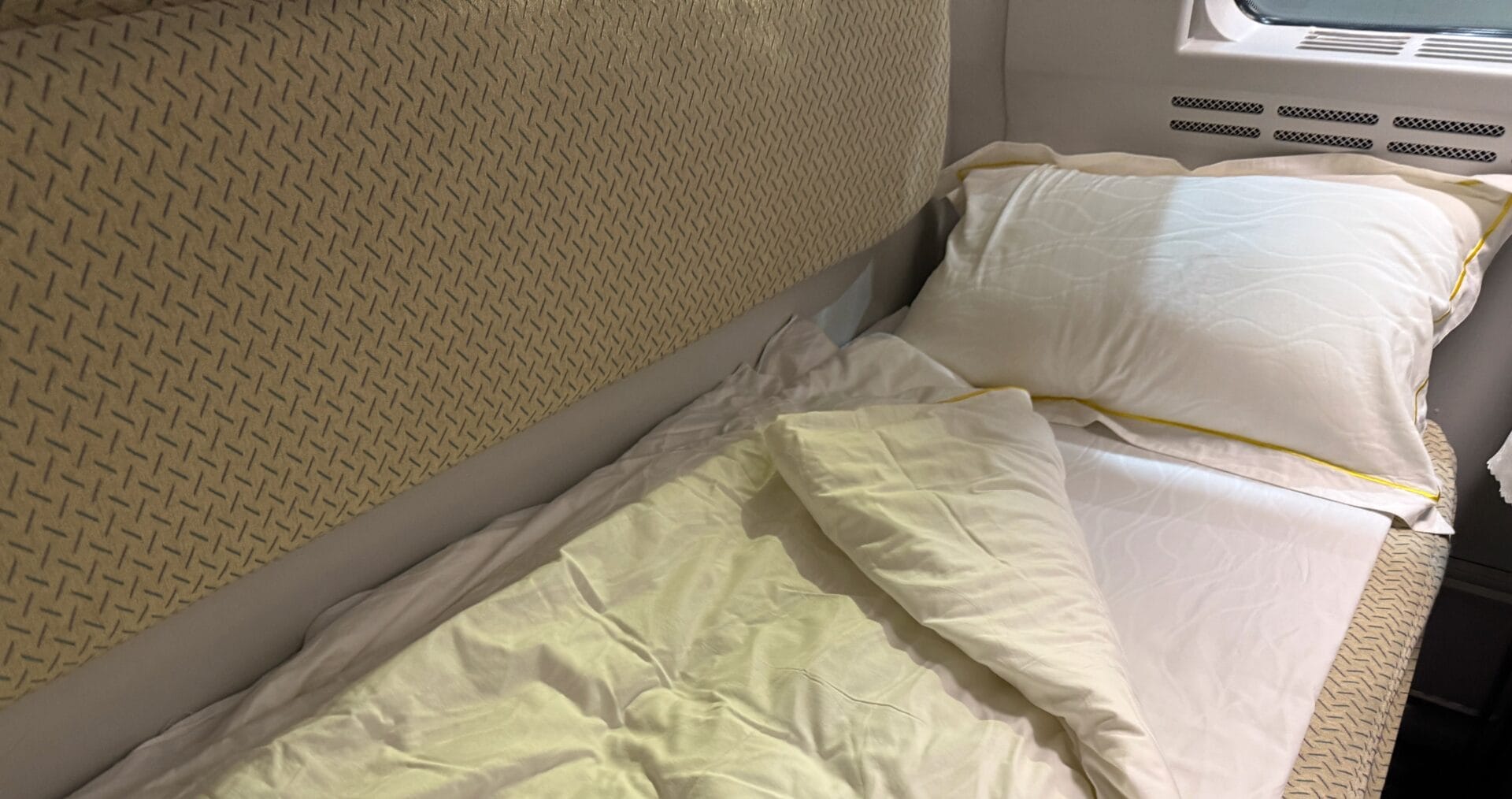
- The duvet is soft, the pillow thick, and the mattress significantly more comfortable than in the other two Chinese night trains I tested.
Most passengers had dinner before departure, but some prepare instant noodles using the hot water dispensers present in all Chinese trains.
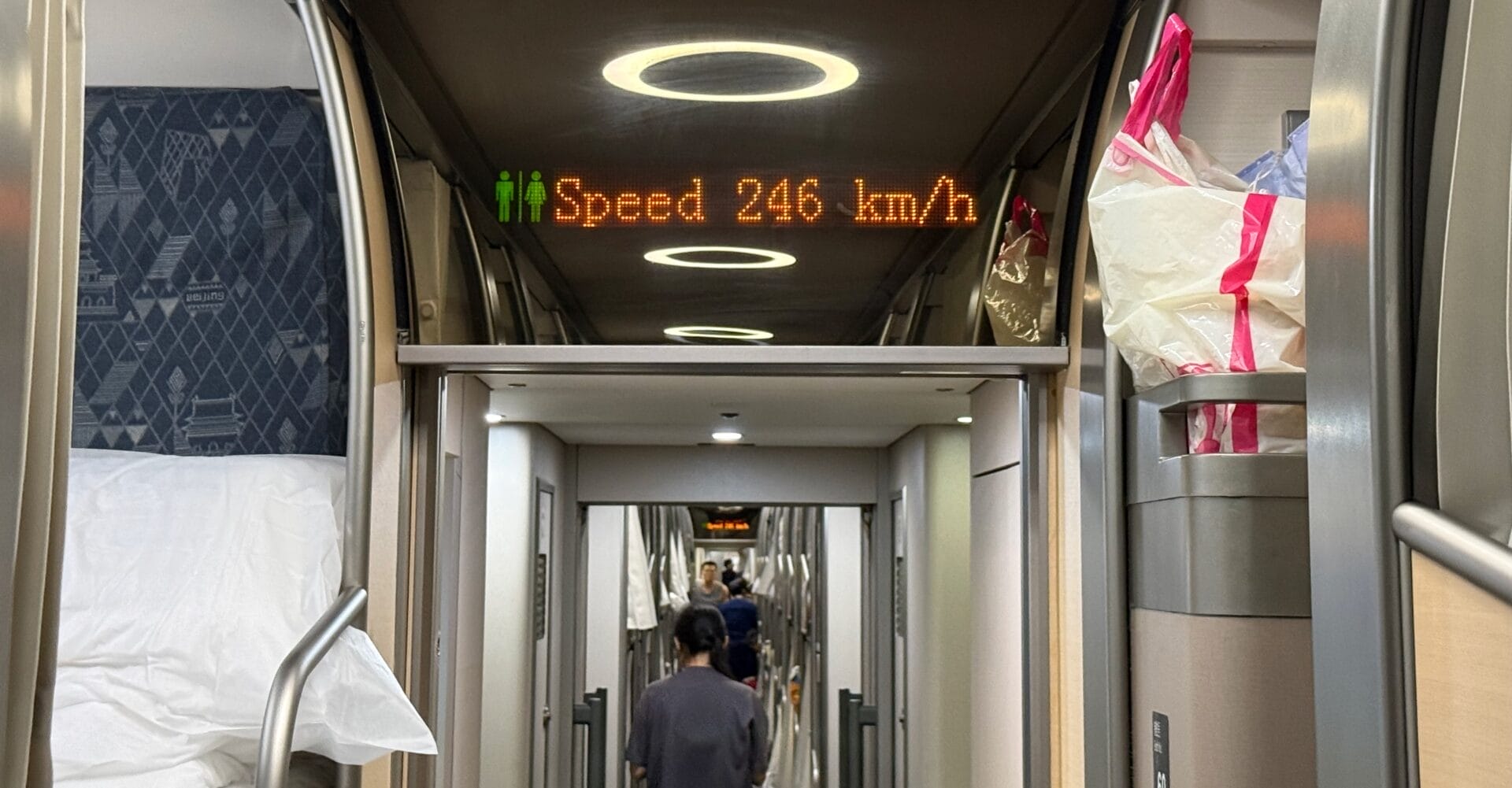
With the train full, some bulky luggage ends up in the central aisle.
Our train leaves Shenzhen at 6:25 PM, with arrival scheduled for the next day at 6:35 AM in Beijing. Shortly after departure, we make three stops in Guangzhou, China's third-largest metropolis.
Night on Board: Density versus Comfort
When going to bed, I face two inconveniences that concern me:
The first concerns the curtain, which is not completely opaque. With the light remaining on in the corridor, my space is not sufficiently plunged into darkness.
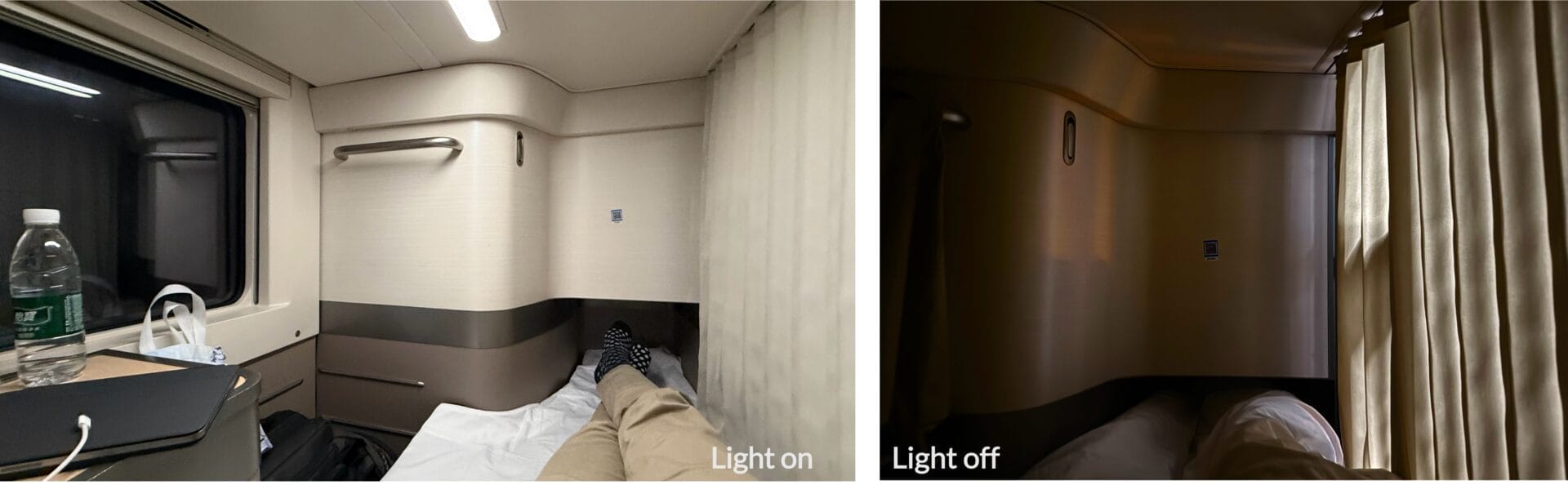
The second is related to noise. The train's noise level is generally low (around 59 decibels), but it increases by about ten decibels when passing through tunnels. With the southern terrain being rugged, we pass through many of them early in the night. This alternation in noise level is somewhat disturbing.
Fortunately, an eye mask and earplugs, which I always have with me when traveling, allowed me to isolate myself effectively.
Moreover, unlike on a plane, the stability of the high-speed train is remarkable, and naturally without the slightest air pocket.
A small detail I appreciated: different colored slippers are offered to passengers to allow them to walk around the train without shoes and without mixing them up.
On the other hand, I wasn't disturbed by other passengers, who remained discreet throughout the journey. My sleeper being located in the center of the car, it was probably better insulated than those near the toilets.
Sanitary Facilities Aboard the CRH2E
Aboard the CRH2E, I find the same sanitary facilities organization as in all the Chinese trains I've taken. In each car, there's a Western-style toilet and a squat toilet, traditionally used in China.
Another peculiarity: the sinks are located outside the toilets and accessible to everyone. As in some French campsites, passengers do their washing in public. On a train, this can surprise Europeans.
However, it remains practical, as it limits the use of toilets to their primary function.

It's an excellent night despite the density of passengers
I wake up at 6 AM, shortly before our arrival at Beijing West station. I slept very well.
The design of the sleepers, in capsule form, made me forget that we were nevertheless about sixty passengers in a relatively confined space.
Getting off the train, I'm surprised by the coolness. We've gone from Shenzhen's subtropical climate to Beijing's continental climate.
In one night, we covered approximately 2,200 km in twelve hours, an average speed of 185 km/h — equivalent to a journey between Casablanca and Paris.
Technological Duel: The CRH2E versus the Austrian Nightjet
In 2024, I experienced between Hamburg and Innsbruck the capsule sleeper concept of the new Austrian Railways (ÖBB) Nightjet. So I compared them.
Nightjet Advantage:
- Roller blinds provide better darkness and sound insulation than the curtains used in Chinese trains.
- The sober and elegant interior decoration is less austere than that of the Chinese train, all in gray tones.
- The ability to communicate with a travel companion thanks to a removable partition between two capsules.
- The ability to lock your capsule with a magnetic badge.
- Doors isolate each car from one another. This is more pleasant than the endless corridor of the CRH2E.
CRH2E Advantage:
- The width of Chinese trains allows for better optimization of interior layout (3.3 m versus 2.9 m in Europe).
- A longitudinal arrangement of capsules that significantly facilitates access, unlike the Nightjet where capsules are arranged perpendicularly.
- Bedding consisting of a mattress topper and duvet much more pleasant than the sheet and blanket offered on the Nightjet.
- More luggage space than on the Nightjet.
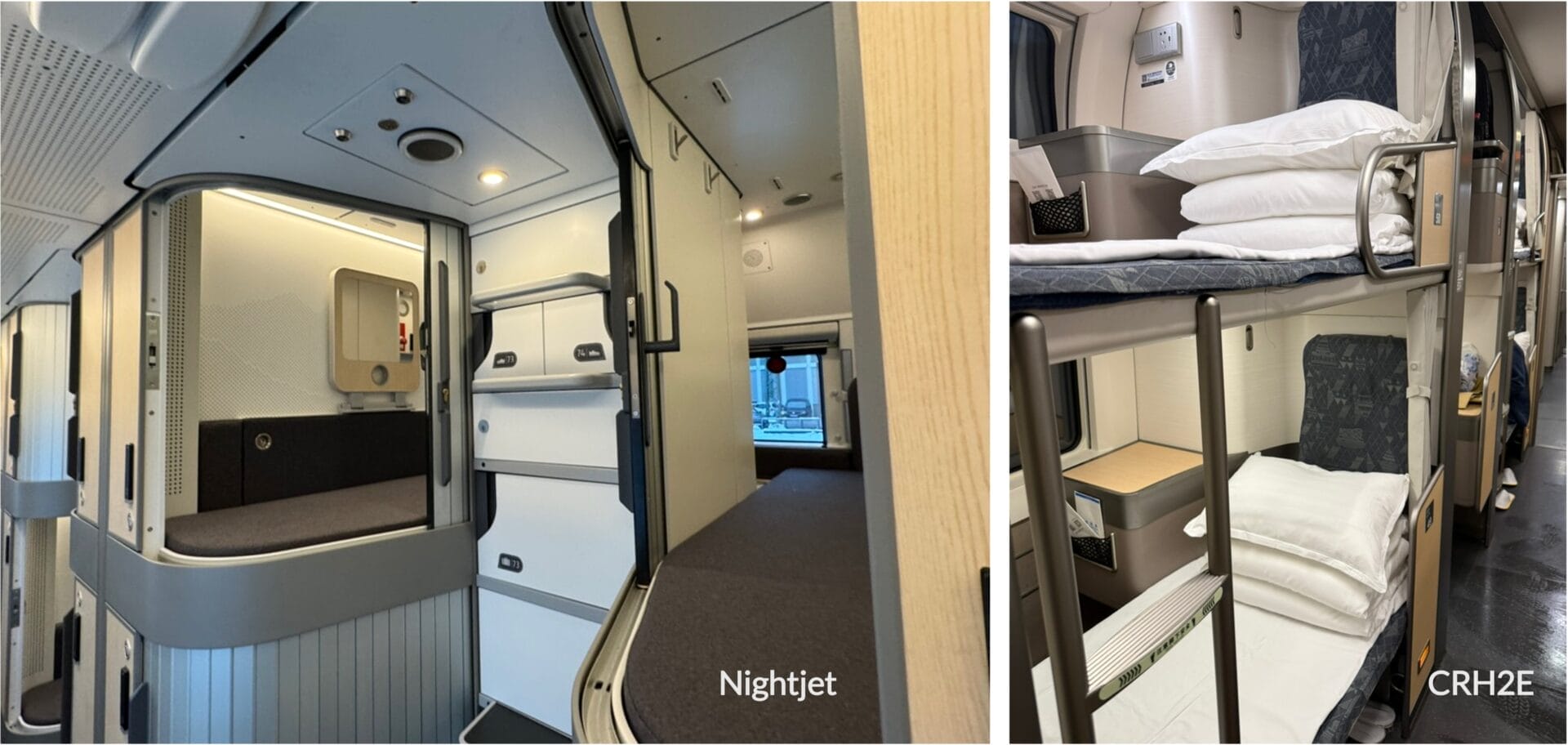
The night train of the future will probably be a combination of these two approaches. Players like Luna Rail or Nox Mobility are already exploring these avenues.
Beijing — Chongqing: High speed with sleeper compartments aboard the CRH1E
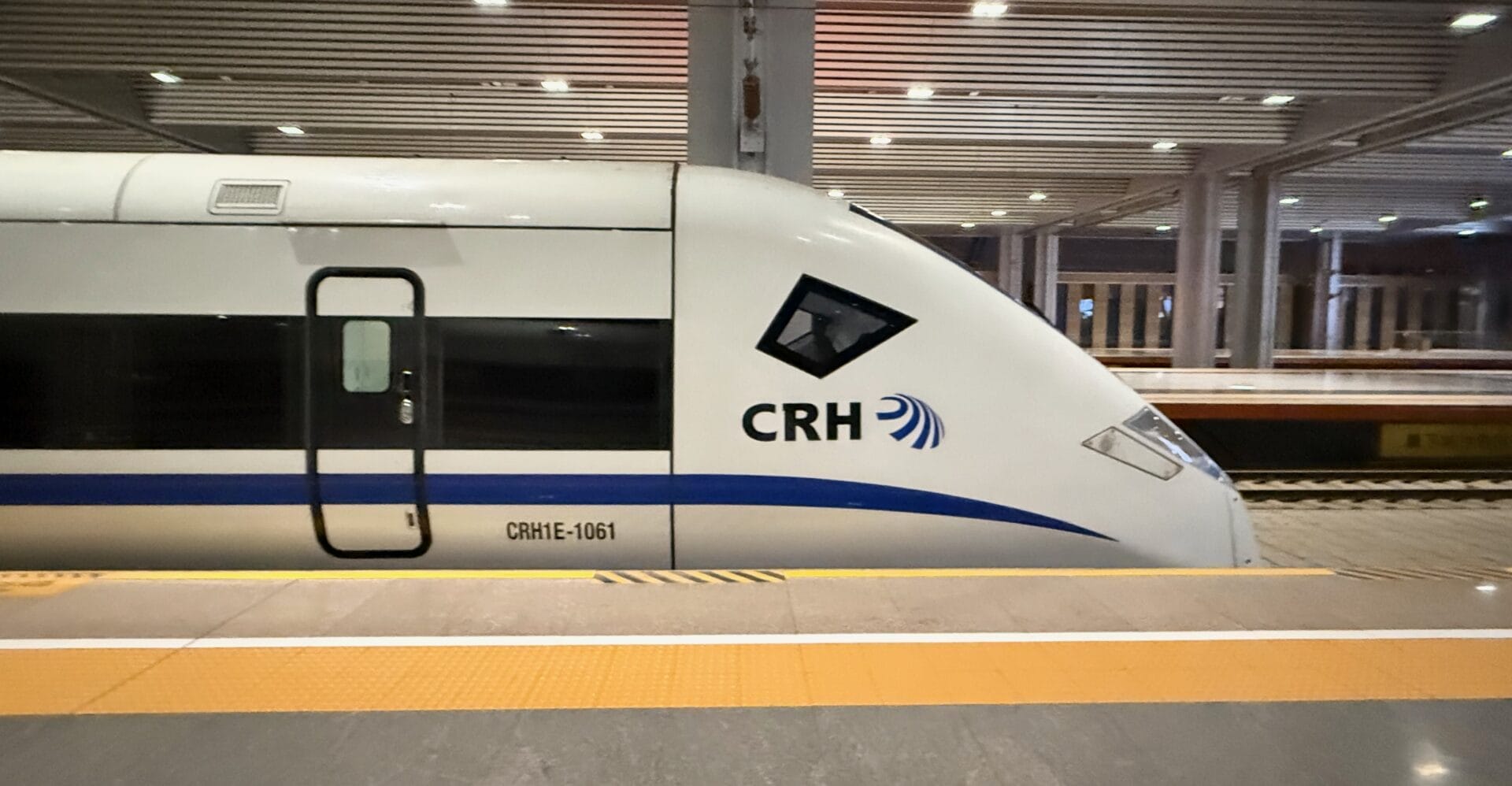
For my second experience, I travel from Beijing to Chongqing, two cities 1,300 km apart like Paris — Vienna, aboard another high-speed night train: the CRH1E, which was built under Bombardier license, a manufacturer of Canadian origin.
Train D997 with a CRH1E
Departure Beijing Fengtai: 8:41 PM
Arrival Chongqing Xi: 10:22 AM D+1
The CRH1E is arranged very differently from the CRH2E I took from Shenzhen to Beijing, with a more classic offering for a night train:
- Deluxe class, with two-berth compartments;
- First class, with four-berth compartments;
- Second class, with seated places.
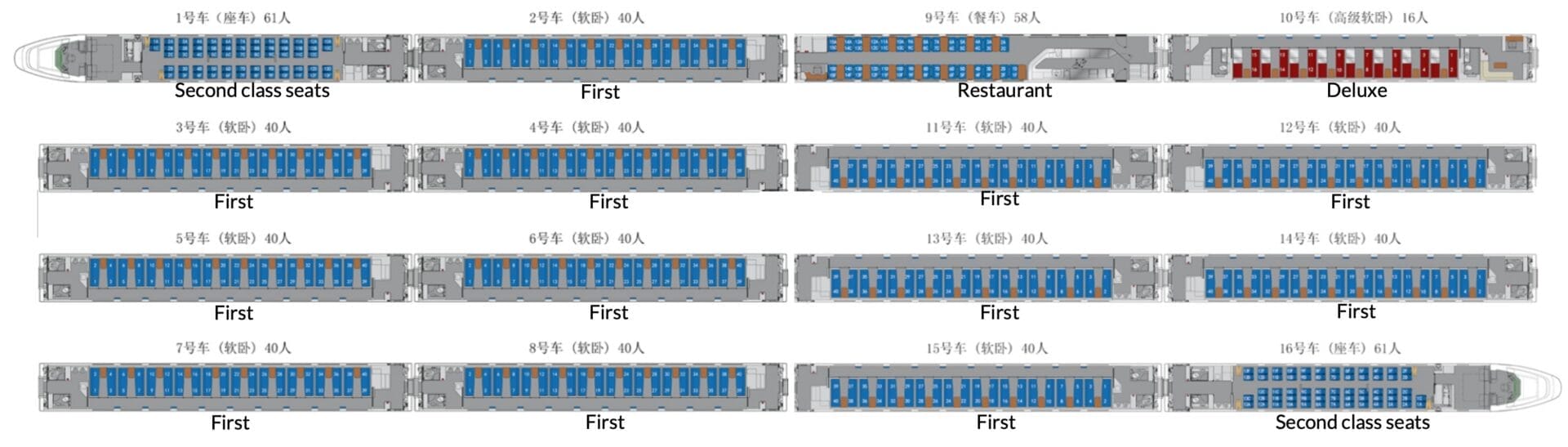 Source: 12306.cn
I chose to travel in Deluxe class, the highest-end product. For information, this doesn't exist on all CRH1Es.
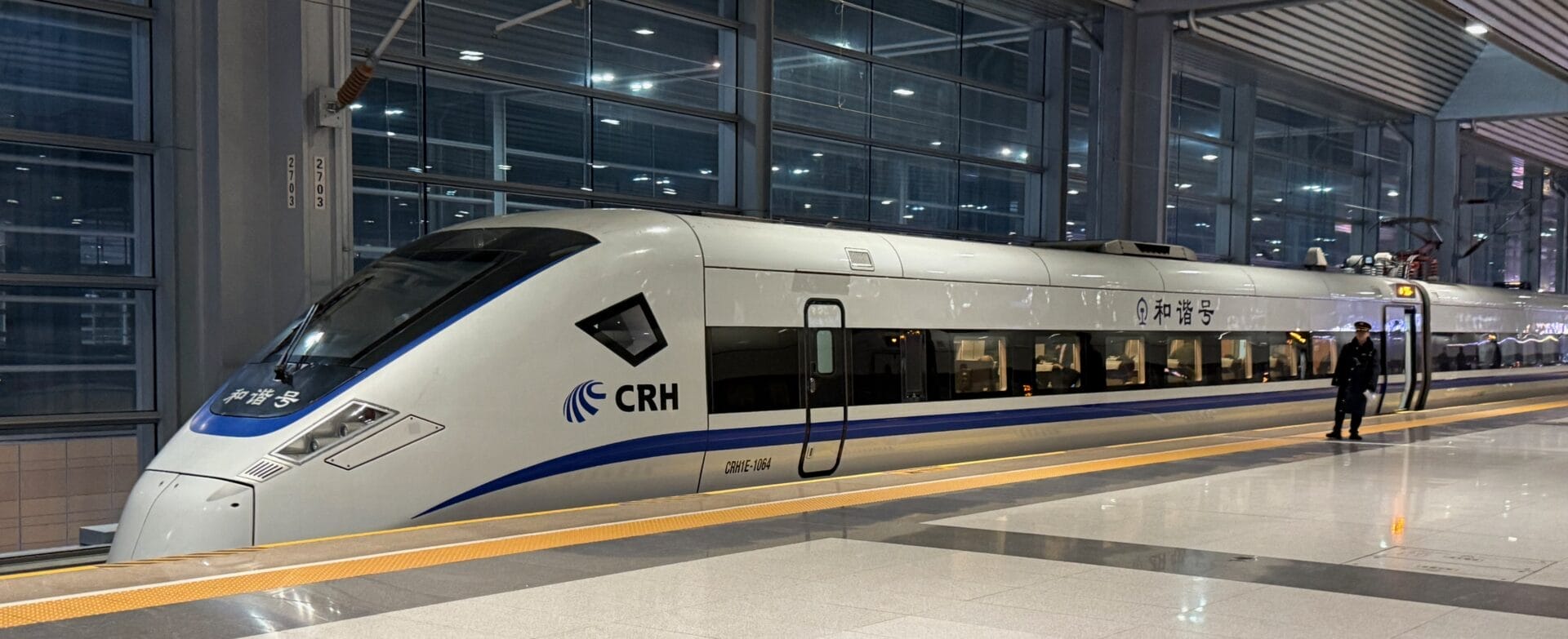
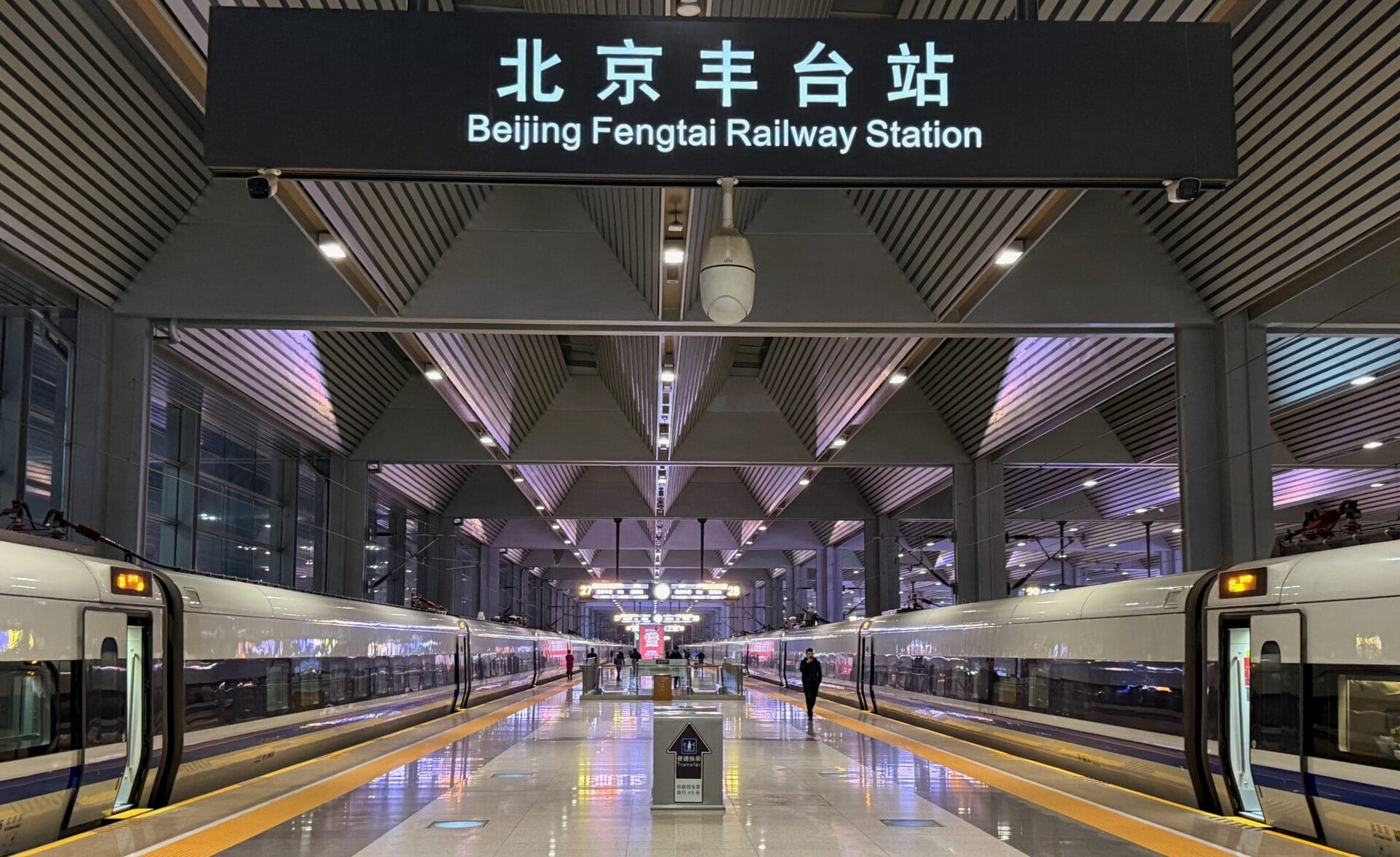
Beijing Fengtai Station on a Monday evening: very quiet
We depart from Fengtai station on a Monday evening and the station is very quiet.
Chinese New Year holidays are over and traffic has returned to its usual rhythm. My train is particularly empty, with an occupancy rate of about 20%. A stark contrast to my first journey!
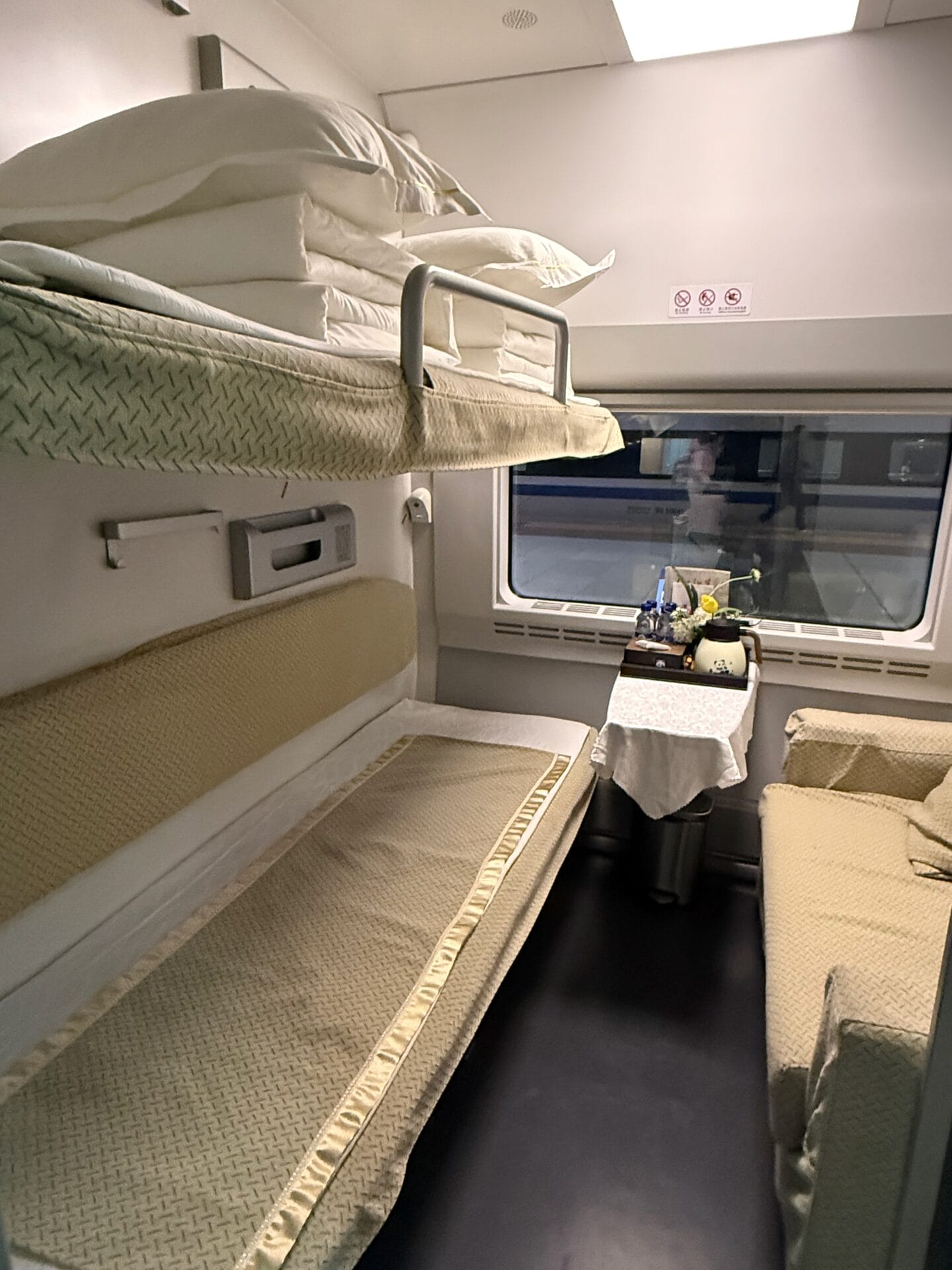
The Deluxe Experience: The high end of night trains in China
There's only one Deluxe car on the train, for just 16 passengers.
On the platform, I'm greeted by a hostess who leads me to my cabin. It seems comfortable and spacious, with two berths and a small sofa.
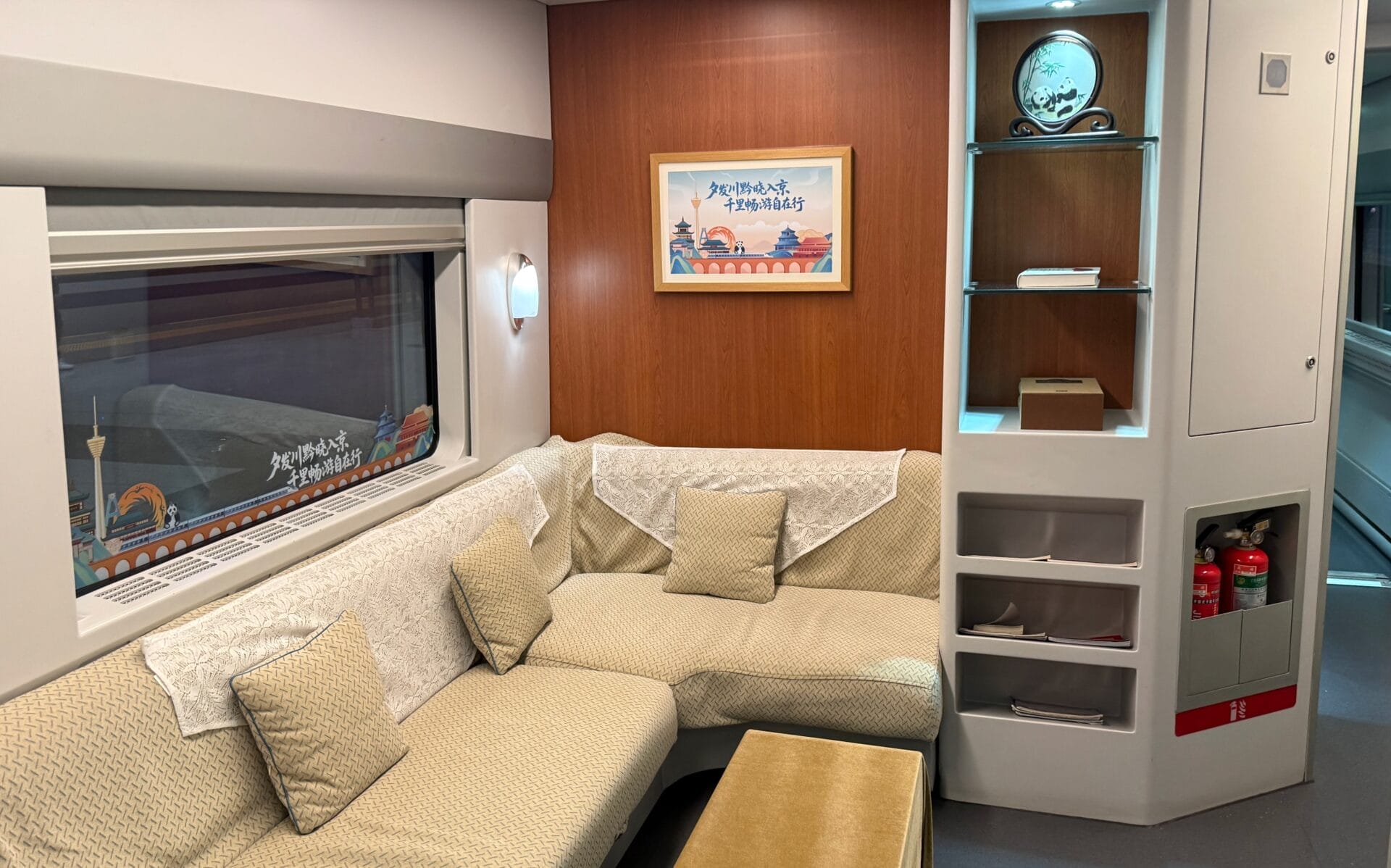
A small lounge allows passengers to meet and chat in a friendly atmosphere. It's located at the entrance to the car.
Finally, toilets and WCs are shared and located at each end of the car. A likely explanation is that high-speed trains are subject to weight constraints that limit the installation of private sanitary facilities and associated water reserves.
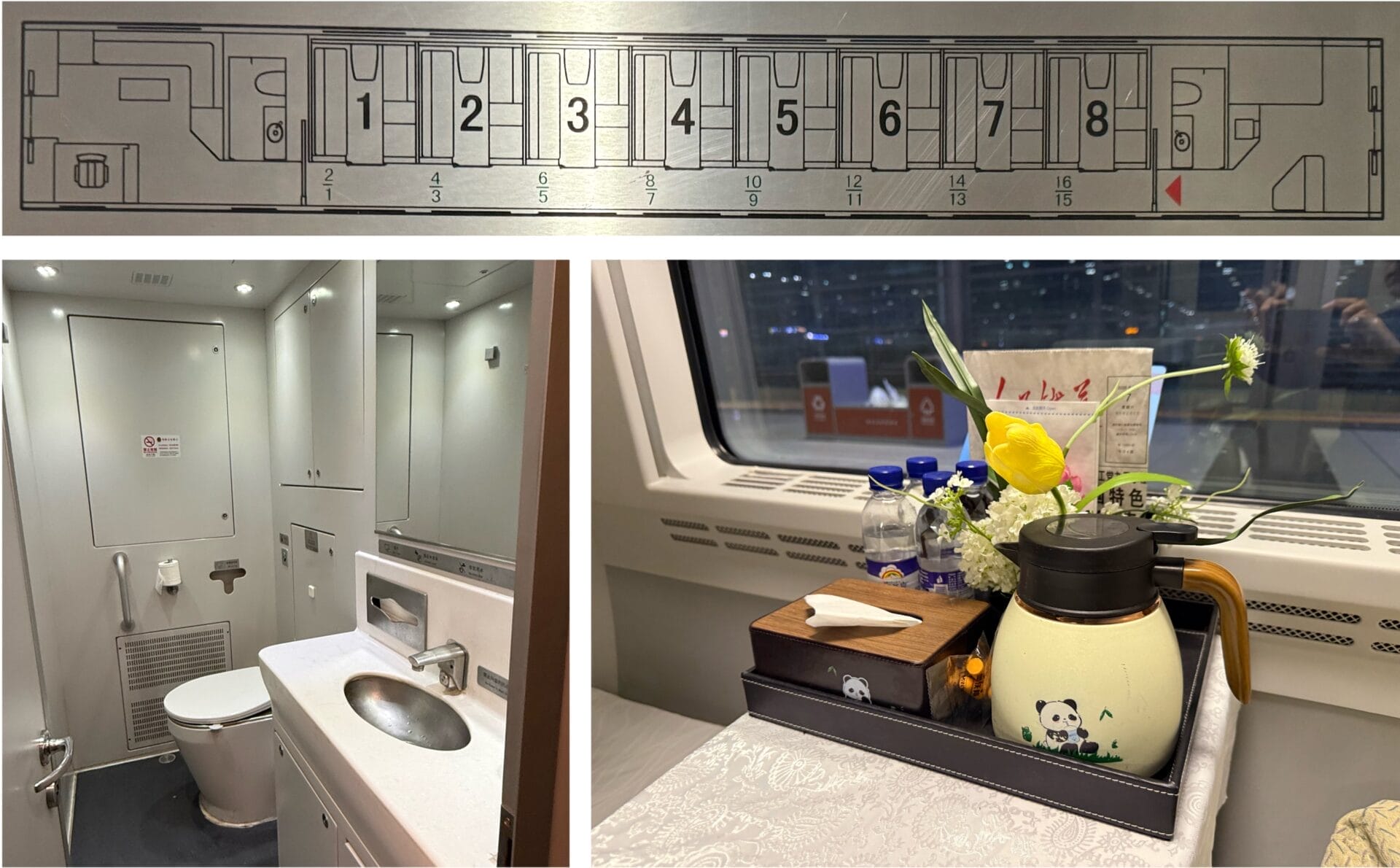
After departure, the onboard hostess comes to check my passport and offers me a small comfort kit containing a toothbrush, comb, earplugs, and slippers. Her uniform is more modern and less strict than that of the crew on old classic trains.
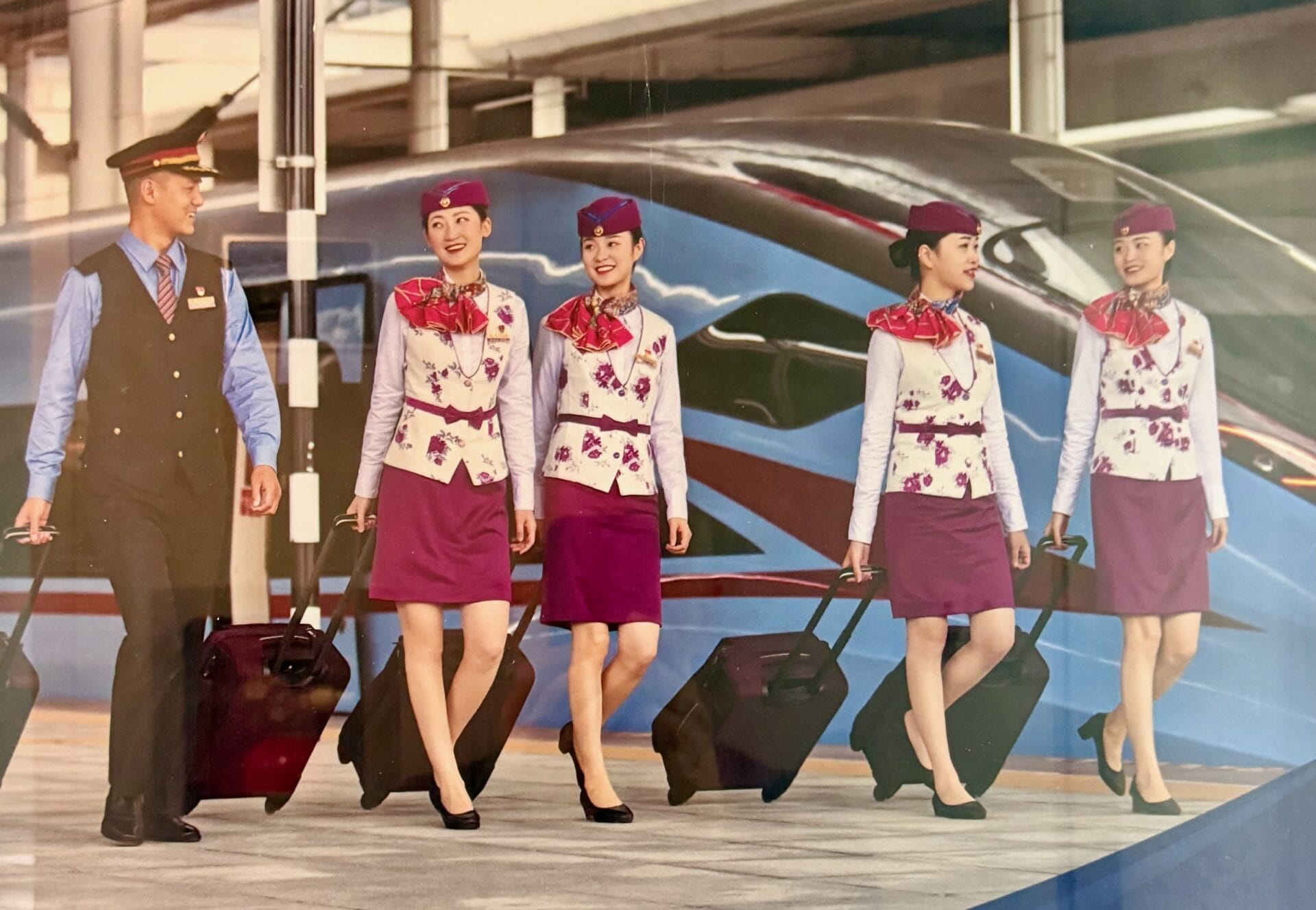 Source: photo of a Chinese railway poster
A First class with four berths per compartment
With 480 berths spread over 12 of the 16 cars, First class constitutes the majority offering.
The compartments consist of four berths, similar to those on classic trains.
In case of insomnia, fold-down seats in the corridor allow passengers to temporarily settle outside their compartment.

A second class car with seated places
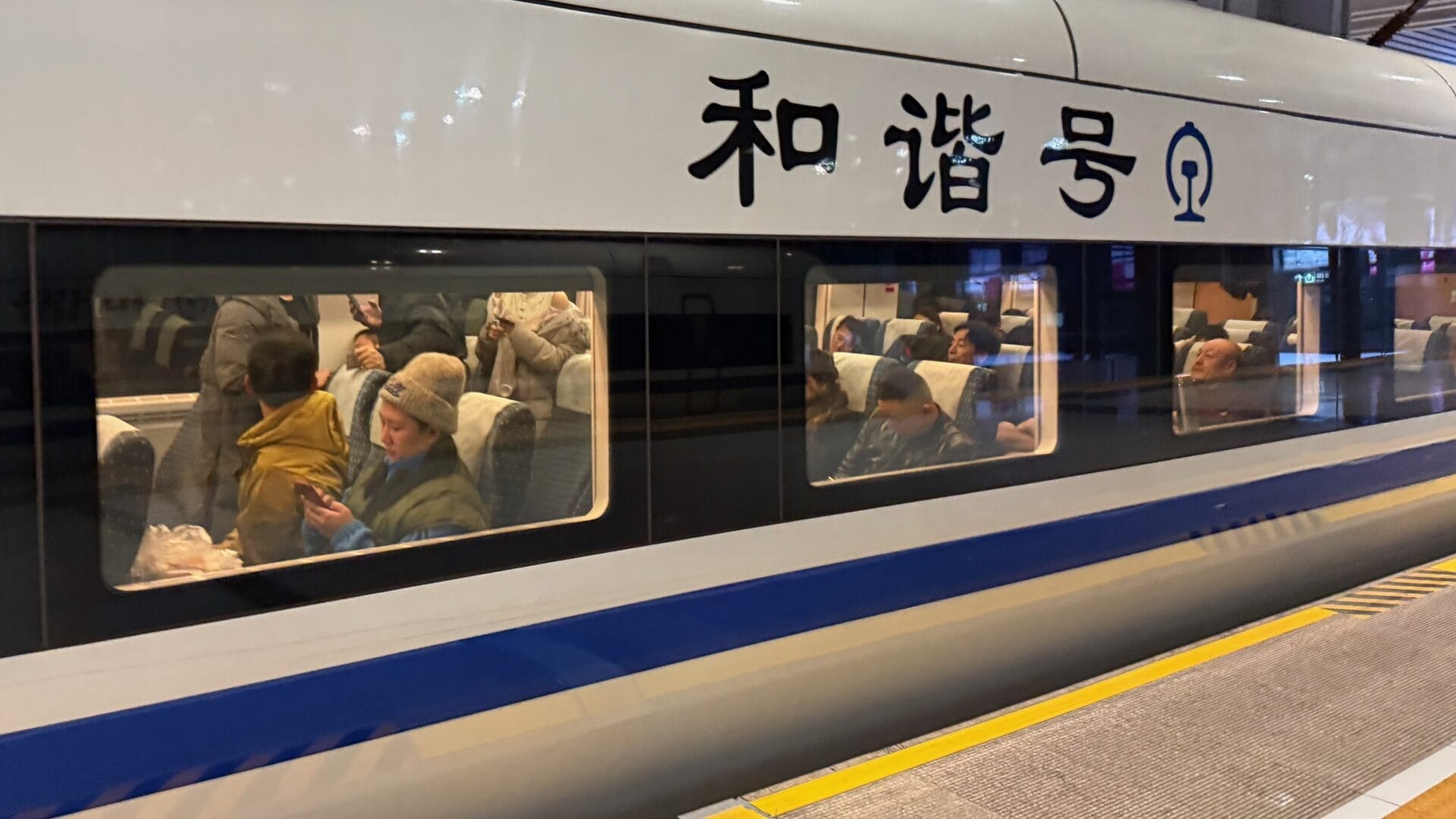
At each end of the train, a second class car with seats arranged five abreast is offered. It's more comfortable than traditional hard seat cars, with significantly more reclinable seats.
A dining car without a kitchen
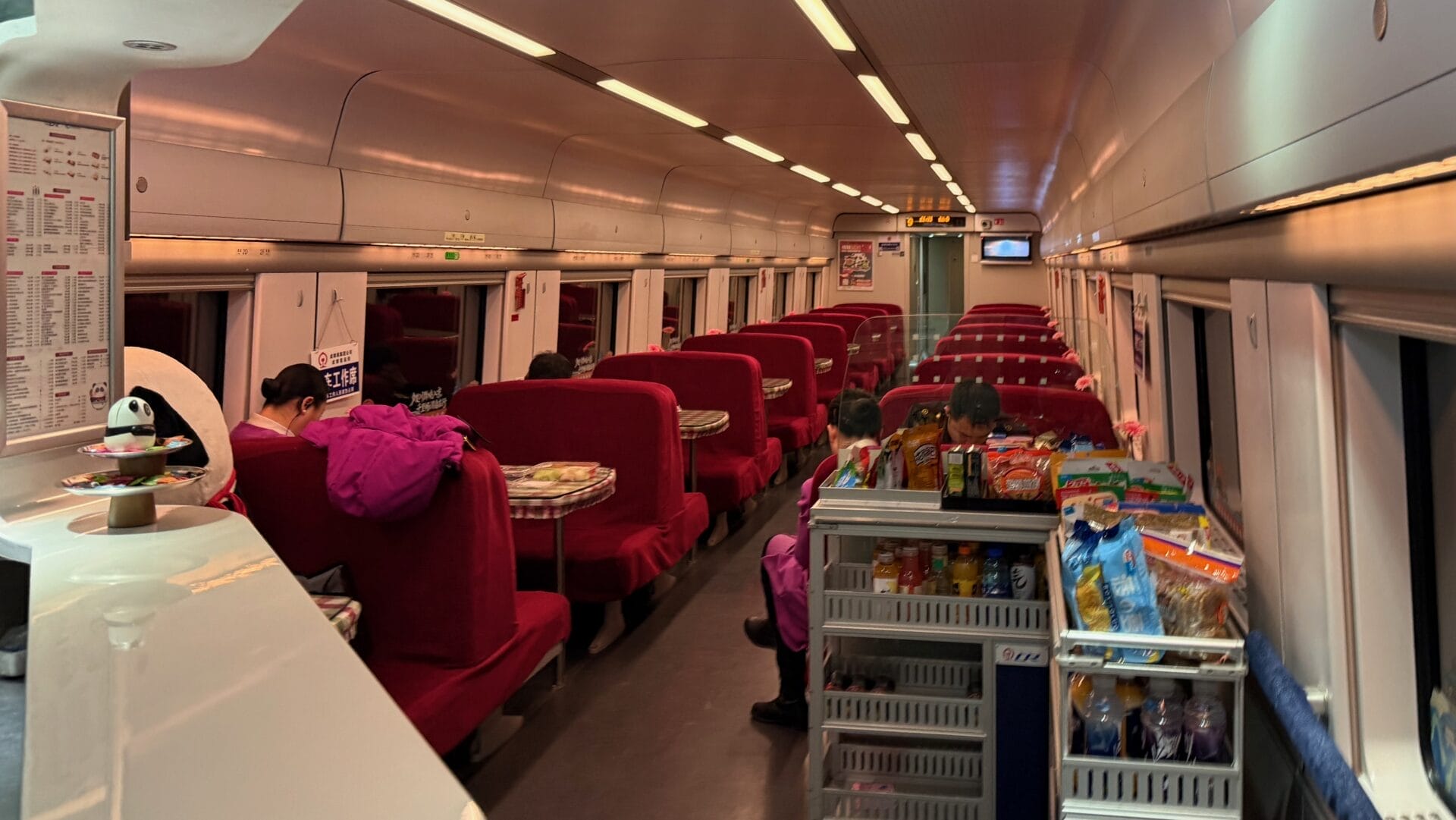
In the middle of the train is a dining car with large capacity, with 58 seats around tables of four. However, unlike classic trains, meals are no longer prepared on board, but simply reheated in the microwave.
From Manchuria to Sichuan: Awakening under subtropical softness
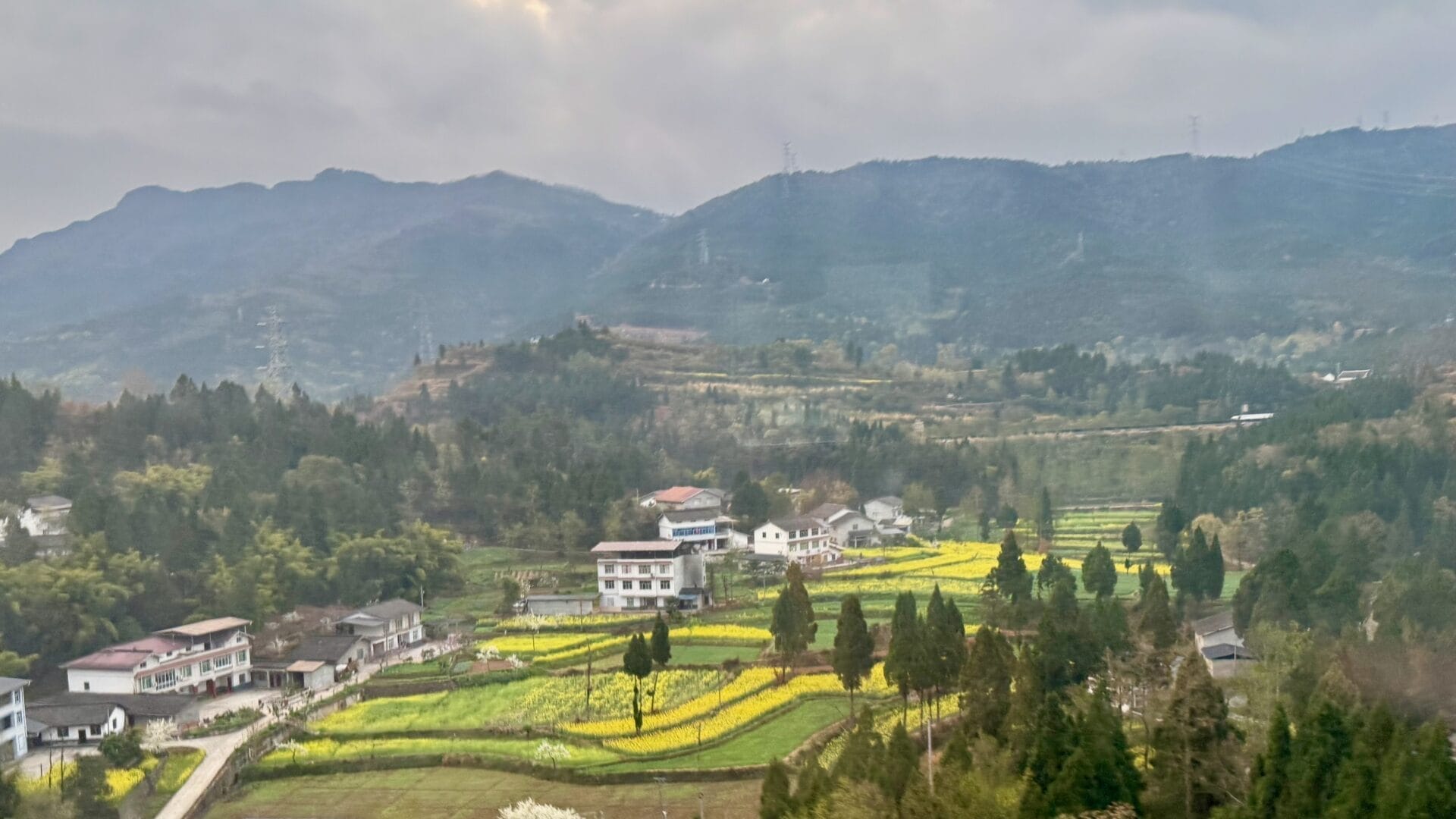
Upon waking, somewhere between Xi'an and Chengdu, the landscape has radically changed. The wintry regions of the north have given way to verdant subtropical landscapes, with rice paddies and deciduous forests. The villages seem more lively. Welcome to Sichuan.
This is all the magic of the night train: waking up in an environment totally different from the previous evening.
I admire the yellow of rapeseed flowers contrasting with the green of the landscapes.
We arrive in Chengdu at 8:47 AM, a city famous for its pandas.
Then we begin the final stretch to Chongqing, through more rugged terrain, punctuated by numerous tunnels. The villages are still wrapped in morning mists.
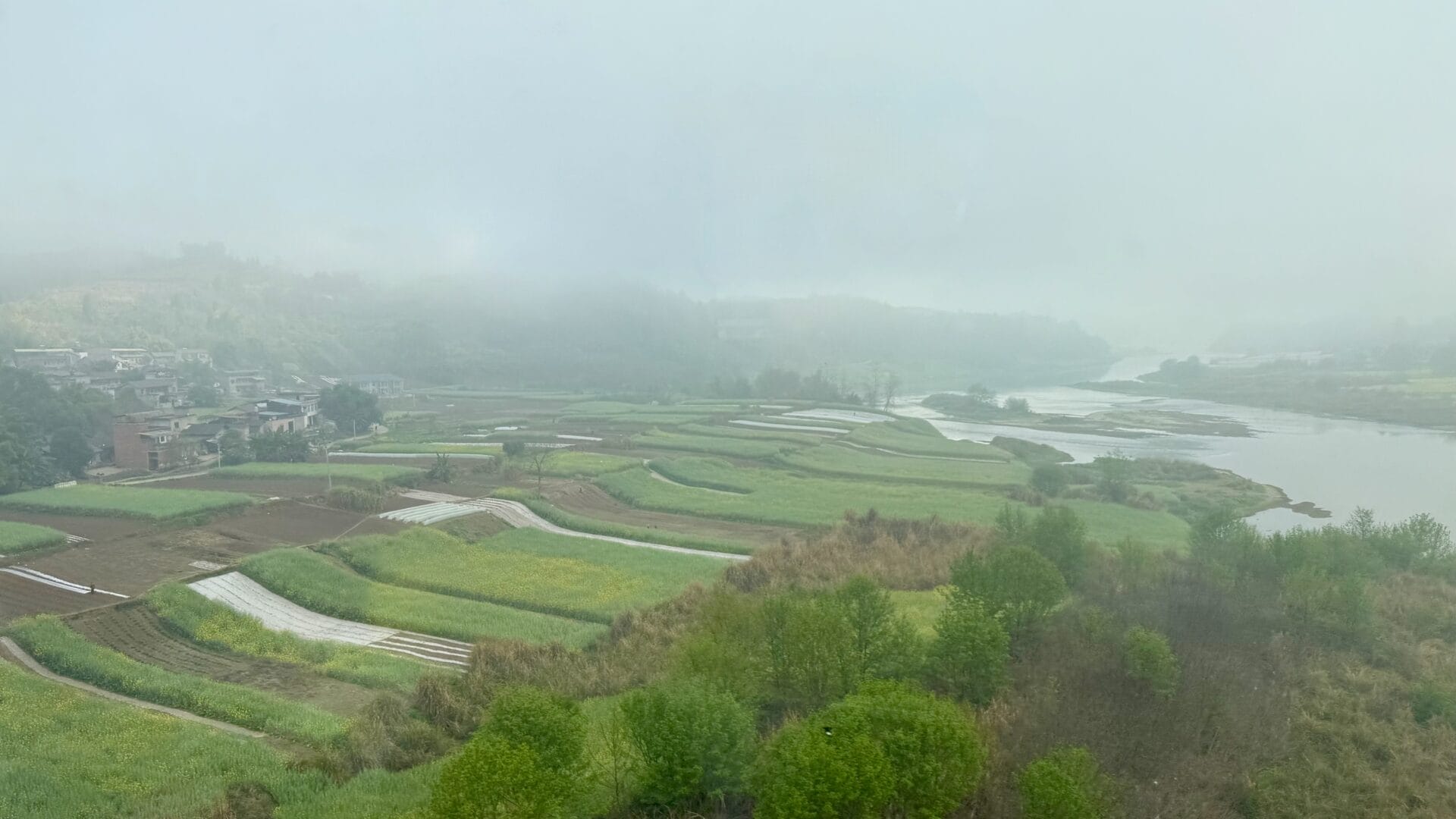
It's only as we approach Chongqing that the sun becomes fully visible.

The CRH1E: A night train with very classic layout
Shanghai — Harbin: Immersion in Chinese Railway Heritage
To better understand the origins of the Chinese railway network before the rise of high speed, I also wanted to test a journey on a classic night train, as many still exist in China.
So I traveled from Shanghai to Harbin, a city located in the northeast of the country not far from Siberia and North Korea, over a distance of 2,400 km, equivalent to a Paris — Kyiv journey.
Train Z172
Departure Shanghai: 7:34 PM
Arrival Harbin Xi: 7:37 PM D+1
Trains made for China's immensity
Until about twenty years ago, the average speed of Chinese trains was only about 60 km/h, while the distances covered often reached several thousand kilometers.
China being a continent-sized country, trains had to be designed for journeys combining day and night.
These trains still exist today, complementing the high-speed network. They're recognized by their designation:
- Z ("Zhida Tekuai"), the fastest and most comfortable
- K ("Kuai"), which serve more intermediate stations
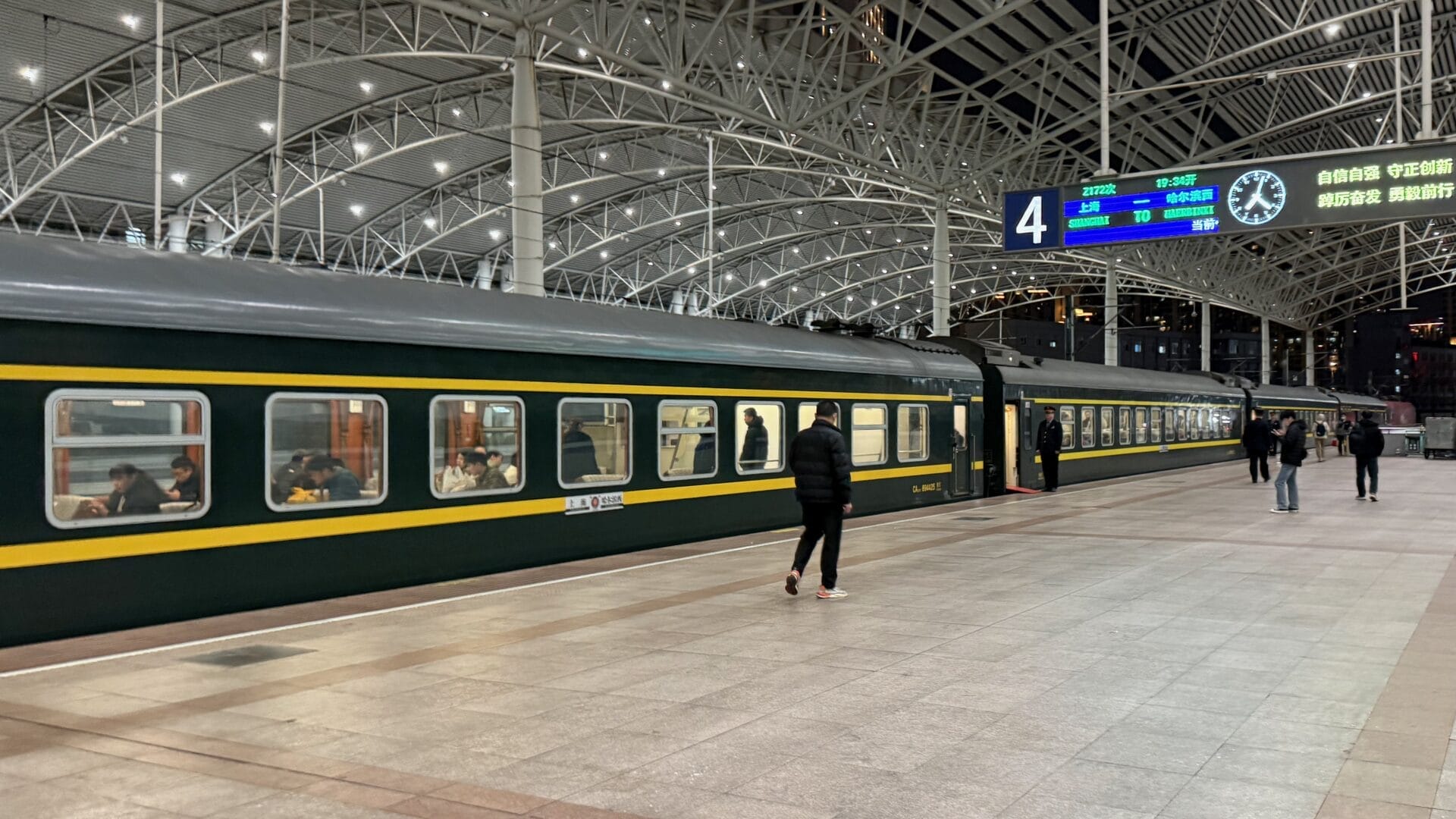
For this journey, I head to Shanghai Central Station: It's quite recent, having only been put into service in 1987 to replace the North Station, which was the historic one that had become too small. Its architecture is sober and without particular aesthetic pursuit: it clearly prioritizes efficiency.
It's no longer the city's main station, with most high-speed trains now serving Shanghai Hongqiao.
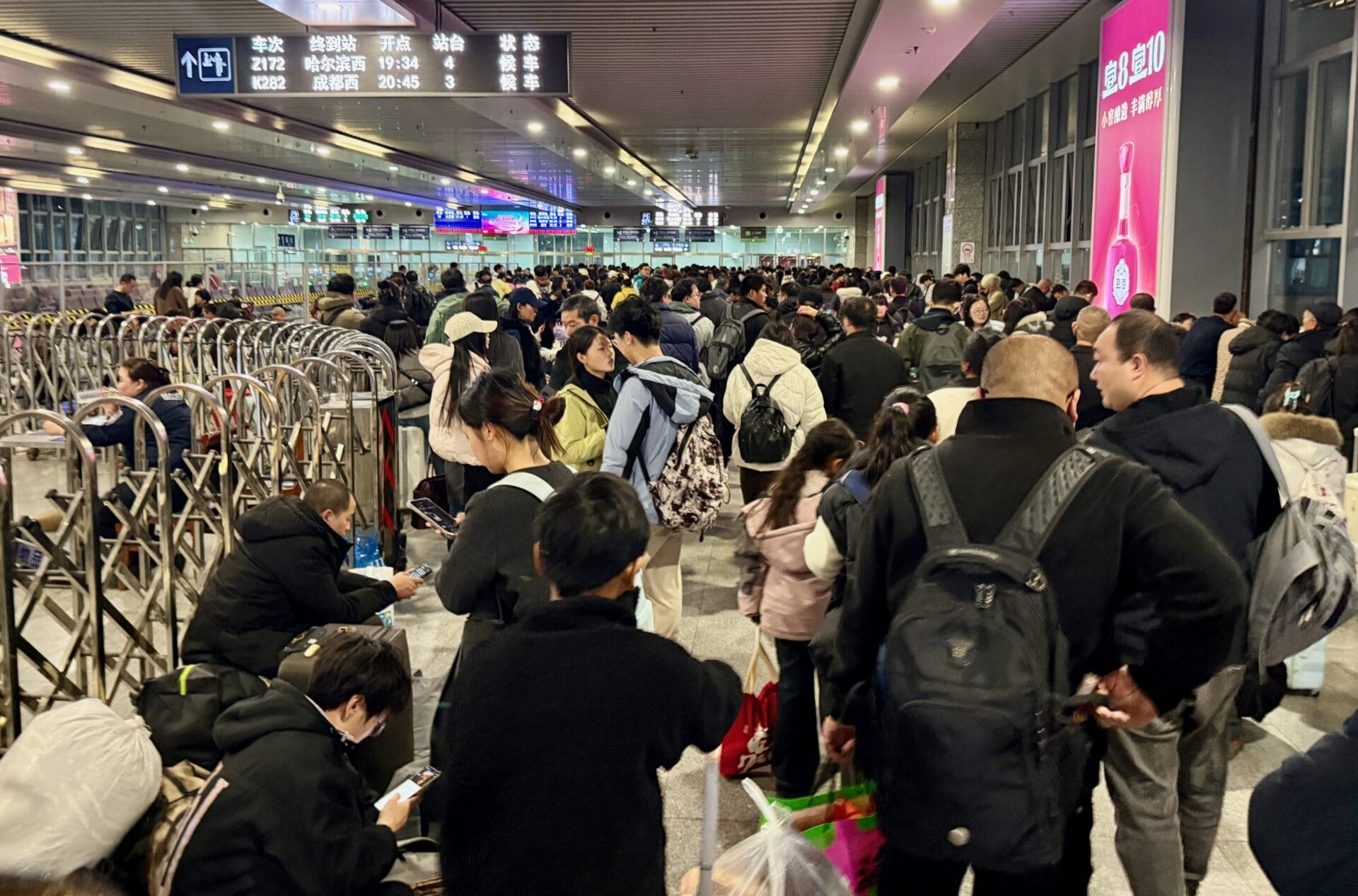
We board about thirty minutes before the scheduled departure at 7:34 PM. The train is full and access to the platforms is marked by some disorganization, with everyone trying to pass through identity checks as quickly as possible, which serve as tickets.
"Wagons-Lits" atmosphere of yesteryear and Soviet heritage
The train consists of 18 cars, all painted in dark olive green with two yellow stripes. The electric locomotive, an HXD3, is massive and imposing.
At each car, a uniformed agent greets passengers. The atmosphere is rigorous, almost military.
It reminded me of what I had experienced aboard the Trans-Siberian in the 2000s.
I'm traveling in Deluxe Soft Sleeper class, the highest category on classic trains. It's only available on certain long-distance trains.
My cabin is spacious and designed for two passengers. I share it with a businessman returning to Shenyang. In China, the concept of a private cabin doesn't exist: it's not possible to book all the beds, as each ticket is associated with an identity document. In a country accustomed to high density, the notion of personal space is different from what we know in Europe.
We have an adjoining toilet and WC for our sole use.
Opposite the berths, a comfortable armchair allows one of the two passengers to enjoy the journey during the day. The other must sit on their berth.
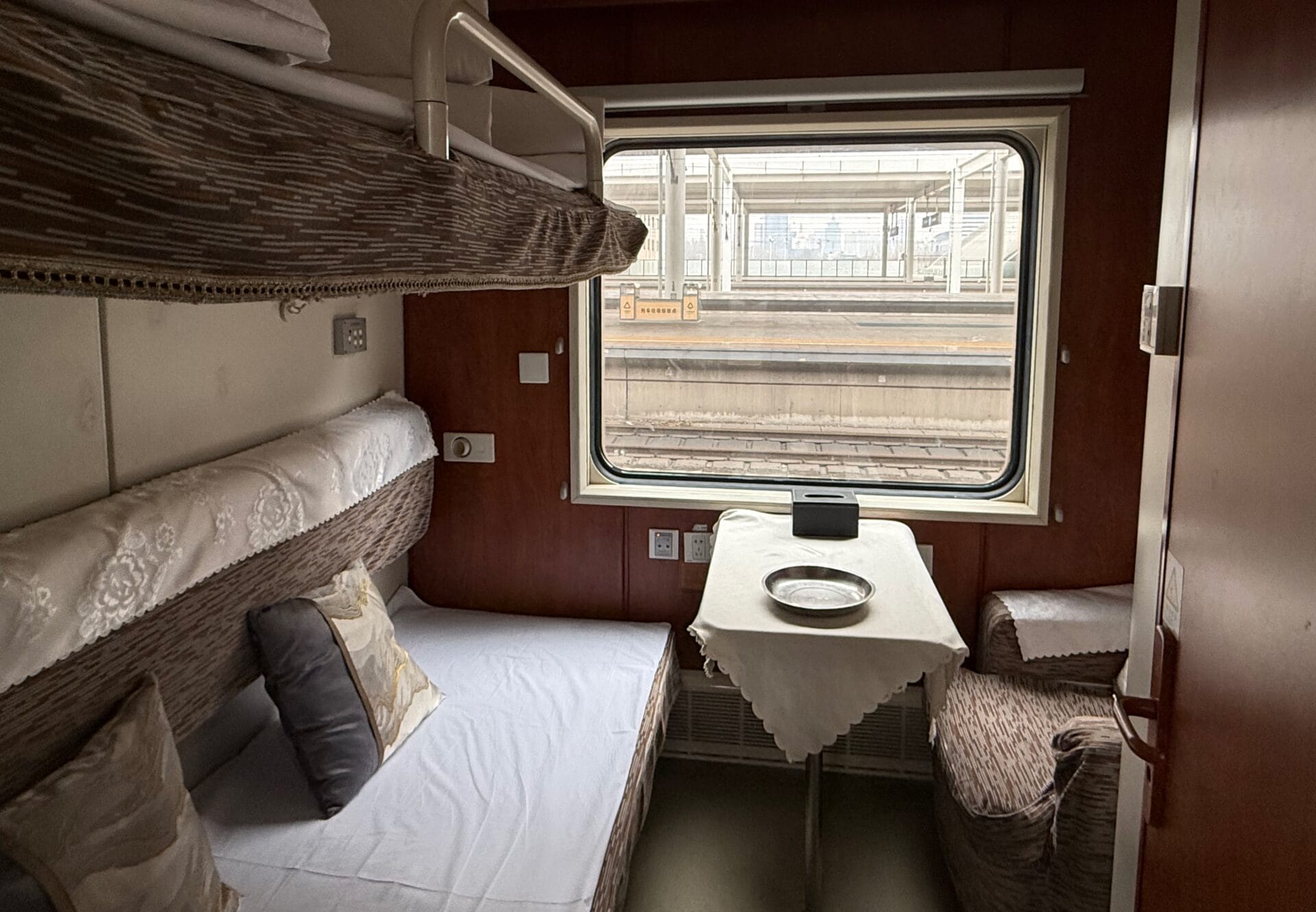
A Deluxe Soft Sleeper car has eight two-berth compartments, so only 16 passengers. That's very few and perhaps explains why very few trains offer this level of comfort, which is not at all optimal for transporting 1.4 billion Chinese.
The train also includes:
- Two soft sleeper cars (4-berth compartments)
- Eleven hard sleeper cars (open 6-berth compartments)
The terms "hard" and "soft" don't refer to mattress quality, but to occupancy density.
Depending on the class chosen, you therefore share your car's space with 16, 36, or 66 passengers, which profoundly changes the experience. All compartments are mixed.
Life on Board: Between Comfort and Density
In hard sleeper cars, the absence of doors and the noise level can make the journey tiring for a European. Chinese people don't hesitate to use their smartphones without headphones or talk loudly among themselves without worrying about other passengers.
Unlike European trains, compartments remain in "night" configuration all day. Only the upper berths have some semblance of privacy.
Fold-down seats in the corridors however allow passengers to sit outside their berth.
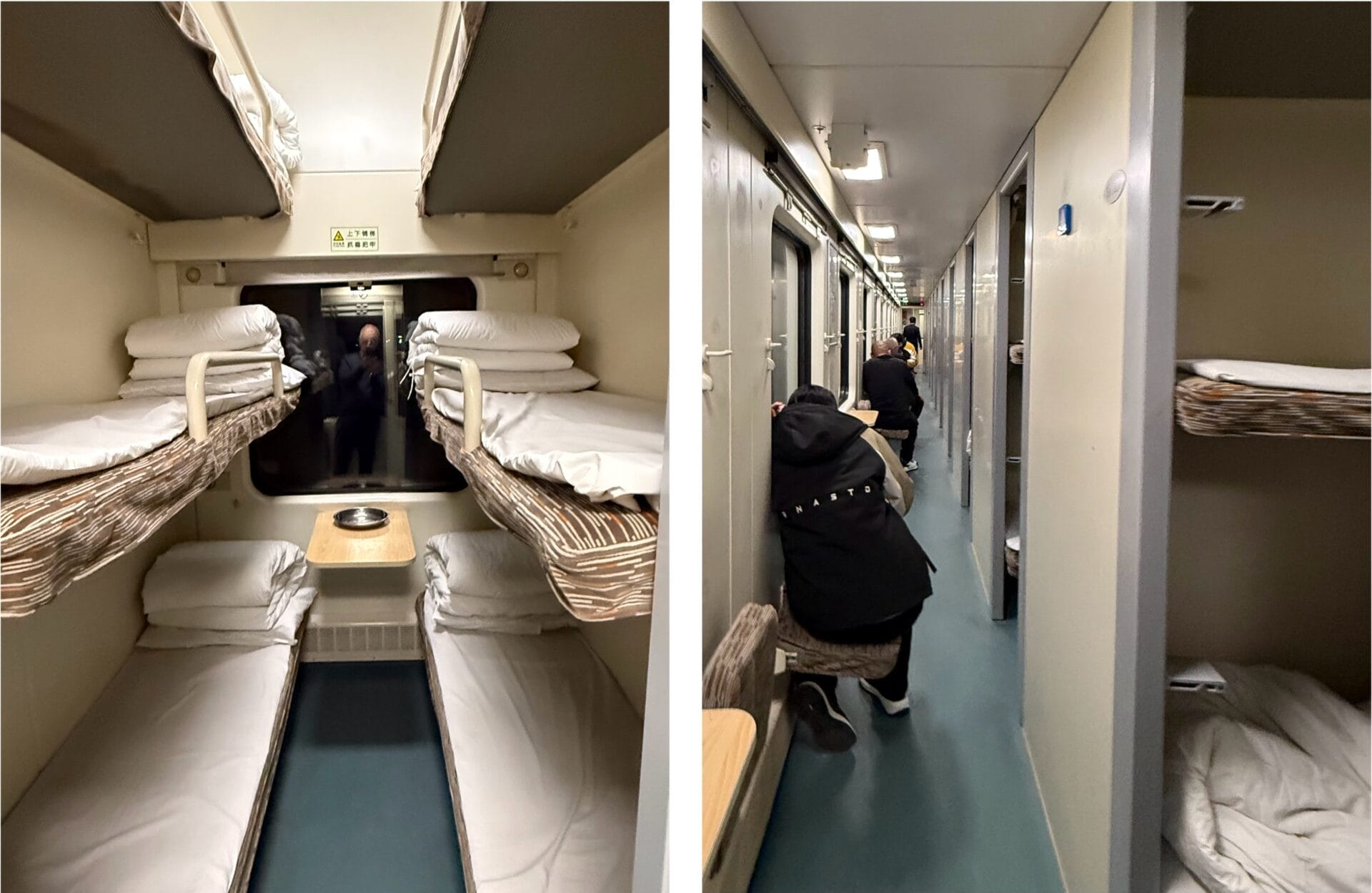
But I'm lucky to be in Deluxe class and I wake up in Tianjin, not far from Beijing, after having had an excellent night:
- The duvet and pillow are particularly comfortable.
- The noise level is low (55 to 59 decibels) and, above all, the train is remarkably stable throughout the journey. Alongside the new high-speed lines, the Chinese have continued to invest in and maintain their classic network. This deserves to be highlighted, as neither Germany nor France have followed the same approach.
- But the mattress is very firm, comparable to a futon, and this may not necessarily please everyone.
The Dining Car: The Heart of Train Life
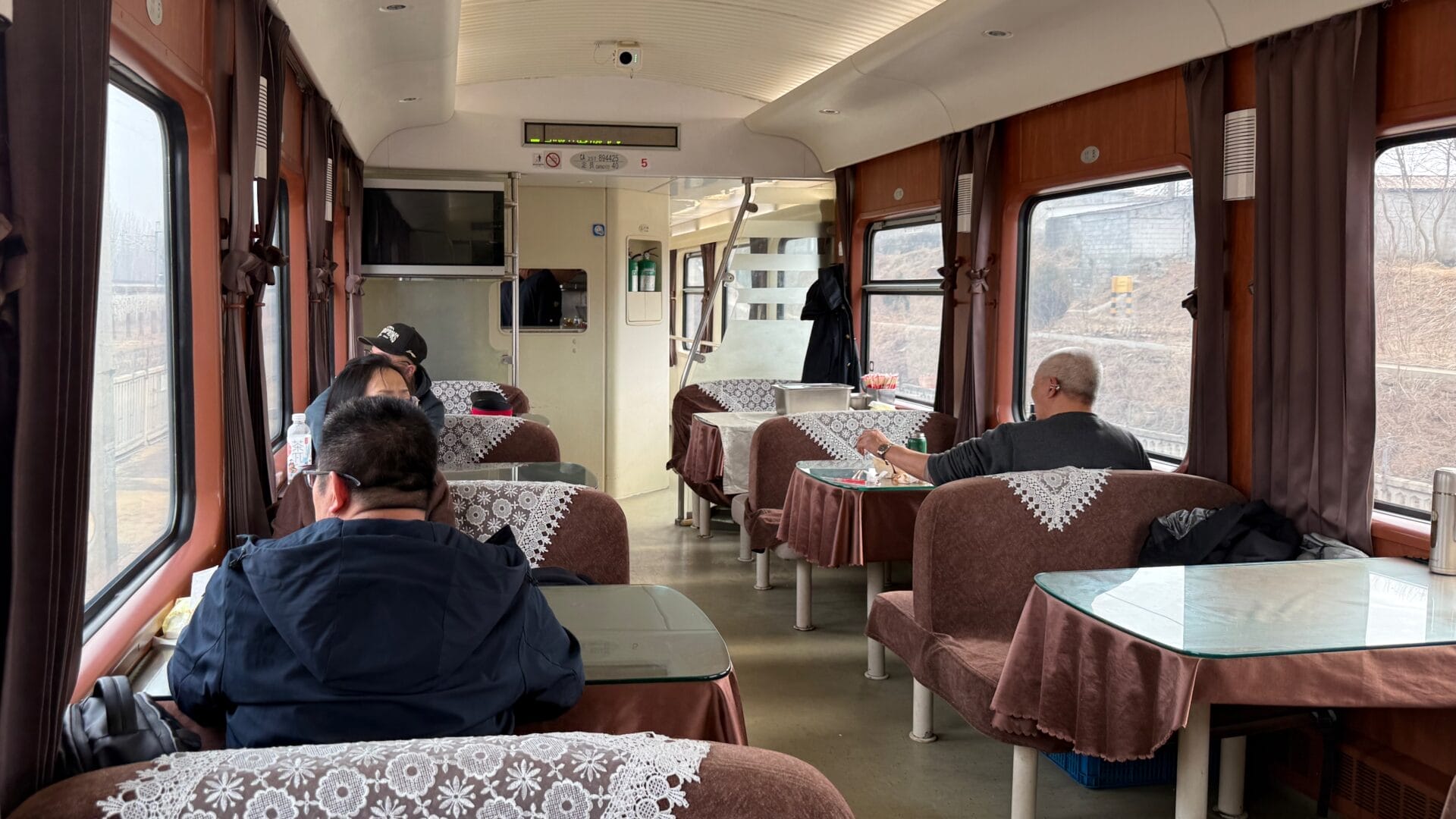
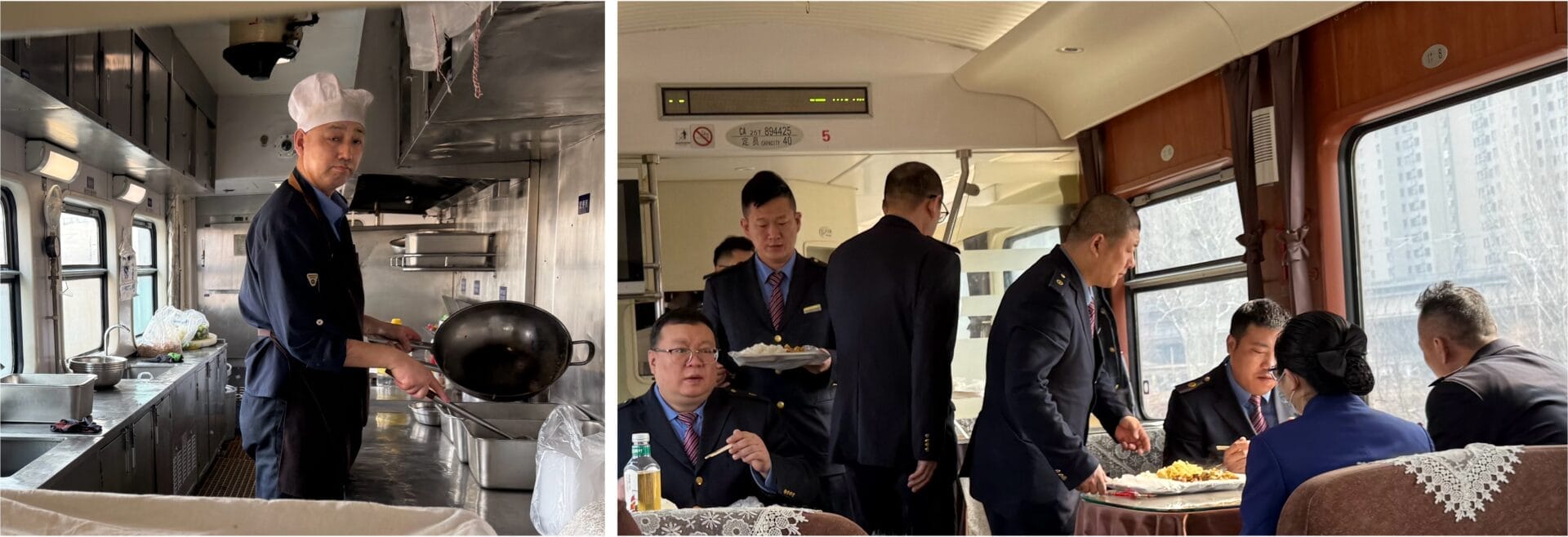
Around noon, I head to the dining car located in the middle of the train, with a chef who prepares meals on board in a real kitchen:
- It's not only a place to eat, but also to chat and relax. Passengers seem to appreciate meeting there to pass the time or have a drink.
- My cabin mate confides in me however that our journey conditions are particularly comfortable, with a relatively limited number of passengers, as many of them, who boarded in Shanghai the previous evening, got off at intermediate stops during the morning.
- Normally, the dining car is often crowded, occupied both by passengers who didn't get a seat and by train staff who come to relax there.
- In the absence of a menu, I don't really know what to choose during my visit. I settle for a bowl of noodles. I then very clearly feel that I'm in deep China, probably the only foreigner on board. It must be said that few European travelers undertake such a long journey between Shanghai and Harbin, apart from train enthusiasts.
On the other side of the dining car are two seated cars, called hard seat.
The seats, arranged in rows of five, are narrow and don’t recline much, which gives a strong sense of crowding. However, few travelers make the entire journey under these conditions.

The main downside of this trip remains the smell of cigarette smoke. Although it’s officially banned, in practice smoking is tolerated in the vestibules near the doors. The smoke then spreads throughout the train.
Heading for the Far North: scenery and arrival in Harbin
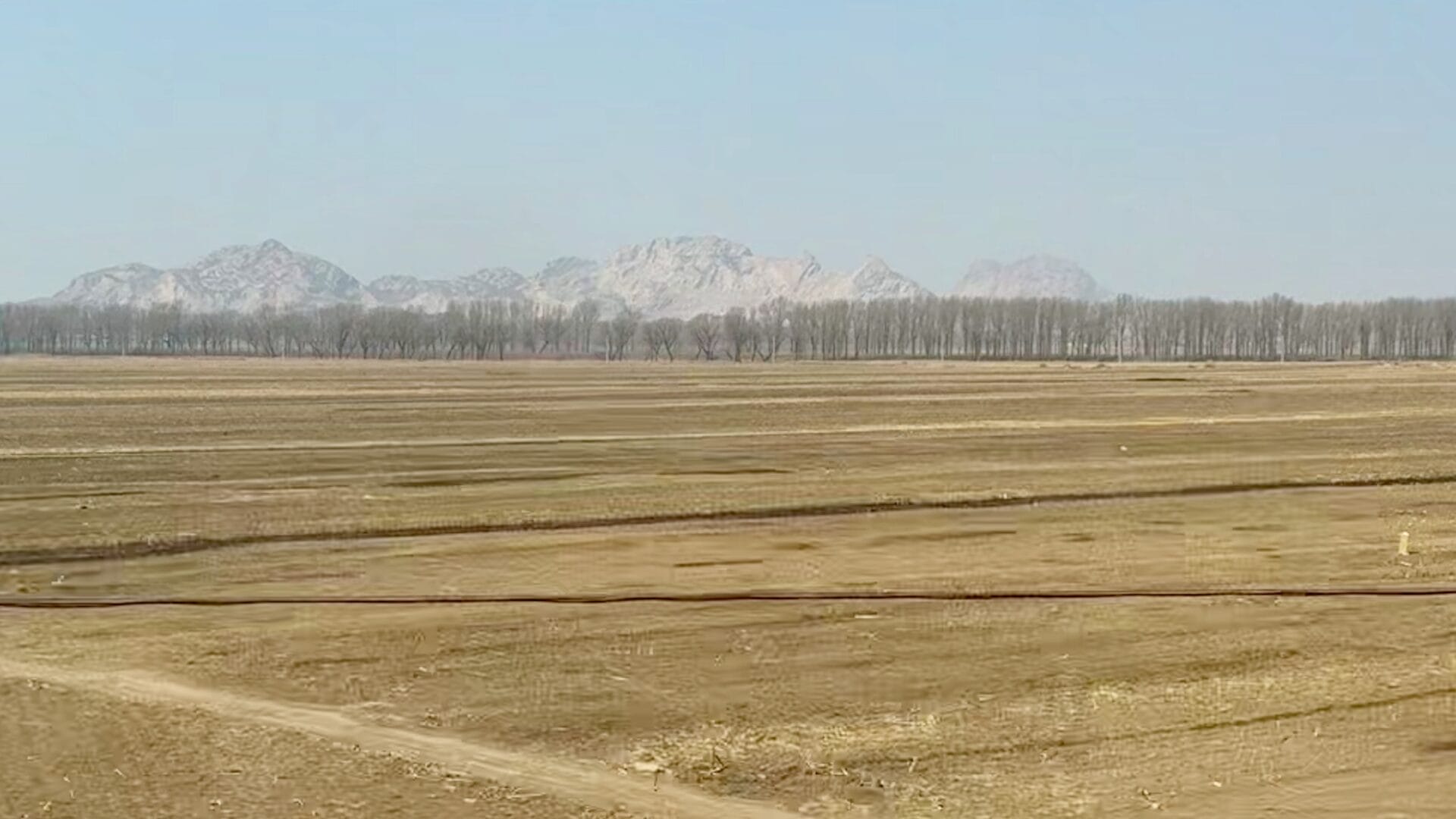
In early March, the scenery is still very wintry. The fields are resting and the rivers are frozen.
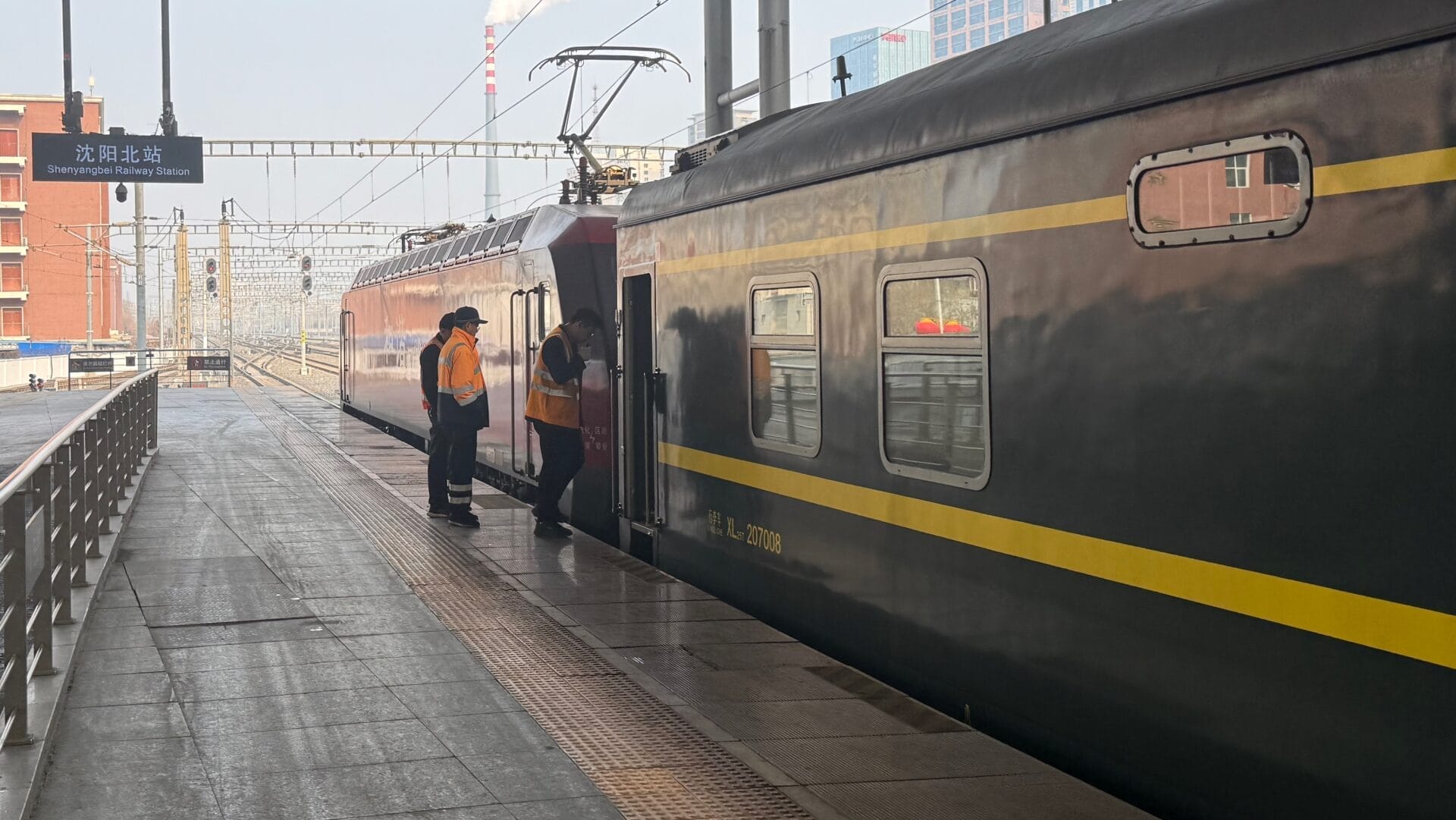
We arrive in Shenyang at 2:21 PM for a 39-minute stop. Unfortunately, it’s not possible to move freely around the station: once passengers have gotten off, the doors are locked until departure.
Shenyang, though little known in Europe, is a metropolis of 5.6 million inhabitants. It played a major industrial role, notably in steelmaking.
I finish my journey comfortably reading in my seat and watching the scenery go by. I love that particular feeling when time seems to stand still and you just let yourself be carried along by the rhythm of the train.

We arrive on time, at 7:37 PM, at Harbin West station. This is the new station dedicated to high-speed trains. It’s functional but has no particular character, and it’s located on the outskirts.
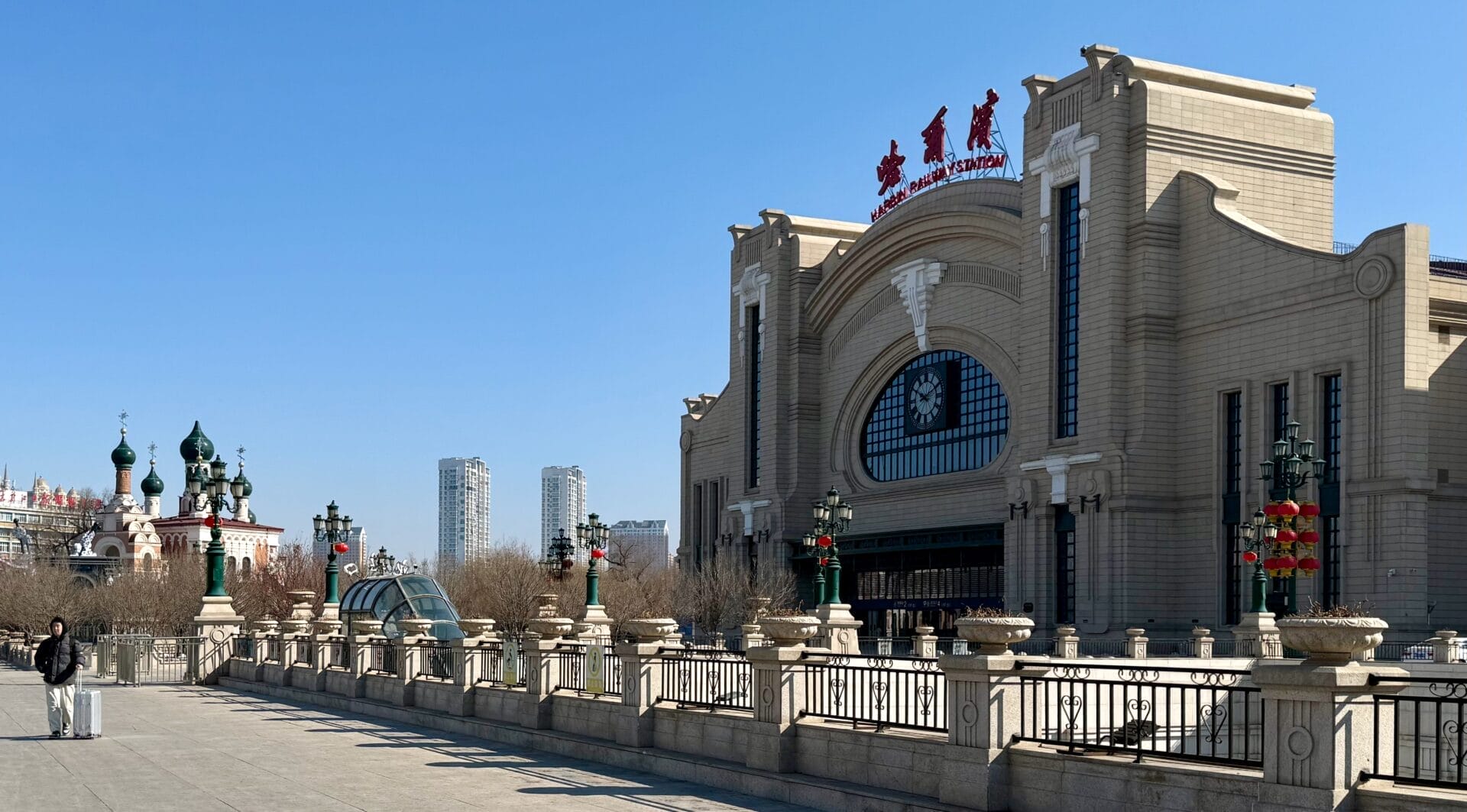
I’m a bit disappointed: I would have preferred to arrive at the old station, with Art Nouveau and Russian influences, more in keeping with the slightly retro charm of this train. I’ll take the time to visit it the next day.
A journey between the Maoist past and modernity
What lessons for the future of night trains in Europe?
Chinese trains can be disconcerting for European travelers, especially when it comes to privacy.
Hard-sleeper cars open to the corridor, as well as shared washbasins, would be difficult to transpose to the European context.
On the other hand, investing in modern, high-performance rolling stock, as Chinese operators do, is a decisive lever for attracting new customers.
Four lessons for European night trains
In the 2000s, the Chinese took the best of Japanese, French, German, and Canadian high-speed trains to develop their own network. In 2026, it’s our turn to do the same. I see four key takeaways:
- Complementarity: the night train isn’t meant to be replaced by high-speed rail, but to play a complementary role.
So even on the main Beijing–Shanghai corridor, where a daytime train takes 4 h 30 to cover the distance, night trains have been maintained.
- Maintaining the conventional network: it remains relevant for serving intermediate cities or lines not yet covered by high-speed rail.
- Mixed operations: it’s possible to run daytime and nighttime services on the high-speed network, while retaining the capacity needed for its maintenance.
- Competitive even over long distances: the high-speed night train is particularly well suited to long distances.
By adapting this concept, it would be possible to consider a high-speed night train service linking Paris to Rome in Europe, using existing infrastructure. This train could offer around 500 to 600 couchette or bed spaces, with a planned departure at 9 PM and an arrival at 8 AM. Such an offer could be highly competitive with air travel.
My verdict: Train travel experiences just the way I like them
Personally, my night-train experiences in China were both a change of scenery and enriching. I fully appreciate how lucky I was to discover them in such a varied context.
On the one hand, conventional trains extend a rail tradition suited to very long distances, with a strong social and collective dimension.
On the other hand, high-speed night trains aim to offer a product with 21st-century standards, focusing on speed and comfort.
Finally, more recent concepts, such as capsule berths, explore new forms of individual space optimization.
This diversity reflects a pragmatic approach: rather than replacing one model with another, China allows them to coexist according to uses and needs.
To delve deeper into this analysis, I invite you to read:
- my article on the travel experience on daytime high-speed trains,
- and the one where I explain the global framework of the Chinese railway revolution.
Finally, if you wish to experience night trains in China yourself, I invite you to refer to my practical guide for easy train travel in China.

0 Comments