
Travel to Yemen in 1983
In the early 80s, I had the opportunity to accompany a group of tourists to North Yemen, a country now at war and formally discouraged from visiting.
I'll tell you about this trip, which was still a real adventure! The photos have yellowed a bit, but they're period photos.
France: The Era of Currency Controls
It's 1983: Yannick Noah won the Roland Garros final, Professor Montagnier discovered the AIDS virus, Franck Ribéry was born and Louis de Funès passed away, the Paris-Lyon TGV line was finally fully open. Ronald Reagan was president of the United States, and after the euphoria of François Mitterrand's 1981 election, it was a time of disillusionment. Prime Minister Pierre Mauroy announced an austerity program that included currency controls.
French people could no longer travel abroad as they wished, and their spending abroad was restricted to 2,000 francs per person. This effectively forced them to take their holidays in France. However, I was 21, still a student with limited financial means, but my desire to explore the world was calling. What to do?
I Become a Tour Leader at Nouvelles Frontières
I decided to try my luck at Nouvelles Frontières. In the 80s, this tour operator was much talked about. Its founder, Jacques Maillot, fought for the democratization of travel. To reduce costs, trips were organized in small groups with a volunteer tour leader. The latter, in exchange for a free trip, handled its preparation and budget management. They also acted as the interface with local service providers. I applied to become one of them.
Lucky break! I was offered the chance to accompany a group to Yemen. It was October, which coincided with university holidays. I said yes without hesitation, despite my inexperience in travel!
My group consisted of about ten tourists, and our tour would be done with two Toyota 4x4s driven by Yemeni drivers. Nouvelles Frontières entrusted me with a budget covering car rental, accommodation, and meals. I was free to organize the itinerary as I saw fit, with my group's agreement. That's the spirit of adventure tours: no predefined program, no hotel reservations. It was up to me to manage.
However, traveling to Yemen in 1983 was still a true adventure. My sources of information were limited to a very succinct chapter in a backpacker's guide to the Middle East and reports from previous Nouvelles Frontières tour leaders. Minitel was just starting, and the internet was merely a futuristic concept.
Our two-week journey unfolded according to the following itinerary:
- Travel with Syrian Arab Airlines
- Sanaa: The Pearl of Arabia
- On the Way to Taiz
- Towards the Red Sea and the Tihama Coastal Plain
- The Market of Bait al Faqih
- Manakha in the Heart of Djebel Haraz
- Towards Saada: The Northern City
- Return to Shibam and Thula
All texts in color coral indicate an internal or external link.

We Depart with Syrian Arab Airlines
The adventure begins at Orly. The small group I'm accompanying meets at the Syrian Arab Airlines check-in counter. There's a crowd around us, mostly young people dressed in hippie style: wide jeans, XXL T-shirts and jackets in the brightest possible colors. We're surprised, as we didn't know Syria had become a stop on the road to Kathmandu! We'd later understand that they were continuing to India with just a connecting flight in Damascus.
Compared to today, airport security checks were very light in 1983. Al Qaeda would only destroy the Twin Towers 19 years later.
Syrian-style Welcome Aboard!
We quickly reached our old Boeing 727, which was already there. Boarding could begin. To our surprise, we were asked to descend a staircase onto the tarmac, then board the plane through the rear door, located at the end of the fuselage. A long queue formed, as each passenger was searched by the stewards and stewardesses. No smiles, no welcome...
It must be said that the previous year, the Syrian army, under the orders of Hafez al-Assad, the father of the current Syrian leader, had carried out a massacre of tens of thousands of people in Hama as part of a Muslim Brotherhood uprising.
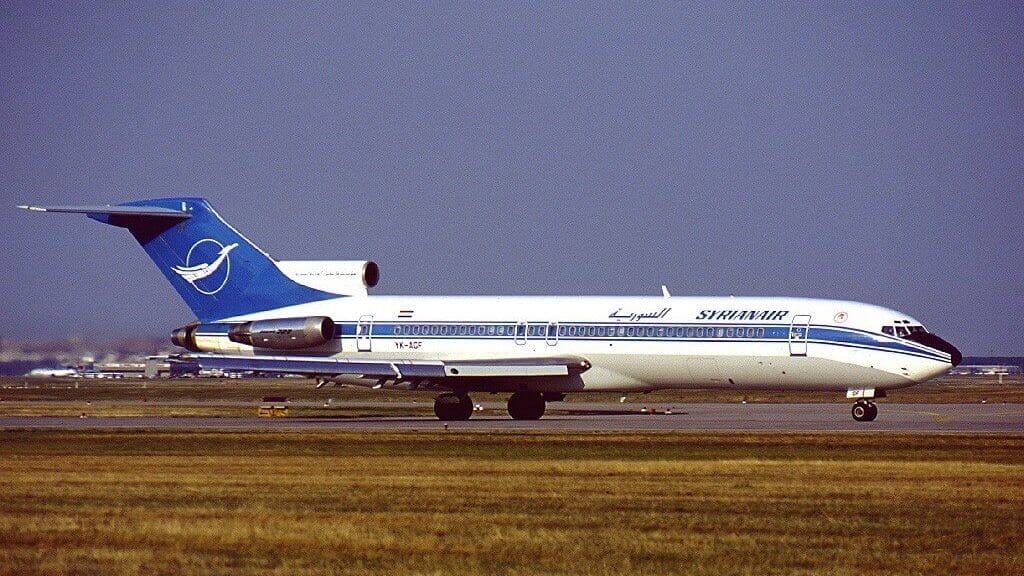 (Photo credit: Konstantin von Wedelstaedt)
At 10:30 AM, we finally took off for Damascus with a stopover in Rome. The flight was uneventful, and we even got a hot meal with the traditional airline chicken. At 5:50 PM, we saw the lights of Damascus already in the dark.
No sooner had we disembarked than the vast majority of our fellow passengers rushed towards the Boeing 747 that would take them to Delhi. As for us, we learned that our connecting flight to Sanaa was scheduled for late at night.
In the Company of Pilgrims to Mecca
We tried to kill time in a deserted airport, without a single shop to distract us. It wasn't until two in the morning that we boarded for Sanaa. The passengers around us had changed considerably. We found ourselves lost among pilgrims heading to Mecca. Indeed, our flight had a stopover in Jeddah. No rolling suitcases, but bundles of all kinds in the luggage racks!
Finally, Sanaa in the early morning. We were exhausted, but amazed! The Yemeni capital, at the foot of Mount Nogoum, all in ochre colors, revealed itself to us during the descent.

Sanaa: The Pearl of Arabia
No sooner had we left the airport than we were immersed in the atmosphere. We saw few women, some entirely covered in black veils, and many men in their traditional tunics. With rather stern faces, they wore a strange curved dagger at their waist: the jambiya. We felt it was best not to joke too much with Yemen's warrior and tribal customs.
Our hotel offered very limited comfort. No hot water, and the toilets were just a hole in the ground into which we poured a bucket of water instead of flushing! This would be the case almost everywhere on our Yemeni journey. Anyway, apart from in the big cities, there was nothing else. Travel had to be earned!
We Visit the Old City
Despite the fatigue, we set off to explore the old city. It felt like being in the tales of a thousand and one nights. The houses were made of stone or ochre-colored mud, and the windows were beautifully decorated with white surrounds that made them stand out.
With its flat roofs and tall buildings, up to 6 or 7 stories high, Sanaa had a slight resemblance to a Middle Eastern version of an American city! The architecture was one of the main attractions for visiting this country. Formerly, the old city was surrounded by ramparts, but almost all of them had disappeared a very long time ago.
In 1983, the district still felt very authentic. A renovation program was undertaken in the 90s which seems to have stripped Sanaa of some of its charm by making it too polished. But with the war raging since 2014, I dare not imagine the state of the city I discovered today...
Before going to bed, we visited the Bab el-Yemen souk: a real journey back in time! The market was immense with all sorts of shops: fruits, vegetables, meat directly on the ground, hardware stores, clothes, blacksmiths... a true Ali Baba's cave. We were the only tourists.
Sanaa is at an altitude of about 2,200 m. Nights get cool quickly.


And Now, On the Way to Taiz
We woke up to the call of the muezzin. Our drivers, Mohammed and Ashwall, were waiting with two brand-new Toyota 4x4s. A long leg, 260 km, awaited us to the large southern city: Taiz.
We started by climbing towards the Yislah Pass. From there, we would be in lush green landscapes, and we noticed many crops, some of them terraced. We were in Yemen's breadbasket. Moreover, the sky was rather cloudy, and we even got a few drops of rain. The landscapes around us were subtropical.
On the way, we stopped in Ibb and especially in the village of Dhi Jiblah, famous for its minarets. We felt like we were stepping back in time. The souks, the poorly paved streets were medieval. Unfortunately, the setting was somewhat spoiled by the dirt. Plastic and multicolored bags lay everywhere.
In the evening, we found ourselves in Taiz, the country's second-largest city. We tasted Yemeni fondue: bread to dip in a spicy bean porridge!


Towards the Red Sea and the Tihama Coastal Plain
We couldn't go as far as the mythical Aden, as we had dreamed. In 1983, present-day Yemen was still divided into two countries: the People's Democratic Republic of Yemen in the South and the Yemen Arab Republic in the North, which we were traveling through. So, we turned west to head towards the Red Sea.
The Red Sea: a name evocative of dreams and journeys.
We were still the generation that read the adventures of Henri de Monfreid. A French smuggler who converted to Islam and lived off illicit trade thanks to his dhow sailing the Red Sea. His friend Joseph Kessel persuaded him to become a writer.
Armed with these readings, we were all the more disappointed by what we discovered. The coastal plain, the Tihama, was flat and inhospitable. The first town we visited by the sea was Mokha. Its name sounded like coffee, but it was uninteresting. The heat was oppressive. To top it all off, we argued with the drivers who insisted we have lunch at a roadside inn that was borderline squalid.
Al Khawkhah, the African-like
We arrived in Al Khawkhah, a small coastal town. The atmosphere was more African, and the architecture less spectacular than in the mountains. It was essentially huts or houses in poor condition.
Unable to find suitable accommodation, the group decided to settle in a palm grove by the sea to spend the night under the stars.
We put on our swimsuits and rushed into the water, too happy to cool off. Big surprise: the sea was over 30 degrees Celsius! A few oil slicks forced us to get out quickly. We consoled ourselves by admiring the dhows, or wrecks, stranded on the beach.
Then we quickly fell asleep after that day, but it didn't last! A rooster crowing at midnight (jet-lagged), incessant dog barking, Yemeni parties with blaring radios, and a thunderstorm just before sunrise.
In the early morning, the group woke up haggard and in a bad mood. I was the only one who had slept well. That's the advantage of being 21. At that age, you can sleep anywhere.


We Visit the Bait al Faqih Market
It was a Friday, and it was market day in Bait al Faqih. It's one of the best-known and oldest in Yemen. It long served as a hub between the port of Mokha and the rest of the country for coffee trade.
In my memories, Bait al Faqih is one of the most extraordinary markets I have ever visited worldwide. Perhaps because it was one of my very first trips?
In any case, that day, my group was enchanted. The discomforts of the previous day were forgotten, and we let all our senses guide us. The smell of warm bread mingled with that of straw used for basketry. The blacksmiths' hammer blows were punctuated by the lowing of cattle. The cupping practitioners, straight out of Molière's time, captivated us. Hairdressers winked at us to attract our attention.


Welcome to Sheikh Ali's Home
In the evening, we were hosted by Sheikh Ali, a local dignitary with a full beard. After a hearty meal, we slept peacefully under the stars in his well-protected courtyard. The group had regained their smiles. Our drivers relaxed by smoking shisha.


The Highlight of the Journey: Manakha in the Heart of Djebel Haraz
The next day, we set off again towards the mountains and their cooler, windier climate. As we progressed, we felt invigorated. Manakha, in the heart of Djebel Haraz, was our stop for the day.
This region offers the most beautiful scenery in the country. We wandered from village to village, preferably on foot. They were all perched spectacularly on rocky peaks. We stayed there for two days, which, in hindsight, wasn't enough. We should have driven less and explored certain regions more thoroughly. At 21, I didn't yet have the travel experience that would have allowed me to convince my group to explore the country differently.
The highlight of our stay was the visit to the village of Al Hajjarah, spectacularly perched on its rocky peak. Imagine five to six-story buildings on the edge of a cliff several hundred meters high. Enough to make you dizzy!


We Are Invited to a Wedding
We arrived during a wedding celebration to which we were kindly invited. Only the women in our group could join the bride-to-be. As for us, we only saw the groom, a handsome young man (the fourth from the left in the photo), who also didn't know his fiancée! The dances were performed, among men, with the jambiya as an accessory.
It was clear that we were invited because tourist traffic in Yemen was still low. As everywhere at that time, we were the only tourists. Encounters with Yemenis were spontaneous and led to genuine exchanges despite the language barrier.


Night in a Funduq
In Manakha, there were no hotels in 1983. We slept in a funduq. An inn, but one that resembled more a homestay.
We had at our disposal a large room with a bench running along the entire wall. Carpets covered the entire floor. Naturally, one had to take off their shoes before entering. It was in this room that my group slept and dined together with little privacy.
The sanitary facilities were, of course, very rudimentary... and smelly! Travel was still synonymous with discomfort. It wasn't a matter of money; there simply wasn't any choice.
Our meals during the journey were generally substantial but not very varied: rice, a kind of stew, eggs, and tasty honey cakes. We served ourselves from the communal dish, using bread as a scoop and naturally only our right hand. The left, of course, is reserved for other uses!


Towards Saada: The Northern City
After passing through the capital, Sanaa, again, we continued towards Saada, which is less than 60 km from the Saudi border. The journey was long, nearly 6 hours, and the landscape became increasingly desert-like.
We entered another world. The stone architecture was replaced by rammed earth. The city still has ramparts that allow for a pleasant walk.
The inhabitants seemed more reserved than in the south. We also noticed that many were armed, not hesitating to walk around with a Kalashnikov slung over their shoulder. Needless to say, it's best to be careful when taking photos.

We were in the Zaydi region, which already claimed autonomy from the rest of the country. This would become one of the sources of the armed conflicts that Yemen would experience a few years after our visit.
The climate is hotter and more arid than in the more mountainous central regions. We are almost at the border with Saudi Arabia.


Khat: A Yemeni Institution
In the afternoon, we couldn't rely on our drivers. Like the rest of the population in Yemen, they were dedicated to chewing khat.
Lounging lazily, Yemenis ingest khat leaves, which they then chew for a long time to experience slightly euphoric effects.
We tried it, of course, but weren't convinced because we didn't feel anything immediate. Moreover, the taste is very bitter, and you have to drink a lot of Coke to sweeten it.
Khat in Yemen was an institution not without consequences for health and the economy. A third of cultivated land was dedicated to this plant in the 80s. Khat represented a significant expense and required substantial logistics, as it must be consumed fresh and harvested the same day. For all these reasons, it has been banned in other countries. With the war, I don't know if this custom has persisted.

Visit to Shibam and Thula before returning to France
Our journey was nearing its end. We decided to visit a few localities in the mountains around Sanaa. The dizzying viewpoints, terraced crops, and villages like forts clinging to rocky peaks continued to captivate us. We went specifically to Shibam and Thula.

End of the tour and flight to Orly
A two-week trip is very short in a country like Yemen. So, it was with a bit of frustration that we returned to Sanaa.
The return flight was like the outbound one with Syrian Arab Airlines via Jeddah, Damascus, and Rome. Stepping off the plane, the development contrast between France and Yemen was striking. My classes at Paris Dauphine University awaited me without any transition!
Trip Summary
At 21, this trip was a great challenge for me.
Our two Yemeni drivers didn't speak English and didn't quite understand what tourists wanted to visit. It took me hours of negotiations to get them to take us where the group wanted.
They told me that their Toyota was worth the price of a woman!
A demanding group of Baby Boomers
The dozen or so tourists I was leading were between 35 and 45 years old. That's twice my age! They were the first children of the Baby Boom.
All of them had already traveled quite a bit, and they had trouble accepting a tour leader as inexperienced as I was. They expected me to know the country and guide them. However, my role as a guide was more to be a facilitator and coordinator.
For my part, I was rather surprised by their consumerist attitude. By their reactions, I felt that for them, this trip was more a service provided by Nouvelles Frontières than an adventure with its share of unforeseen events.
A very tight budget
Furthermore, Nouvelles Frontières had allocated me a very tight budget for such a trip. I had to manage it down to the last rial, and I wasn't always comfortable having to fight for a discount equivalent to a few francs, which meant little to my group of Western tourists but a lot to the Yemenis.
This adventure helped me grow and taught me a lot. It was foundational for the future travels of my life.
What has become of Yemen 40 years later?
Nearly 40 years later, I suspect the country has changed enormously. Yemen first experienced significant economic development in the 2000s, only to enter a period of war. Beyond the human suffering, I hope that the country's exceptional heritage has not been too ravaged.

Your turn to go ? Unfortunately, no...
Yemen is currently an inaccessible country. In 2021, it is in its seventh year of civil war. . The situation is dire.
In 2014, the Houthis, a tribe from northwestern Yemen and close to Iran, conquered the capital Sanaa. Since then, they have been clashing with Sunni loyalist forces, supported by Saudi Arabia. The country, which was already one of the poorest in the world, has plunged into anarchy. 80% of the population depends on humanitarian aid to survive.
All indicators are in the red. High illiteracy, little respect for freedoms, as mentioned in an Amnesty report.
Today, no encouraging prospects are in sight. The Covid crisis, of course, didn't help.
If you wish, you can help Yemenis by making a donation to the United Nations Refugee Agency (UNCHR).
رحم الله اليمن !
May Allah have mercy on Yemen !
0 Comments