
My last journey aboard the Berlin–Paris Nightjet: why this service disappeared
Article written in November 2025 and updated in January 2026
Paris - Berlin - Paris: Two Direct Trains, one by Day on the ICE, the other by Night on the Nightjet
France and Germany are two deeply interconnected countries, both economically and politically.
Yet, their respective capitals, Paris and Berlin, had not been connected by a daily direct train since 2014.
Things evolved with the launch of the night train on December 11, 2023, followed by the direct day train on December 16, 2024.
During my trip to Berlin in October 2025, I wanted to test these two complementary connections: so I took the day ICE on the outbound journey and the night Nightjet on the return.
My outbound journey from Paris to Berlin by day train is the subject of a first article.
This article is dedicated to my return by night train, aboard the Nightjet.
First, I recount my sleeper car journey from Berlin to Paris, then I share my verdict, as I experienced it,
before delivering my analysis on the reasons for the Nightjet's suspension and potential solutions to save the Paris–Berlin–Paris night train.
Berlin — Paris by Night Train with the Nightjet
I traveled by day train, taking the ICE from Paris to Berlin. I then stayed there for five days to explore the city.
On Tuesday, October 14, 2025, it's already time for my return, and I'm very excited because I'm taking the Berlin—Paris night train in a sleeper car! My passion for night trains dates back to my youth when I worked as an attendant on them.
The train is scheduled to depart from Berlin at 7:08 PM and arrive the next day at 9:38 AM at Paris Gare de l'Est. A very comfortable schedule, allowing for a good night's sleep.
Until 2014, Berlin - Paris had a daily night connection. It was interrupted for economic reasons, and it wasn't until 2023 that it reopened.
It is operated by ÖBB, the Austrian railways, in cooperation with DB, the German railways, and SNCF, the French railways. The night train is called a Nightjet.
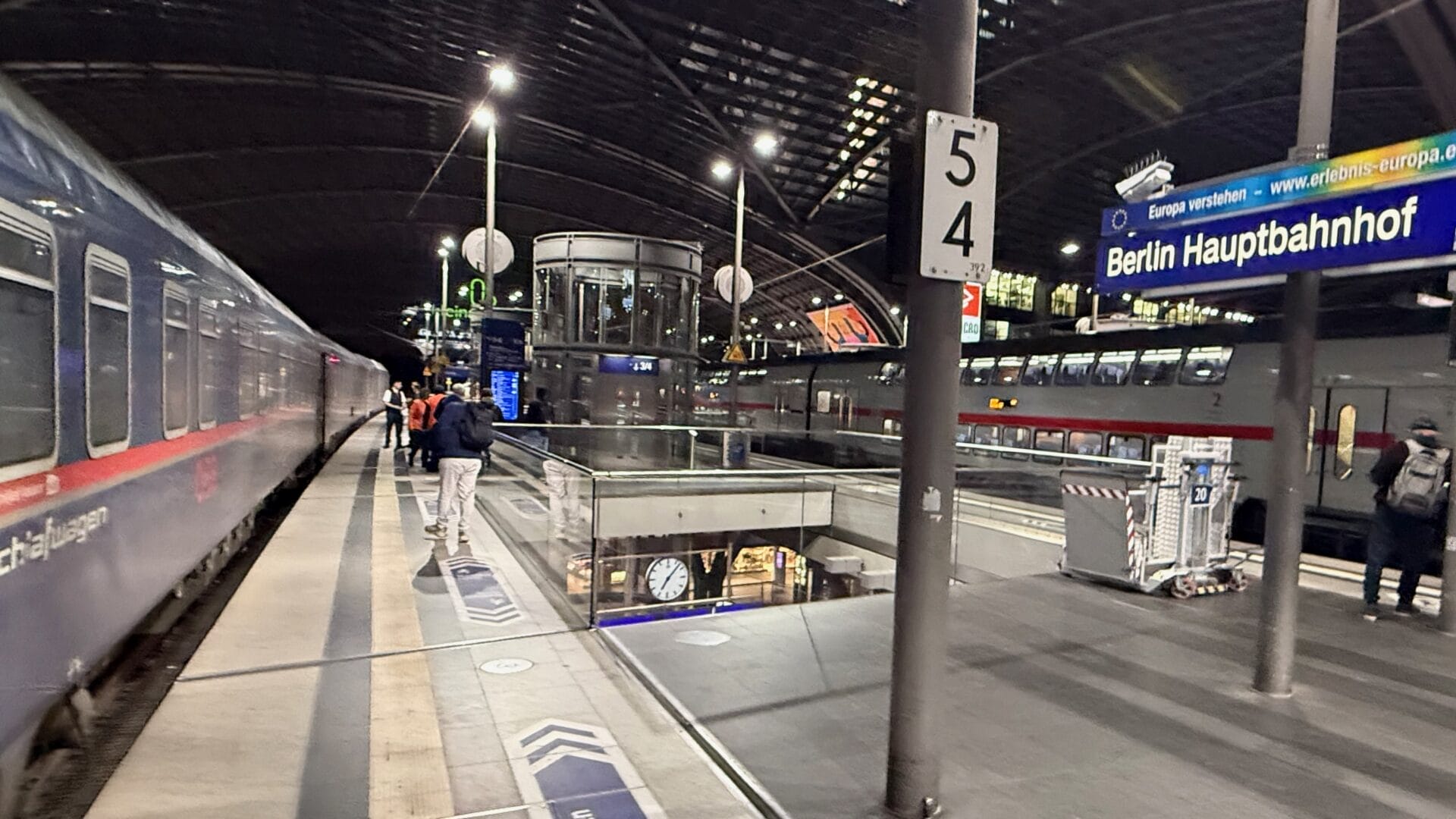
On a rainy and very autumnal evening, an hour before departure, I made my way to Berlin Central Station (Hauptbahnhof), to take the time to visit this remarkable station, which I describe in the first article about my train trip to Berlin.
The Paris Berlin Nightjet: a Train Showing its Age
Scheduled for platform 13, the train eventually arrived at platform 14. The change was only announced a few minutes before departure. It can be a bit stressful in a large station like Berlin, where trains are constantly arriving and departing.
Fortunately, the Nightjet is recognizable by its distinctive blue livery, highlighted by a red stripe. From the outside, the train truly shows its age: the paint is faded, the stainless steel frames are pitted, and the windows, obscured by dirt, are hardly inviting.
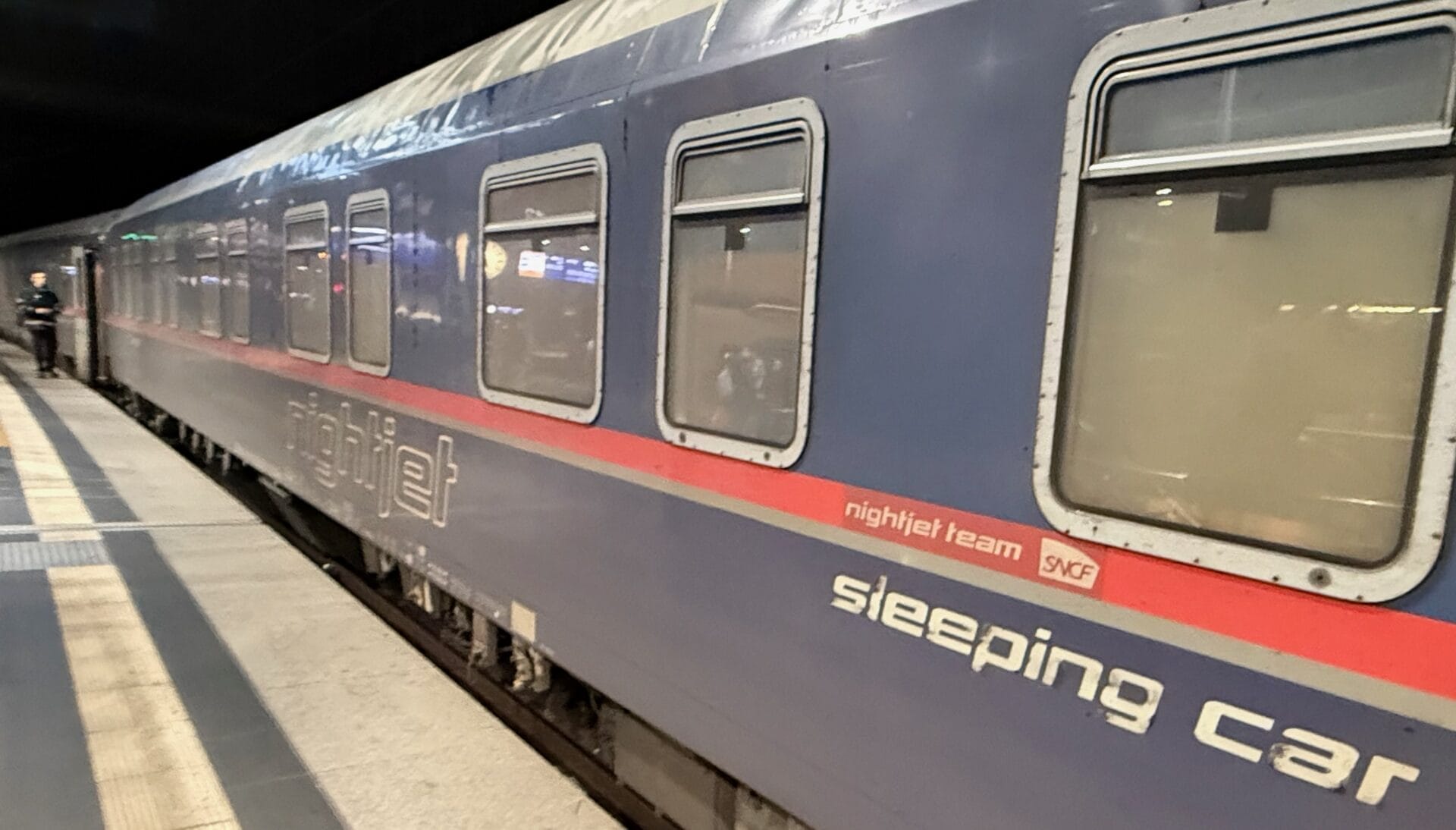
Upon boarding, my impression was much better. The interior of my sleeper car is certainly old, but meticulously maintained. It was built by Siemens for DB between 2003 and 2005.
Two Sleeper Car Categories
My sleeper car is of classic design, with twelve compartments, featuring a layout similar to the MU-type sleeper cars where I worked in the 1980s.
There are two categories of compartments in the sleeper cars: Standard and Deluxe.
In the Standard category, the toilets and shower are shared at one end of the car, with only a small sink in the compartment.
In the Deluxe, the toilet and shower are private, located in an adjoining compact bathroom.

All compartments are modular: one to three beds for night configuration and three armchairs for day configuration with a table.


Shared Sleeper Car Compartments: an Outdated Concept
In both categories, it is possible to book a bed in a compartment to share with one or two other travelers. Cabins are mixed-gender, except for women, who can choose to travel exclusively with other women.
In 2025, this seems like a deal-breaker to me, because the very principle of a sleeper car is to replicate the comfort of a hotel room: being able to undress, sleep in pajamas — or even naked — and attend to personal hygiene in complete privacy. Hard to imagine that with strangers!
It is, of course, possible to book a private cabin, but the prices offered by Nightjets quickly become prohibitive: for a single person, expect to pay between €300 and €700, depending on demand.
I'm Traveling in a Deluxe Cabin: the Nightjet's Top Tier
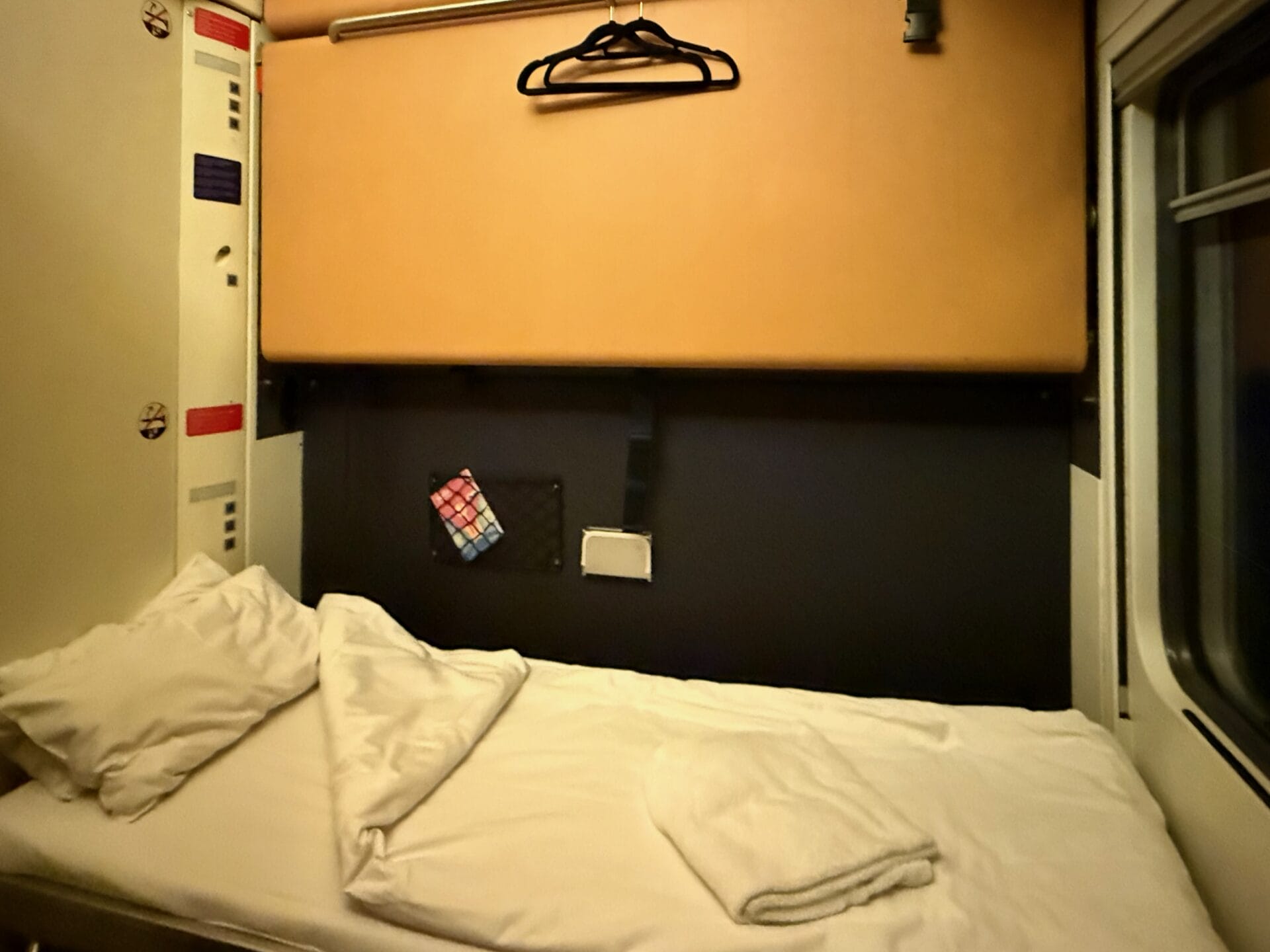
By booking in advance, I was lucky enough to secure a still affordable rate (€353) for a private Deluxe cabin: the ultimate in comfort. I therefore had plenty of space, and most importantly, my privacy was preserved.
The steward came to show me my cabin and ask if I wished to dine. I told him that I did the same job as him in the 80s, which allowed us to share a moment as "colleagues"!
A Simple, yet Filling and Inexpensive Dinner
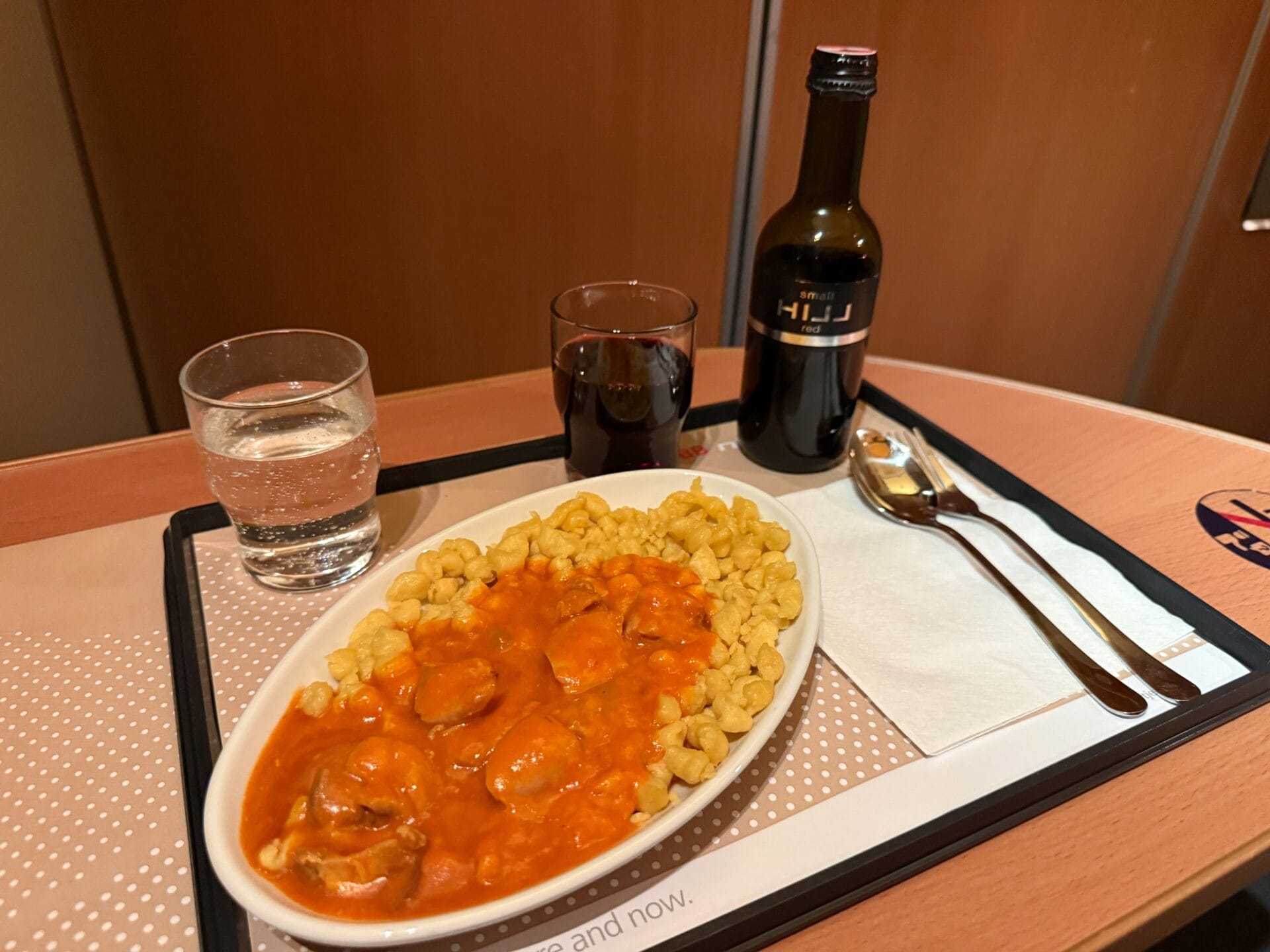
My dinner was delivered to my cabin, as there is no dining car. This didn't bother me, as my cabin is comfortable and features a large table.
I chose a typically Germanic dish: paprika chicken with Spätzle, which are traditional German noodles. I paired it with a good Austrian red wine. While not gourmet, the meal was tasty and offered at a very reasonable price of €12.70. I appreciated being served with real crockery, just like on the ICE.
A Relaxing Evening with a Good Book
Given the car's age, over twenty years old, there's no Wi-Fi, and the only power outlet is in the bathroom.
I therefore took the opportunity to read a good novel, just as I used to in the old days. If you wish to watch a movie, remember to download it before your departure.
I also appreciate the presence of the corridor, which offers me the opportunity to stretch my legs or chat with other travelers.

Göttingen: a Barbara Tune
We made a brief stop in Göttingen at 9:35 PM, taking a moment to recall Barbara's magnificent song, which celebrates Franco-German reconciliation—a beautiful symbol for the Berlin-Paris night train.
And never mind those who are surprised,
And may others forgive me,
But the children are the same,
In Paris or Göttingen.
Oh, may it never return
The time of blood and hatred
For there are people I love,
In Göttingen, in Göttingen.
A family boarded our train. This is also one of the benefits of night trains: allowing small towns to be connected to major urban centers.
Furthermore, this family, with three children, was traveling in two cabins — a triple and a double — which could be connected. A comfort that only the night train can offer them.
A Good Shower before Bed
When it was time to go to bed, I asked the steward to make my bed, which he did in less than two minutes.
I then took my shower. The water pressure was strong, and the water was very hot. However, the space is tiny and certainly not suitable for tall or large individuals.

A Peaceful Night Lulled by the Train's Gentle Rhythm
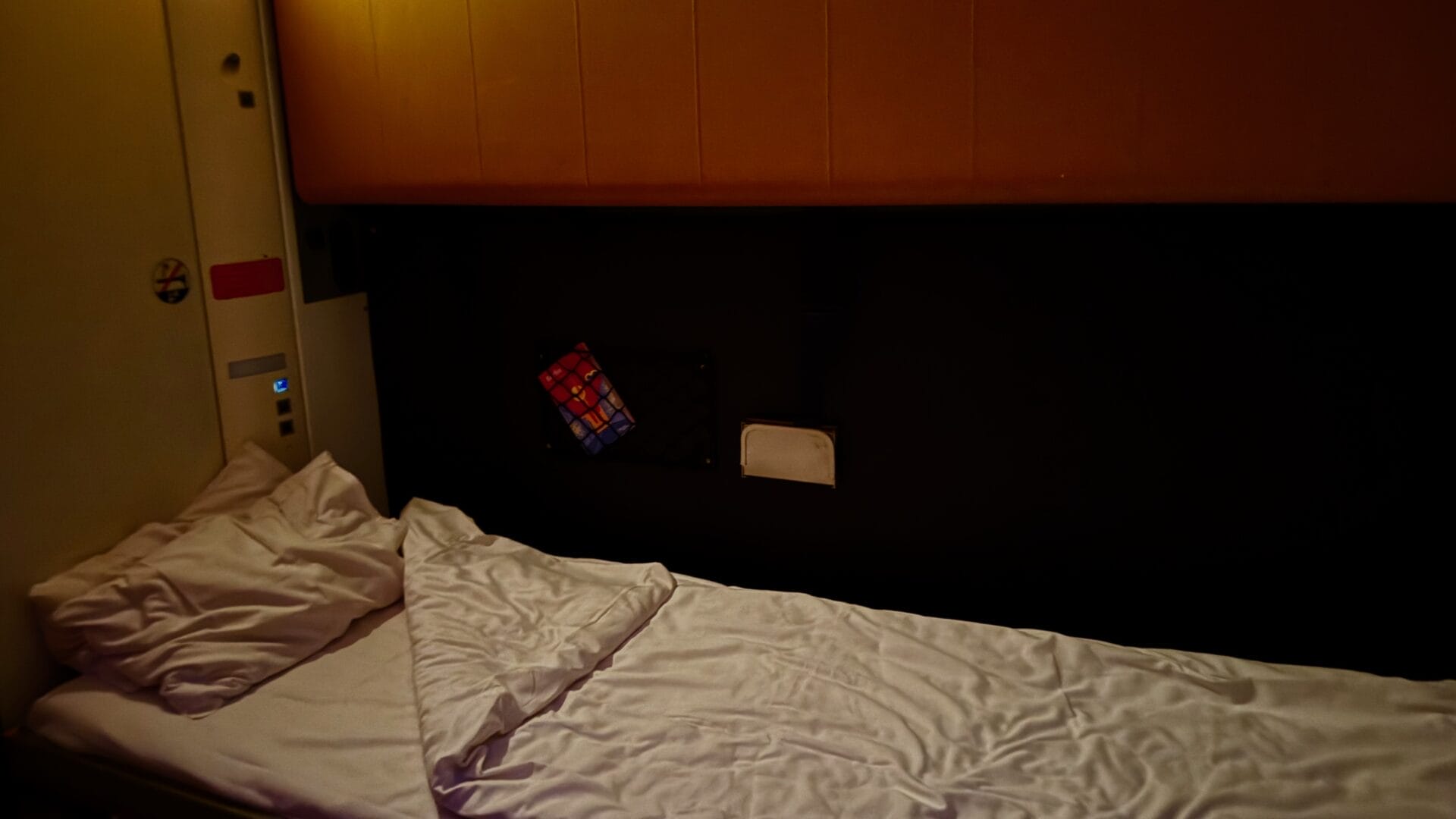
Then I slipped under my soft duvet. My only regret was the tiny and sparsely filled pillow: I had to use two to achieve acceptable comfort. I quickly fell asleep, lulled by the train's gentle rhythm.
Major Railway Operations in Mannheim
Paradoxically, I was woken up around 2 AM by the silence. Our train was stopped at Mannheim station, where we would remain for a while due to the train's reconfiguration with the one arriving from Vienna. The Vienna-Paris section would be coupled to ours, and the other would continue towards Brussels.

The Pleasure of Waking up to a New Landscape
I fell back asleep until 8 AM, enjoying one of the greatest pleasures of night train travel: gently waking up in my cozy bed and opening the curtain to a new landscape. This time, it was agricultural fields before the Champagne vineyards that revealed themselves to me!
Once my compartment was converted to day configuration, my steward brought me my breakfast. It was included in the ticket price.

After my breakfast, I took the opportunity to explore the other cars of the train.
The section originating from Berlin comprises two sleeper cars, two couchette cars, and two seating cars. The Vienna section has the same composition.
Traveling in Couchettes on the Nightjet
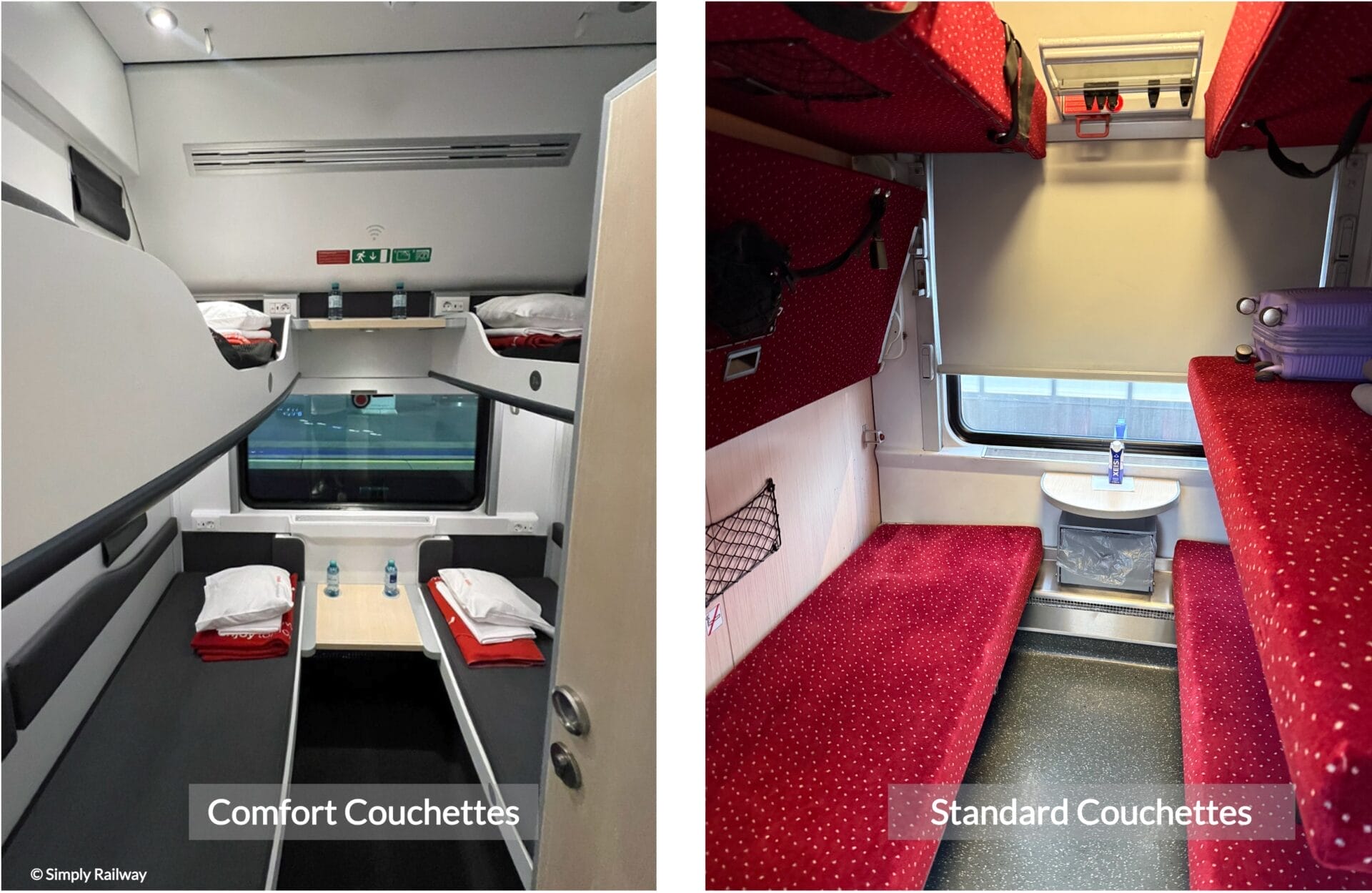
In couchettes, two types of cars coexist:
- The more modern one is the “Comfort” type, with four-berth compartments similar to those of the new Nightjets. It also includes a compartment specifically designed for passengers with reduced mobility.
- The oldest, the "Standard" type, has compartments with six berths each. If it's full, the proximity between travelers can be unpleasant. The interior feels much more rustic and old-fashioned.
Traveling in Seated Coaches on the Nightjet
Seated coaches are arranged in compartments of six seats.
Here too, if the train is complete, the journey can be very uncomfortable. Otherwise, for two or three people, it's possible to recline somewhat thanks to the modularity of the seats.

All couchette and seated compartments can be booked privately, but the supplement is only affordable if at least three people are traveling together.
A Perfectly On-Time Arrival in Paris!
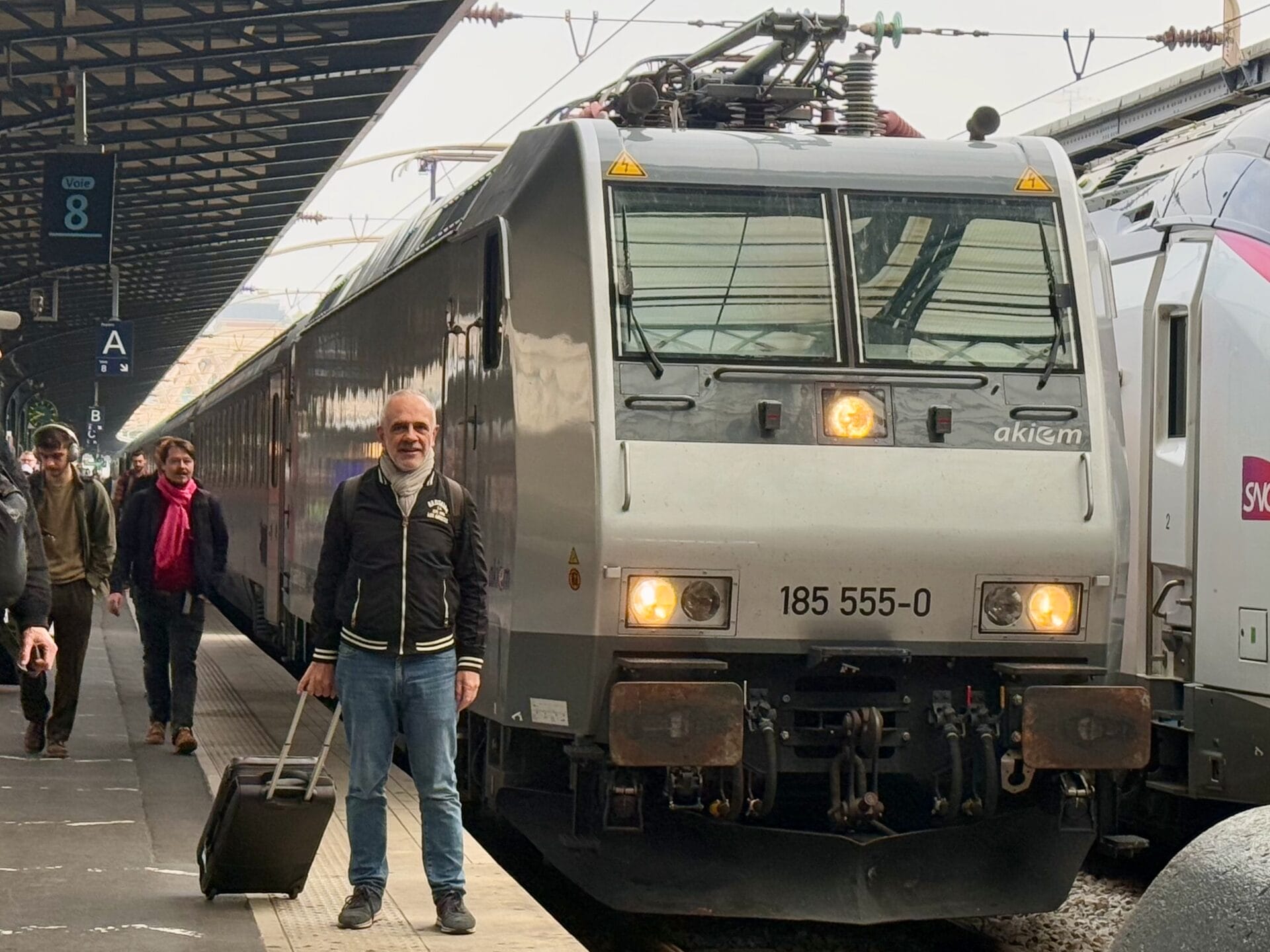
We arrived perfectly on time, at 9:38 AM, in Paris, at Gare de l'Est. An excellent performance, as night trains in Europe are often known for delays. Less than two-thirds generally arrive on time.
My Verdict: Berlin–Paris is the Ideal Night Train Distance
Berlin is one of the major cities located approximately 1,000 to 1,200 km from Paris as the crow flies, similar to Madrid, Vienna, Venice, Rome, or Copenhagen. This is, I believe, the ideal distance for night trains, as a journey of such length starts to become too long by day train.
Night Journey on the Nightjet: Excellent Comfort, Provided You Pay the Price
I really enjoyed the return journey by night train. The schedules are ideal, allowing for a good night's sleep and a relaxed morning, without losing your day before and after the trip, unlike the day train, which is quite long (eight hours).
But I am aware that I made the journey under the best possible conditions: alone, in a Deluxe cabin with a private shower and toilet.
Traveling in Comfort Couchettes is Preferable to Sharing a Sleeper Car Cabin
If I hadn't gotten a reasonable price for my Deluxe cabin, I would have preferred to travel in a Comfort category couchette car, rather than sharing a sleeper cabin. These cars are newer, and each compartment only has four berths.
Sharing with strangers is less intrusive in terms of privacy, because you generally sleep dressed — much like on a long-haul business class flight — and not in nightwear, as you would in a hotel or a private sleeper car.
Traveling by Day is Better than Sleeping Poorly in Six-Berth Couchettes or Seated Coaches
While six-berth couchette compartments or seated coaches indeed promise a budget-friendly trip, they offer little comfort: the cars are old and their amenities are outdated.
In this case, a day trip seems preferable to me. By booking in advance, ICE prices remain affordable.

How to Book your Night Train with the Nightjet?
As surprising as it may seem, SNCF was not marketing this train, even though it was a partner! The reasons given were a technical issue with SNCF Connect that prevented it from marketing foreign trains.
The only way was therefore to go to nightjet.com. It is comprehensive and easy to use.
But all of this is now history, as the service was discontinued on December 14, 2025.
Why was the Nightjet Paris — Berlin discontinued?
It was through a brief press release that ÖBB announced the bad news: the Paris-Berlin and Paris-Vienna Nightjet services might no longer operate after December 14, 2025.
A Grand Inauguration with many Ministers
Yet, on December 11 and 12, 2023, the inaugural Berlin–Paris night journey took place, and it was celebrated with great fanfare: no fewer than four ministers, including Clément Beaune, France's Minister of Transport, and four CEOs, were present!
In a rare spirit of cooperation, the national railway companies of Austria (ÖBB), Belgium (SNCB), Germany (DB), and France (SNCF) had inaugurated the first Nightjets between Paris and Berlin, as well as between Brussels and Berlin.
Christophe Fanichet, the director of SNCF Voyageurs, grandiloquently declared: "We are proud of this new night train service, which strengthens our European rail network. Following the successful launch of the Paris–Vienna connection, which has been a real success with travelers, the Paris–Berlin line is another strong symbol of the rebirth of night trains, made possible thanks to funding from the French government."
Officially, the night train service ended because the French government ended its subsidy.
The press has widely cited the cessation of the French state's subsidy to justify the train's discontinuation, but that seems a bit too simplistic to me.
However, the government had been unequivocal: it was a launch aid, and it was then up to the operators to do everything possible to ensure the project's success.
But the reasons for the discontinuation are more complex and involve multiple parties.
It must be noted that nothing was done to ensure the success of the night service:
- A frequency limited to three weekly journeys, whereas it should have quickly become daily to meet demand;
- Too few sleeping cars and too many seated cars compared to demand;
- A pricing policy that’s not very competitive for sleeper and couchette compartments.
- Cars with outdated comfort and unsuited to travelers' expectations, particularly concerning privacy;
- A total lack of marketing for the service by SNCF, which didn't even display it on its sales channels;
- A service interruption for several weeks right after launch, due to works on the German railway network;
- No financial support from the German government, unlike France.
The end of the Paris–Berlin night train is therefore not a surprise, but remains a deep disappointment. The most striking thing is that, despite the poor quality of the service, demand was indeed there.
Real Demand for the Paris — Berlin Night Train despite a not Entirely Suitable Service
Railway companies jealously guard statistics on the number of passengers transported, and it is difficult to obtain precise data to understand the causes of the relative success or failure of the Paris–Berlin night connection. The press often mentions the figure of 30,000 annual passengers and a 70% occupancy rate. But this lacks precision.
On the night train I took, on a weekday in October, almost all the sleeper compartments were occupied — which wasn’t the case in the seated cars, as one of the two was completely empty.
Three Conditions for a Truly Suitable Night Service
For the Paris–Berlin night train to attract more travelers, three conditions should, in my opinion, be met:
- Offer a daily night service;
- Offer many more affordable sleeper and couchette berths with new trains like the new Nightjet Hamburg — Innsbruck or Amsterdam — Vienna;
- Market more dynamically and in a coordinated manner by all involved partners: Öbb, DB, and SNCF.
Rather than lobbying for higher taxes on air travel and demanding subsidies for international connections or night trains, railway companies should innovate more and take responsibility.
All is not Lost!
Upon the announcement of the discontinuation, public and press reaction was strong, and the French government sought a solution to maintain the Paris–Berlin and Paris–Vienna night trains. However, budgetary constraints were such that nothing could be achieved at the governmental level. SNCF downplayed its role to avoid showing its responsibility.
The solution came from a small Dutch start-up, European Sleeper, which has been running the Brussels–Amsterdam–Berlin–Prague route for several years. European Sleeper will launch a new Paris–Brussels–Berlin service, running three times a week starting at the end of March 2026.
More on that later, as I've already booked my ticket to experience the new Paris–Berlin night train!
0 Comments