
Paris-Turin-Nice by Train (2/2): The Train des Merveilles and the Roya Valley
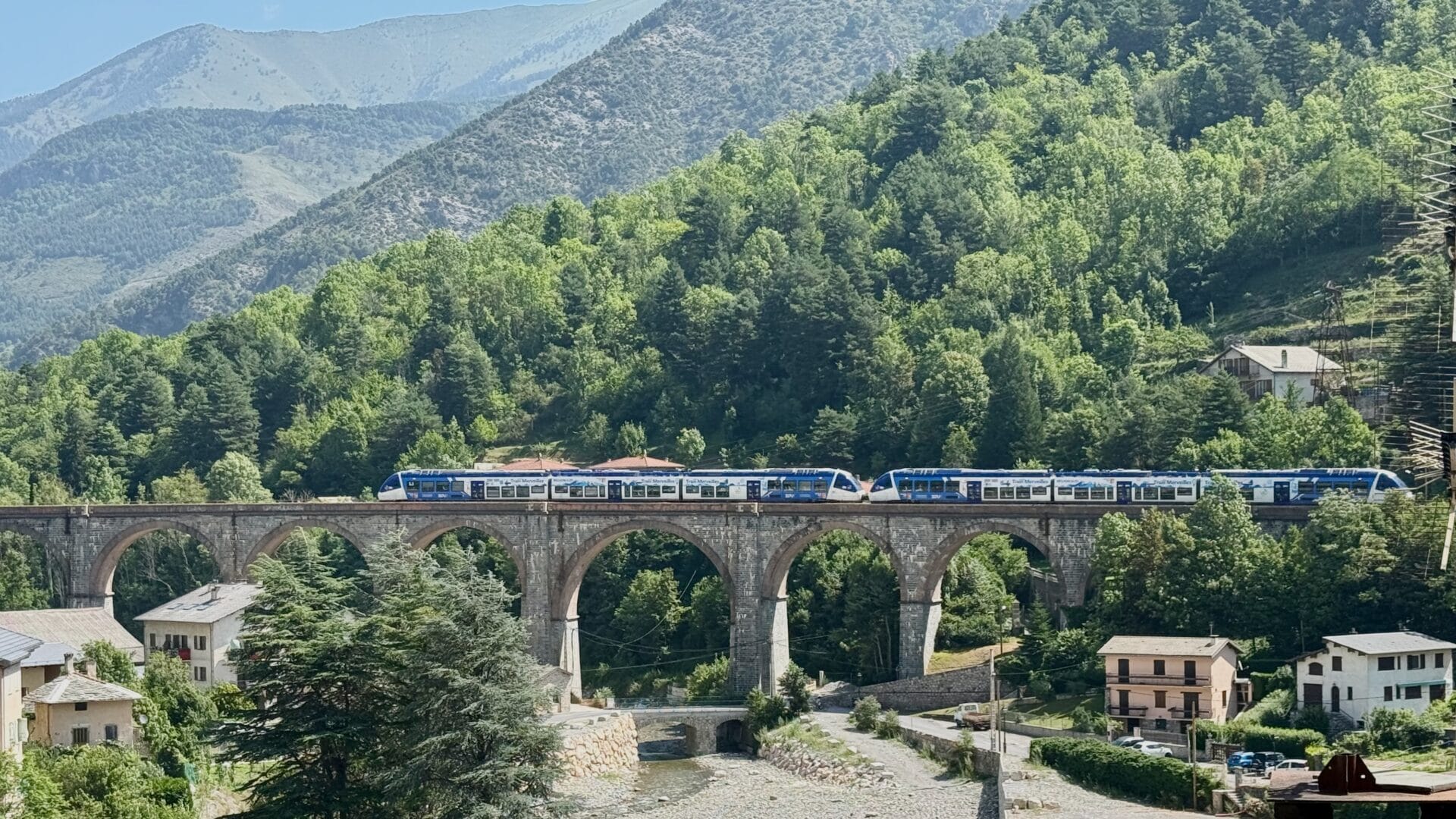
Traveling by train from Paris to Nice in a different way.
To get from Paris to Nice, I chose a five-day rail itinerary via Turin, Cuneo, and the Roya Valley. After a day in Turin, I took a regional train to Cuneo, the starting point of the famous Train des Merveilles (The wonder train in English). I then spent two nights in Tende before continuing on to Nice aboard this spectacular train.
This article is the second and final part of my five-day train journey from Paris to Nice, via Turin and the Roya Valley. I describe my train journey from Turin to Nice and my discovery of the most beautiful villages in the Roya Valley.
- A Brief History of the Train des Merveilles
- From Turin to Tende via Cuneo by Italian Regional Train
- The Villages of the Roya Valley
- The French SNCF Train des Merveilles: From Tende to Nice Through the Southern Alps
- Paris — Nice via Turin by Train: Why Choose This Route?
If you missed the first part, which covers the TGV journey to Italy, you can find it in the article "Paris-Turin-Nice by Train (1/2): Paris-Turin by TGV Through the Alps."
After my Alpine crossing and a very interesting day in Turin, it's time to begin the most thrilling part of this journey: reaching the French Riviera by taking one of the most spectacular railway lines in Europe.
Leaving the Piedmontese capital in the morning, my route first takes me to Cuneo, a small Italian town at the foot of the Alps. It's here that I board the legendary Train des Merveilles to cross the Italian-French border and reach Tende, a village located in the Roya Valley.
After two days of exploration amid these rugged landscapes, I board the Train des Merveilles again to descend toward the Mediterranean and complete this journey in Nice.
In this second part, I take you along the viaducts and tunnels of this exceptional line, before sharing all my practical tips for organizing your own crossing, whether from Paris to Nice via Turin or just part of the route, such as Paris → Turin, Turin → Nice, or simply the Train des Merveilles.
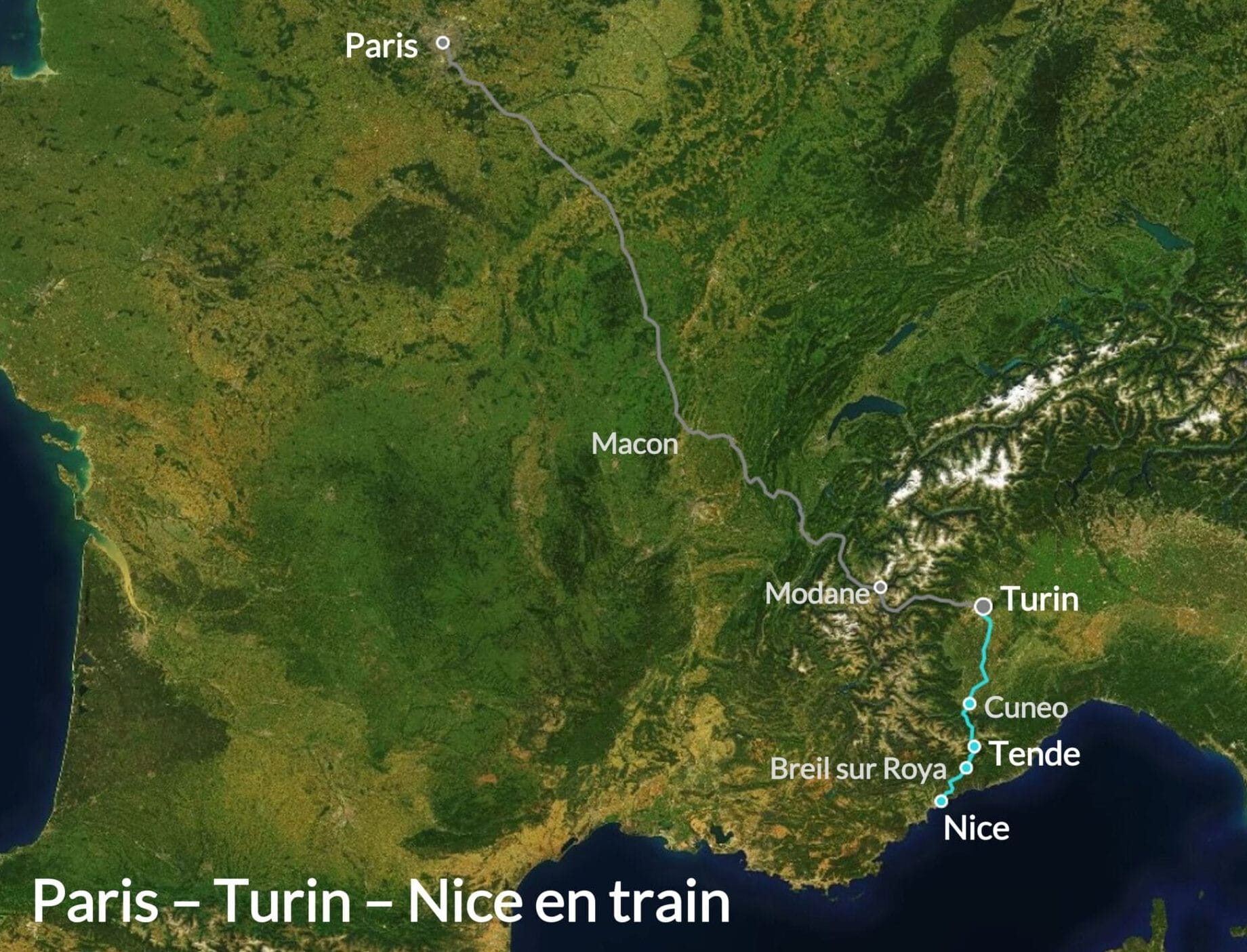
Paris-Nice via Turin in 5 Days: My Itinerary
Day 1: Paris → Turin by TGV
Day 2: Discovering Turin
Day 3: Turin → Cuneo → Tende aboard the Italian version of the Train des Merveilles
Day 4: Discovering the villages of the Roya: Tende → La Brigue → Saorge → Tende by electric mountain bike
Day 5: Tende → Nice aboard the French version of the Train des Merveilles
A Brief History of the Train des Merveilles
Contrary to what one might think, the Train des Merveilles doesn't bear this name because the journey is "marvelous," but because it serves the Valley of Marvels, an exceptional archaeological site located in the heart of Mercantour National Park, at the foot of Mont Bégo. This site, famous for its tens of thousands of Bronze Age rock carvings, is located about twenty kilometers west of Tende.
The Train des Merveilles Line: A Turbulent History
The Cuneo — Nice line, with a branch at Breil-sur-Roya toward Ventimiglia, is one of only three railway lines connecting France to Italy. The other two pass through Modane and Ventimiglia (the French Riviera line).
Italy launched the work in the late 19th century, notably with the construction of the Col de Tende railway tunnel, eight kilometers long. But political tensions, strategic concerns of French military authorities, and technical difficulties considerably delayed the project. It wasn't until 1928 that the line between Cuneo and Breil-sur-Roya finally opened for service, later extended to Ventimiglia on one side and Nice on the other.
This military purpose still shows up today in certain tunnels, pierced with loopholes that let soldiers fire on potential enemy trains. A surprising detail that recalls how long this valley was considered a strategic axis.
Due to its military importance, the line was severely damaged during World War II. Destroyed bridges, dynamited tunnels, and collapsed viaducts made its operation impossible for many years. Traffic wasn't fully restored until 1979.
When Nice and Turin Were Directly Connected by Train
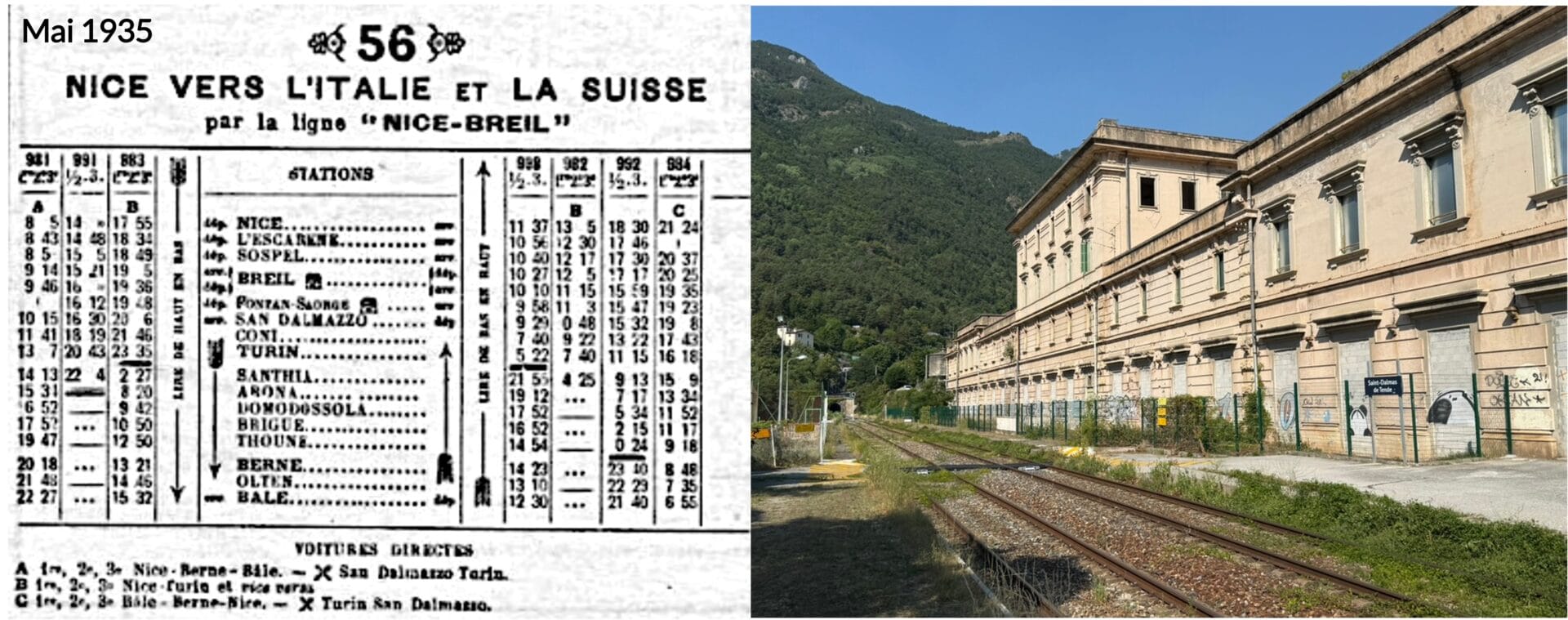
Between 1928 and 1940, the line experienced its golden age. Direct trains connected Nice to Turin daily in about six hours. Some were even extended to Switzerland via Domodossola.
At that time, the Italian border station was located at Saint-Dalmas-de-Tende. Mussolini had a monumental station built there intended to accommodate customs controls and impress travelers. Now abandoned, this imposing building still exists.
From Turin to Tende via Cuneo by Italian Regional Train
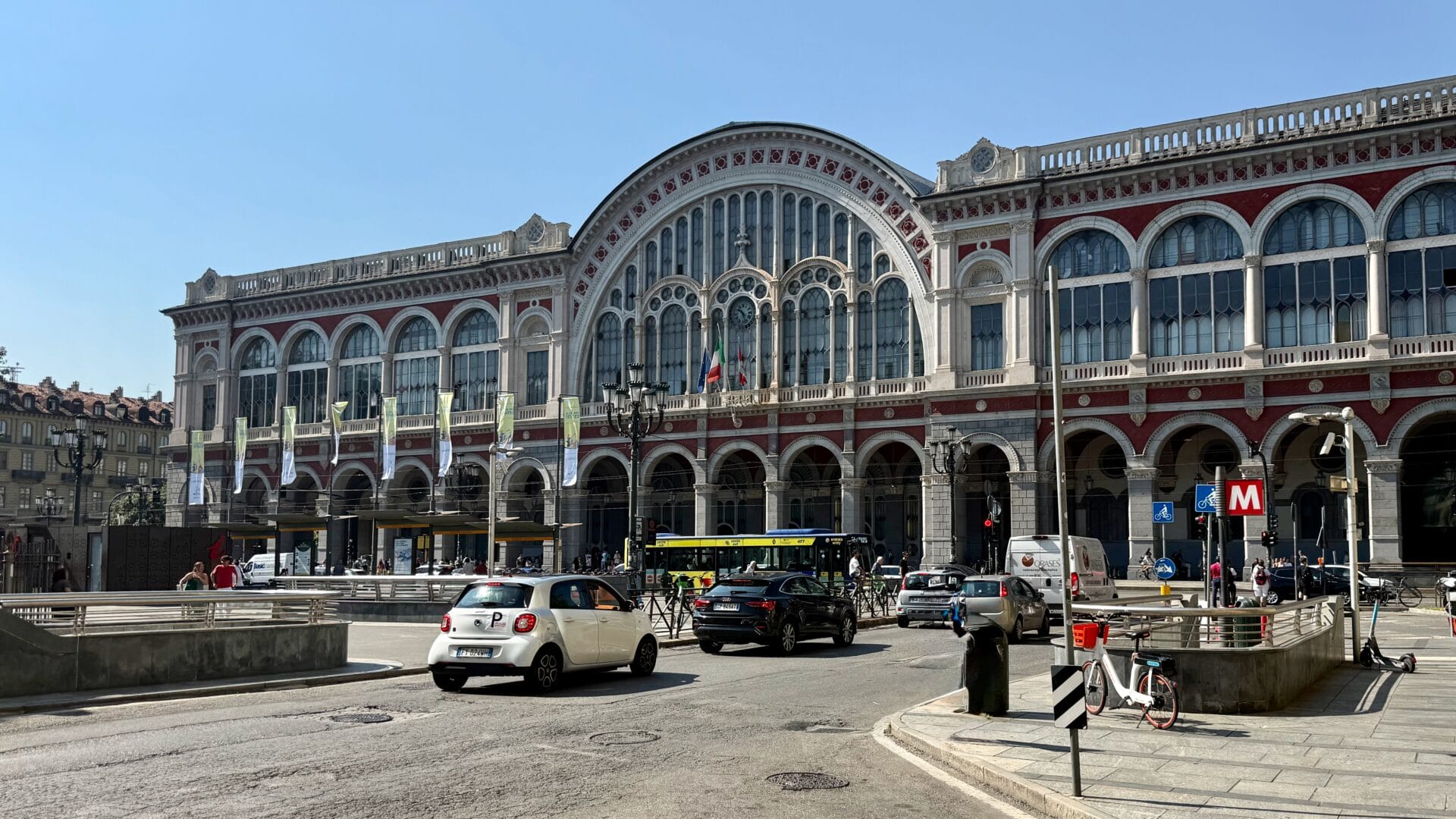
I'm on the third day of my journey, and early in the morning I head to Porta Nuova station, which has retained its elegant, original late-19th-century façade.
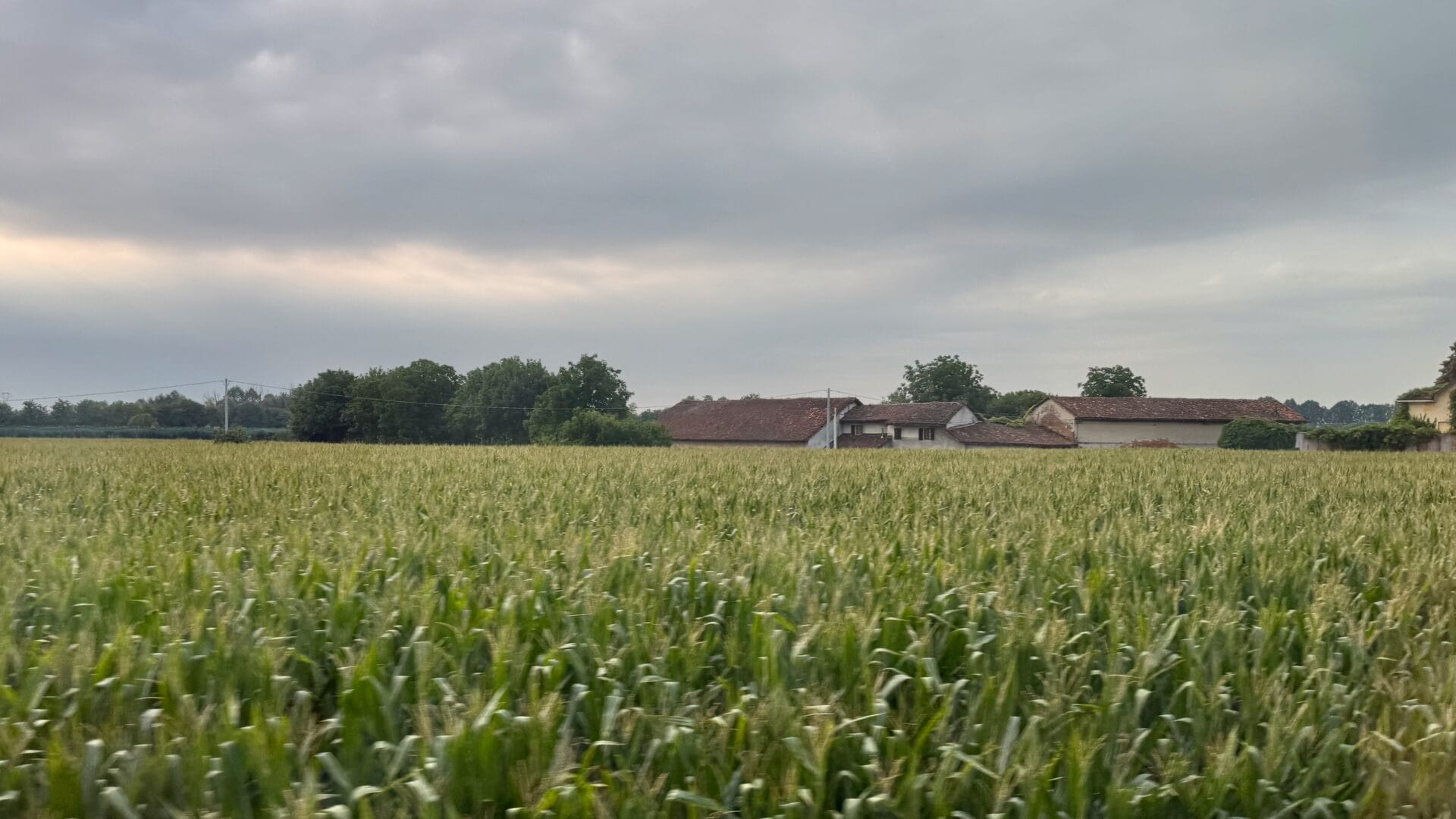
I take a regional train to Cuneo, where I'll begin this famous journey aboard the Train des Merveilles through the mountains. We first cross the immense Po Plain, with its vast agricultural fields.
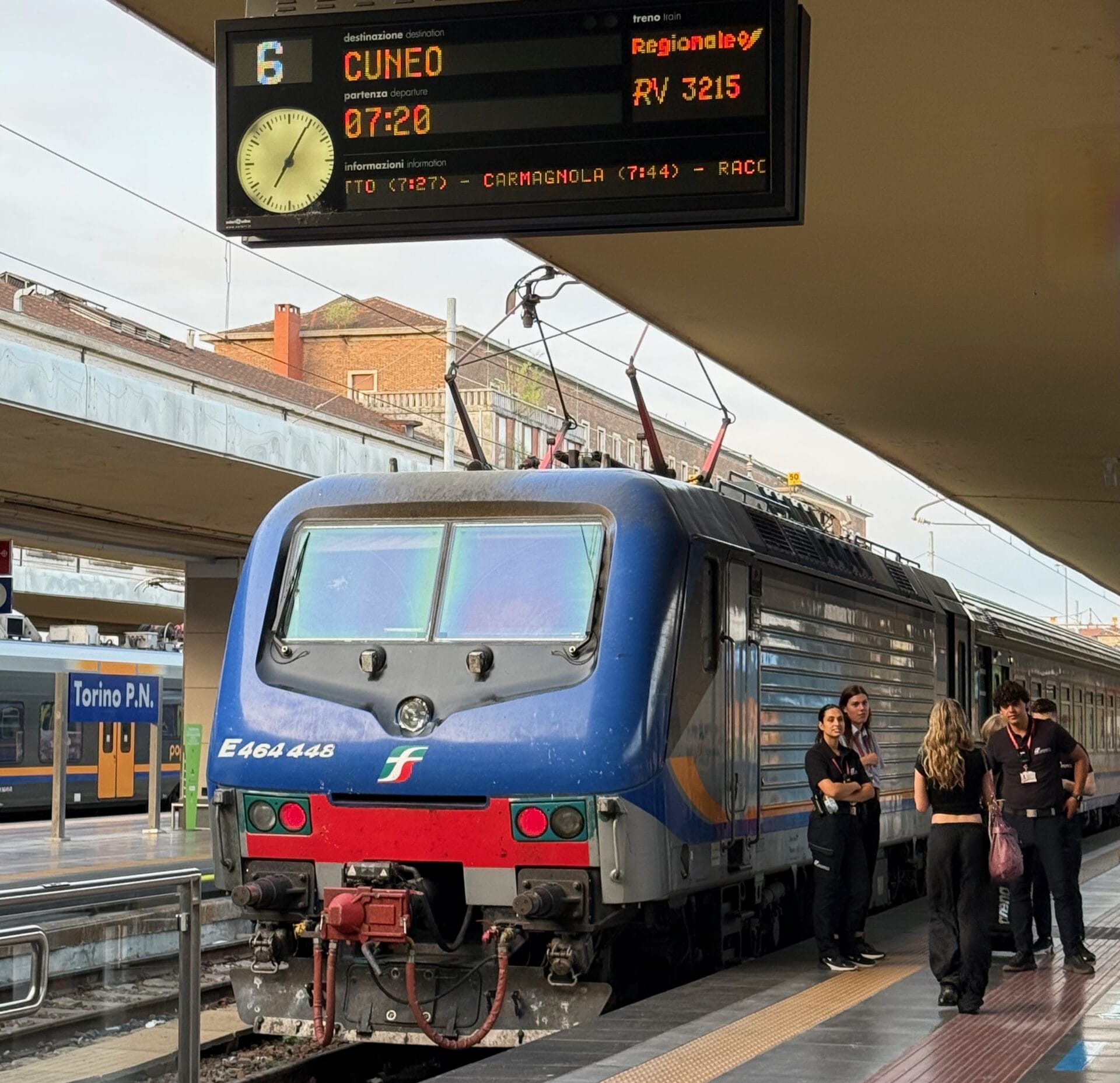
Cuneo is a small town renowned for its impressive arcade network. But choices must be made. So I decide not to visit it and to take my connection directly on the platform to reach Tende aboard the Trenitalia Cuneo — Ventimiglia regional train.
From Cuneo to Tende: Trenitalia's Train des Merveilles
Strictly speaking, only the SNCF train officially bears the name Train des Merveilles. For convenience, however, I'll use this name for all trains running on the line.
The Italian Train des Merveilles connects Cuneo to Ventimiglia. Between Tende and Breil-sur-Roya, it uses the same section as the French Train des Merveilless, which then continues on to Nice.
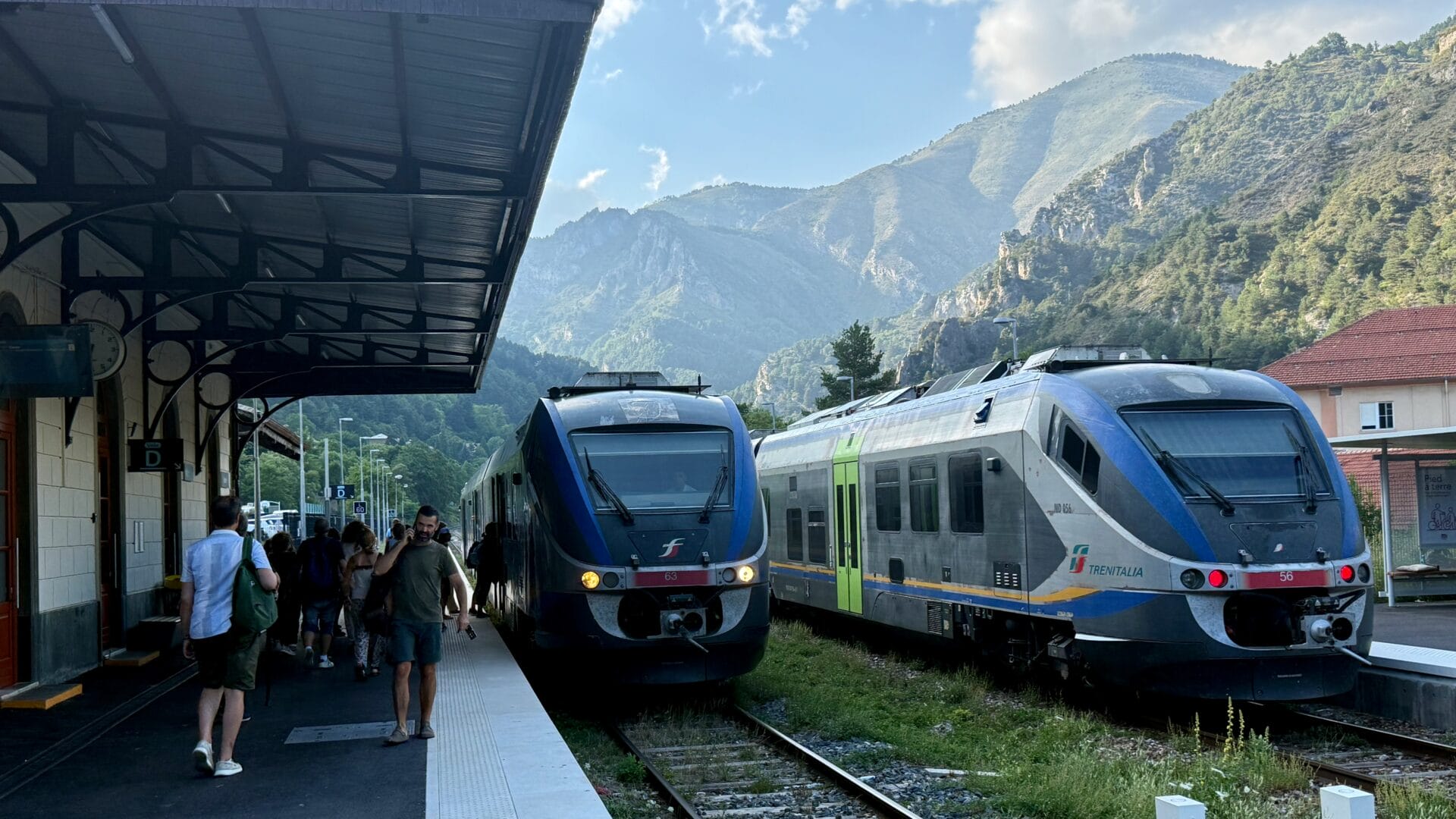
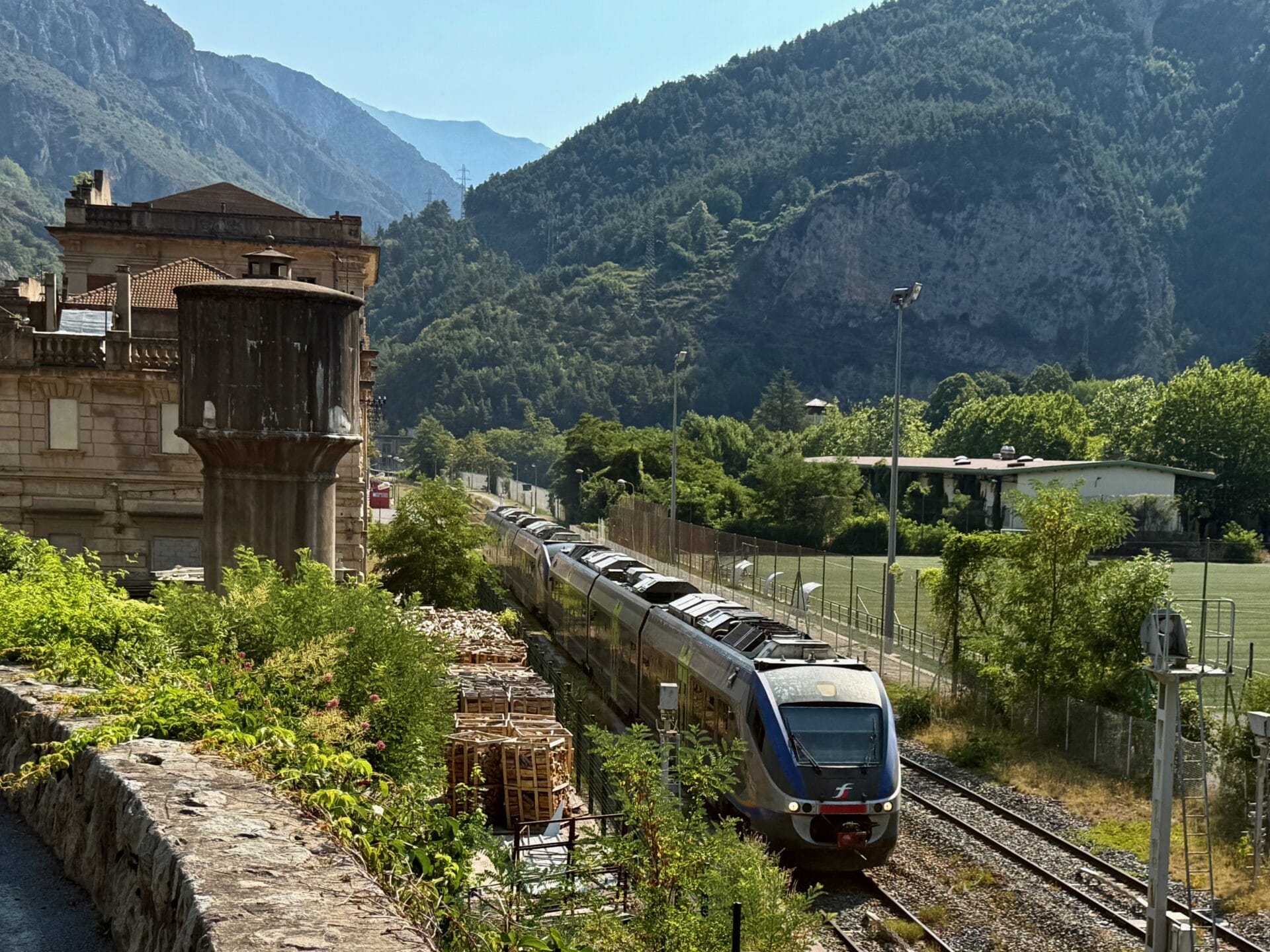
After Cuneo, the line is no longer electrified. So it's a diesel-powered Minuetto railcar that takes us toward the Alps. The train is over twenty years old, and it shows. It's probably time for the Piedmont region to renew the fleet.
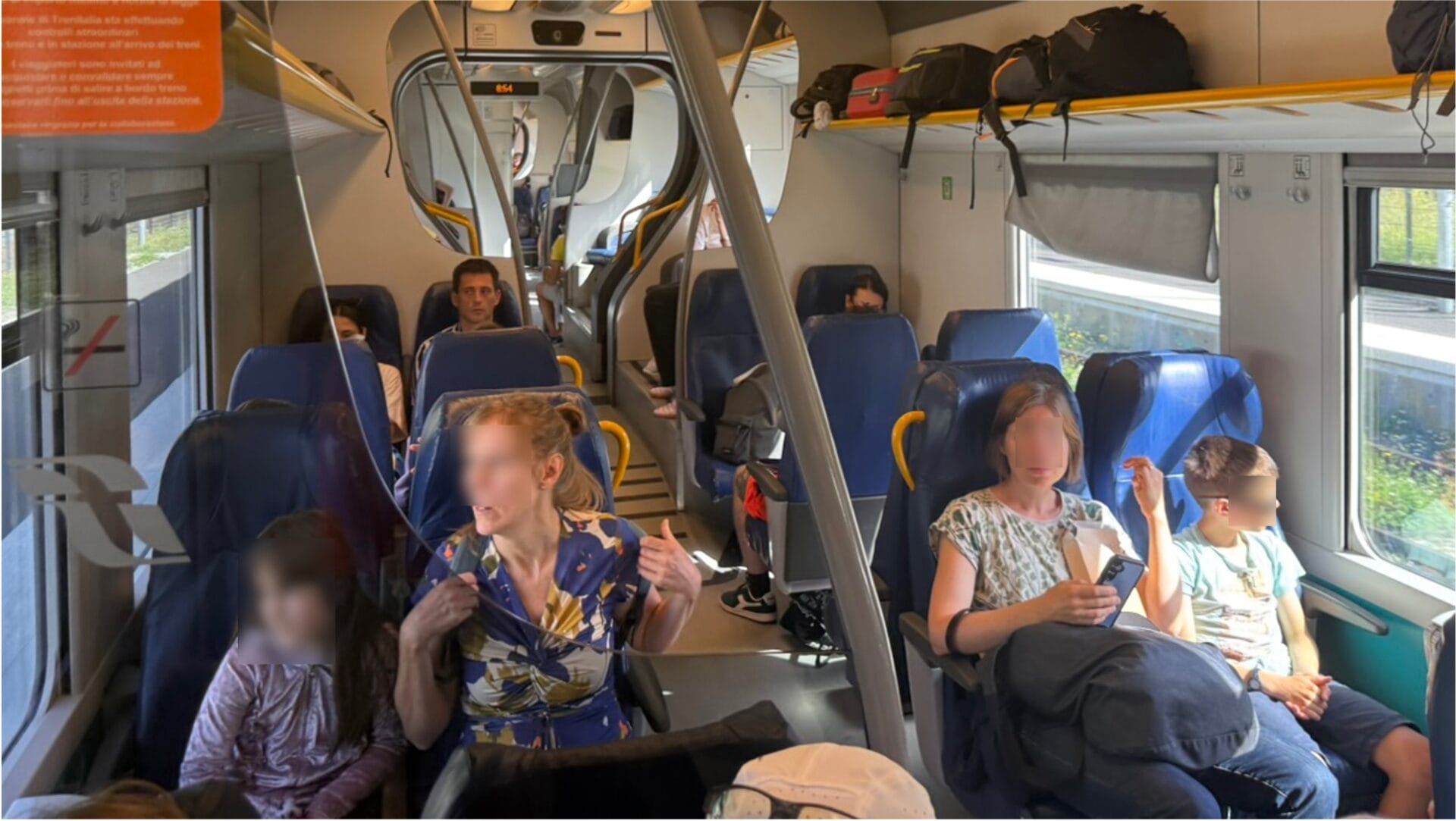
To my great surprise, this train is also quite full. I thought there would be few passengers, since we're heading toward small mountain villages. In reality, the explanation is simple: to travel from Turin to Ventimiglia, these two regional trains constitute both the fastest and most economical route. And, as I'll quickly discover, the line crossing the Alps is one of the most spectacular in Europe.
The Cuneo—Ventimiglia line has a surprising feature: although the train departs from Italy and returns there, most of its route runs through France. A curiosity inherited from the geography of the Alpine valleys and the turbulent history of this border region.
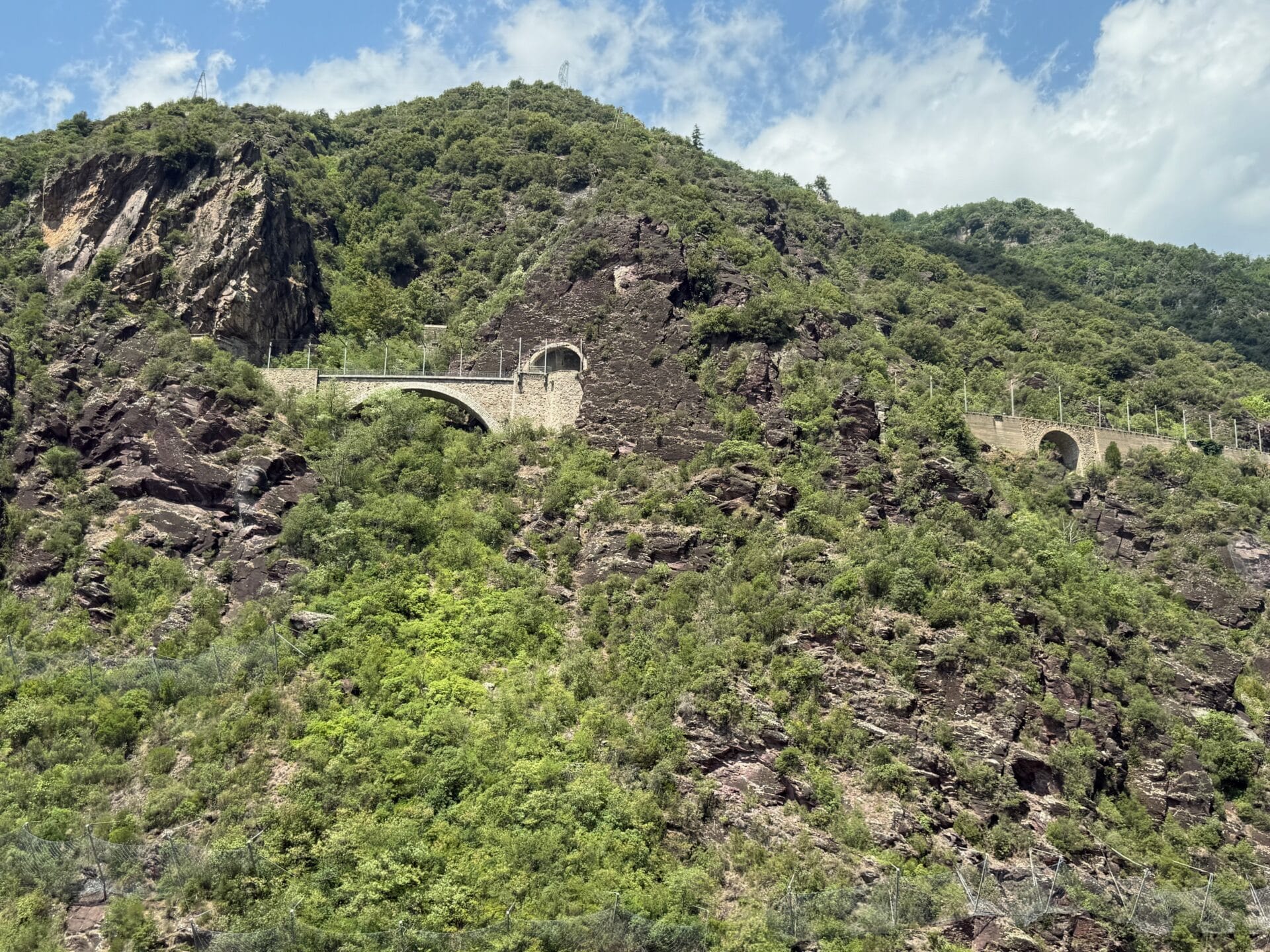
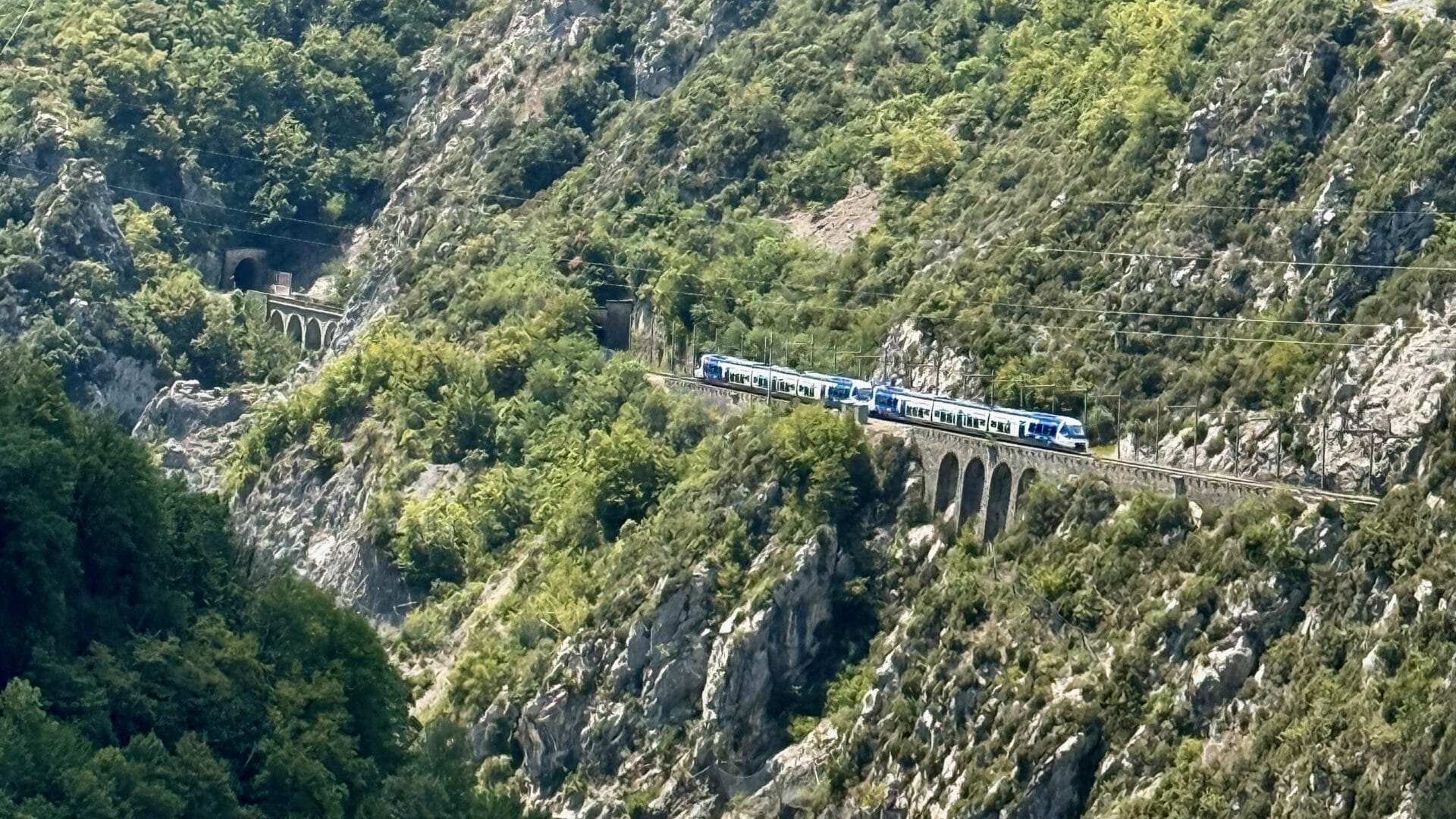
Very quickly, we reach the Pre-Alps before a succession of tunnels, viaducts, and tracks clinging to the mountainside.
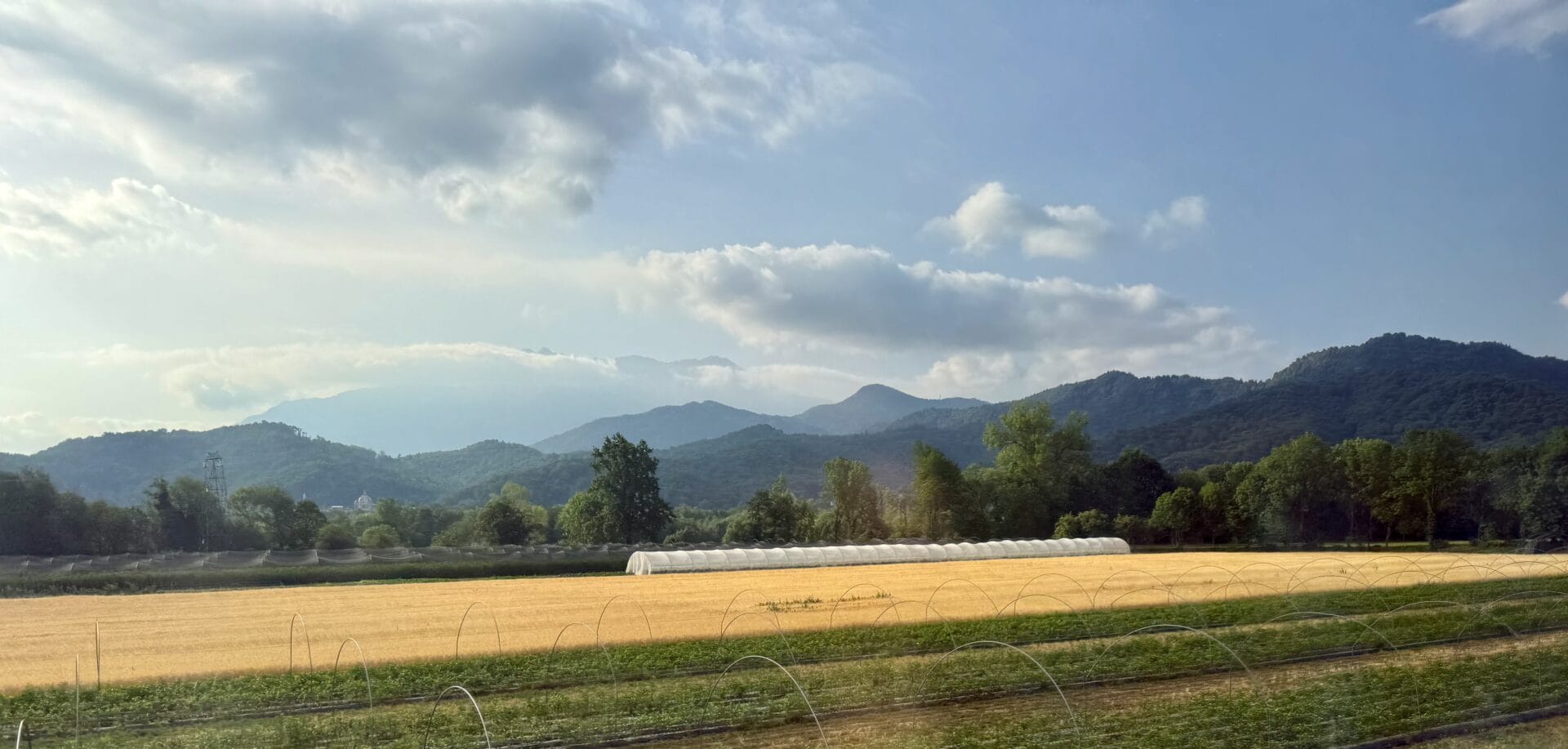
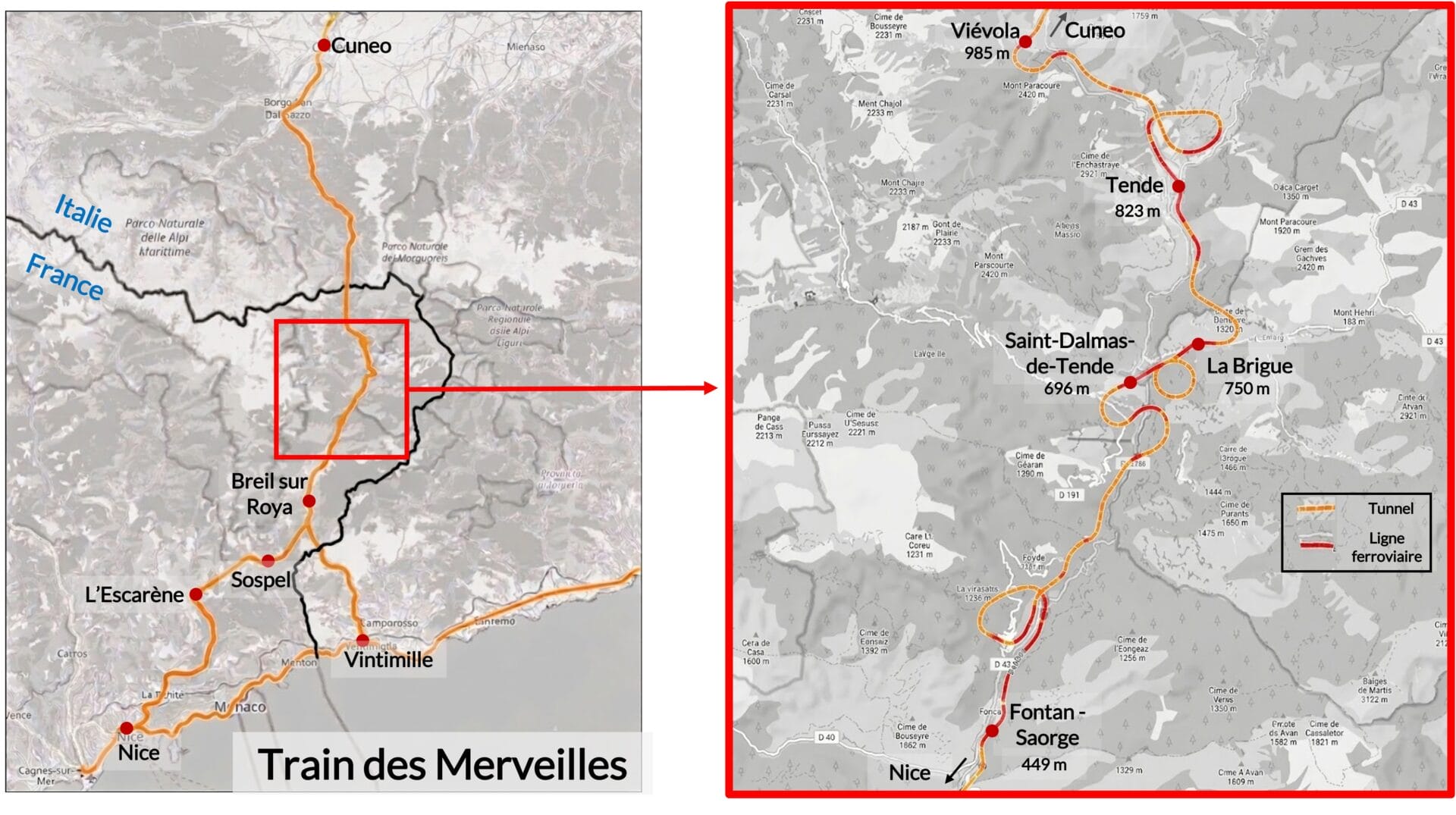
Between Cuneo and Ventimiglia, the railway line covers nearly 100 kilometers through the Alps. Continuing to Nice, that's about 120 kilometers of magnificent landscapes, traveled at an average speed of barely 40 km/h. Now that's what I call real slow travel! But it's hard to complain: this leisurely pace leaves plenty of time to admire the scenery.
At each turn, the mountains seem to draw a little closer. Villages appear clinging to the slopes, while engineering works follow one after another. I quickly understand why this line is considered one of the most beautiful in Europe.
A major advantage of the Schengen Area: I don't even notice that we've left Italy and entered France.
I get off at Tende, a small village perched in the heart of the French Alpes-Maritimes. The line is single-track. Train crossings therefore take place at stations with two tracks.
The Villages of the Roya Valley
Perched at 823 meters, Tende offers a much more pleasant temperature than Turin on this hot July day. I've chosen to spend two nights here to take time to discover some of the most emblematic villages served by the Train des Merveilles.
Tende: The Main Town of the Roya Valley
Tende is located at a strategic point on the salt route connecting Piedmont to the Mediterranean. The Counts of Tende grew rich in the 16th century by collecting passage fees on goods and travelers.
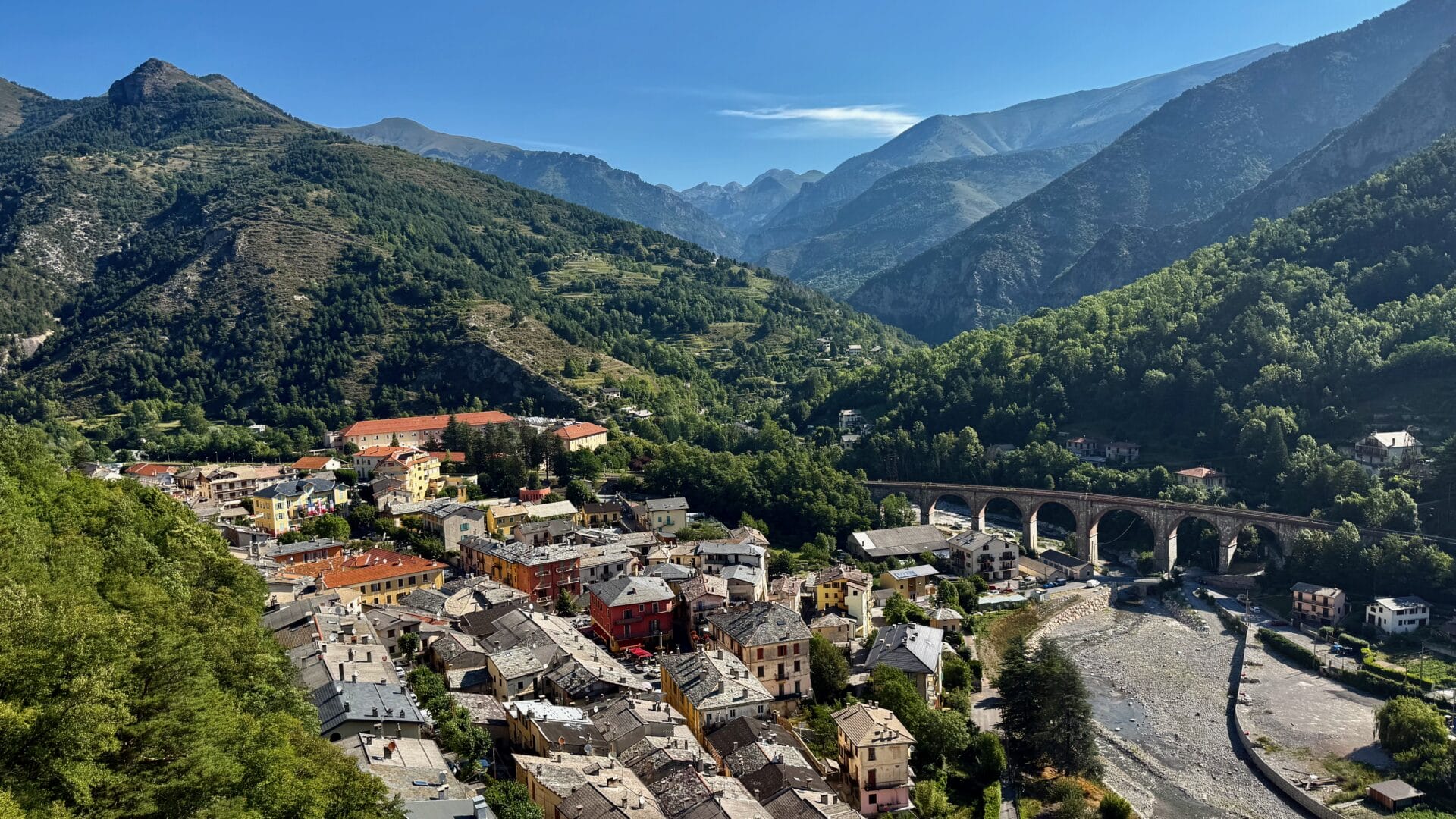
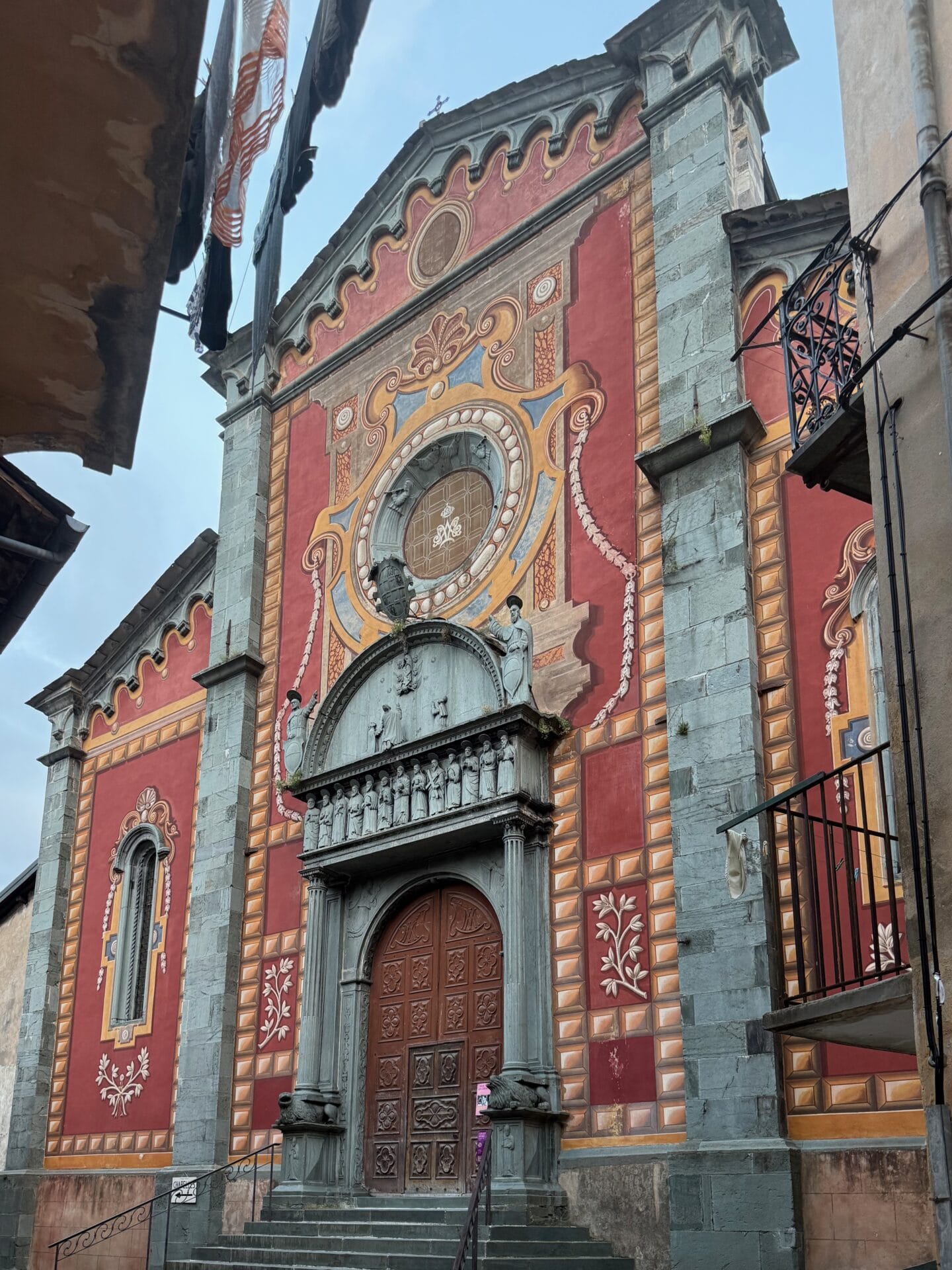
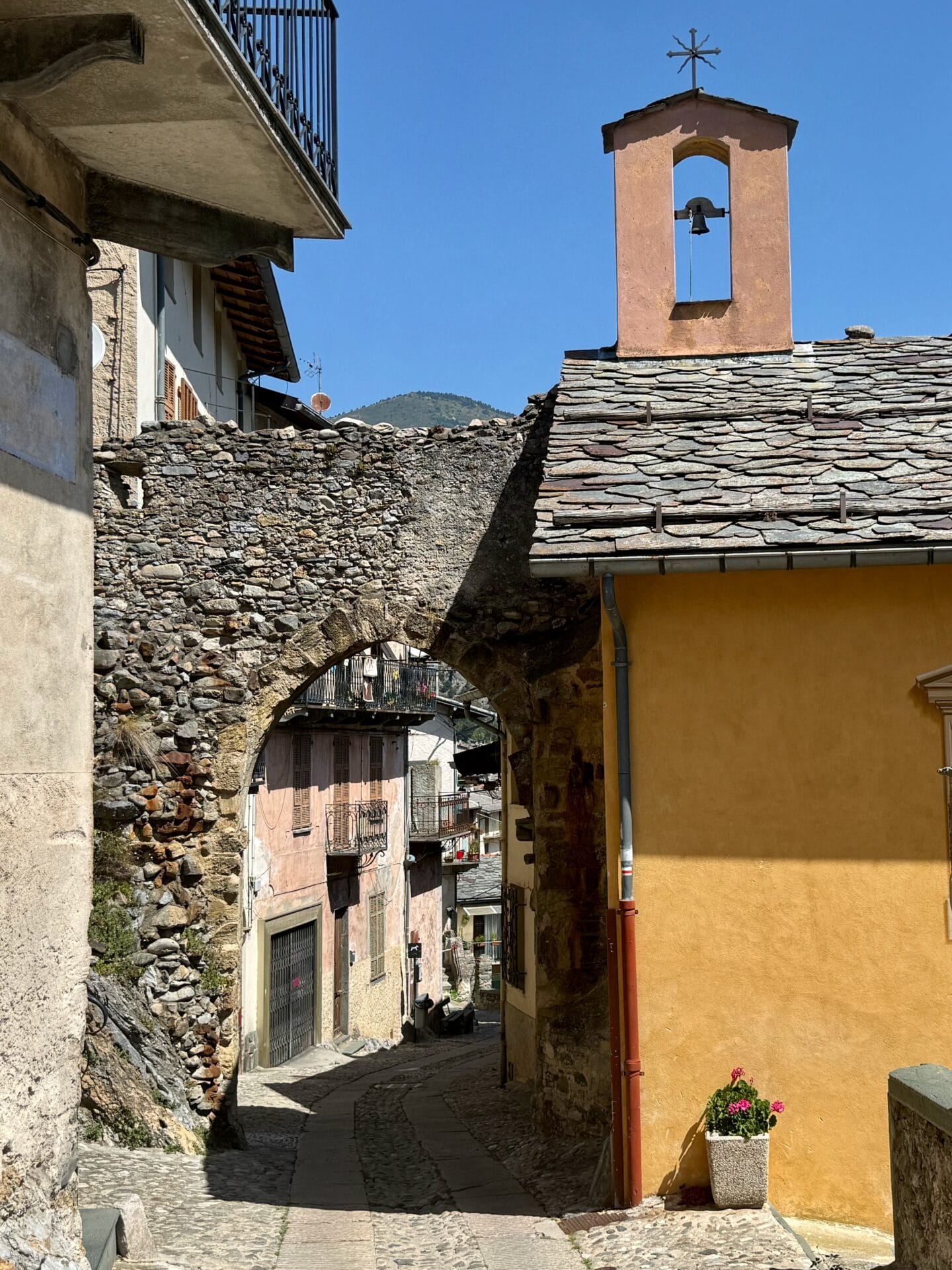
Leaving the station, I'm a bit disappointed. The main road seems to cut through the middle of the village. Fortunately, you only need to step a few meters away to enter a maze of medieval alleyways that climb up to the cemetery, located at the foot of a feudal castle, of which only a fragment of the tower remains today.
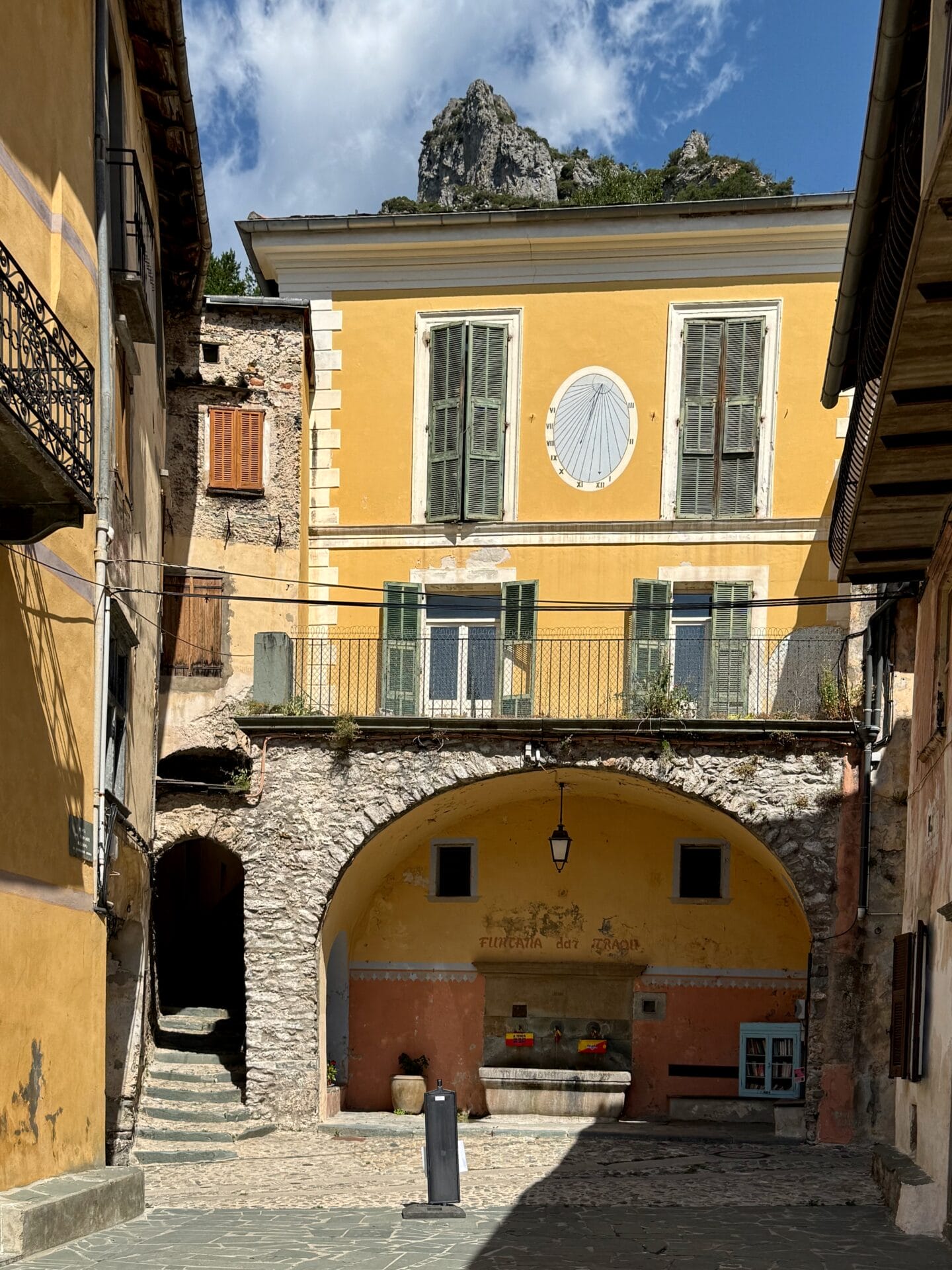
A little further on, I discover the very original façade of the collegiate church, dating from the 15th century, then Place du Traou, with its fountain and sundial.
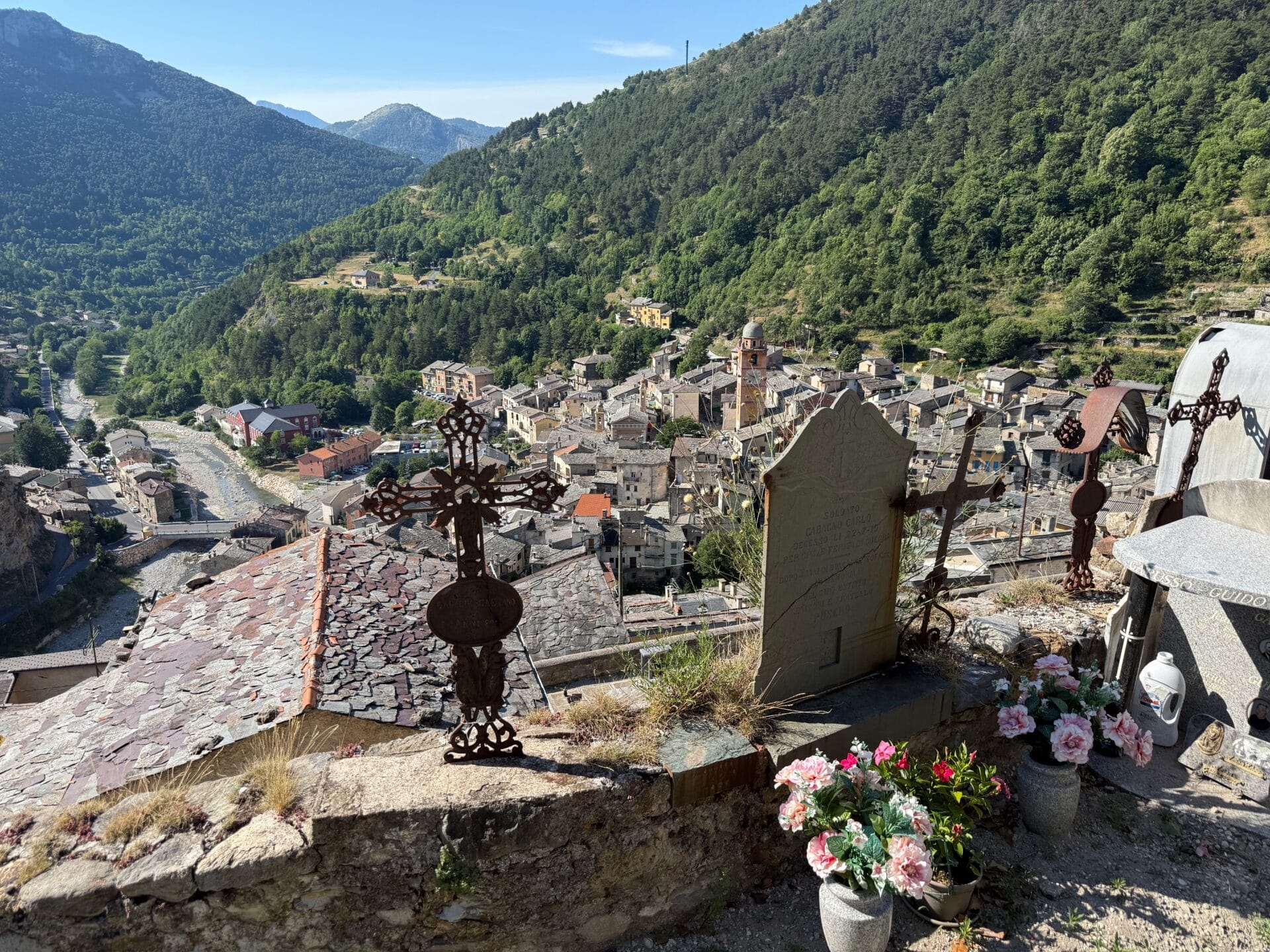
I end my visit at the cemetery, located at the top of the village. I find it a beautiful symbol to see the dead as both closest to heaven and seemingly protecting the living below!
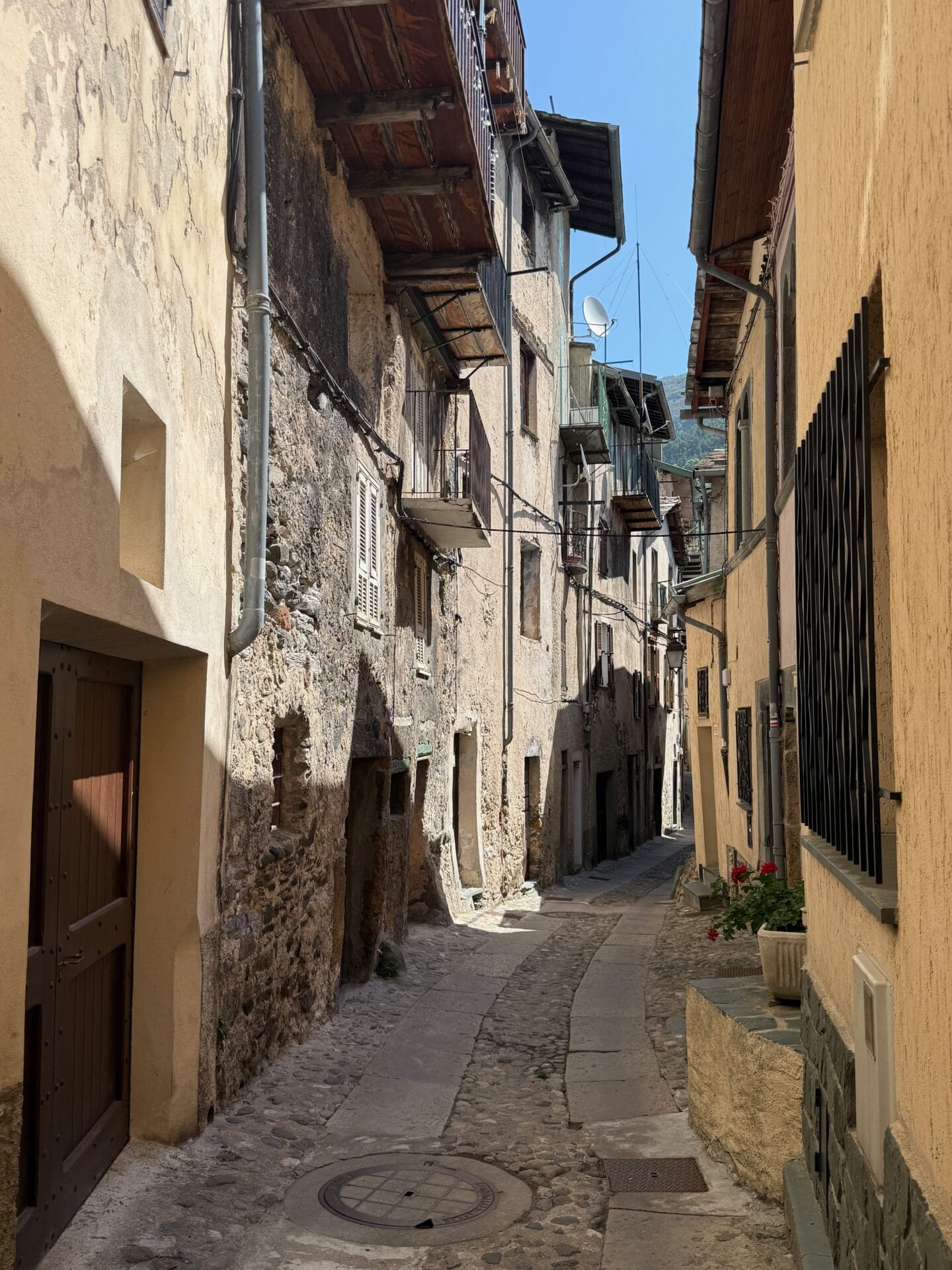
I'm staying with a local resident, Mandy, who offers visitors a simple but peaceful room. She also rents electric mountain bikes, an excellent way to explore the neighboring villages of La Brigue and Saorge. That's actually the option I've chosen for the next day.
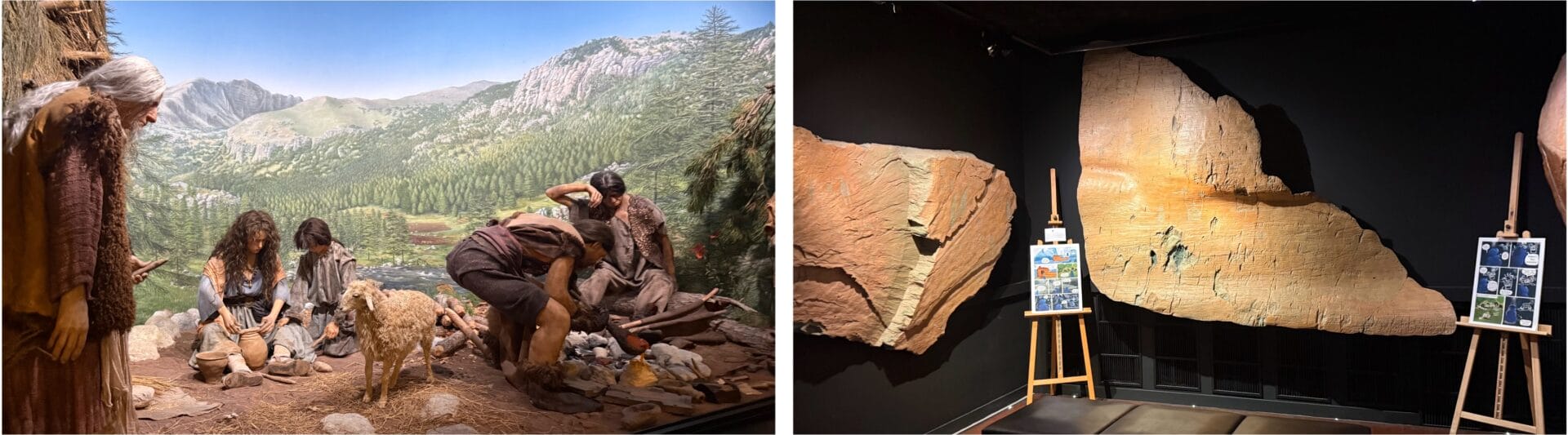
In Tende, I visit le Musée des Merveilles. It presents, in a very educational way, the origin of the rock carvings discovered in Mercantour National Park. What I appreciate most are the reconstructions and explanations that help us better understand our ancestors' way of life and its evolution over millennia. A visit not to be missed under any circumstances.
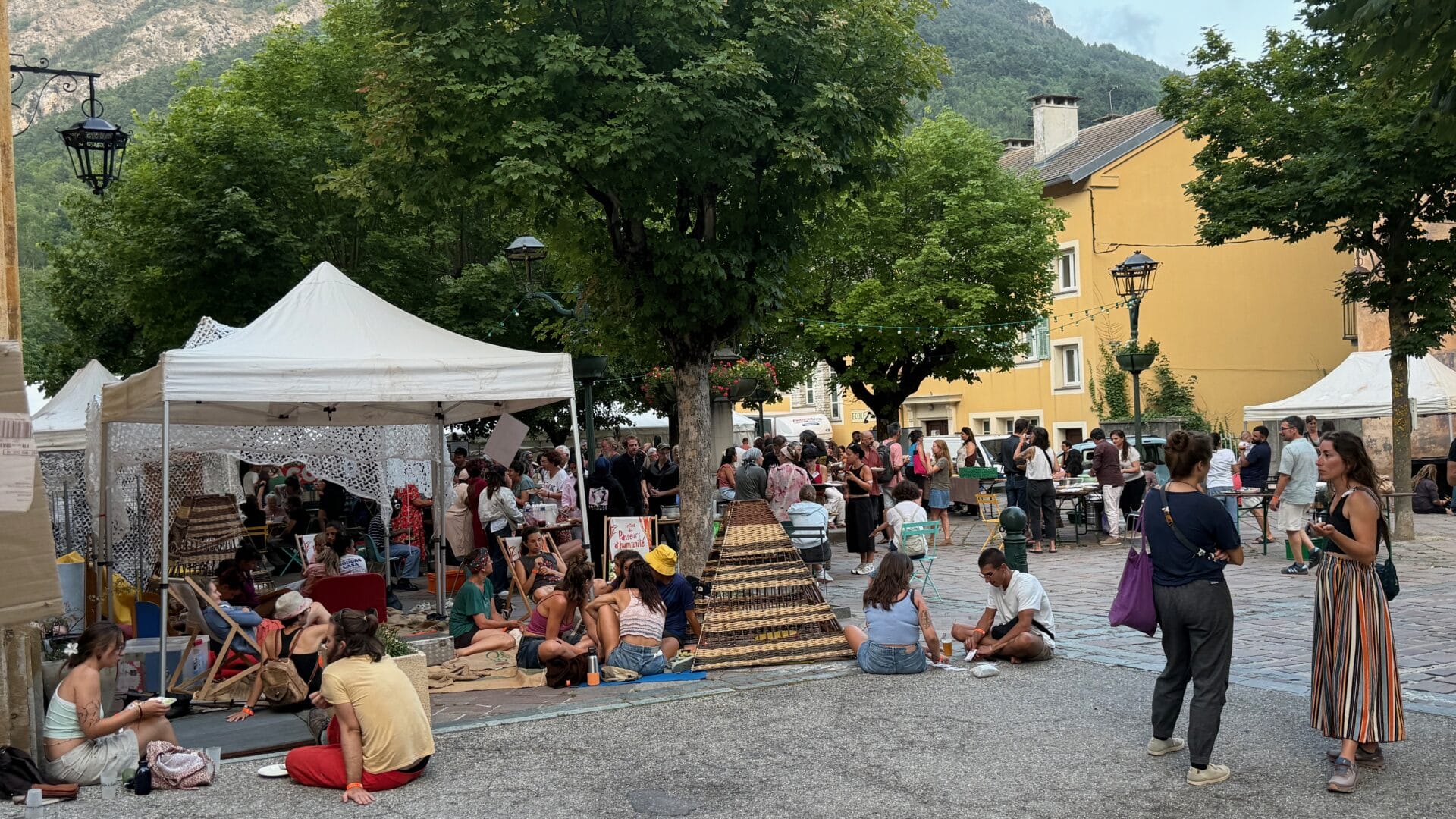
During my stay, the Passeurs d'Humanité festival is taking place. It was created after Storm Alex, which devastated the Roya Valley in 2020. Torrential rains swept away roads and bridges, destroyed numerous buildings, and deeply disrupted residents' lives. This disaster ranks among the most significant that France has experienced in recent decades.
The festival celebrates the values of solidarity, sharing, and dialogue through concerts, debates, and many convivial moments. It's a far cry from the glitz of the French Riviera. I really appreciated the simple, warm atmosphere and laid-back hippie vibe.
I found Tende to be the liveliest village in the valley. There are several restaurants, a bakery, and a few shops. The tourist office also has a branch there where knowledgeable staff provide numerous brochures and valuable advice for discovering the region.
La Brigue: A Village with a Franco-Italian Atmosphere
I reached La Brigue by electric mountain bike.
La Brigue is located about fifteen kilometers from Tende. These two villages have the distinction of only becoming French in 1947, following the Treaty of Paris. Their history can still be read in the architecture, traditions, and even the surnames of their inhabitants. At times, you no longer really know whether you're in France or Italy. It's a beautiful illustration of how relative borders can sometimes be.
La Brigue is a particularly peaceful village, away from the main road. I visited it during siesta time, and the only residents who came to greet me were… a few cats lazily settled in the shade of the alleyways.
The village has a rich religious heritage, including several remarkable chapels and churches, notably the Notre-Dame-des-Fontaines chapel, nicknamed the "Sistine Chapel of the Alps" for the extraordinary quality of its 15th-century frescoes. Unfortunately, it's located 4 km from the village, and I didn't have time to go there because I really wanted to visit Saorge. However, know that from the village to the chapel, you can get there either on foot via a lovely path or by bike.
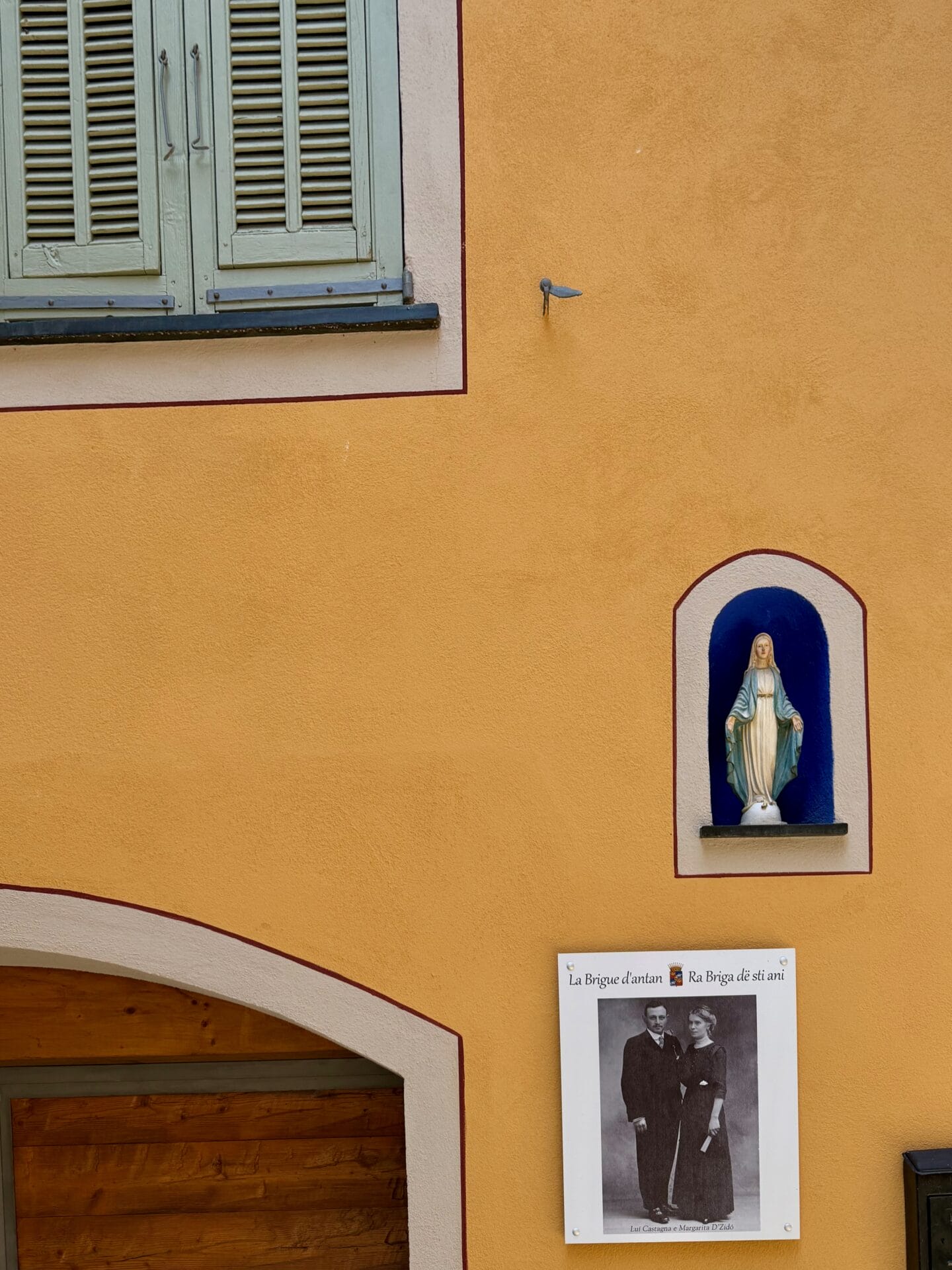
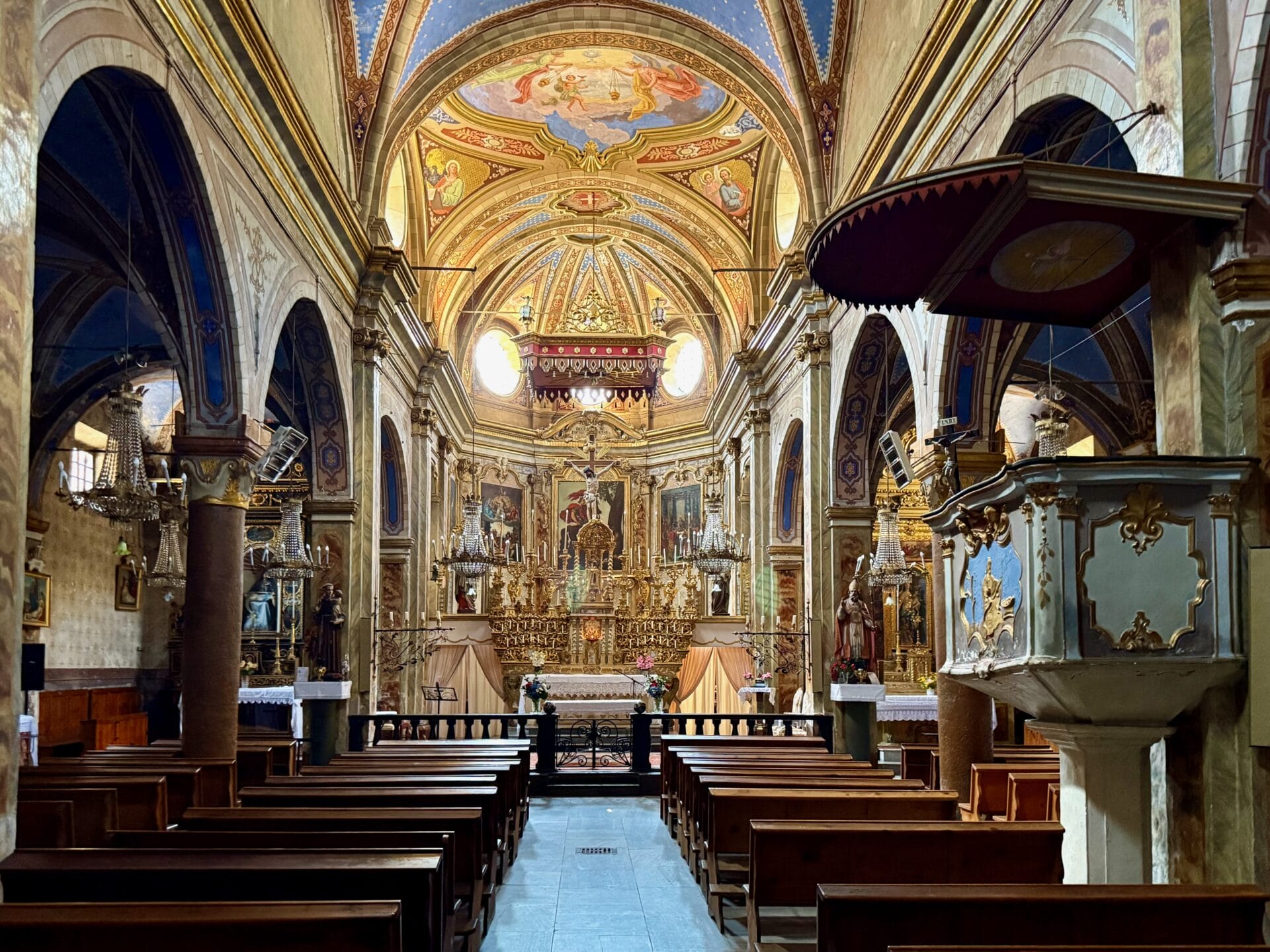
Saorge: The "Tibetan Village" of the Roya Valley
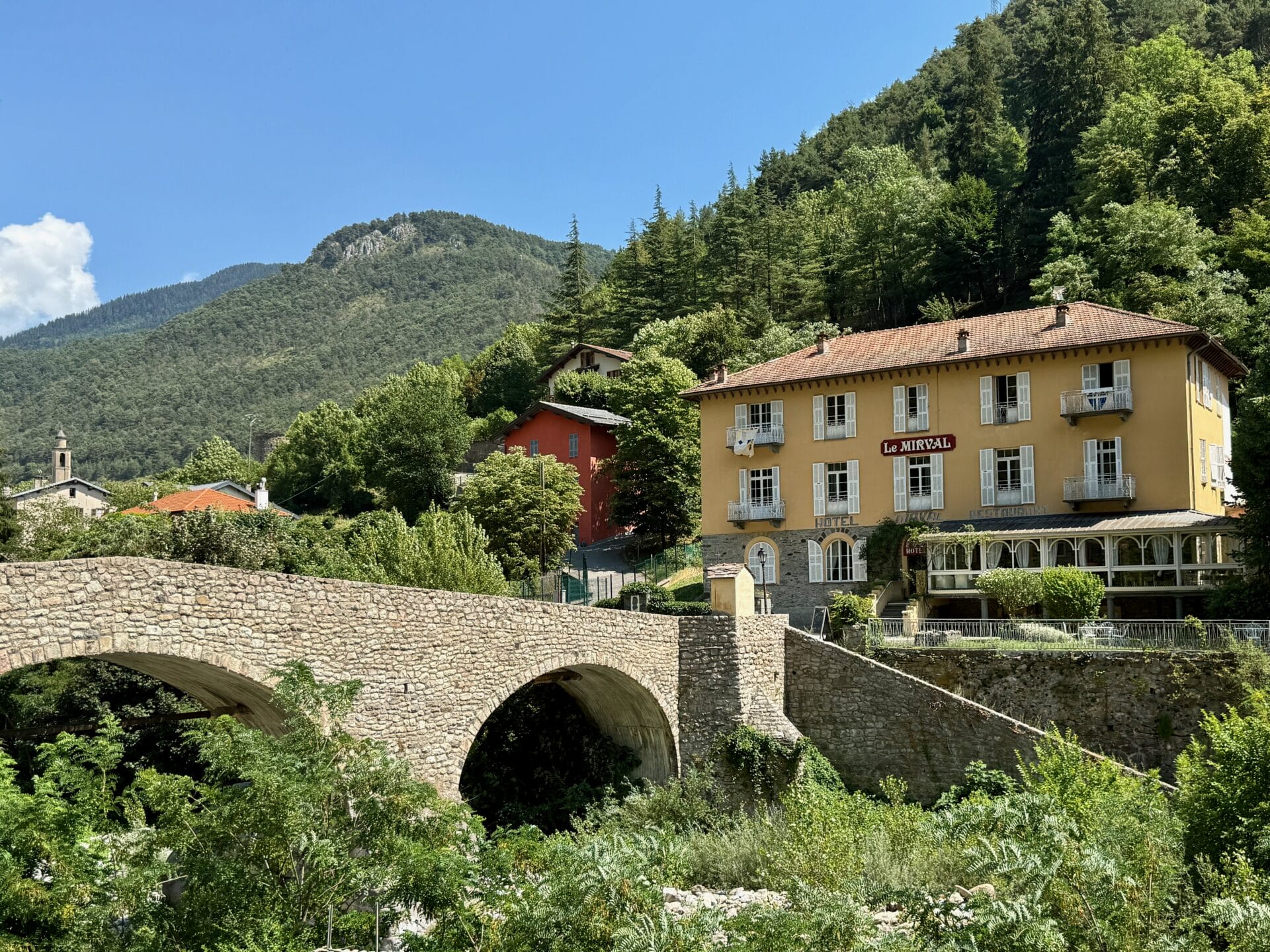
Saorge is my favorite in the valley. From La Brigue, you can take a mountainside path accessible by mountain bike. But since I was alone, I preferred to be cautious and go to Saorge by road. Indeed, a flat tire or a fall could have compromised my excursion, as I'd been warned it was relatively little used.
On the road, I pass by a hydroelectric plant dating from 1914. Captured at an altitude of 530 m, the water enters a penstock over 3 km long that drives two electric turbines.
The village of Saorge clings to the side of a mountain overlooking a particularly narrow valley. To reach it, after passing near Fontan-Saorge station, I go through a tunnel that gives it a bit of a secret village feel.
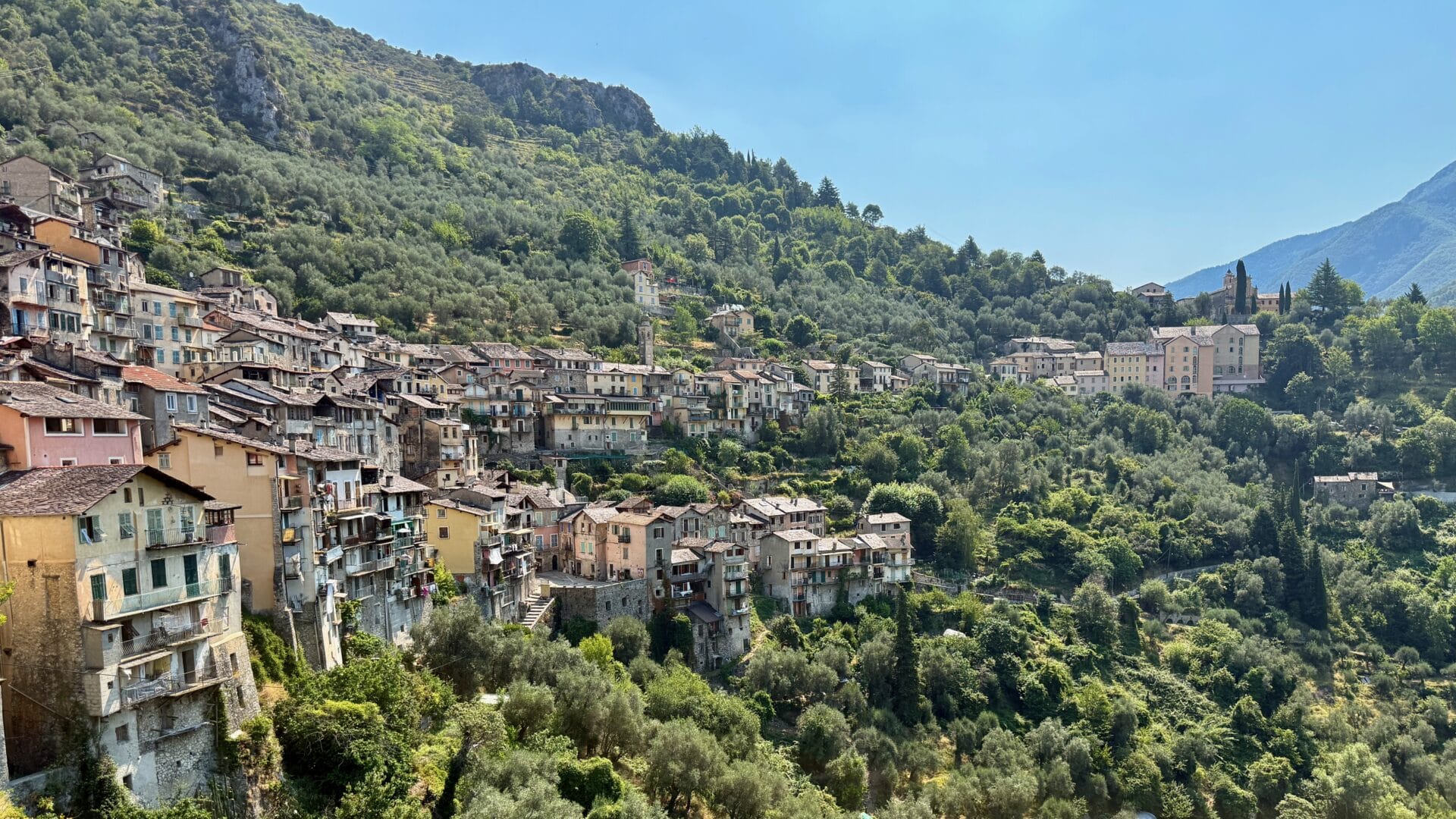
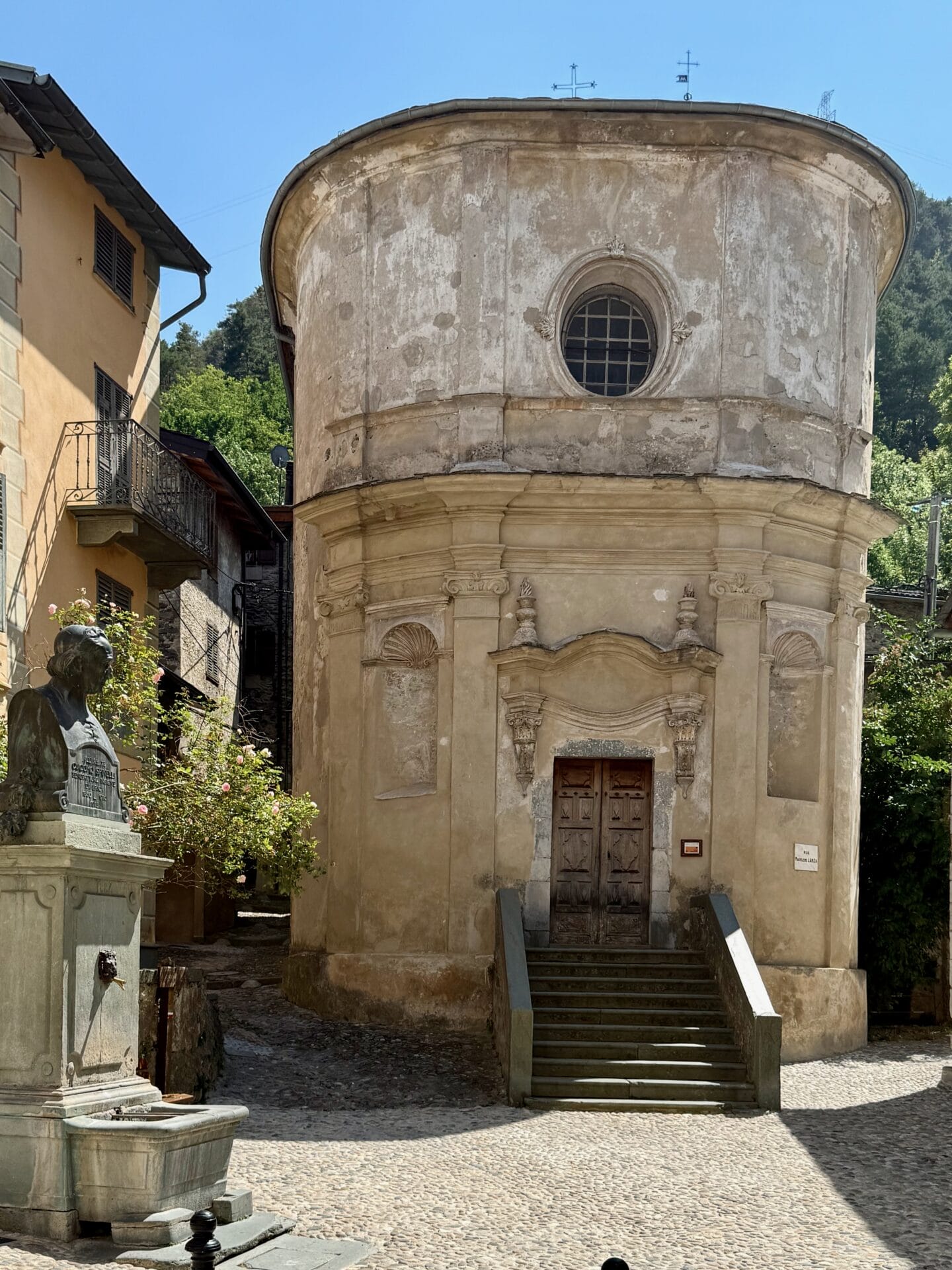
Once inside, the vaulted alleyways, covered passages, and stairs, closed to cars, invite wandering. In the past, Saorge occupied a strategic position that let it control passages through the Roya Valley: a truly unavoidable gateway.
And, remarkably, the village hasn't been spoiled by tourism. Here, there's no succession of art galleries, fashion boutiques, or souvenir shops, as in Saint-Paul-de-Vence. Saorge is authentic, and its medieval architecture has remained almost intact.
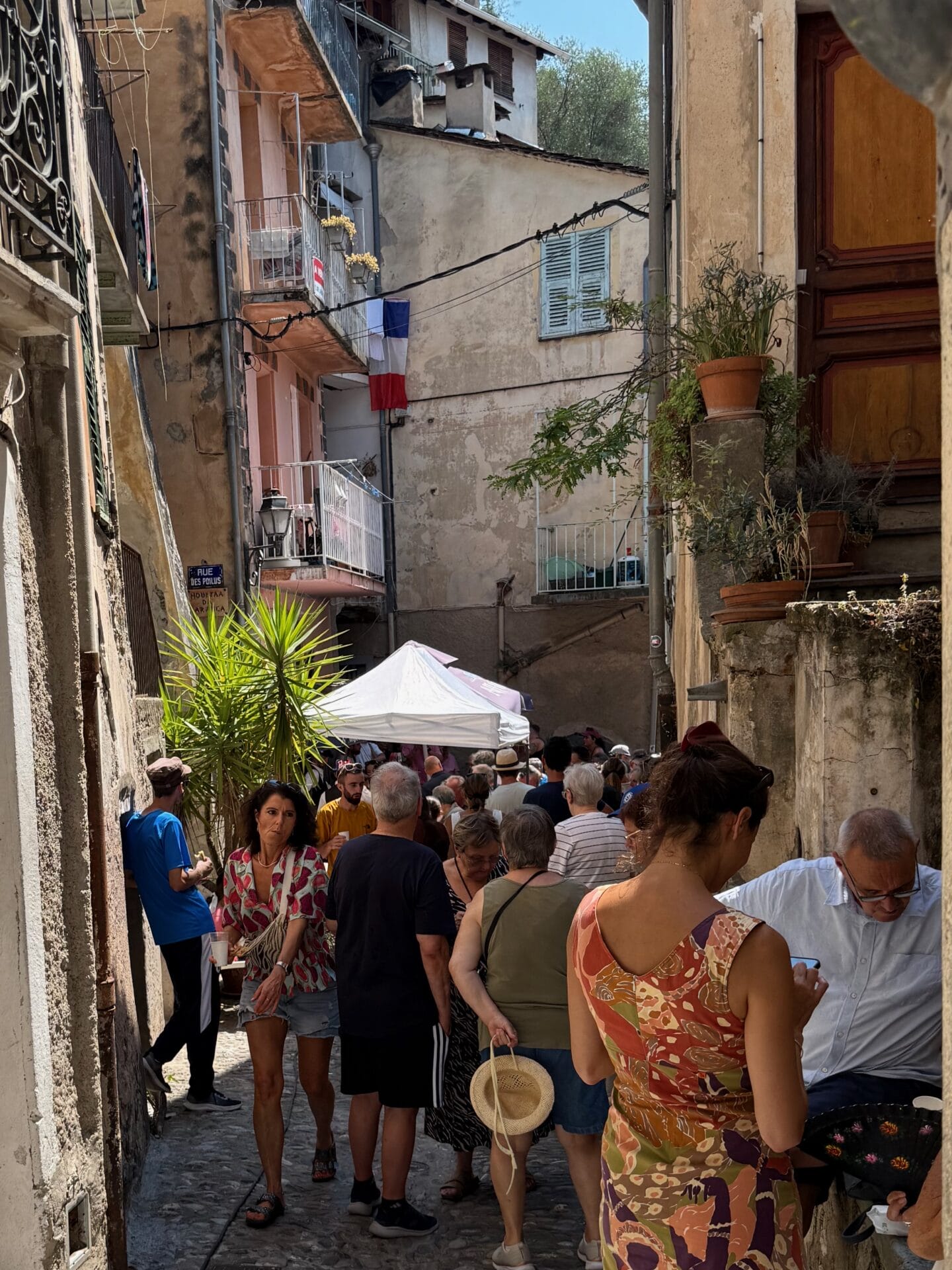
I happen to arrive during the Tourte Festival. On this day, residents gather around the communal oven where traditional Saorgian vegetable pies are baking. It's mainly a village celebration, but visitors are welcomed with simple, genuine kindness.
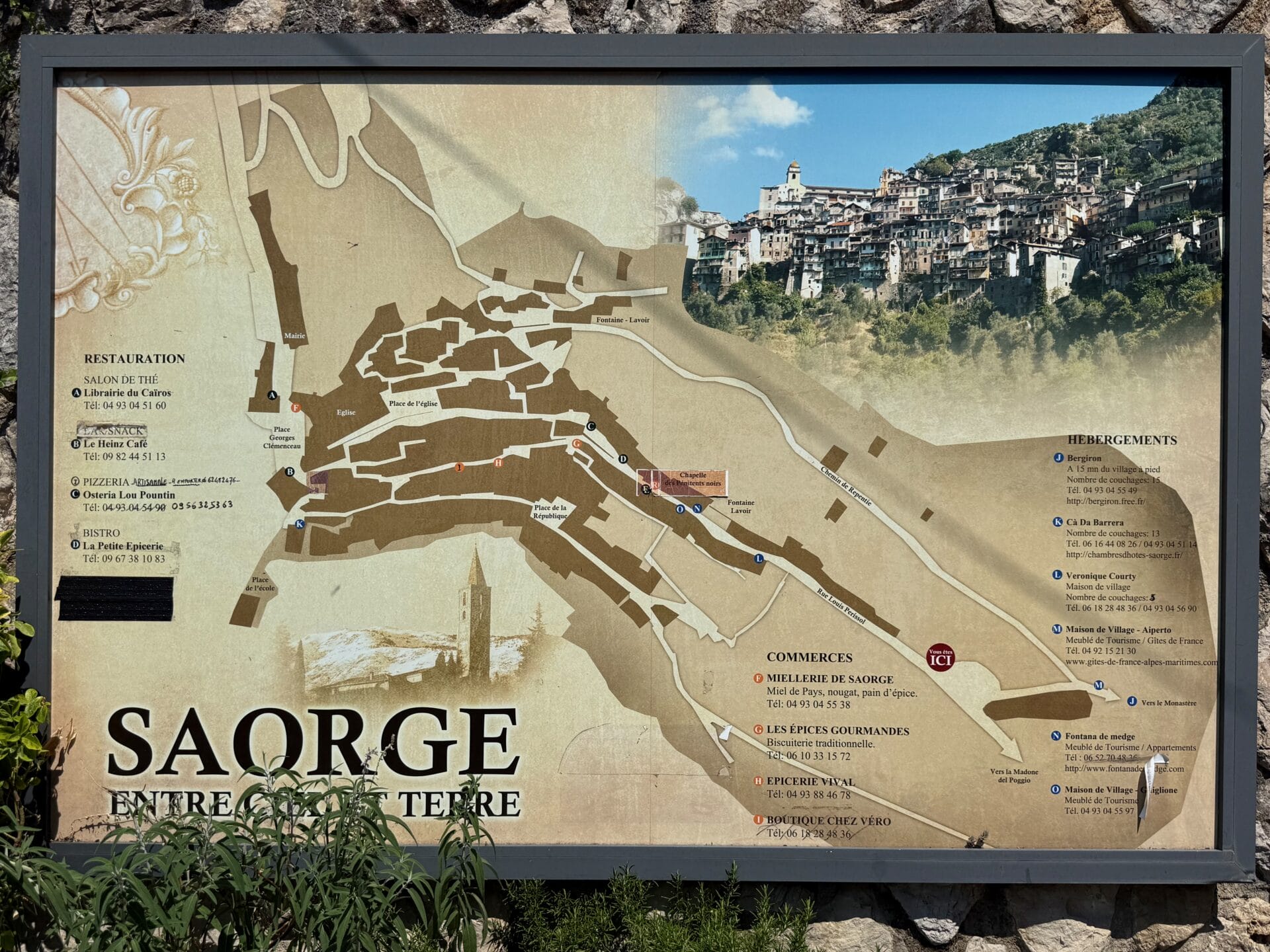
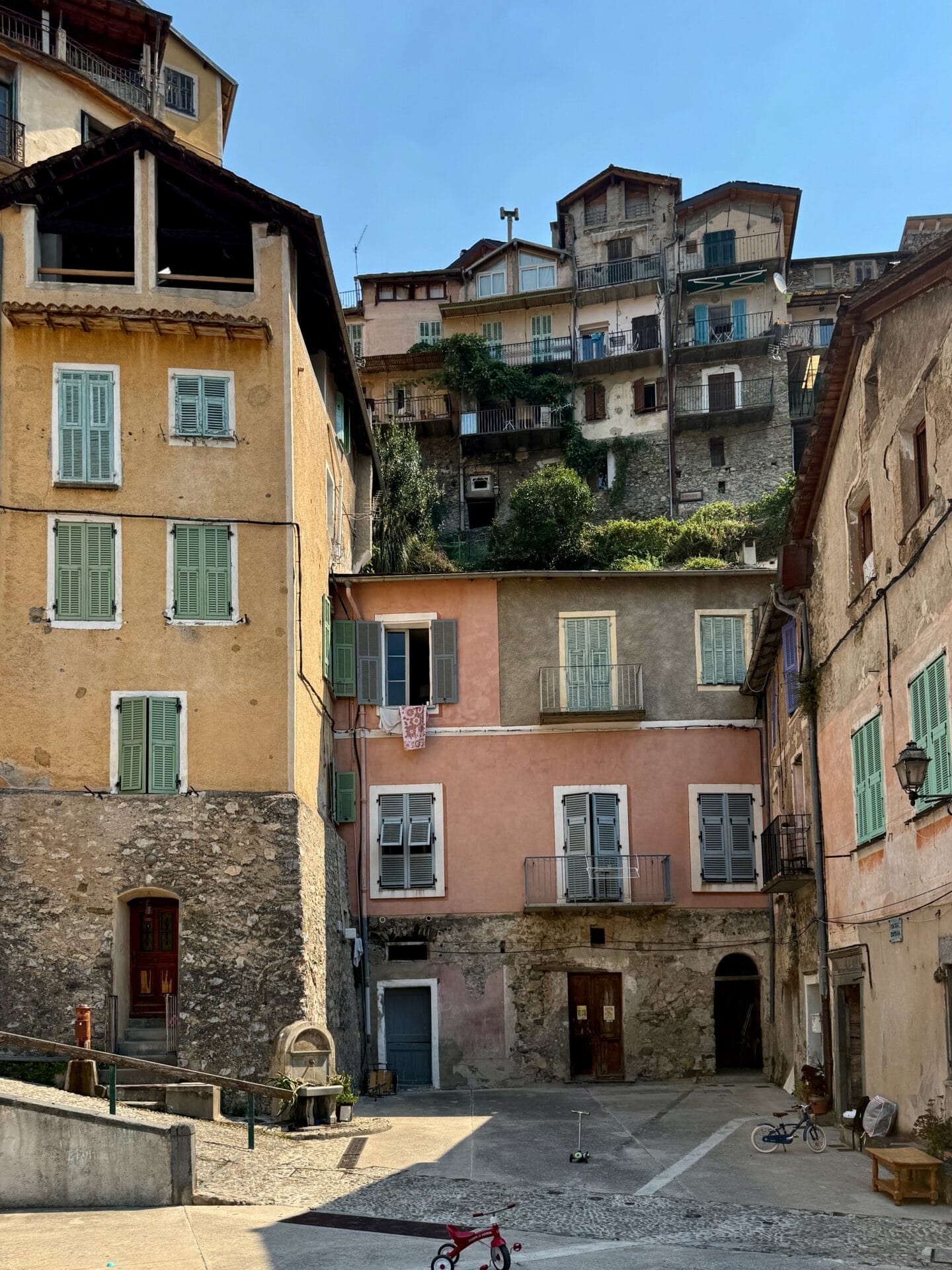
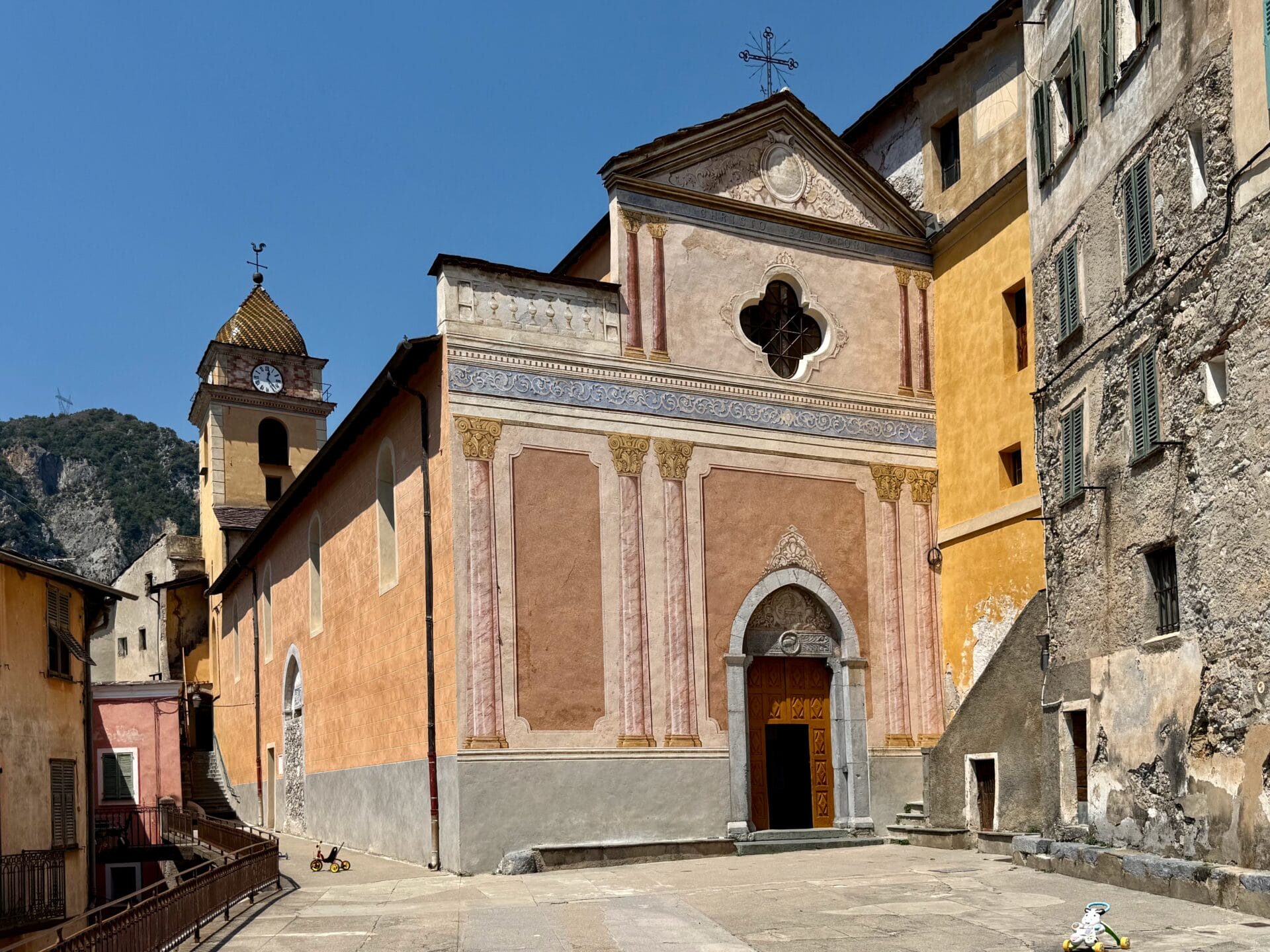
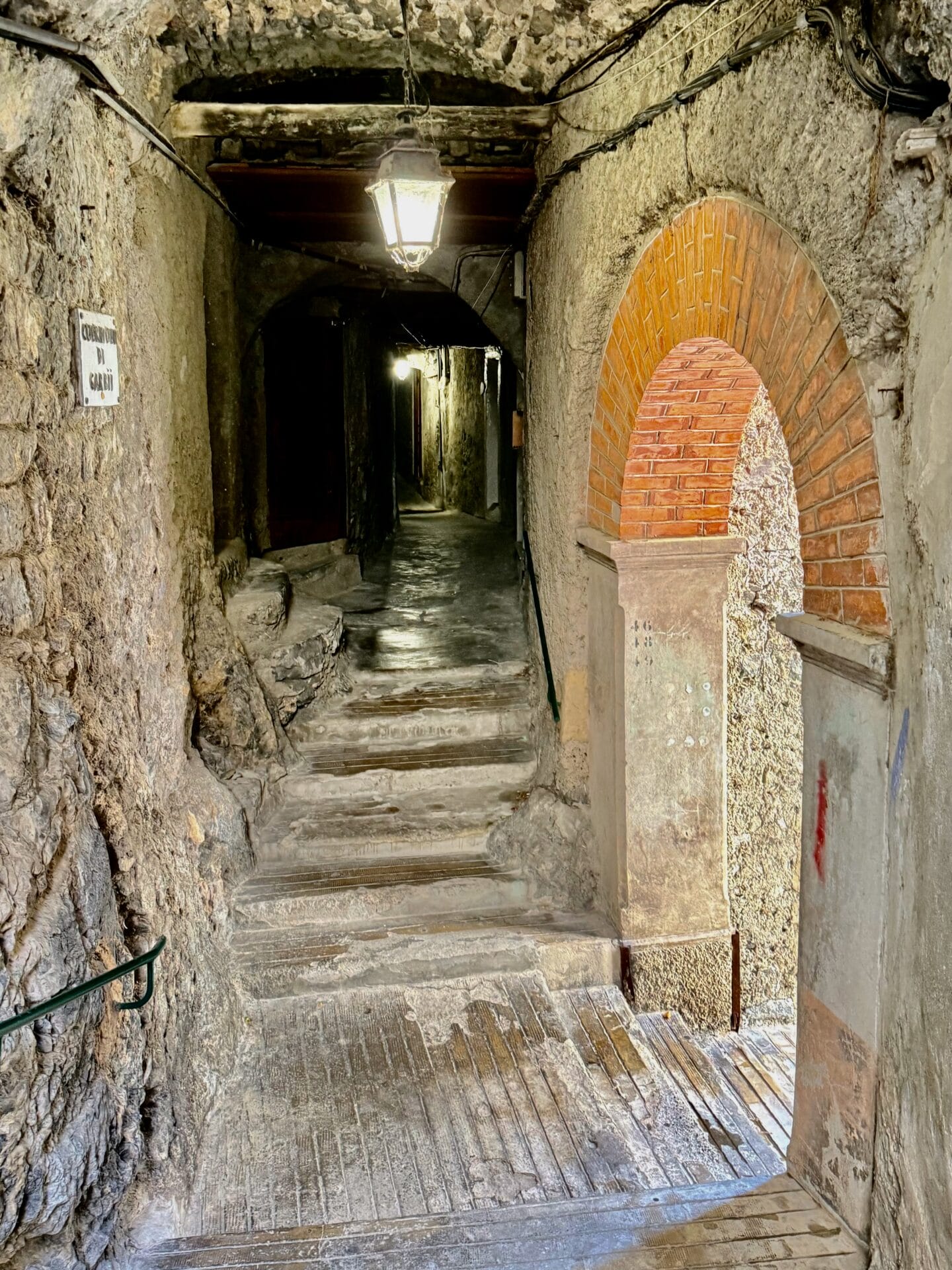
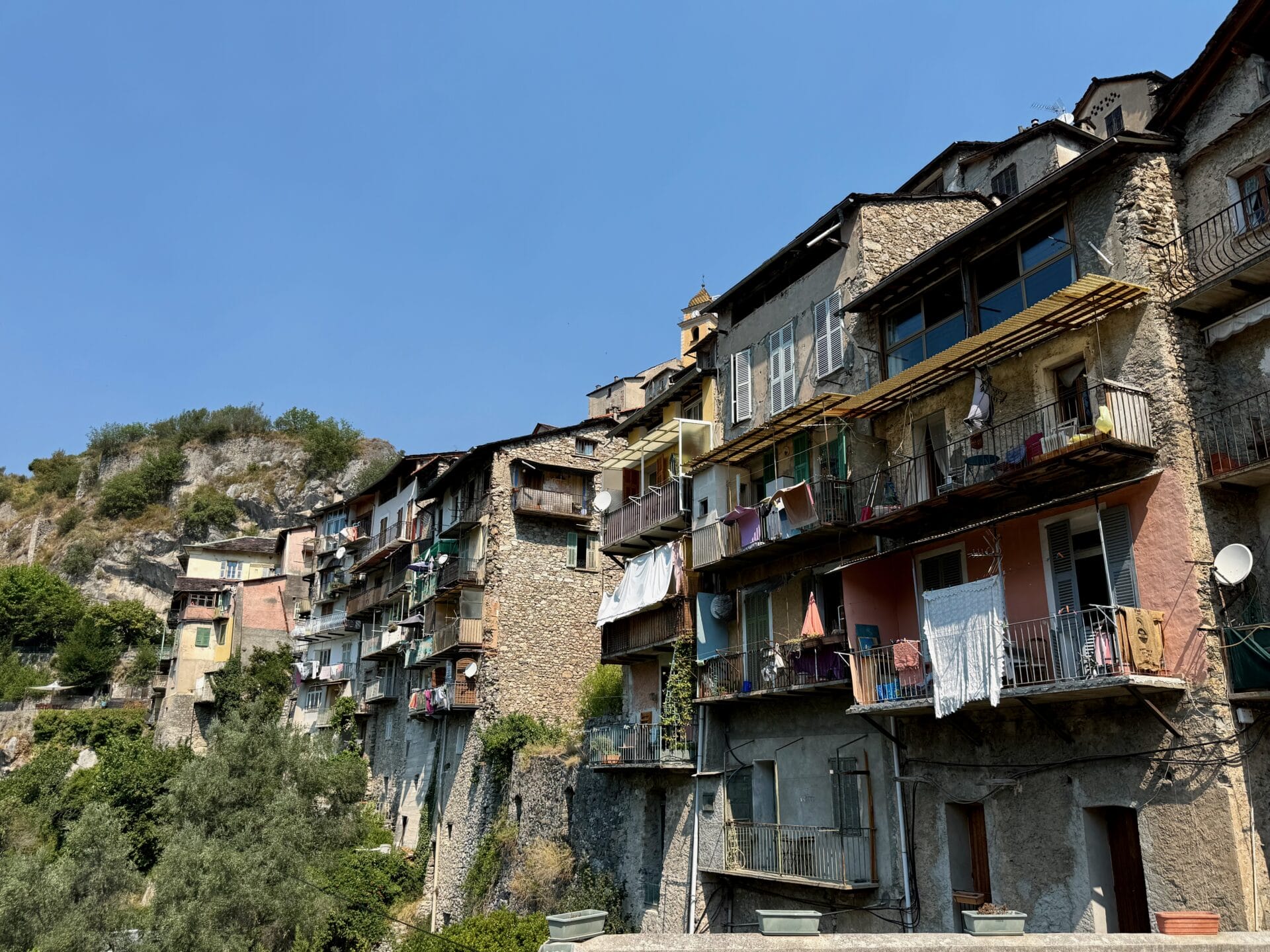
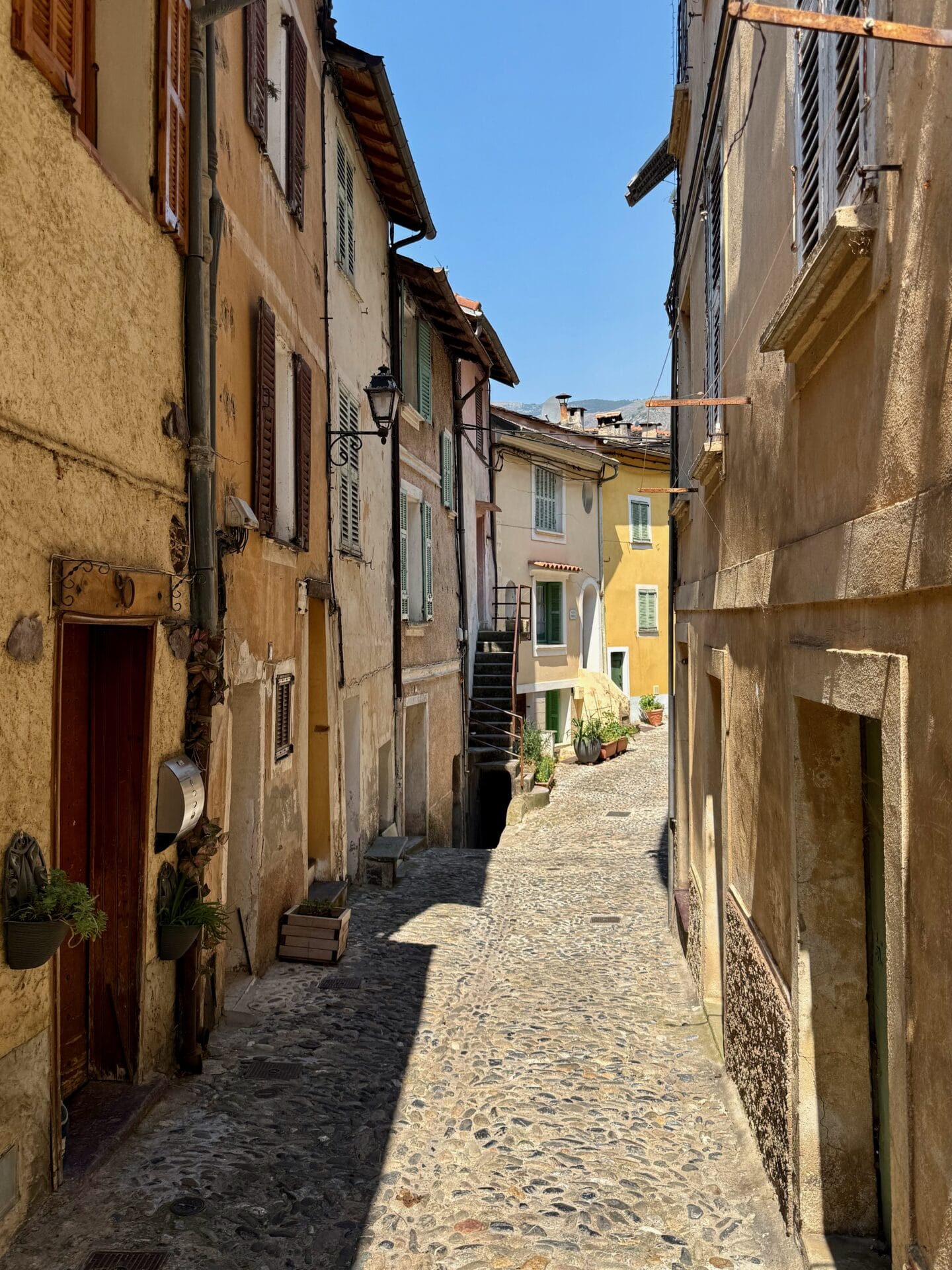
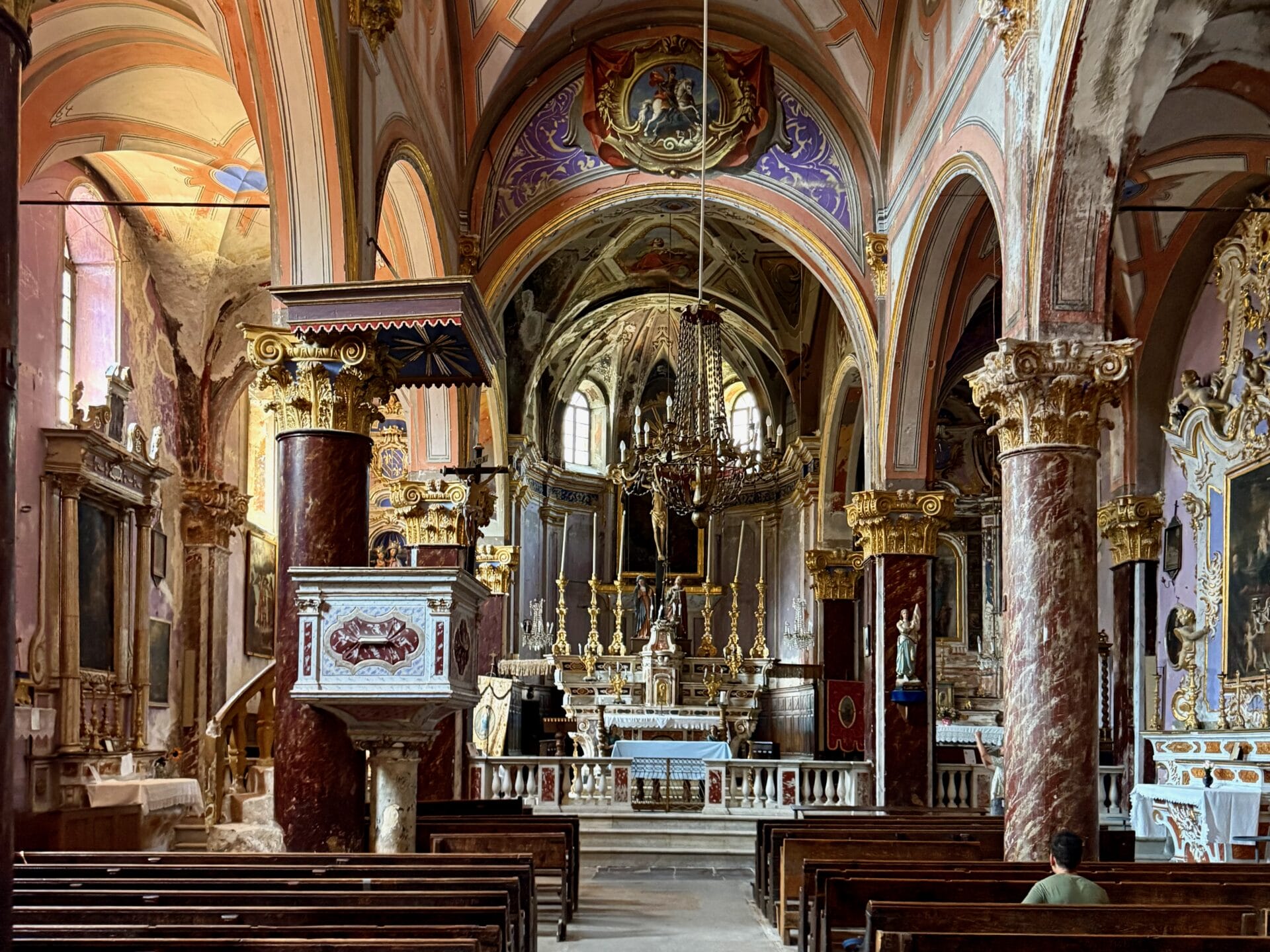
Saorge also has a magnificent monastery, perched above the village. It offers superb views of the gorges below. Now transformed into a cultural center, it has retained such a peaceful atmosphere that you almost expect to see Franciscan monks emerging from their garden to dine in the refectory, which remains intact.
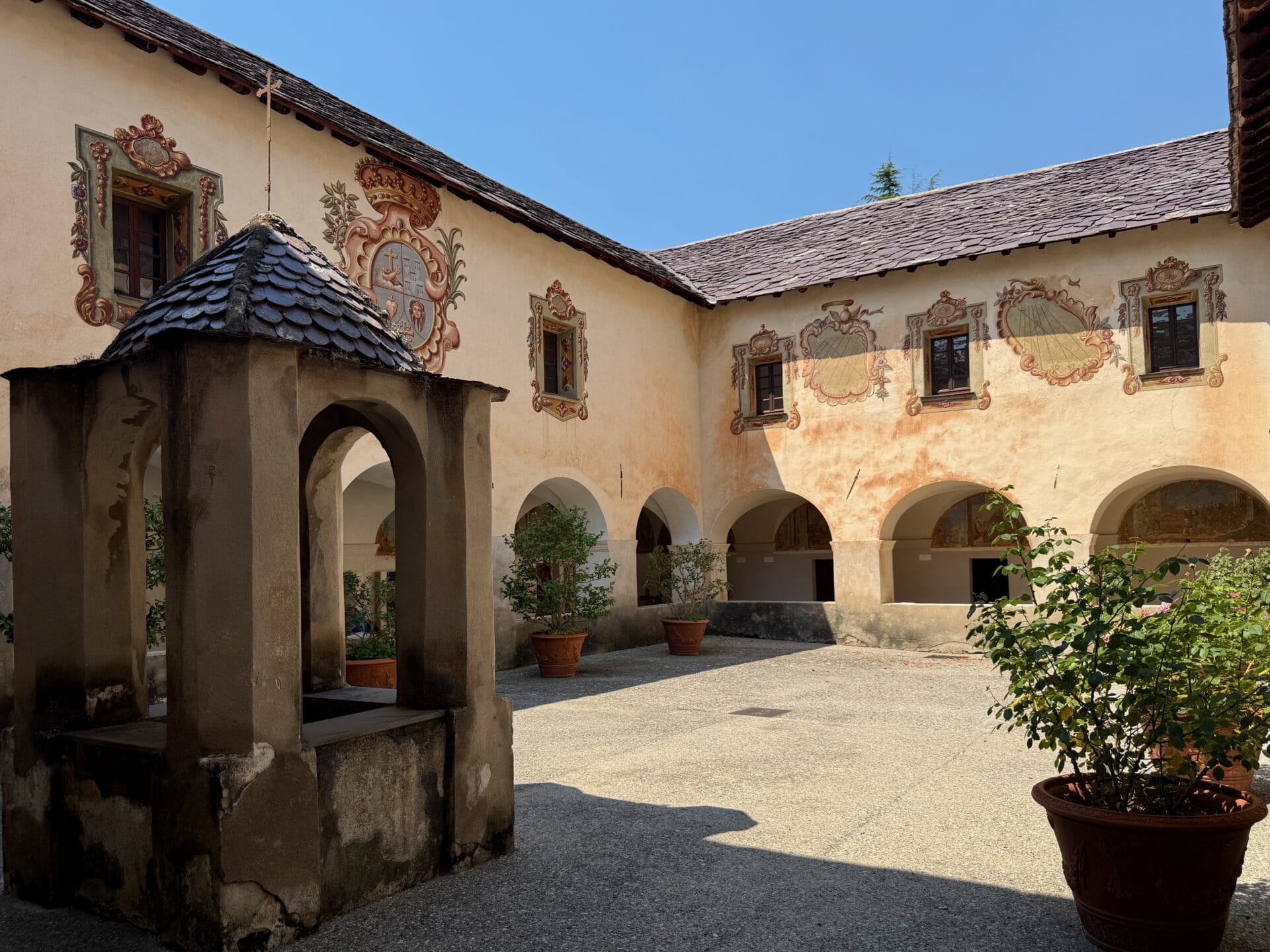
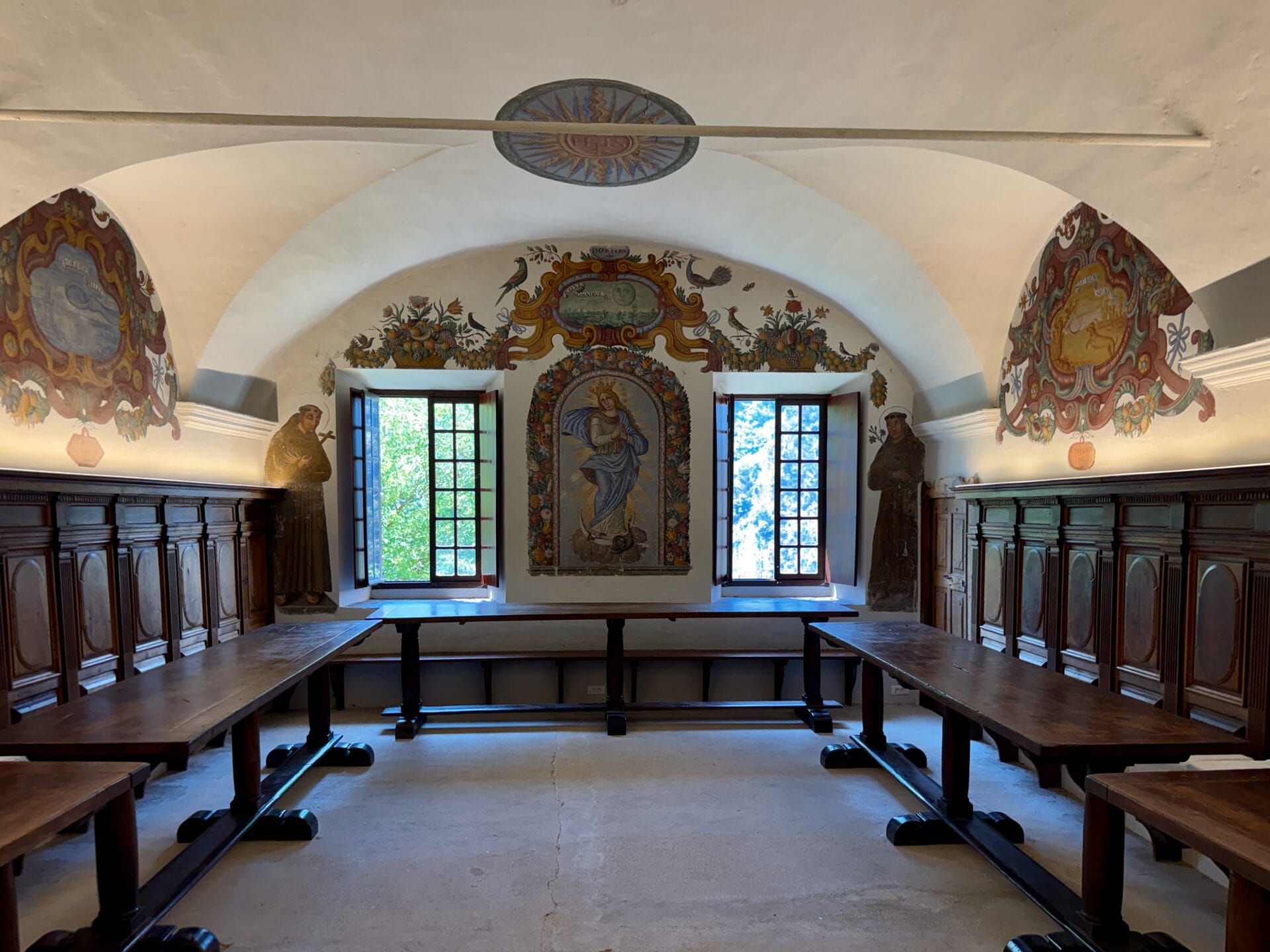
Saorge fully deserves its nickname as the "Tibetan village of the Alps." I'll certainly return, especially since the Train des Merveilles station is less than two kilometers away.
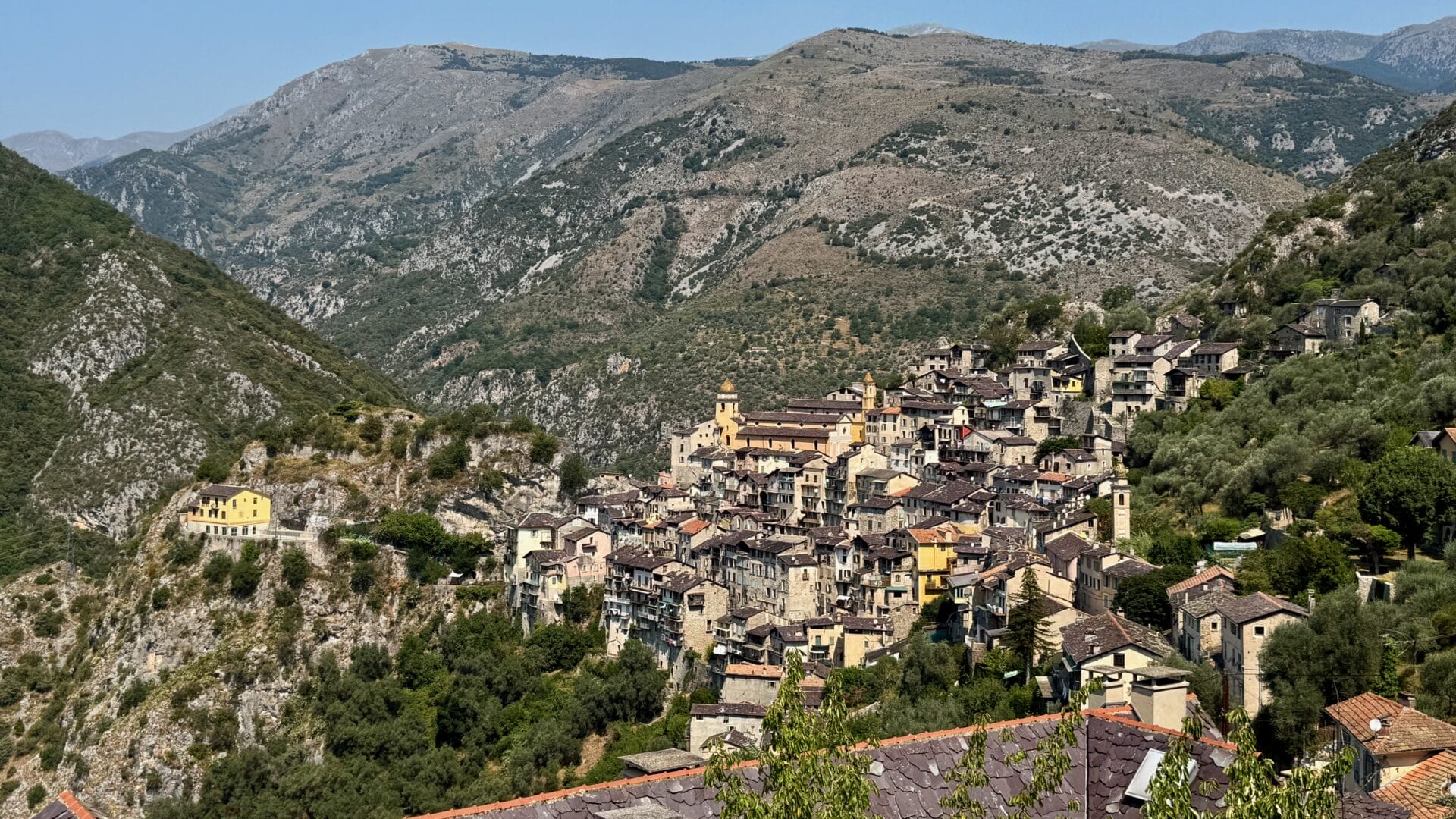
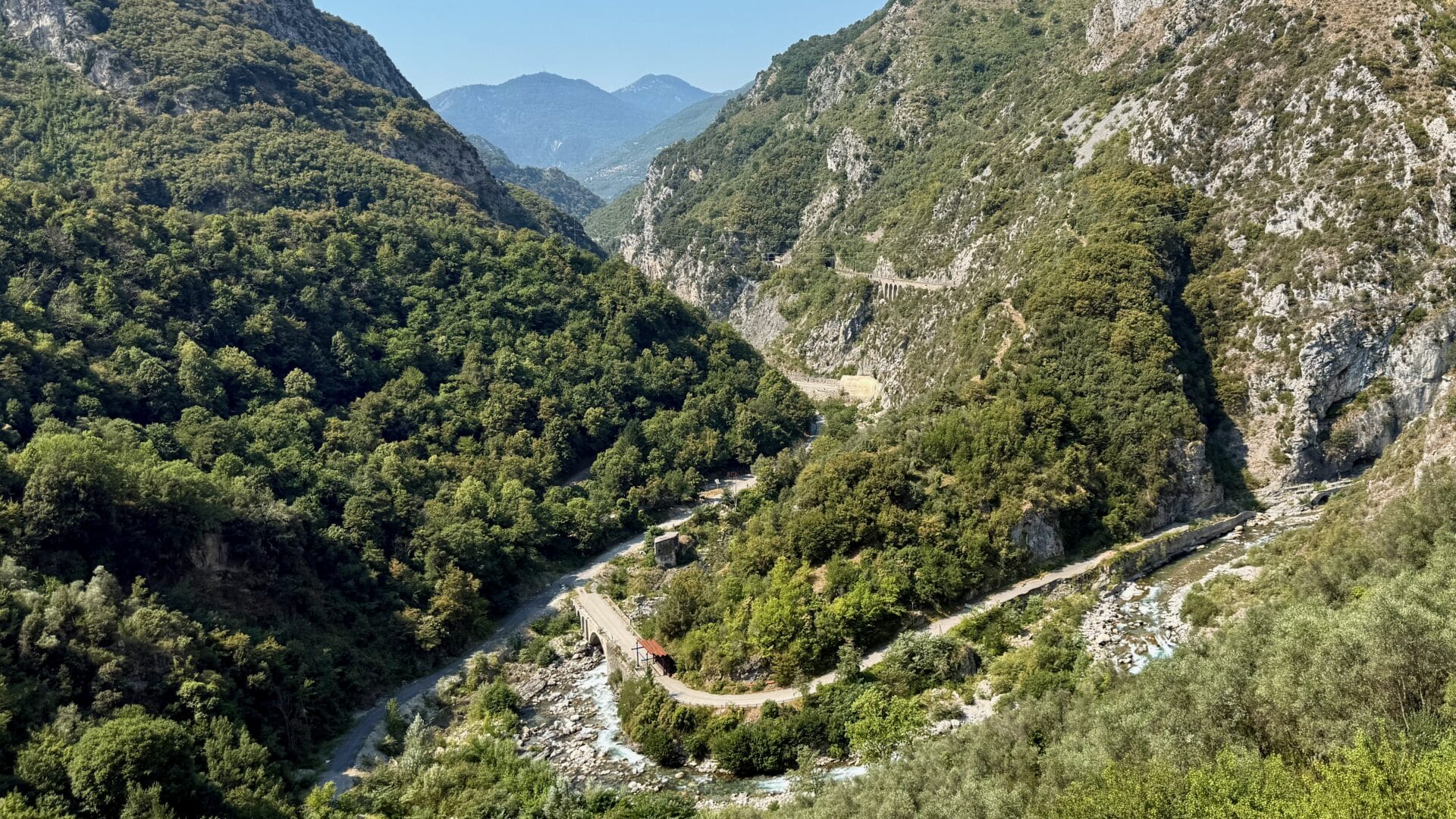
After these discoveries of La Brigue and Saorge on the same day, I returned to Tende by road. That's where I really appreciated having an electric mountain bike to tackle the 400 meters of elevation gain between Fontan and Tende! At the bottom of the valley, I see the Roya, a tumultuous mountain river that taunts me, because I'm sweating profusely. Indeed, I would have gladly stopped to plunge into its water, which from a distance seems cool!
The Roya Valley: Another Vision of the French Riviera Where You Take Your Time
My discovery of the Roya Valley was only a taste. I would have gladly stayed several more days.
First to discover other villages, like Breil-sur-Roya or Sospel, located further downstream, which perfectly illustrate the transition between Alpine and Mediterranean landscapes.
Then, to go hiking in the surrounding mountains, particularly in the superb Mercantour National Park, whose trails seem to offer countless discovery opportunities.
The Roya Valley is the exact opposite of the image many have of the French Riviera. Here, no seaside resorts or summer crowds, but preserved mountains, authentic villages, and a pace of life that invites you to slow down. That's probably what makes it so charming. Yet we're only two hours by train from Nice!
The silence of the villages struck me, only disturbed by the distant passage of the Train des Merveilles and the sound of church bells. The atmosphere is relaxing.
The French SNCF Train des Merveilles: From Tende to Nice Through the Southern Alps
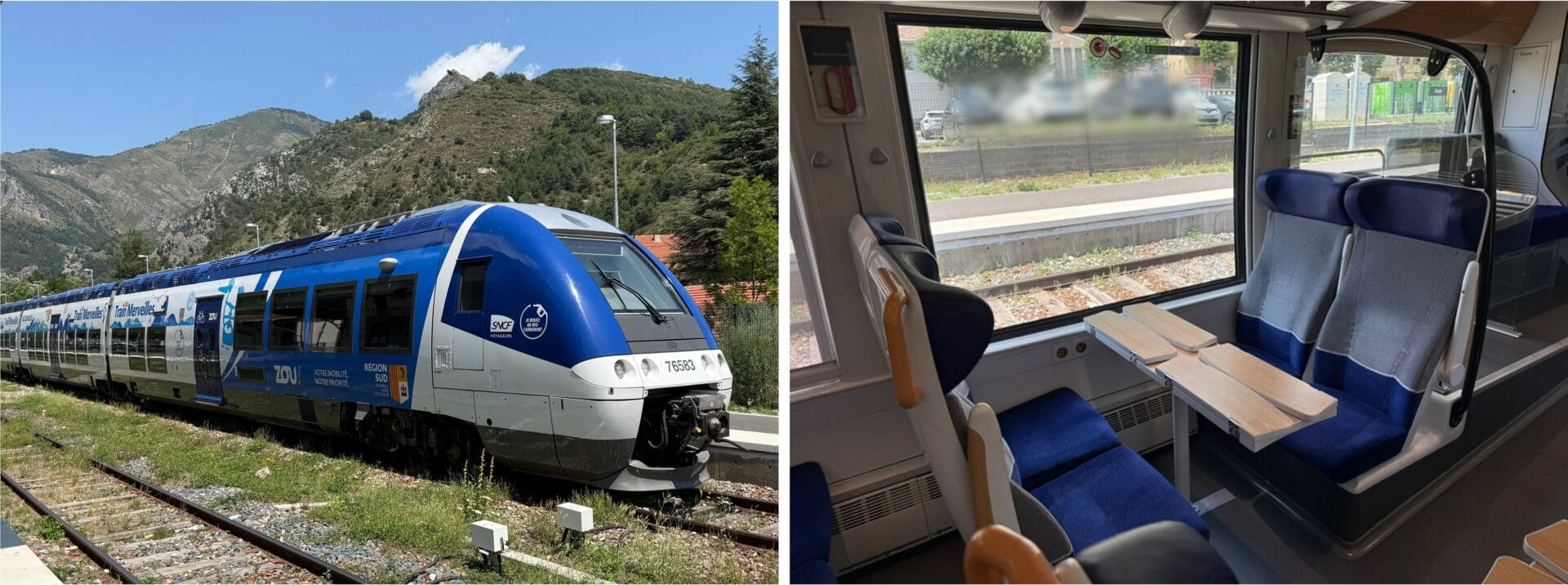
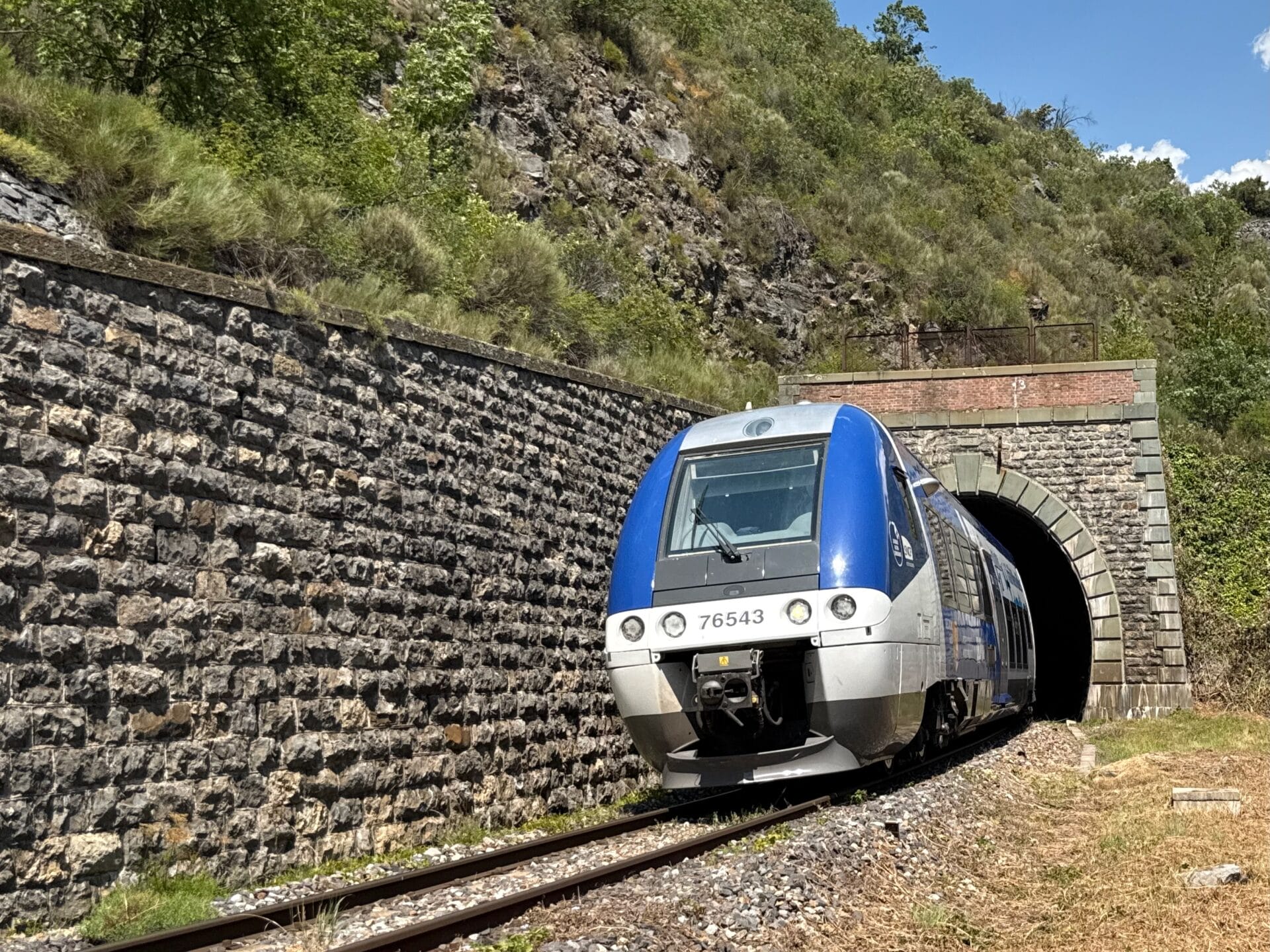
Final stage of my journey: I head to Tende station to take the regional train operated by SNCF to Nice.
The train is brand new and relatively uncrowded. Unlike the Italian train that connects, with a short connection, the metropolises of Turin and Ventimiglia, the French train is limited to a role of opening up the Roya villages. A few tourists also use it to admire the spectacular landscapes of the Alpes-Maritimes.
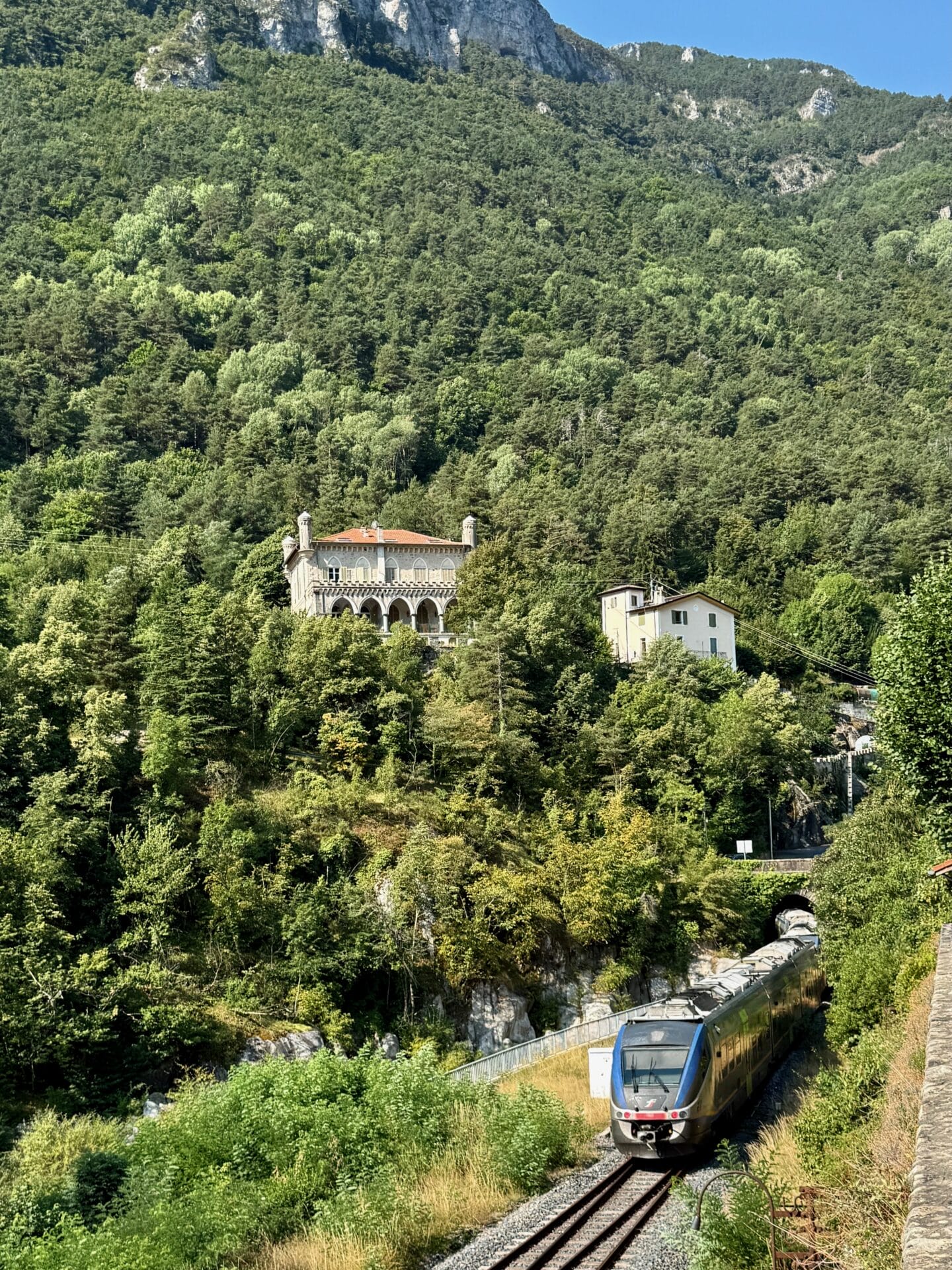
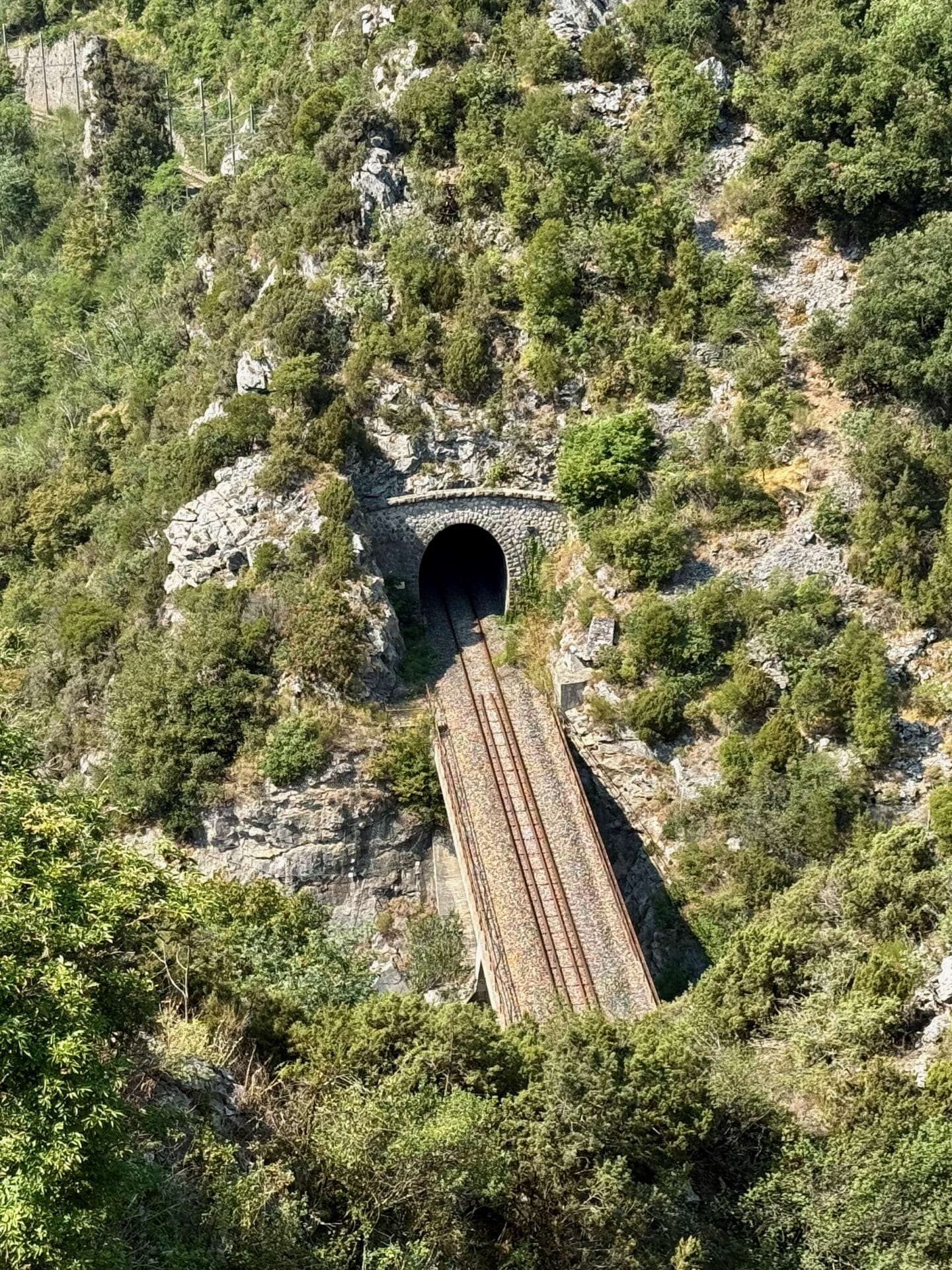
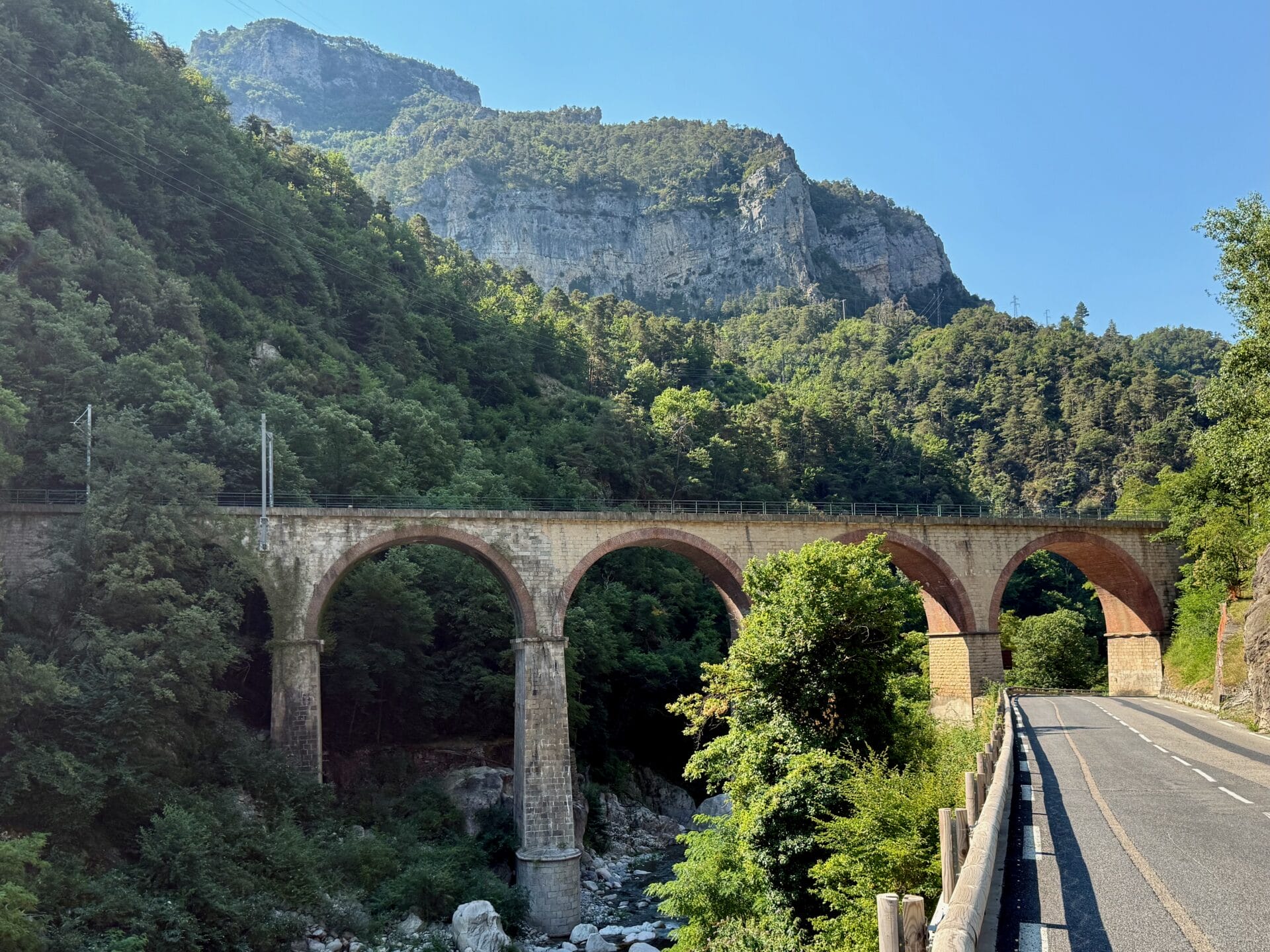
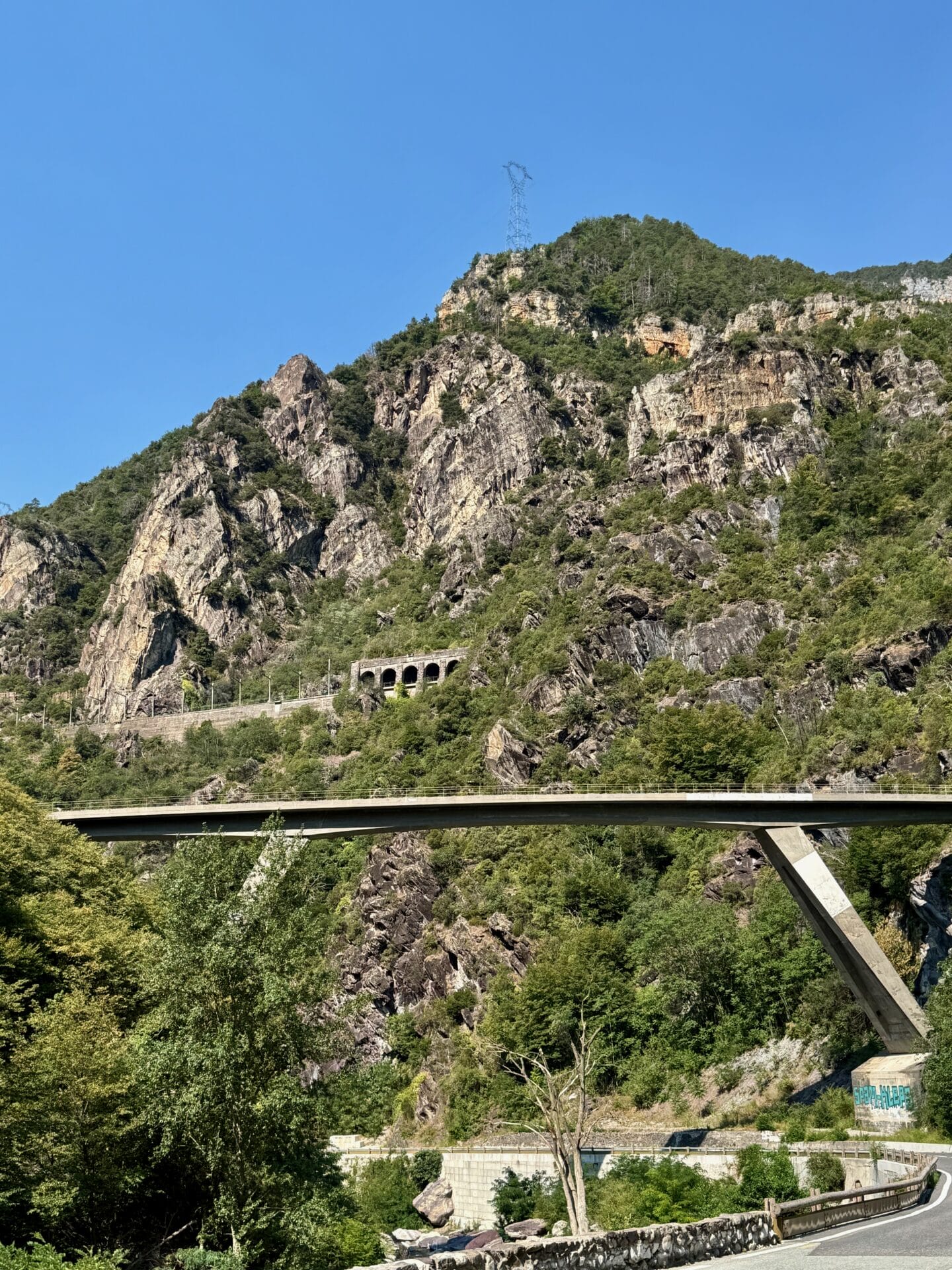
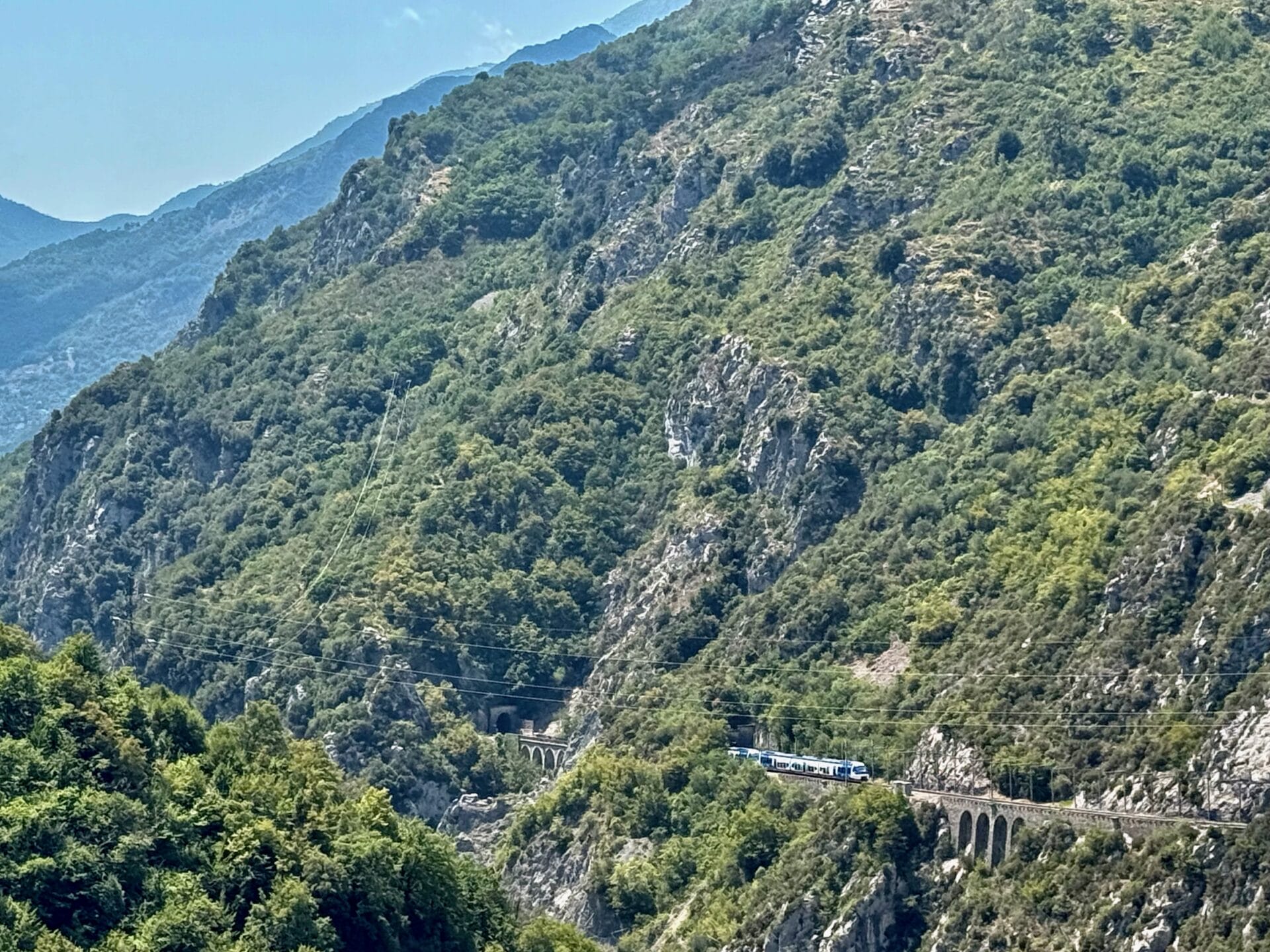
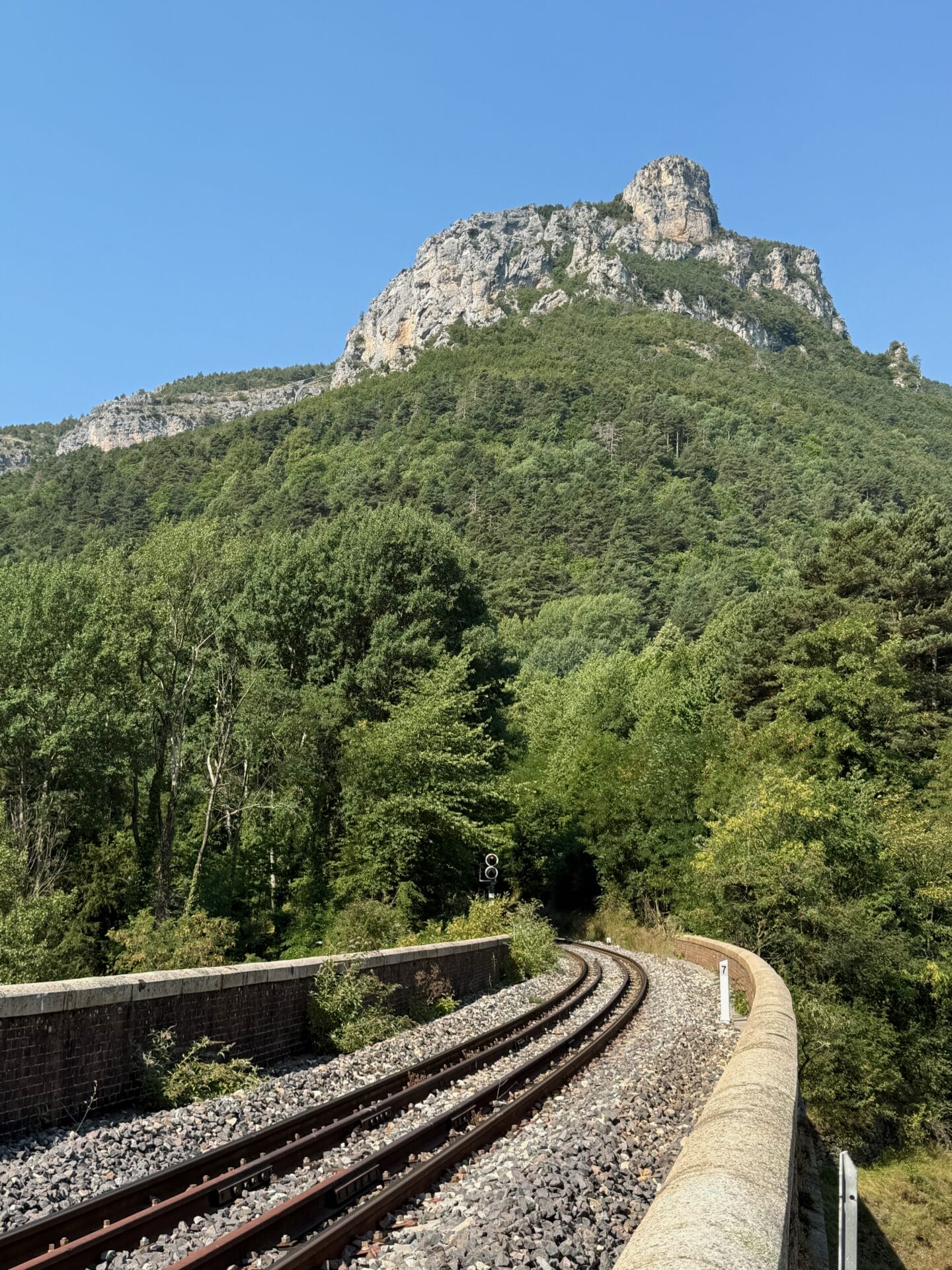
The tunnels are particularly numerous and have a surprising characteristic: several are helical.
Between Tende and Breil-sur-Roya, the train loses more than 500 meters of altitude in less than twenty kilometers. However, a train can only handle a relatively gentle slope. Engineers therefore devised an ingenious system: they made the track trace wide spirals inside the mountains to artificially lengthen the route.
Between Saint-Dalmas-de-Tende and Fontan-Saorge, keep your eyes open: you'll see, far below, a railway track on the other side of the valley. It's not another line, but the very one your train will use a few minutes later when exiting a helical tunnel. The effect is surprising because you don't feel the train turning in the tunnel.
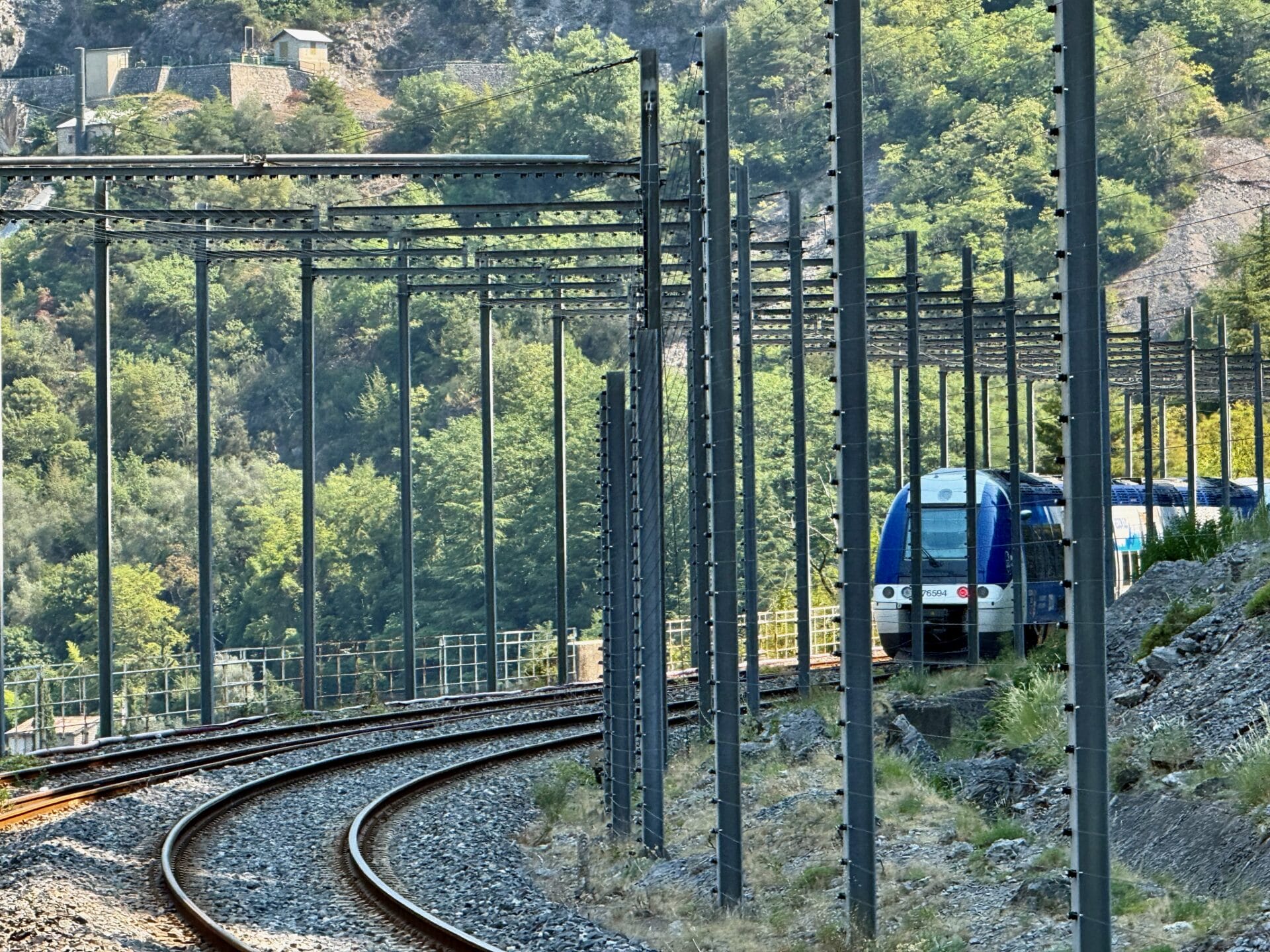
I also notice the numerous nets installed above the track. They serve to detect rockfalls. If a rock breaks an electric cable, rail traffic stops immediately to prevent an accident.
Breil-sur-Roya and Sospel on the Train des Merveilles Line
I would have needed one more day to discover the villages of Breil-sur-Roya and Sospel. So what I can tell you about them is only what I saw from the train.
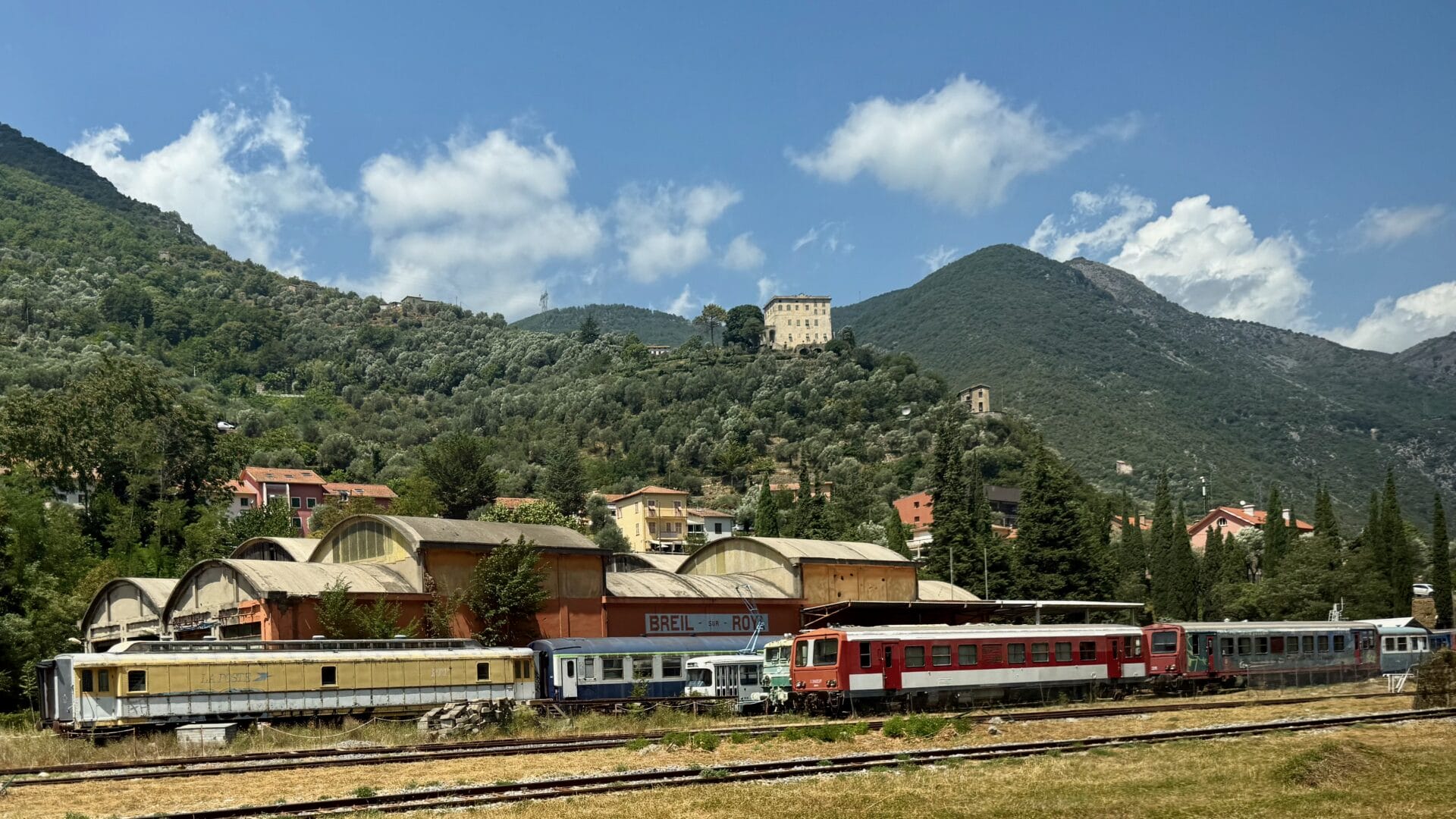
In Breil-sur-Roya, I noticed several old locomotives and trams. This is the Train des Merveilles Ecomuseum, which displays historic railway equipment and traces the line's extraordinary history. Unfortunately, the museum was closed during my visit.
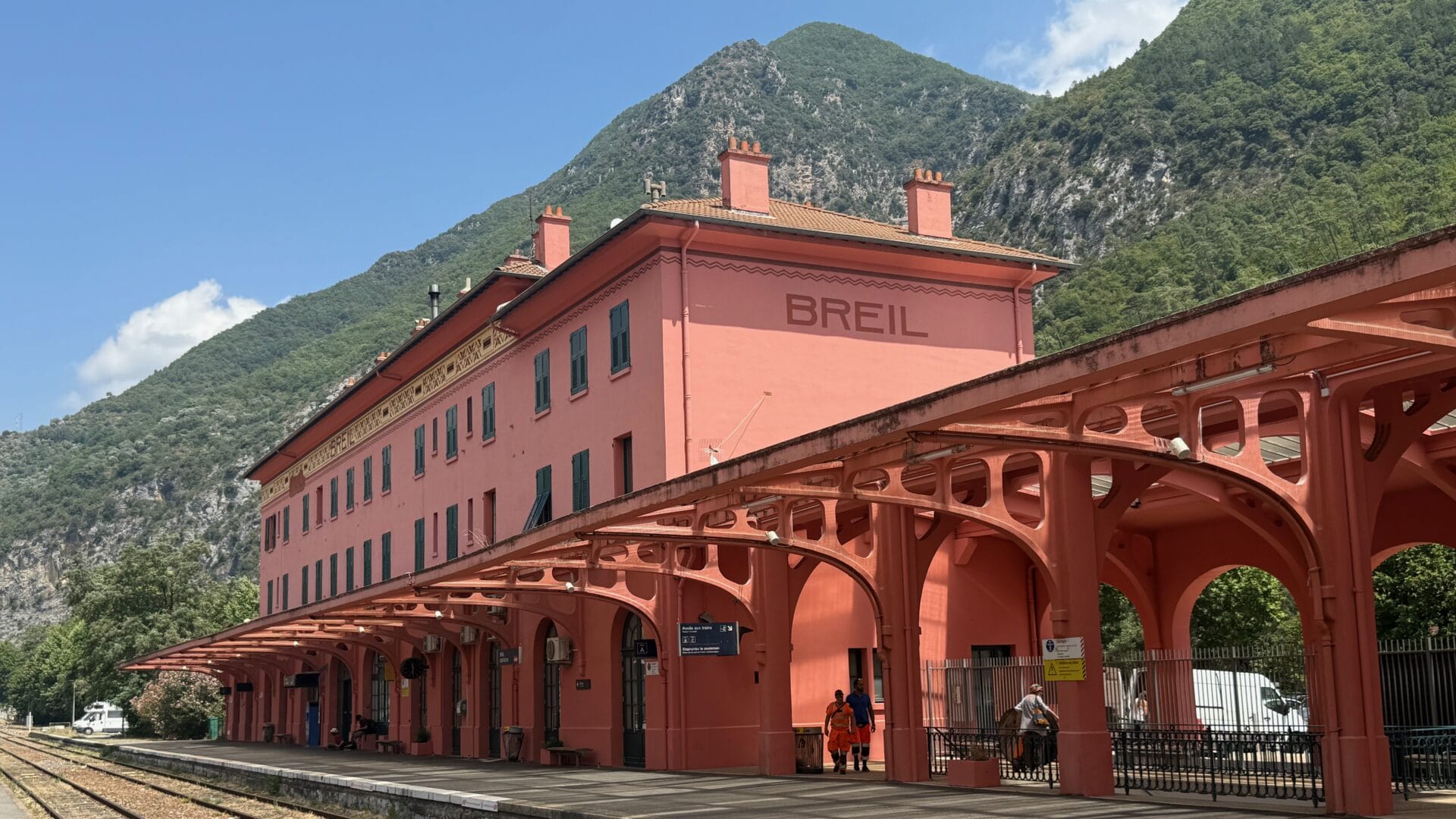
Breil-sur-Roya station doesn't go unnoticed with its bright pink!
From Sospel, we'll only see the Golf Palace from afar. It was created in the early 19th century for wealthy aristocrats who came to the French Riviera to relax in winter and play golf. Opened in 1914, it never really served as such. Today, private apartments occupy it.
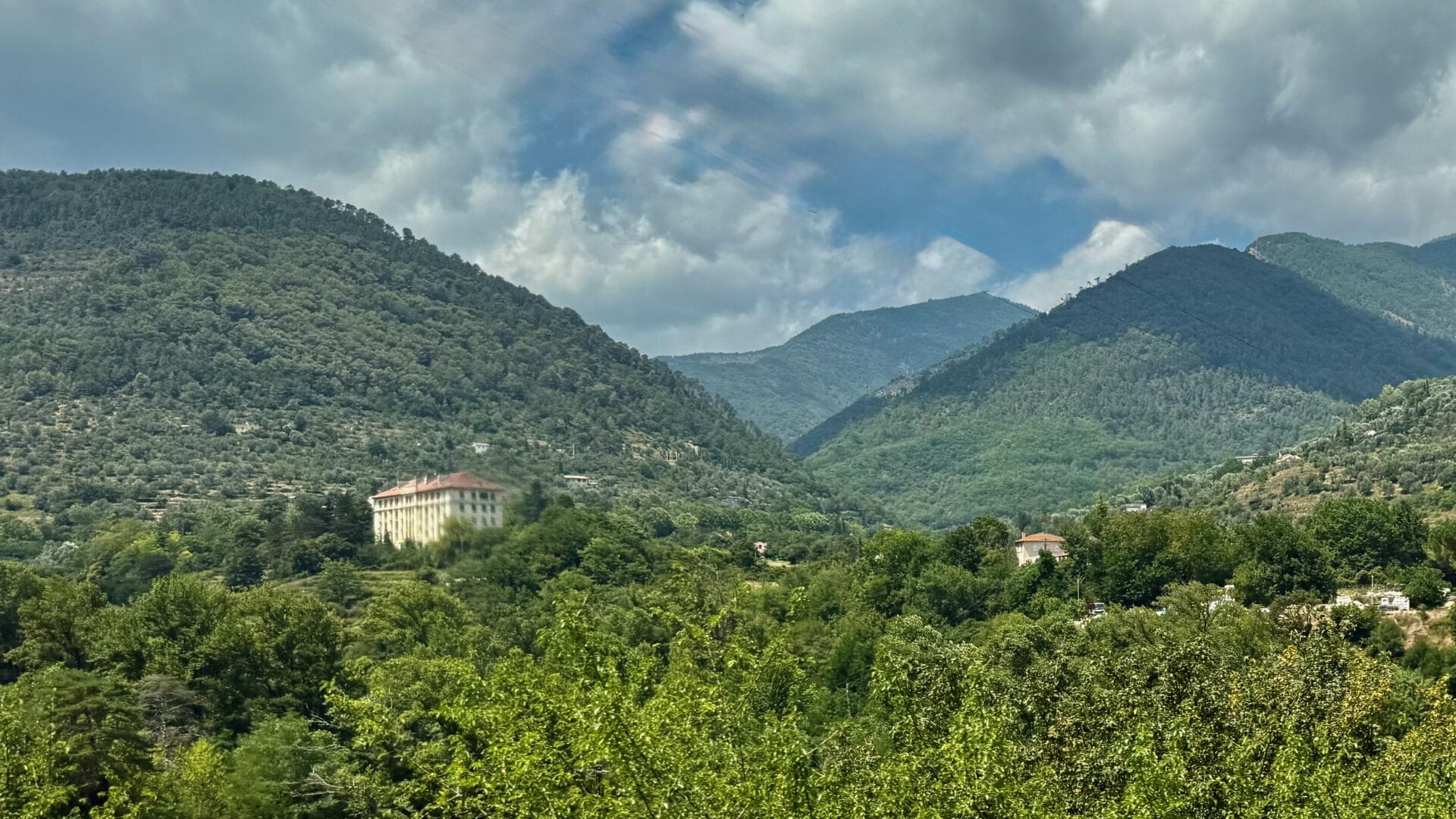
As we advance, the terrain becomes gentler, the vegetation more Mediterranean, and the buildings more numerous.
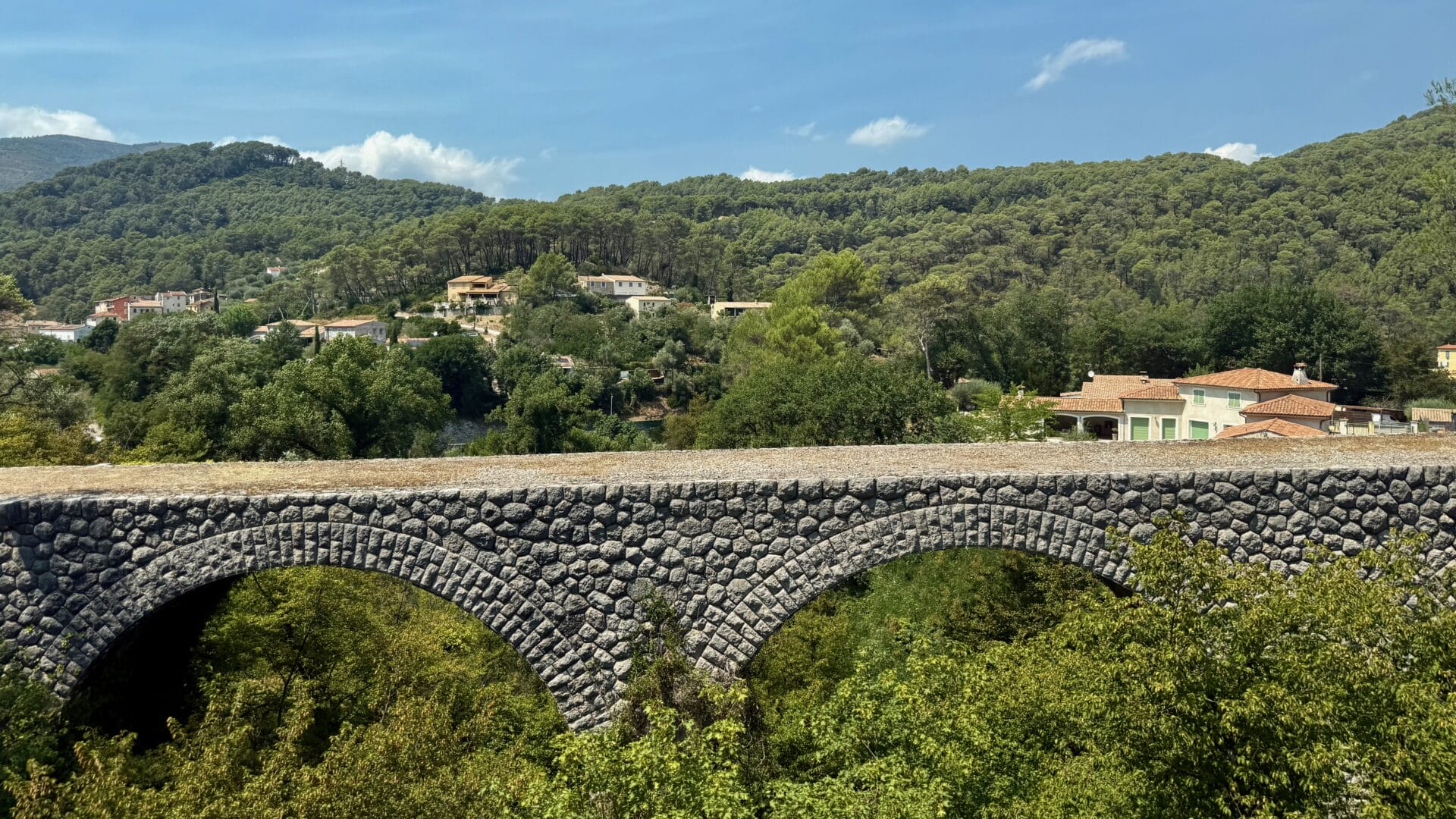
Terminus: Nice, the Most Italian of French Cities
Everyone off! Here's Nice at last, the goal of my journey.
From Cuneo, barely 120 kilometers away, I will have crossed 81 tunnels, crossed 407 bridges and viaducts, and made 21 stops at intermediate stations. Having left Cuneo, located at an altitude of 550 meters, I will have climbed to the Col de Tende tunnel, at 1,040 meters, before gradually descending to Mediterranean sea level.
Nice-Ville station has been beautifully renovated while preserving its original architecture. Its large glass roof and elegant Second Empire-style architecture recall the era when Nice became the preferred winter destination for European aristocracy.
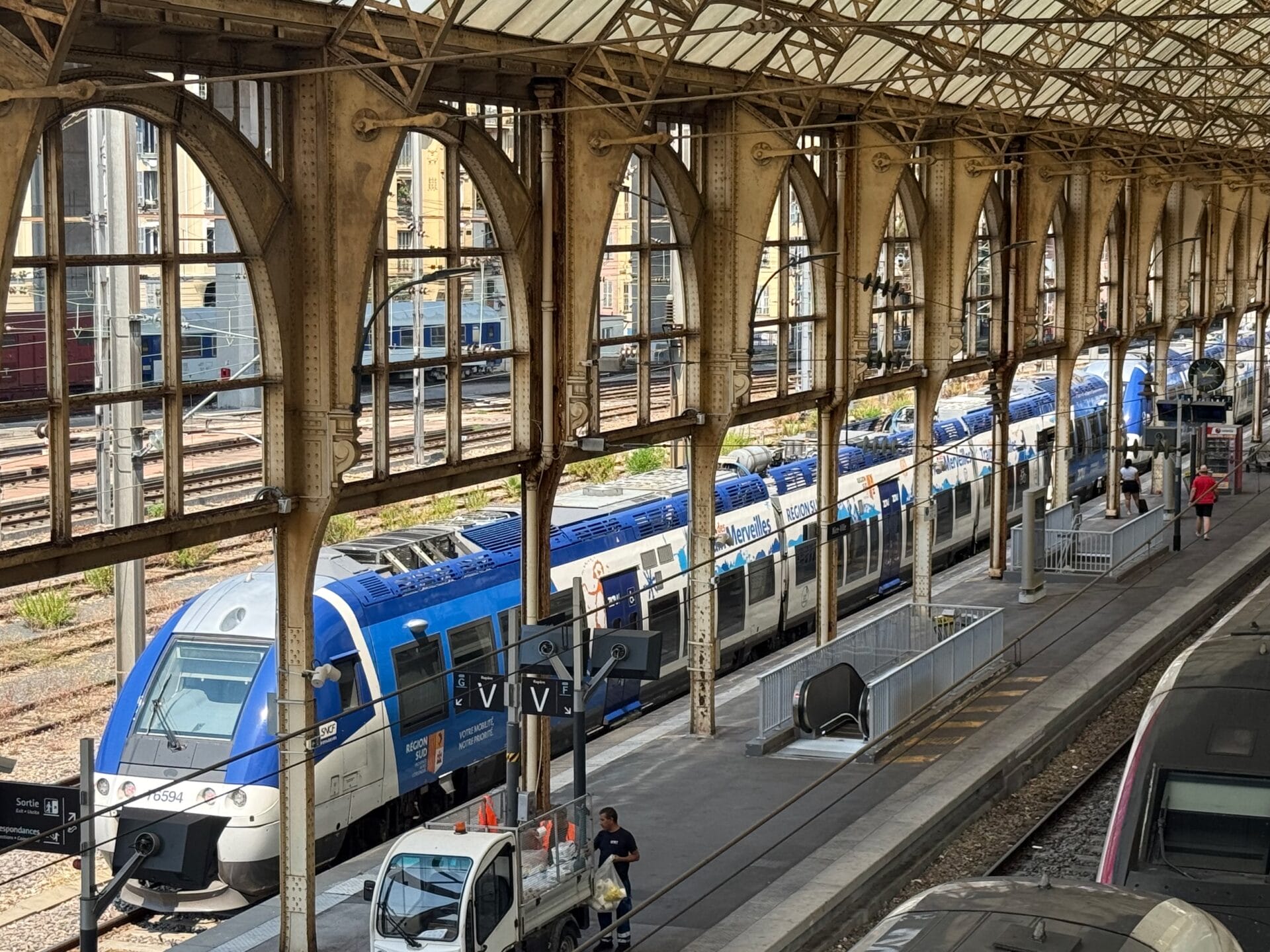
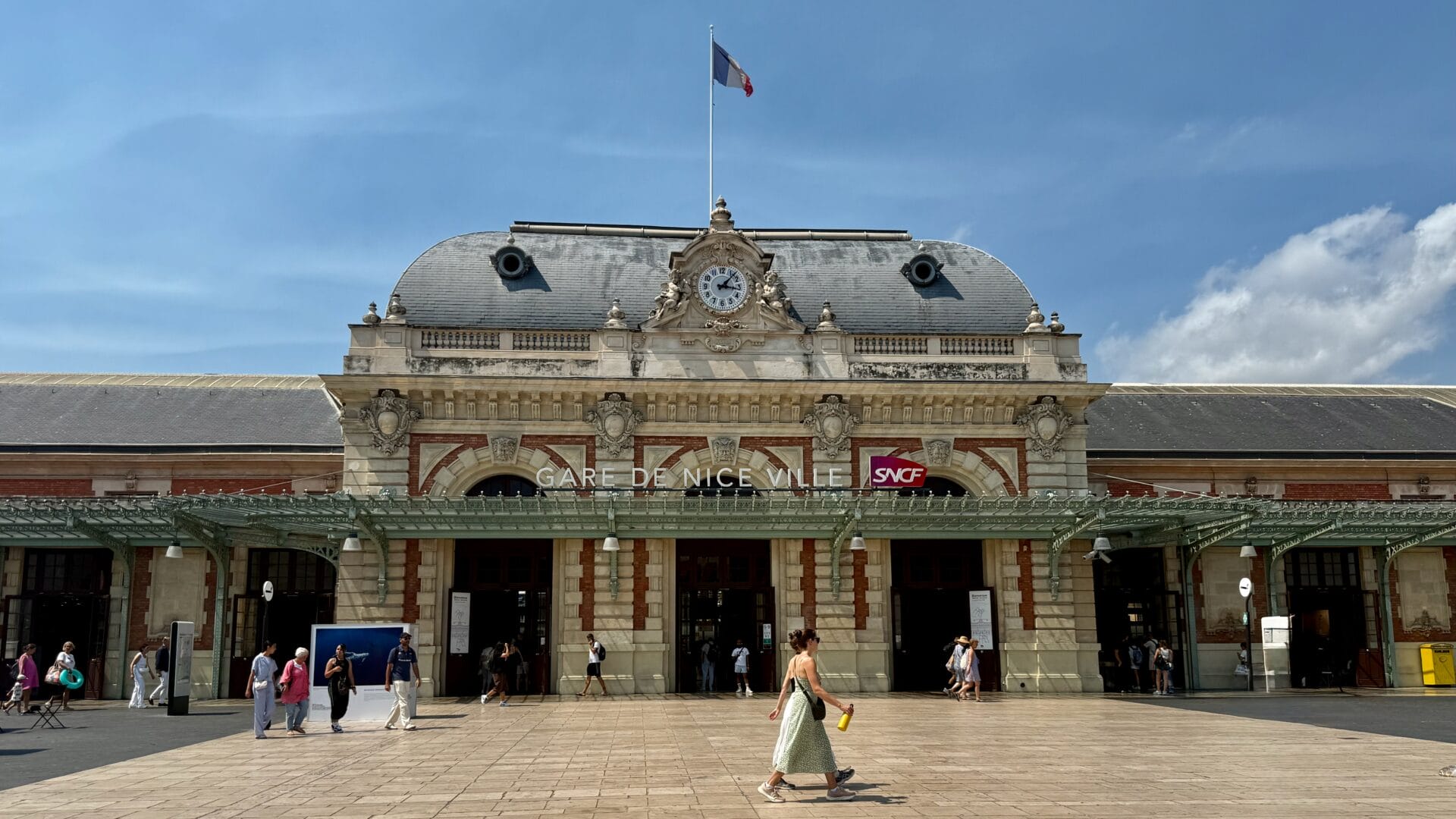
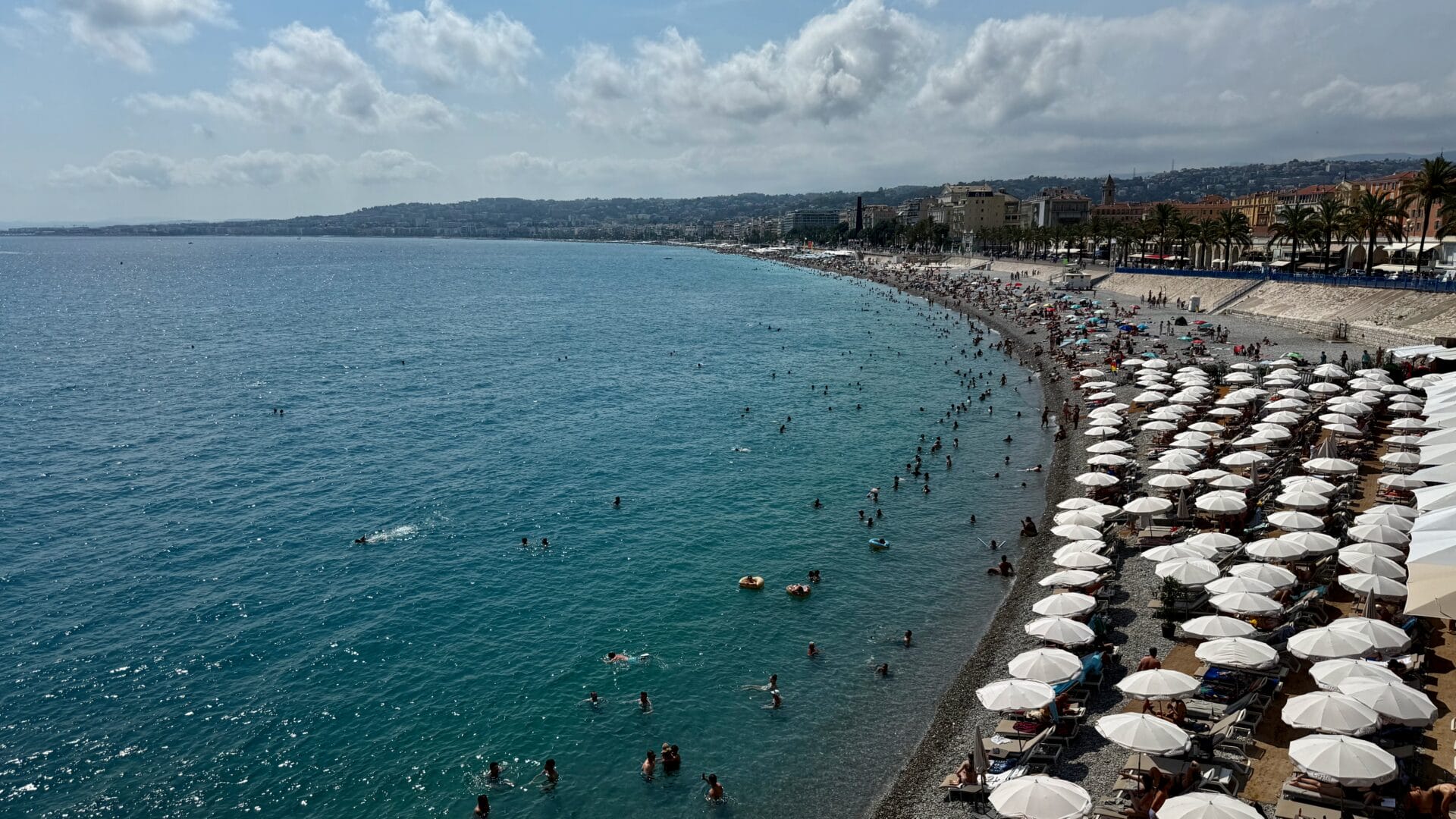
Leaving the station, I naturally head to the Promenade des Anglais to admire the Baie des Anges, whose beauty alone explains why Nice remains one of the most iconic cities on the Mediterranean.
My story ends here. The beautiful city of Nice, which I love very much, will certainly be the subject of another article one day.
Paris — Nice via Turin by Train: Why Choose This Route?
From a purely practical standpoint, going from Paris to Nice via Turin is obviously not the most efficient route. But the purpose of this journey wasn't to arrive as quickly as possible. It was to enjoy the journey as much as the destination. From that perspective, I'm delighted with my choice.
Nice and Turin long belonged to the Duchy of Savoy. Discovering them during the same journey allows for a better understanding of their common origins. And, on a more personal level, they're both among my favorite cities: one in France, the other in Italy.
This journey also let me cross the Alps by train through spectacular landscapes on two of Europe's most beautiful railway lines.
The villages of the Roya Valley were a magnificent discovery. Far from the bustle of the French Riviera, they've managed to preserve an authenticity that's becoming increasingly rare.
Finally, this journey taught me a great deal about history, both through my visit to the Palazzo Reale in Turin and through discovering the extraordinary history of the Train des Merveilles line.
With this journey, I wanted to show you that travel begins not when you arrive at your destination, but the moment you close your front door. It's a conviction and I'm happy to have verified it once again.
I discovered a route that's ultimately not so complicated to organize, but oh so rich in emotions and new discoveries.
Practical Tips for Your Journey from Paris to Nice via Turin by Train
Important: these tips will be useful whether you’re doing the full journey from Paris to Nice via Turin or you choose to travel only part of the route: Paris → Turin, Turin → Nice, or Tende → Nice. They’re also valid if you’re making the trip in the opposite direction!
Journey times
Paris → Turin Porta Susa
- SNCF: around 5 hr 40 min, with 2 to 3 trains per day.
- Trenitalia: around 5 hr 50 min, with 2 trains per day. The journey is slightly longer because the train goes via Lyon.
Turin Porta Nuova → Tende
- Trenitalia: around 2 hr 30 min to 3 hr, with a connection in Cuneo and 3 trains per day.
- The train then continues to Breil-sur-Roya and Ventimiglia.
Tende → Nice
- SNCF: around 2 hr on a direct train, with 2 trains per day.
- It’s also possible to combine a Trenitalia train from Tende to Breil-sur-Roya with an SNCF train from Breil-sur-Roya to Nice, which adds 3 more travel options per day.
- Be aware, though: you’ll need to buy two separate tickets and the connection is not guaranteed.
Where to book your train journey
To make this trip, you’ll inevitably have to juggle between SNCF and Trenitalia—two companies that used to be partners and are now fierce competitors.
From Paris to Turin, you can choose between SNCF and Trenitalia. Prices vary with demand, from very cheap to extortionate. It’s up to you to compare prices carefully on both companies’ websites.
From Turin to Nice, fares are very affordable, as they’re subsidized by the Piedmont and Provence-Alpes-Côte d’Azur regions.
From Turin to Tende, with a connection in Cuneo, you must take Trenitalia.
From Tende to Breil-sur-Roya, you can once again choose between SNCF and Trenitalia.
Beyond Breil-sur-Roya, the line splits in two: SNCF continues to Nice, while Trenitalia continues to Ventimiglia.
To check fares and timetables, go directly to the websites of the two rail companies for the routes each one operates.
To buy tickets, the easiest option is to download the SNCF and Trenitalia apps on your smartphone.
Between Paris and Turin, how do you choose between SNCF and Trenitalia?
Both companies offer a fairly similar level of comfort and service in First/Business and Second/Standard. With a few exceptions, the choice mainly depends on your situation:
- Do you have a discount or loyalty card? Choose the relevant company.
- Do you want to be able to cancel your ticket easily? SNCF offers more favorable cancellation conditions. Trenitalia applies a penalty of 20%, even on full-fare tickets.
- Are you looking for a premium service? Trenitalia is the only one to offer an Executive class, with a higher level of comfort and service.
- Do you want to go via Lyon? Trenitalia takes this route, unlike SNCF’s direct TGVs.
- Do you have a connection in France? Choose SNCF. Conversely, if your connection is in Italy, choose Trenitalia. In case of delays or connection issues, it is better to have the entire journey covered by the same company.
In summary: outside of Executive class, the comfort levels are very similar between the two companies. The best choice therefore depends mostly on your discount cards, ticket conditions, and connections.
How many days should you plan for?
I did this trip in 5 days:
- Day 1: Paris → Turin by TGV
- Day 2: exploring Turin
- Day 3: Turin → Cuneo → Tende by train
- Day 4: exploring the Roya valley villages by electric mountain bike
- Day 5: Tende → Nice aboard the Train des Merveilles
If you are short on time, it is possible to do the trip in 3 days, but it will be a bit frustrating. Simply remove days 2 and 4.
If you have more time, I recommend staying 2 to 3 days in Turin to properly discover the city, then planning 2 to 5 days in the Roya valley to fully enjoy the region and possibly take a detour to the Mercantour National Park.
When to go?
Between May and October.
June and September are the ideal times: it is less hot in Turin and Nice, conditions are ideal in the Roya valley, and there are fewer tourists.
The weather!
I took my trip in July and it was very hot in both Turin and Nice! However, in the Roya valley, the days remained bearable and the nights were very pleasant.
Accommodation
In Turin, the choice is very wide and at all price points. Search with your favorite search engine, but try to stay in the center, not too far from Porta Nuova station and Via Roma, so you can visit everything on foot.
In Turin, I was very satisfied with my choice: close to Porta Nuova station, comfortable, and reasonably priced.
Loger Confort Residence & Apartments
In the Roya valley, the choice is much more limited and accommodations book up quickly in high season.
In Tende, I stayed with Mandy, who offers a simple but comfortable room in her home at the bottom of the village. She also rents out electric mountain bikes. You can contact her on her Facebook page. She will do everything possible to make your stay a success:
In La Brigue, the Fleur des Alpes hotel has a good reputation.
In Saorge, there are no hotels but it is possible to rent a small apartment and the reviews seem positive.
Tourist offices
Tourist office websites are a real goldmine of information.
In Turin:
The Roya valley tourist office is attached to the one in Menton. It is, in fact, a beautiful alternative to Nice for ending your trip if you decide to go through Ventimiglia.
In Tende, stop by the office located near the Musée des Merveilles to pick up maps and brochures to organize your visits.
Buon viaggio!
Have a good trip!
0 Comments